Maya did not take her eyes off the signature on Rosa’s tablet.
‘Before anyone touches that folder,’ she said, ‘I want this page preserved exactly as it appears.’
The deputy asked Rosa to place the tablet on the patio table.
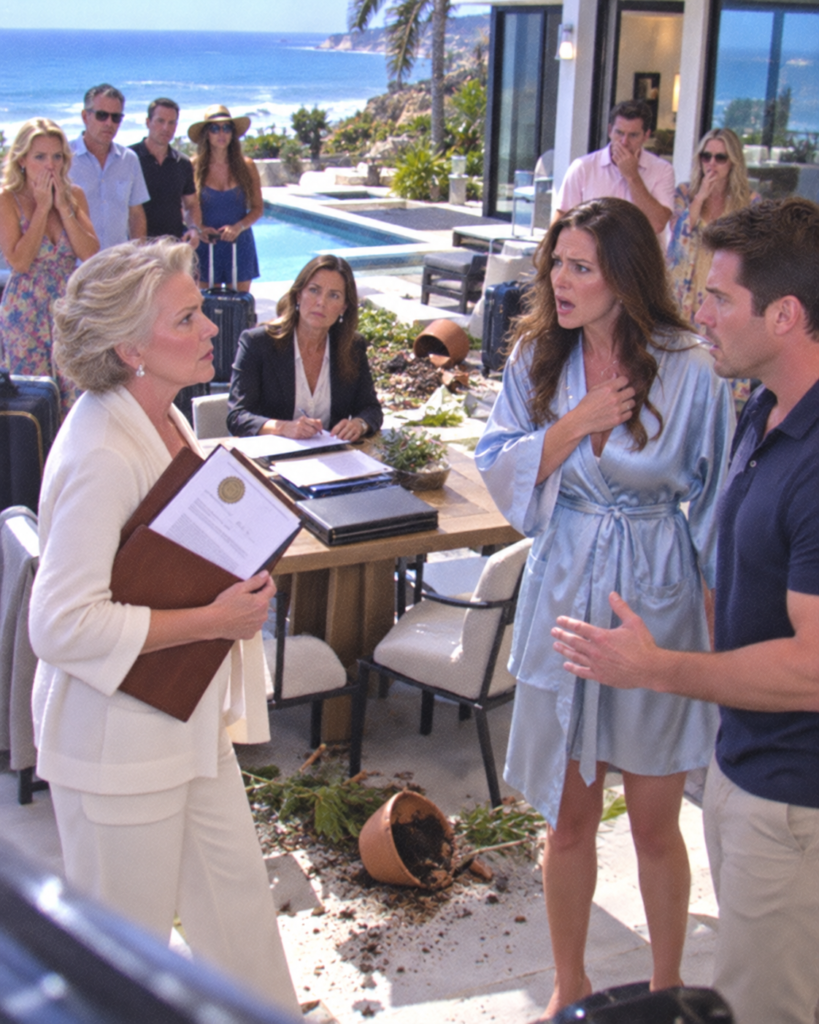
Maya photographed the rental listing, the authorization form, the host profile, and the dates showing that Daniel and Jessica had been accepting reservations for nearly four months.
I stood beside the table while music continued playing inside my house.
Through the open windows, I could see strangers holding drinks beneath the family photographs I had hung myself.
Jessica folded her arms.
‘That authorization is legitimate.’
‘No,’ I said.
‘It is not.’
My name appeared at the bottom in a smooth blue signature, but the shape was too careful.
Whoever had copied it had traced the version printed on an old Christmas card.
I knew because the final letter curved differently from the way I had signed my name for the past decade.
Daniel rubbed both hands across his face.
‘Mom, it was only for the rental platform.
They needed proof that we had permission.’
‘So you created proof.’
‘I did not say that.’
Jessica stepped in front of him.
‘You told us we could always use the house.’
‘I told you where the emergency key was in case a pipe burst or Rosa needed help during a storm.
I did not give you permission to move in, destroy my garden, or rent my bedrooms to tourists.’
One of the weekend guests appeared at the door carrying a suitcase.
He looked from Jessica to the deputy.
‘Are we being asked to leave?’ he said.
Maya answered before Jessica could.
‘You were rented a property by people who had no authority to rent it.
You should contact the booking platform immediately.’
The man stared at Daniel.
‘You told us this was your family estate.’
Daniel looked away.
Within minutes, the party began collapsing.
Guests collected bags, parents called their children out of the yard, and cars started backing down the driveway.
Nobody shouted at me.
Their anger was directed at the two people who had taken their money.
Jessica watched them leave with growing panic.
‘You cannot throw everyone out,’ she said.
‘We have bookings through the end of summer.’
Maya closed the tablet cover.
‘That statement may become useful later.’
She then opened the certified deed.
The first page showed the legal description of the Malibu property and the county recorder’s stamp.
The document had been signed three weeks before I left for the volunteer assignment.
It granted the remainder interest in the property to the Harbor Homes Foundation while reserving a life estate to me.
The language was simple.
For as long as I lived, I retained the exclusive right to occupy, control, maintain, and benefit from the house.
When I died, the property would pass to the foundation that rebuilt homes for widows and families displaced by coastal storms.
Daniel read the paragraph twice.
‘What is this?’ he whispered.
‘The recorded deed,’ Maya said.
‘No.
What is this foundation doing on it?’
I looked past him toward the ocean.
‘Making sure the house continues to mean what it has always meant to me.’
His voice rose.
‘I am your son.’
‘Yes.’
‘Then the house should come to me.’
‘You
expected it to come to you.
That is not the same thing.’
Jessica snatched one of the renovation receipts from a folder near the door.
‘We spent almost ninety thousand dollars here.
New locks, paint, furniture, landscaping, appliances—’
‘Landscaping?’ Rosa said.
‘You mean ripping out her roses.’
Jessica ignored her.
‘She cannot keep our improvements and tell us we own nothing.’
Maya turned toward her.
‘You made unauthorized alterations to property you did not own.
Whether any expense is recoverable will depend on evidence, not on the total printed on your receipts.’
Daniel struck the table with his palm.
‘She left.
We believed she was not coming back.’
‘I told you the assignment lasted several months,’ I said.
‘You barely called.’
‘I called every Sunday.
You stopped answering after the third week.’
His face tightened because he knew it was true.
Jessica tried a different argument.
She said the house was too large for me, that coastal maintenance was expensive, and that they had protected the property from sitting vacant.
Each sentence made her sound less like a caretaker and more like a person explaining why taking something had been practical.
Then Maya asked the question that silenced her.
‘Where did the rental income go?’
Jessica blinked.
‘What?’
‘Four months of bookings.
Five bedrooms.
Holiday weekends.
Where is the money?’
‘That is private.’
‘Not anymore.’
The deputy explained that he was documenting the confrontation, the suspected fraudulent authorization, and the condition of the property.
He could not decide every ownership issue on the porch, but the deed established that Daniel and Jessica had no recorded interest.
Maya handed them formal notices prohibiting further rentals, removal of property, or additional alterations while she sought immediate court relief.
Daniel refused to take his copy, so the process server placed it on the entry table after documenting delivery.
Jessica laughed too loudly.
‘A notice does not mean we are leaving tonight.’
‘No,’ Maya said.
‘But a judge’s order will mean much more.’
I did not force my way into the house.
Maya had warned me that anger could turn a clean case into a chaotic one.
Instead, I walked through each room with the deputy while he photographed the condition.
My sewing room had been turned into a bar.
The oak worktable where I had altered hundreds of wedding dresses was stained with circles from wet glasses.
My fabric cabinets had been removed.
The guest room contained two sets of bunk beds and a laminated checkout sheet.
The family photographs in the hallway had been rearranged to make space for framed pictures of Daniel and Jessica posing on the balcony.
In one, Jessica held a champagne bottle beneath a banner that read ‘Our New Beginning.’
My bedroom hurt the most.
My late husband’s clothes were gone from the cedar chest.
My jewelry box had been pushed into a closet.
Jessica’s cosmetics covered the dresser, and my pale blue robe hung from the bathroom door.
I lifted it carefully.
The fabric still carried the faint lavender scent of the sachets I used, now mixed with Jessica’s perfume.
Daniel stood behind me.
‘Mom, she did not know it was special.’
‘She knew it was mine.’
He had no answer.
That evening, I stayed with Rosa.
From her front window, I watched Daniel and Jessica move
through my house, arguing in every room.
A delivery driver arrived to collect rented outdoor furniture.
Shortly after midnight, another car came.
Daniel carried several boxes toward it until the deputy’s warning apparently returned to his mind.
He stopped, looked toward Rosa’s house, and carried them back inside.
Rosa had been watching too.
‘He thought you would never stand against him,’ she said.
‘I spent his childhood protecting him from every hard thing I could.’
‘Perhaps he mistook protection for permission.’
The next morning, Maya obtained a temporary order preventing Daniel and Jessica from renting the property, removing furnishings, altering records, or interfering with my access.
The booking platform suspended their listings and froze the most recent payouts after receiving the deed and the fraud report.
That was when the messages began.
Daniel texted that I was humiliating him.
Jessica wrote that I was destroying their income.
Relatives who had not called me in years suddenly said family disputes should remain private.
One cousin told me to let Daniel keep the house because he had children to think about.
Daniel and Jessica did not have children.
They had apparently told several relatives that the children seen at the property belonged to them, making their takeover sound like a struggling young family seeking stability instead of a luxury rental business.
I saved every message and sent them to Maya.
Two days later, Rosa found the original advertisement announcing the launch of ‘Hale House Malibu.’ It described Daniel and Jessica as second-generation owners restoring a private family estate.
The photographs showed my garden before it was destroyed, my furniture before it was removed, and the ocean view my husband and I had saved for decades to afford.
The advertisement included one sentence that made my hands shake.
‘Lovingly passed from mother to son.’
Nothing had been passed.
At the first court hearing, Daniel arrived in a dark suit and sat without looking at me.
Jessica wore cream-colored clothes and carried a thick binder of receipts.
Their attorney argued that they had entered with a key, improved the property in good faith, and believed they had the owner’s consent.
Maya placed the deed, the rental listings, and the false authorization before the judge.
Then she called Rosa.
Rosa testified that she had watched the couple arrive with a moving truck three weeks after I left.
When she questioned Daniel, he told her I had decided to remain with the volunteer organization permanently.
He said I had given him the house early because managing it had become too much for me.
Rosa had asked to speak with me.
Daniel told her I was in an area without reliable phone service.
That lie explained why she had not immediately warned me.
She had still sent messages, but Jessica had replied from an old email account I rarely used, claiming I was safe and did not want to be disturbed.
Maya displayed the emails.
The writing style was not mine.
The messages referred to Rosa as ‘Rose,’ a name I had never called her.
One contained a misspelling Jessica regularly made in her own social media posts.
Jessica shifted in her chair.
The judge asked Daniel whether he had told Rosa that ownership had been transferred.
He said he could not remember the exact conversation.
Then
Maya produced security footage from Rosa’s doorbell camera.
Daniel’s voice was clear.
‘Mom signed everything over before she left,’ he said in the recording.
‘The place is finally ours.’
The courtroom became completely still.
Daniel’s attorney requested a recess.
During the break, Daniel found me near the drinking fountain.
‘Why did you leave the house to a foundation?’ he asked.
I studied the man he had become.
For weeks, I had imagined this moment and wondered whether I would shout.
Instead, I felt tired.
‘I did not leave it to them while I am alive.
I gave them the future interest because I wanted the house to shelter people after I am gone.’
‘You chose strangers over your own child.’
‘I chose people who understand that shelter is not something you steal.’
He flinched.
‘I had debts,’ he said.
‘Jessica’s business was failing.
We thought a few rentals would get us through.’
‘A few rentals did not require you to tell people I had abandoned my home.’
He looked down.
‘Why did you not ask me?’
His answer came so softly I almost missed it.
‘Because I knew you would say no.’
That was the truth beneath every excuse.
When the hearing resumed, the judge found that the deed clearly established my right to exclusive possession.
Daniel and Jessica had no lease, ownership interest, or credible evidence of permission.
Their false statements, commercial rentals, and attempted concealment weighed heavily against them.
The court ordered them to vacate and preserve all financial records connected to the property.
A separate accounting would determine rental proceeds, damage, and recoverable costs.
The suspected forged authorization was referred for further investigation.
Jessica stood so abruptly that her chair scraped the floor.
‘We improved that ruin,’ she said.
The judge looked at the photographs of my house before their arrival.
‘Nothing in these images resembles a ruin.’
They were given a short, court-supervised period to remove their personal belongings.
Maya arranged for an inventory professional to be present.
Every box was photographed.
Furniture that belonged to me remained.
Items they had removed to storage were returned after invoices revealed the location.
My husband’s cedar chest came back with a cracked hinge.
My sewing cabinets were scratched but intact.
The wind chimes were discovered in a garage box beneath discarded garden tools.
The roses could not be returned.
Jessica’s financial records showed that the rentals had brought in far more than she admitted.
Some money had paid their personal credit cards.
Some had funded a leased luxury car.
Almost none had been used for essential maintenance.
The court eventually ordered them to account for the income and pay damages for unauthorized alterations, missing property, and restoration costs.
The platform refunded affected guests and released frozen funds according to the court’s instructions.
Daniel and Jessica sold one car and moved into a rented apartment inland.
Their attorney negotiated the civil claims, while the signature investigation continued separately.
I did not ask for vengeance.
I asked for the house to be restored and for every dollar earned from it to be disclosed.
Daniel called once after moving out.
He apologized for lying but then said Jessica had pressured him.
I reminded him that his voice was the one on Rosa’s recording.
‘I kept thinking it would become mine eventually,’
he said.
‘That thought allowed you to stop seeing me as alive.’
He began to cry.
I did not comfort him.
Not because I had stopped loving him, but because love could no longer mean protecting him from the meaning of his own choices.
Months passed before we spoke again.
During that time, I repaired the house slowly.
Volunteers from Harbor Homes helped repaint the fence white.
Rosa replanted climbing roses along the porch.
I restored the sewing room and kept the stain on one corner of the oak table because sanding it away would have removed too much of the wood my husband once touched.
The front door became blue again.
I washed the robe twice, folded it, and placed it in the cedar chest.
I could not wear it anymore, but I was not ready to let it go.
On the first evening after the repairs were complete, I sat on the porch as the sun lowered across the Pacific.
The wind moved through the new roses, still small but beginning to climb.
Daniel arrived alone.
He did not have a key.
He stood outside the gate and waited until I invited him in.
That mattered.
He brought no excuses.
He said he had started making monthly payments toward the judgment and had entered counseling.
He did not ask about the deed or whether I might change it.
He asked whether he could repair the cracked hinge on his father’s cedar chest.
I let him.
Forgiveness did not arrive that evening.
Trust did not return because he tightened two screws and apologized again.
But for the first time since I had found strangers in my garden, he behaved as though the house belonged to someone other than himself.
After he left, I walked through every room and locked the blue door behind me.
The house was quiet.
My photographs were back on the walls.
My wind chimes sounded from the porch.
Beyond the windows, the ocean continued moving beneath the darkening sky.
For years, I had believed the beach house proved that grief had not defeated me.
Now it proved something else.
A home is not protected merely by locks, family promises, or the hope that people will do what is right.
Sometimes it is protected by a recorded deed, a neighbor willing to speak, an attorney who arrives with evidence, and the quiet decision not to surrender when someone you love mistakes your kindness for weakness.
I had built that house so no one could tell me I did not belong.
When my own son tried, I did not scream.
I opened the folder.