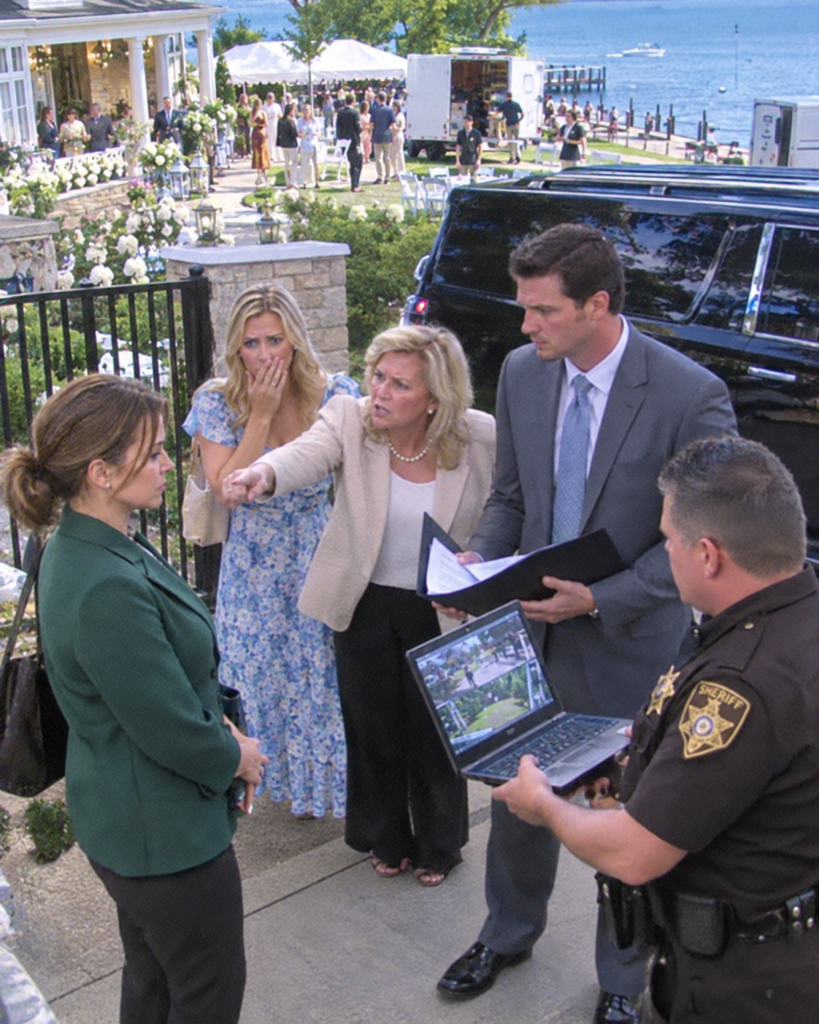
“Before anyone makes another statement,” my attorney said, resting one hand beside the laptop, “I suggest you watch what your clients told law enforcement seven days ago.”
The driveway went still.
My mother stood beside her SUV with one hand gripping the strap of her purse.
Caroline was a few feet away, furious enough that the muscles in her jaw kept jumping.
Trevor had moved behind her, but for the first time since this started, he no longer looked confused or detached.
He looked nervous.
The deputy glanced at the laptop screen, then at Mom.
“Go ahead,” he said.
My attorney clicked the first video.
It was ordinary at first.
Mom’s SUV appeared on the security feed from the previous Saturday.
The timestamp sat clearly in the corner.
She pulled up to my gate, entered the temporary code I had texted her, and drove onto my property.
The next clip showed Caroline directing a florist toward the lawn.
Another showed Trevor carrying cases of champagne through my side entrance.
Then came the engagement party.
The camera above the garage had captured me walking toward the deck while the celebration continued behind me.
My attorney increased the volume.
Mom’s voice filled the driveway.
“Ma’am, you need to leave.
You weren’t invited.”
Caroline flinched.
The clip continued.
“This is my house,” my recorded voice said.
Then Mom, louder: “We don’t know you.”
Nobody spoke.
The decorators standing beside their van suddenly seemed fascinated by the pavement.
My attorney clicked another file.
This one was driveway audio recorded shortly before the police arrived.
Caroline’s voice came through clearly.
“Just stick to it.
If everybody says she doesn’t belong here, what is she going to do?”
Trevor’s face changed.
Mom spun toward Caroline.
“You said the cameras didn’t record sound.”
That sentence landed harder than any accusation I could have made.
The deputy turned slowly toward her.
My attorney closed the laptop halfway.
“Mrs.
Caldwell, I’d be very careful about what you say next.”
I was watching everything through the live camera feed from my apartment in Chicago.
I had decided not to be at the lake house in person because my attorney advised me not to give Caroline another opportunity to create a confrontation.
Instead, I listened with headphones while he handled the property dispute exactly as we had planned.
For seven days, my family had apparently convinced themselves nothing would happen.
They were wrong.
The trouble had started months earlier, although I had not understood the pattern then.
I bought the Lake Geneva house four years before Caroline’s engagement.
It was not inherited.
It was not family property.
It was not purchased with help from my parents.
I had spent thirteen years building a consulting firm, sold my share, and used part of the proceeds for the house.
My father had died long before that, and Mom had never contributed a dollar toward it.
But once I bought it, the language around it changed.
At first Mom called it “Harper’s lake place.”
Then it became “the lake house.”
Eventually Caroline began telling friends, “Our family has a place in Lake Geneva.”
I noticed, but I did not correct her every time.
It seemed petty.
That was my first mistake.
The second was giving Mom a permanent access code.
She used the house occasionally when I was traveling.
I did not mind.
I wanted her to enjoy it.
Then Caroline got engaged.
She called me three months before the party and said she wanted “something intimate by the water.”
I knew what was coming before she asked.
“Can we use the house?”
I hesitated.
Caroline heard it immediately.
“Oh my God, Harper.
It’s one party.”
I told her I wanted clear limits: no overnight guests I did not know, no access to my office, no moving furniture upstairs, and a professional cleaning service afterward.
She sighed as if I had handed her a legal deposition.
Mom called twenty minutes later.
“Why are you making this difficult?”
“I’m not.
I said yes.”
“You gave her a list of rules.”
“It’s my home.”
That sentence always irritated them.
Mom preferred another one.
“We’re family.”
In her vocabulary, family usually meant my boundaries were negotiable.
Two weeks before the party, Caroline’s caterer required another deposit.
Caroline complained she was stretched thin because of wedding expenses.
Mom asked me to cover it as my engagement gift.
It was more than I planned to spend, but I agreed.
Then came rentals.
Then extra staff.
Then a larger tent because Caroline’s guest list had somehow grown from forty people to nearly a hundred.
By the night of the party, I had paid thousands of dollars toward an event being held at a house I owned.
I arrived expecting tension.
I did not expect erasure.
Later, after I drove away, I replayed the encounter over and over in my mind.
The hardest part was not Caroline lying.
She had always been competitive with me.
The hardest part was watching Mom support her without hesitation.
There had been no confusion in Mom’s face when she called the police.
No panic.
No uncertainty.
She knew exactly who I was.
She simply believed that if she said otherwise loudly enough, everyone would accept her version.
The officer who responded that evening had not formally removed me from the property.
Once he saw my identification and noticed the address connection, he clearly suspected the situation was more complicated than Mom claimed.
But because I volunteered to leave and no crime had occurred in his presence, the confrontation ended quietly.
That saved me from a public spectacle.
It also gave me time.
The next morning, I called attorney Evan Mercer, who had handled the purchase of the house.
I explained everything.
He listened without interrupting.
When I finished, he asked one question.
“Do they have any written lease, ownership interest, or continuing permission to use the property?”
“No.”
“Good.”
That was the first moment I felt my breathing return to normal.
Evan told me not to argue with anyone.
Instead, we documented the facts.
The deed showed me as the sole owner.
Property-tax records showed the same.
Utility accounts were mine.
Insurance was mine.
The security system was registered to me.
Then we preserved the footage.
That was where the situation stopped being merely ugly and became legally serious.
The cameras had captured Mom and Caroline telling police I was a stranger while footage from earlier that same day showed them entering using credentials I had personally provided.
More damaging was the audio.
They had planned the story before police arrived.
Evan drafted certified letters revoking all permission for Mom, Caroline, Trevor, or anyone acting on their behalf to enter the property without my written consent.
The letters stated clearly that any previous informal family permission was terminated immediately.
Mom signed for hers.
Caroline signed for hers the following day.
We saved both receipts.
I changed the locks and gate code.
Then I waited.
I did not expect them to return within a week.
What I later learned was that Caroline had scheduled a second event at the house—a wedding-planning photo shoot and tasting session.
She had already given the address to vendors and apparently assumed I would back down before anyone arrived.
Instead, she found a locked gate.
When the alert appeared on my phone, I called Evan.
He was already nearby because we had anticipated they might test the notice.
He contacted the county sheriff’s office and met a deputy at the property.
That was how they all ended up in my driveway with a deed, certified-mail receipts, and a laptop full of evidence.
On the live feed, Caroline finally found her voice.
“This is harassment,” she said.
“She’s using legal paperwork to punish us because she’s jealous.”
The deputy looked at the gate, then at the rental vans.
“Were you told you could come here today?”
Caroline crossed her arms.
“We’ve always used this house.”
“That wasn’t my question.”
Mom stepped forward.
“My daughter is getting married.
Harper is emotional.
This is a family issue.”
Evan lifted the certified receipt.
“This is a property issue.”
Then he read the relevant sentence from the notice aloud.
Permission to enter, occupy, access, host events upon, or otherwise use the property is revoked effective immediately.
The deputy asked Mom whether the signature on the delivery receipt was hers.
She stared at it.
“I thought it was junk mail.”
“You signed for it.”
“I sign for things all the time.”
Caroline interrupted.
“She cannot just lock us out of a family house.”
Evan placed the deed on the hood of the county vehicle.
“Show me your name.”
Caroline did not move.
He pointed to mine.
Harper Caldwell.
Sole owner.
Trevor stepped closer and read it himself.
Then he looked at Caroline.
“You told me your mom owned this place.”
The silence that followed was different from the silence at the engagement party.
That night, everyone had been watching me.
Now everyone was watching her.
Caroline recovered quickly.
“I said it was basically Mom’s.”
“No,” Trevor said.
“You said your mother inherited it from your father.”
Mom’s face tightened.
“That doesn’t matter right now.”
“It matters to me.”
Caroline snapped at him to stop.
The deputy reminded everyone that the immediate issue was simple: they had been formally denied permission to enter.
If they crossed the gate or attempted to force entry, the matter could become criminal trespass.
The decorators began quietly repacking equipment.
Caroline saw them and panicked.
“No.
Nobody leaves.
We paid deposits.”
One of the vendors answered without looking at her.
“We’re not entering a property after a deputy tells us we don’t have permission.”
That was the first practical consequence.
The second arrived minutes later.
Trevor asked Evan whether he could see the rest of the footage.
Caroline immediately said no.
Evan looked toward the camera, knowing I was listening.
My phone rang.
“Harper,” he said when I answered on speaker, “Trevor would like permission to view the recording involving him.”
I knew exactly which recording he meant.
“Play it.”
The clip had been captured by the camera near the side patio about thirty minutes before I arrived at the engagement party.
Caroline and Mom were standing near the catering entrance.
Trevor was not visible at first.
Caroline said, “When she gets here, don’t let her inside.
If she starts arguing, call the police.”
Mom asked, “And what do I tell them?”
Caroline laughed.
“Tell them we don’t know her.
She’ll lose it.
Once she starts screaming, everyone will see what she’s really like.”
Then Trevor walked into frame carrying a case of wine.
He stopped.
“What are you talking about?”
Caroline immediately changed her tone.
“Nothing.
Harper drama.”
The clip ended.
Trevor stared at the laptop.
“You planned it.”
Caroline’s confidence cracked.
“She ruins everything.
I just wanted one night where she wasn’t making it about herself.”
“She paid for the party,” he said.
Caroline looked at him as if that fact were irrelevant.
Mom stepped in.
“Trevor, this is between sisters.”
“No,” he said quietly.
“You called the police on the owner of the house while throwing a party she paid for.”
I had never liked Trevor much.
Until then, I had considered him another person willing to accept Caroline’s version of reality because it was convenient.
But watching him in that driveway, I realized he had not known the full plan.
That did not excuse his silence during the party.
It did explain his face when the recording played.
Caroline started crying.
Real tears this time.
She accused me of destroying her engagement.
She accused Mom of saying the plan would work.
She accused Trevor of abandoning her in front of strangers.
For once, nobody rushed to rescue her.
The deputy told the vendors they were free to leave.
Then he instructed Mom and Caroline to remove their vehicles from the entrance.
Caroline refused at first.
Evan reminded her that the cameras were still recording.
She went silent.
Ten minutes later, the driveway was empty.
The legal consequences did not become some dramatic courtroom spectacle.
Reality was quieter.
The sheriff’s office documented the incident and the prior report.
My attorney submitted preserved footage and a written statement clarifying that I had been the legal owner during the engagement party and that my relatives had knowingly misrepresented their relationship to the property.
The earlier trespassing accusation against me went nowhere.
Mom and Caroline were formally warned that returning without permission could lead to enforcement.
I also revoked every remaining financial connection I had been maintaining out of habit.
I canceled the card Mom used for lake-house expenses.
I removed Caroline from a shared family phone plan I had been paying for.
I stopped covering wedding costs.
Those choices angered them more than the gate ever had.
For weeks, Mom sent messages accusing me of humiliating the family.
I answered only once.
I wrote that I had not humiliated anyone.
I had documented what happened and protected my property.
Then I stopped responding.
Trevor contacted me about a month later.
He apologized for standing silent during the party.
He said Caroline had told him for years that I was unstable, controlling, and obsessed with status.
The engagement-party stunt had been intended, in her words, to finally make everyone see it.
Instead, it made him see something else.
Their engagement ended two months later.
I did not celebrate that.
A broken engagement was not the victory I wanted.
What mattered was that I no longer needed anyone in my family to admit what they had done before I trusted my own memory of it.
The following spring, I returned to Lake Geneva alone.
The house felt strange at first because every room carried echoes of that night—the caterers in my kitchen, strangers on my deck, my mother blocking my front door.
I almost sold it.
Instead, I changed the place.
I replaced the old gate keypad.
I repainted the guest rooms.
I removed the family photos Mom had arranged in the hallway as if the house belonged to all of us.
Then I invited a few friends for dinner.
Nothing elaborate.
No tent.
No speeches.
We ate outside while the sun lowered over the lake.
At one point, someone asked whether I regretted leaving quietly when my family called the police on me.
I thought about it.
“No,” I said.
Leaving had felt humiliating in the moment.
But if I had stayed and screamed, Caroline would have gotten exactly what she wanted: a scene she could reinterpret forever.
By leaving, I had given myself something far more useful.
Time.
Time to save the footage.
Time to send the letters.
Time to let the truth become paperwork instead of argument.
I used to believe defending yourself meant having the perfect words in the moment.
Now I know sometimes the strongest response is much quieter.
Sometimes you take your identification back.
Sometimes you walk to your car.
Sometimes you let people congratulate themselves for winning.
And then, when they return to the house they told everyone was theirs, they find a locked gate, a deputy, a certified letter, and their own voices waiting for them on video.