Two days after Christmas, my six-year-old daughter came home from her grandmother’s house and did something she had never done before.
She walked straight past the Christmas tree, ignored the unopened boxes still sitting beneath it, went into my bedroom, and locked the door behind us.
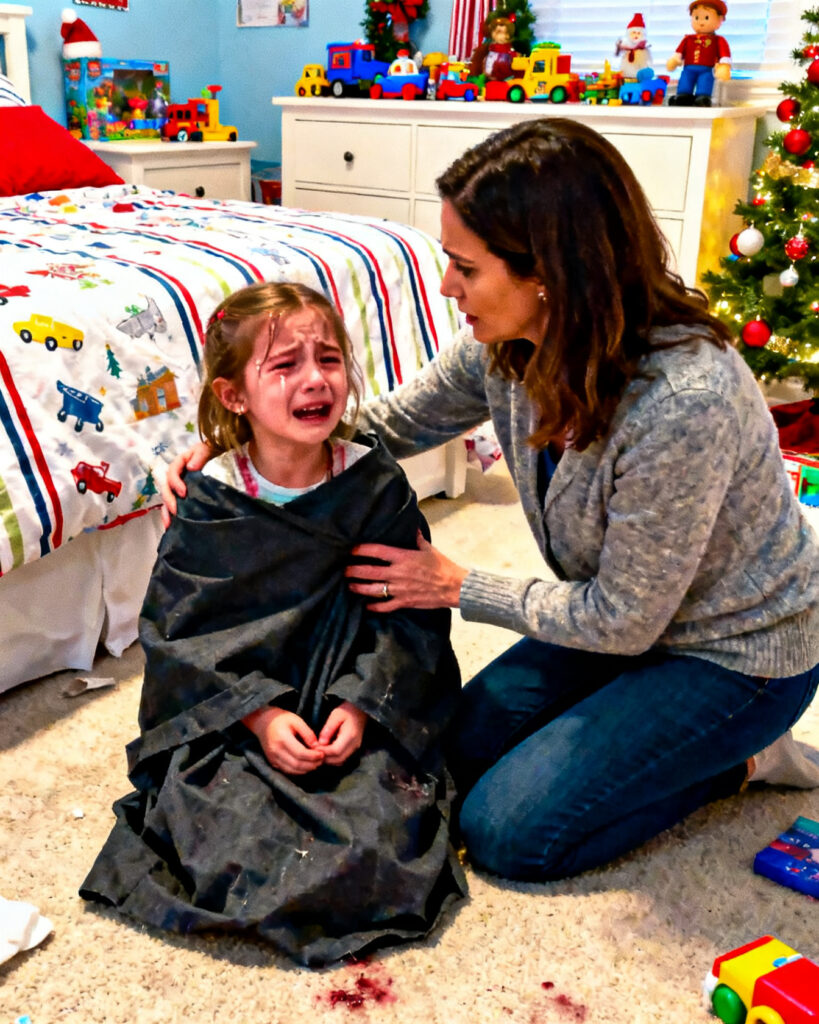
Then she looked up at me and whispered, “Mom, promise you won’t be mad at me.”
It was December 27 in Guadalajara.
The colored lights we had hung before Christmas were still glowing around the living room windows, scraps of wrapping paper remained behind the couch, and the house still smelled faintly of cinnamon, coffee, and the pine-scented candle Ricardo had insisted on buying.
Everything looked normal.
Sofía did not.
She usually came home from visiting her grandmother talking so quickly I had to ask her to slow down.
She would tell me what she had eaten, what she had watched, whether Grandma Teresa had let her help in the kitchen, and which cousin had annoyed her.
That afternoon, there was none of that.
Her steps were small and stiff.
Her arms remained pressed tightly against her sides.
When I asked whether she had enjoyed herself, she said only, “I’m tired.”
Then she disappeared down the hallway.
I followed.
The moment I entered my bedroom, she closed the door.
“Mom, promise.”
I crouched in front of her.
“I’m not mad.”
“You promise?”
“I promise.”
She looked at me for another second, as if deciding whether my answer could be trusted.
Then she lifted her red sweater.
What I saw underneath did not make sense at first.
Beneath her T-shirt was black plastic.
I thought perhaps she had stuffed something under her clothes as part of a game.
Then I realized it was a trash bag.
Someone had taken a black plastic trash bag and cut crude openings into it—one for her head and two for her arms—turning it into a makeshift shirt.
The plastic clung to her torso with sweat.
Her skin beneath it was flushed.
I stopped breathing for a moment.
“Sofía, who put this on you?”
She looked toward the floor.
“Grandma.”
I carefully removed the plastic.
I did not yank it.
I did not demand an explanation.
I peeled it away slowly while trying to keep my voice steady enough that my daughter would not think she had done something wrong.
The skin around her shoulders and waist was irritated.
Then she lifted one arm.
That was when I saw the bruising along her side.
Across her lower back were several straight red marks.
They were too evenly spaced to look accidental.
Too deliberate.
Too recognizable.
My stomach tightened.
“What happened here?”
Sofía swallowed.
She still would not look directly at me.
“Grandma got mad.”
“Why?”
“Because I ate cookies.”
The sentence was so ordinary that for a second I thought I had misunderstood her.
“Cookies?”
She nodded.
“She said I had to sweat them out.”
I stared at her.
“What do you mean?”
“So I wouldn’t get fat.”
Something inside me went cold.
For months, Teresa had commented on Sofía’s body.
Not constantly.
That would have made it easier to confront.
Instead, the comments came in small doses disguised as concern.
“Does she really need another cookie?”
“Maybe give her fruit instead.”
“She’s filling out.”
“Girls need to learn discipline young.”
When I objected, Teresa dismissed me.
“You’re too sensitive.”
“I’m only trying to help.”
“Somebody has to teach her good habits.”
The first time she said Sofía was “getting chubby,” I told her directly that we would not speak about our daughter’s body that way.
Teresa smiled and changed the subject.
A few weeks later, she did it again.
Ricardo told me that his mother came from a different generation and sometimes said things without thinking.
I told him that being from a different generation did not make a six-year-old’s body appropriate family conversation.
Eventually, he agreed.
We would give Teresa one last chance.
No comments about food.
No comments about weight.
No shaming.
No “discipline” around eating.
That afternoon was supposed to be that last chance.
Instead, my daughter was standing in front of me wearing a trash bag beneath her clothes.
I looked again at the marks on her back.
“And these?”
Sofía’s voice became smaller.
“I kept taking the bag off because I was hot.”
I felt my hands go cold.
“What happened when you took it off?”
“Grandma got mad.”
She paused.
Then she whispered, “She took out her belt.”
Ricardo appeared in the doorway just as she said it.
He must have heard the last sentence.
I turned toward him.
I had never seen my husband lose color that quickly.
For a moment he simply stood there.
Then he dropped to his knees in front of our daughter.
“Sofía.”
She looked at him.
“You did nothing wrong, sweetheart.”
Her face crumpled.
She began to cry.
Not loudly.
That was the part that hurt me most.
It sounded less like panic and more like relief.
As though she had spent the entire ride home afraid that we would blame her for what had happened.
Ricardo opened his arms, but he did not touch her until she moved toward him.
Then he held her carefully.
I stood beside them feeling two things at the same time.
Rage.
And clarity.
I wanted to call Teresa immediately.
I wanted to demand an explanation.
I wanted her to hear exactly what I thought of what she had done.
But anger was not the priority.
Sofía was.
I took photographs of the visible irritation and marks.
I kept the black plastic bag instead of throwing it away.
I separated the shirt she had been wearing.
I wrote down when she had arrived home.
Then I wrote down what she had said using her wording as closely as I could remember it.
I did not ask her to repeat the story five times.
I did not suggest answers.
I did not tell her what I thought had happened.
Ricardo called pediatric urgent care.
While he spoke to them, I sat beside Sofía on the bed.
She had stopped crying but kept rubbing the sleeve of her sweater between two fingers.
“Am I in trouble?”
“No.”
“Grandma said I wasn’t supposed to tell.”
“You are not in trouble for telling me anything that happens to you.”
“She said you would get mad.”
“I’m mad about what happened to you. I am not mad at you.”
Sofía stared at my face as though she needed to study every word.
Then she leaned against me.
Ricardo ended the call.
“They can see her.”
I nodded.
Neither of us mentioned Teresa.
Not yet.
At urgent care, I felt like I was moving through water.
The waiting room lights were too bright.
A television mounted high on the wall played something cheerful with the sound turned low.
A little boy nearby was holding a toy truck.
Sofía sat between us with her coat zipped to her chin.
She looked tiny.
I kept thinking about how she had been taught, in only a few hours, to hide something from us because an adult had told her it was shameful.
The medical staff examined her.
We answered what we knew.
When we did not know something, we said so.
I watched Ricardo throughout the visit.
He was pale.
He stayed close to Sofía.
When she reached for water, he got it.
When she became quiet, he did not pressure her to speak.
But there was something underneath his reaction I could not identify.
At the time, I told myself it was shock.
Maybe it was.
I had been married to Ricardo long enough to know the difference between his anger and his fear.
That evening, I saw both.
When we returned home, Sofía was exhausted.
We made sure she would not be alone.
We did not tell extended family what had happened.
We did not post anything.
We did not call Teresa.
Then I reached for my keys.
Ricardo was standing in the kitchen.
“Where are you going?”
“To your mother’s house.”
His expression changed immediately.
“Don’t confront her alone.”
“I’m not going there to fight.”
“What are you going to do?”
“Listen.”
He frowned.
I held up my phone.
For months Teresa had said we misunderstood her.
That I exaggerated her comments.
That everything she said was out of concern for Sofía.
Maybe she would deny what happened.
Maybe she would explain it.
Maybe she would say something she could not later pretend she had never said.
Either way, I wanted her words.
Ricardo stared at the phone.
Then at me.
“Be careful.”
I slipped it into my coat pocket.
Outside, Guadalajara had that strange post-Christmas feeling where decorations were still everywhere but the excitement had already gone.
Storefront lights remained on.
Plastic Santas still hung from balconies.
Traffic moved through wet streets under a dark winter sky.
I drove to Teresa’s house with both hands tight around the steering wheel.
During the entire trip, I heard Sofía’s voice in my head.
Grandma said I had to sweat them out.
Grandma got mad.
She took out her belt.
I kept thinking about every previous conversation with Teresa.
Every joke about food.
Every time she had looked at Sofía’s plate.
Every time I had been told I was overreacting.
I wondered how many warnings become obvious only after something worse happens.
When I reached Teresa’s street, I stayed in the car for a moment.
My anger had returned.
I could feel it in my chest and throat.
I knew that if I went inside shouting, Teresa would focus on my behavior instead of hers.
So I waited until my breathing slowed.
Then I started the recording.
I placed the phone inside my coat pocket.
The microphone remained unobstructed.
I stepped out of the car.
Teresa opened the door almost immediately after I knocked.
She did not look surprised to see me.
That detail bothered me later.
There was no question in her face.
No “Is Sofía okay?”
No concern about why her daughter-in-law had shown up unannounced after dark.
Just irritation.
She folded one arm across her body.
“You need to teach your daughter to control her body before it’s too late.”
I stood still.
There it was.
Not denial.
Not confusion.
Judgment.
“What do you mean by that?”
Teresa sighed.
“You know exactly what I mean.”
“No, Teresa. I want you to explain it.”
Her eyes narrowed.
“Sofía eats whatever she wants because you let her.”
“She’s six.”
“That’s when bad habits start.”
I felt my pulse beating against the collar of my coat.
I reminded myself why I had come.
Listen.
“Did you put a plastic bag under her clothes?”
Teresa’s mouth tightened.
“It was temporary.”
“Why?”
“To make her sweat.”
“Because she ate cookies?”
“She needs to understand consequences.”
I could hear my own heartbeat.
“What kind of consequence?”
Teresa waved one hand dismissively.
“You make everything sound ugly.”
“I’m asking what you did.”
“I made her move around a little. I told her she needed discipline.”
“She came home with marks.”
Teresa looked away for half a second.
“Children bruise.”
“Straight marks?”
Her eyes came back to mine.
“She was being difficult.”
I said nothing.
The silence made her continue.
That was something I had learned from years of dealing with Teresa.
If you argued, she became defensive.
If you stayed quiet, she often filled the space herself.
“She kept pulling it off,” Teresa said.
“The bag?”
“Yes.”
“Because she was hot?”
“She was being defiant.”
“She’s six.”
“You keep saying that as though six-year-olds cannot learn.”
I clenched my hand inside my coat pocket.
My phone kept recording.
I thought about Sofía crying on my bed.
About the way she had asked if she was in trouble.
About the marks across her lower back.
“What did you use when she took the bag off?”
Teresa gave me a long look.
“You came here wanting a confession.”
“I came here asking about my daughter.”
“You raise her however you want in your house.”
“That doesn’t answer me.”
Her voice sharpened.
“I corrected her.”
“With a belt?”
Teresa did not answer immediately.
Then she said, “Sometimes words don’t work.”
I felt the floor beneath me differently after that.
Until then, a small part of me had still been waiting for some explanation that would make the situation less deliberate.
There wasn’t one.
Teresa believed she had been entitled to do it.
I kept my voice low.
“You were told not to comment on Sofía’s weight.”
“I was told many things.”
“You agreed.”
“I agreed because Ricardo asked me to.”
That was the first time she brought up my husband.
Something in her tone changed when she said his name.
Not affection.
Something more complicated.
I noticed it.
“What does Ricardo have to do with this?”
Teresa crossed her arms.
“You think all this started with Sofía?”
I did not move.
“What does that mean?”
She gave a short laugh.
“You really don’t know your husband as well as you think.”
My stomach tightened.
“Explain.”
Teresa looked toward the hallway behind her.
Then back at me.
There was a strange satisfaction in her expression now, as though she had found a new way to hurt me.
“You keep acting like I invented discipline yesterday.”
I said nothing.
She continued.
“Ricardo knows exactly how children learn consequences.”
The sentence landed slowly.
I thought about my husband at urgent care.
The way the color had left his face.
The way he had dropped to his knees.
The way he had looked away once when a question was asked.
At the time I had dismissed it as shock.
Now the memory returned with sharper edges.
“What are you saying?”
Teresa’s eyes hardened.
“I’m saying your husband grew up just fine.”
“That still doesn’t answer the question.”
“He knows how discipline works.”
My heart began beating faster.
I needed to be careful.
I did not know whether Teresa was implying Ricardo had experienced the same treatment, witnessed it, or simply known about her beliefs.
The only person speaking was Teresa, and I was not going to turn an implication into a fact.
“What exactly does Ricardo know?”
She smiled without warmth.
“Ask him.”
“I’m asking you.”
“He always gets uncomfortable when I talk about consequences, doesn’t he?”
I remembered Christmas dinner.
Teresa had criticized Sofía for reaching toward a second dessert.
Ricardo had abruptly changed the subject.
At the time I thought he was avoiding an argument.
Now I wondered why.
Teresa stepped backward slightly.
“You’ve spent years thinking he takes your side because you’re right.”
“What are you suggesting?”
“I’m saying he knows better than anyone why children shouldn’t be allowed to become defiant.”
My mouth went dry.
This was no longer only a conversation about what had happened that afternoon.
It was about history.
About Ricardo.
About something Teresa believed he understood without explanation.
My phone was still recording.
I forced myself not to reach for it.
“Was what you did to Sofía something you had done before?”
Teresa’s expression changed.
Only slightly.
But enough.
I felt the question settle between us.
Not only had I asked whether Sofía had experienced something similar before.
I had asked whether Teresa had used these methods before at all.
She did not answer.
Instead, she said, “You should go home.”
“No.”
Her jaw tightened.
“You’ve already decided I’m some kind of monster.”
“I haven’t called you anything.”
“You don’t need to.”
“Then answer me.”
She stared at me for several seconds.
I thought of Sofía asking me to promise I would not be angry.
I thought of the plastic bag.
The irritated skin.
The red lines.
The way Ricardo had gone pale when our daughter finally said the word belt.
Then another memory surfaced.
At urgent care, someone had asked whether Sofía had ever returned from Teresa’s house with unexplained marks before.
I remembered answering immediately.
“No.”
Ricardo had taken a second longer.
Only a second.
But he had looked away.
At the time, I assumed he was searching his memory.
Standing in Teresa’s doorway, that second suddenly mattered.
“Was this the first time?” I asked.
Teresa’s mouth curved into a small smile.
Not a happy smile.
A knowing one.
And that was the moment I realized the night was no longer only about getting Teresa to explain what she had done to my daughter.
It was about going home and asking my husband why his mother believed he already understood exactly what she meant by “discipline.”
I had come to Teresa’s house looking for her version of one afternoon.
Instead, I was leaving with a recording that raised questions about years I had never been part of.
I did not confront her further.
I did not threaten her.
I did not tell her everything we had preserved.
I ended the conversation and walked back toward my car with my hands shaking inside my coat pockets.
The Christmas lights along the street blurred through the windshield when I sat behind the wheel.
For several minutes, I did not start the engine.
I listened to one part of the recording again.
Ricardo knows exactly how children learn consequences.
I stopped it there.
I was not willing to guess what Teresa meant.
Not yet.
I had evidence of what happened to Sofía.
I had Teresa’s own words about why she believed she had the right to do it.
And now I had something else.
A question.
A terrible one.
What had Ricardo known before we ever trusted his mother alone with our daughter?
I drove home knowing that the next conversation could not be about protecting Teresa, keeping peace in the family, or avoiding uncomfortable memories.
It had to be about Sofía.
About what was safe.
About what had happened.
And about whether my husband’s reaction that afternoon had come only from seeing his daughter hurt—
or from recognizing something he had spent years trying not to remember.