PART 3 – ENDING — The Character No Court Could Ignore
William Harper placed the folder on the witness stand.
My ex-husband, Ryan, shifted in his seat.
Until that moment, he had looked confident.
His attorney had already suggested that I received special treatment because I knew the Harper family. She portrayed my promotion as evidence that I valued corporate success more than motherhood.
William adjusted the microphone.
“My testimony is not about whether Ms. Carter deserved an interview,” he said. “She did receive one because I asked my grandson to meet her.”
Ryan’s attorney smiled as though he had just admitted their entire argument.
William continued.
“She was hired only after completing the company’s standard assessments, interviews, background review, and reference checks.”
He opened the folder.
Inside were my original interview scores, training results, performance evaluations, attendance records, and promotion recommendations from supervisors who had never heard about the sandwich.
Daniel had already testified that I earned every advancement.
William had brought something different.
Character records.
Letters from employees I had trained.
A statement from a warehouse supervisor describing the night I stayed four hours after my shift because a new employee’s mistake threatened to delay medical supplies.
An email from a colleague whose child became ill during a major project.
I had covered her responsibilities without mentioning it during my own evaluation.
A recommendation from a customer who wrote that I admitted an error before anyone discovered it and corrected the shipment at my own expense of time.
William looked toward the judge.
“For more than two years, I have watched Ms. Carter when no public reward was available.”
Ryan’s attorney stood.
“Mr. Harper, with respect, workplace kindness does not determine custody.”
“I agree.”
William folded his hands.
“Consistent behavior does.”
He turned a page.
“Ms. Carter arrives before her scheduled start time. She leaves at 4:30 to collect her children. She completes unfinished work from home only after they are asleep.”
The judge reviewed the records.
William continued.
“She has declined two promotions.”
Ryan looked at me sharply.
I had never told him.
“Both positions offered significantly more money,” William said. “Both required frequent travel. Ms. Carter declined them because she did not want her children spending additional nights away from their primary parent.”
Ryan’s attorney tried to recover.
“Perhaps she refused because she lacked confidence.”
Daniel answered from his seat before the judge reminded him not to speak.
William did not need the help.
“The first role was offered again after six months. She declined it twice.”
He closed the folder.
“The sandwich showed me she possessed compassion. Her work showed us she possessed judgment. Her decisions regarding travel showed where her priorities remained.”
Then he said the sentence I would remember for years.
“Talent can earn opportunity. Character earns trust. Children deserve parents whose character remains steady when life becomes difficult.”
Ryan stopped looking toward the witness stand.
The judge recessed.
I sat beside my attorney while memories from the divorce returned.
Ryan removing money before telling me he wanted to leave.
Ryan describing my treated postpartum depression as evidence that I was unstable.
Ryan using my new job to claim I had abandoned the twins for a career.
Two years earlier, I would have wanted everyone in that courtroom to know every cruel thing he had done.
Now I wanted only one result.
Stability for Lily and Noah.
The judge returned and reviewed the evidence.
My attendance records showed I had never missed a parent-teacher conference.
School reports listed me as the parent attending nearly every activity and medical appointment.
The twins spent fewer than five hours each week with my sister after school.
There was no evidence of neglect.
The judge turned toward Ryan.
“This court supports meaningful relationships with both parents. It does not support using litigation as a response to a former spouse’s professional progress.”
Ryan’s face tightened.
“Your petition is denied.”
Relief moved through me so quickly I had to grip the table.
The judge was not finished.
“Future petitions must contain substantial new evidence rather than speculation concerning Ms. Carter’s employment.”
He looked at both of us.
“These children deserve stability.”
Outside the courthouse, reporters waited because two members of the Harper family had testified.
A microphone appeared near my face.
“How does it feel to defeat your ex-husband?”
Another reporter asked whether feeding William had changed my life.
I could have told them about the money Ryan hid.
The affair.
The accusations.
The years spent doubting my own worth.
Instead, I said:
“I am grateful the court focused on my children.”
Then I walked away.
William caught up near the parking lot.
“You handled that well.”
“I wanted to say more.”
“I know.”
“He deserved to hear it.”
“Perhaps.”
William looked back toward the courthouse.
“But your children may someday see this footage. You gave them a mother protecting their privacy rather than performing revenge.”
I thought about Lily helping iron my blouse.
Noah insisting I was nice.
“They notice more than we think.”
“They always do.”
Work continued.
Six months later, Daniel called me into his office.
He handed me a proposal for a new program connecting unemployed parents with job training, interview preparation, childcare assistance, and companies willing to consider applicants whose résumés contained difficult gaps.
“We need someone to lead it.”
I stared at him.
“I have only supervised one team.”
“You understand the people this program is meant to serve.”
“That doesn’t automatically make me qualified.”
“No. Your work over the last two years does.”
I accepted.
The program began with one Chicago office and twelve participants.
Some had left abusive marriages.
Others had spent years caring for sick parents.
Several were single mothers trying to explain employment gaps without revealing painful family histories to strangers.
We offered practical support rather than charity disguised as inspiration.
Childcare during training.
Transportation vouchers.
Résumé workshops.
Interview clothing.
Skills courses tied to real openings.
Most importantly, employers evaluated participants on what they could do now—not only on what had happened before.
The program changed my career.
It also changed how I understood my own recovery.
I had spent years seeing myself as the woman left behind.
Now I was helping others recognize that one abandoned chapter did not define an entire life.
Eight months later, Ryan called.
His voice sounded quieter than usual.
“I lost my job.”
I waited.
“The company downsized. I’ve applied everywhere.”
He hesitated.
“Do you know anyone hiring?”
For years, I had imagined the roles reversing.
I thought power would feel satisfying.
Instead, I thought about our twins.
Their father’s unemployment would affect them too.
“Our program partners with several workforce agencies,” I said. “Send me your résumé.”
“You would help me?”
“I’ll forward it to the same intake process everyone uses.”
He became silent.
“Why?”
“For Lily and Noah.”
He sent the résumé.
I did not recommend him personally.
I did not hide his qualifications either.
He completed training, interviews, and background checks like every other participant.
A regional sales company hired him.
That decision did not repair our marriage or erase the custody case.
It gave our children a father with stable work.
That was enough.
Five years passed.
Lily became devoted to painting.
Noah cared about little besides baseball.
Our refrigerator filled with watercolors, school schedules, team photographs, and grocery lists no longer written around an empty account.
The Second Chance Employment Initiative expanded into six states.
On the first morning of every new group, I faced nervous parents and said:
“You may think you are here only because you need a job. You are also here because your future deserves to be judged by more than your hardest season.”
One rainy Monday, I noticed a young woman sitting alone near the elevators.
A diaper bag rested beside her chair.
She repeatedly checked her phone, opened an empty purse, and drank water as though it were breakfast.
I recognized the calculation in her eyes.
I went to the café and returned with a turkey sandwich, an apple, water, and a cookie.
I placed the bag beside her.
“Someone ordered an extra lunch.”
She looked up.
“I can’t pay for this.”
“You don’t need to.”
Tears filled her eyes.
“I haven’t eaten since yesterday.”
“I know.”
“How?”
“Because I once sat exactly where you are.”
She accepted the bag with trembling hands.
“Thank you.”
“When things improve, pass it forward.”
A few weeks later, William invited me to lunch overlooking Lake Michigan.
He was ninety-one and preparing to retire fully from the board.
The newspapers called him a business legend.
To me, he remained the old man who had accepted my sandwich without making me feel foolish.
He handed me another sealed envelope.
I laughed.
“The last one changed my life.”
“I remember.”
Inside was a unanimous board appointment naming me national executive director of the employment initiative.
At the bottom, William had written:
Never forget the sandwich.
“I never could.”
He smiled.
“That is why they chose correctly.”
One month later, Lily and Noah graduated from elementary school.
Ryan stood near the back of the auditorium.
After the ceremony, the twins ran toward him.
He hugged them and then approached me.
“I owe you an apology.”
I waited.
“I blamed you for choices I made. I tried to make your success look dishonest because admitting you had rebuilt without me made me uncomfortable.”
The apology carried no polished charm.
Only regret.
“I hurt the best person who ever believed in me.”
“Thank you for saying it.”
He looked surprised.
“That’s all?”
“I remember what happened. I don’t need to repeat it.”
“I thought you might want me to suffer.”
“I wanted our children to have two parents who could stand in the same room without making them choose sides.”
He nodded slowly.
“I’m trying.”
“Then keep showing up.”
We stood together while Lily displayed her graduation certificate and Noah complained that the ceremony had lasted longer than a baseball game.
We were not friends.
We were no longer enemies.
We were two parents watching the same children.
That was the ending they deserved.
People later asked whether I regretted giving away my lunch.
They usually expected me to say the sandwich produced a miracle.
It did not.
It did not erase my rent debt.
It did not automatically earn the job.
It did not win the custody case.
What it did was remind me who I wanted to remain when life had given me every excuse to become bitter.
When success gave me power, I chose to build opportunities for others.
When Ryan needed help, I chose fairness rather than humiliation.
When another hungry mother entered the building, I recognized her before the world taught her to become invisible.
The greatest victory was never watching the person who hurt me fail.
It was refusing to let his choices determine my character.
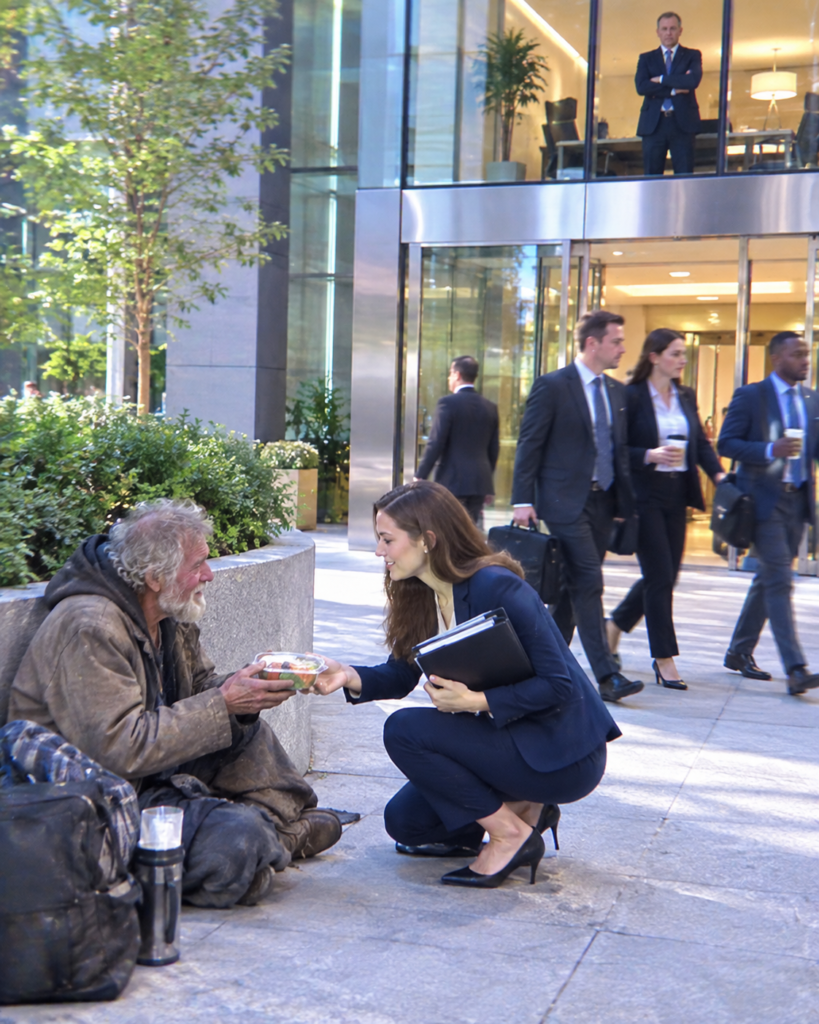
That morning outside Harper Global, I gave away one sandwich because someone was hungry.
Years later, thousands of parents found work because one old man noticed what kindness looked like when no one important was supposed to be watching.