Pamela Whitmore did not speak until the black Mercedes had gone three blocks.
Andrew drove with both hands locked around the steering wheel so tightly that his knuckles had turned white.
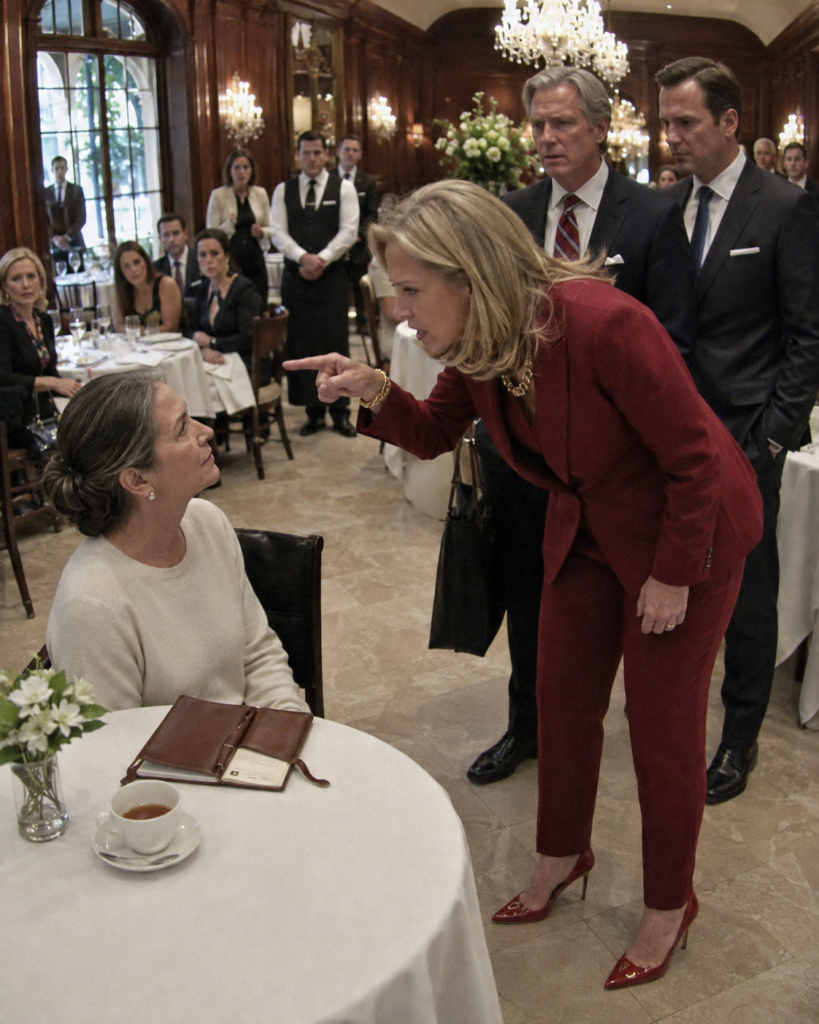
Outside, Charleston passed in glowing fragments—historic balconies, gas lamps, tourists strolling beneath oak trees—but inside the car, the silence felt suffocating.
Finally, Pamela snapped.
“You’re seriously blaming me for this?”
Andrew slammed on the brakes at a red light.
For the first time in twenty-three years of marriage, he turned toward her with something Pamela had never seen in his face before.
Fear.
Not anger.
Not embarrassment.
Fear.
“Do you understand what you just did?” he asked.
“She embarrassed me first.”
“No,” Andrew said. “You embarrassed yourself.”
Pamela stared at him.
Andrew laughed once, but there was no humor in it.
“You walked into a restaurant without a reservation. You demanded someone else’s table. You insulted the owner. Then you threatened to buy a building she already owns.”
“She was dressed like—”
“Stop.”
The single word came out so sharply that Pamela actually fell silent.
Andrew looked forward again.
“The funding Eleanor Vale was considering wasn’t some social favor. It was forty-eight million dollars.”
Pamela’s face changed.
“What?”
“Forty-eight million.”
The traffic light turned green, but Andrew did not move until the car behind them honked.
“Our East Bay development needs that capital by Monday,” he continued. “If we don’t close the extension, the lender can trigger a default clause. If that happens, investors panic. Contractors stop work. Vendors demand cash. And once people smell blood, every other project we have becomes vulnerable.”
Pamela stared straight ahead.
For once, she had no clever response.
When they reached their mansion in South of Broad, Andrew parked but did not immediately get out.
His phone was already vibrating.
Then vibrating again.
And again.
He looked down.
Three missed calls from his chief financial officer.
Two from outside counsel.
One from the bank.
Pamela whispered, “Maybe Eleanor will calm down by morning.”
Andrew closed his eyes.
“You still don’t understand her.”
“How well do you know her?”
“Everyone in serious business knows Eleanor Vale.”
Pamela scoffed nervously.
“She runs a restaurant.”
Andrew turned toward her.
“No, Pamela. The restaurant is what she loves.”
He leaned closer.
“The money is what she built quietly.”
That night, neither of them slept.
At 6:42 the next morning, Andrew received an email from Vale Capital Partners.
The message contained only six sentences.
After review of recent developments, the investment committee had elected not to proceed with Whitmore Development’s proposed financing package.
No further negotiations would occur.
No revised terms would be considered.
The decision was final.
Andrew read the email twice.
Then a third time.
At 7:15, his CFO arrived at the house without being invited.
At 7:40, two attorneys joined by conference call.
At 8:05, their senior lender requested an emergency meeting.
By 8:30, Pamela was sitting alone at the enormous marble kitchen island with untouched coffee growing cold between her hands.
For the first time, wealth did not feel like protection.
It felt like something that could disappear.
Across town, Eleanor Vale was already working.
But not on Andrew Whitmore.
She was standing inside the back kitchen of The Laurel Room beside a nineteen-year-old dishwasher named Caleb.
He had been late three times that month.
Marcus had expected Eleanor to approve his dismissal.
Instead, she asked Caleb why.
The boy stared at the floor.
“My mother started dialysis,” he admitted. “I take my little sister to school before I come here. Sometimes the bus runs late.”
Eleanor listened without interrupting.
Then she asked, “Do you have a car?”
Caleb laughed nervously.
“No, ma’am.”
“Do you have a driver’s license?”
“Yes.”
Eleanor looked at Marcus.
“Move his start time back thirty minutes.”
Marcus nodded.
“And call Daniel at the garage. Tell him I want that old Honda in the company lot inspected.”
Caleb looked up.
“What old Honda?”
“The one you’ll be driving next week if Daniel says it’s safe.”
His mouth fell open.
“Ms. Vale, I can’t afford—”
“I didn’t ask if you could.”
Caleb’s eyes filled instantly.
Eleanor touched his shoulder.
“Your job is to show up, work hard, take care of your family, and someday help somebody else when you’re able.”
Then she walked away before he could thank her.
That was Eleanor Vale.
She remembered exactly how people behaved when they believed nobody important was watching.
But she also remembered kindness.
At 9:17, Walter entered her office carrying a tablet.
“You may want to see this.”
A video from the previous evening had appeared online.
Someone at a nearby table had recorded Pamela’s confrontation.
The clip began with Pamela demanding that Eleanor move.
It ended with Marcus saying:
“Because she owns this place.”
By breakfast, it had hundreds of thousands of views.
By lunch, millions.
People were furious.
Not because Eleanor was wealthy.
That was not what captured them.
It was the way Pamela had spoken before she knew who Eleanor was.
“She clearly doesn’t belong here.”
Those five words spread everywhere.
Former waiters told stories about Pamela snapping her fingers at staff.
A boutique owner said Pamela once demanded a sales associate be fired for refusing to reopen after closing.
A hotel employee anonymously described how she had thrown a room key across a desk because the presidential suite was unavailable.
Then something even worse happened.
Whitmore Development employees began talking.
Anonymous posts appeared describing unpaid overtime, intimidation, contractors pressured into accepting late payments, and junior staff regularly humiliated during meetings.
Andrew had not personally committed every offense.
But his company had developed a culture where powerful people assumed those beneath them would remain silent.
By noon, three city council members who had once praised Whitmore Development publicly announced they were “reviewing future relationships.”
Two investors requested meetings.
One commercial tenant backed out of a pending deal.
Pamela watched it all unfold from her bedroom.
At 12:41, she finally did something almost unimaginable.
She called The Laurel Room herself.
Walter answered.
“The Laurel Room. Good afternoon.”
Pamela swallowed.
“I need to speak to Eleanor Vale.”
There was a pause.
“May I ask who’s calling?”
“You know who this is.”
“I do,” Walter replied pleasantly. “But Ms. Vale is currently unavailable.”
“When will she be available?”
“For you?”
Another pause.
“I couldn’t say.”
Pamela closed her eyes.
“Please tell her I want to apologize.”
Walter’s voice softened slightly.
“I’ll give her the message.”
At 3:00 that afternoon, Eleanor returned the call.
Pamela answered on the first ring.
“Ms. Vale.”
“Mrs. Whitmore.”
Pamela stood beside her bedroom window, looking down at a garden maintained by people whose names she did not know.
“I behaved terribly last night.”
Eleanor said nothing.
“I was stressed. We had an important dinner. I let my emotions—”
“Pamela.”
The interruption was calm.
“You’re still explaining yourself.”
Pamela stopped.
Eleanor continued.
“An apology that explains why cruelty happened is usually just cruelty asking to be excused.”
The words landed harder than any insult could have.
Pamela lowered herself onto the edge of the bed.
“What do you want me to say?”
“The truth.”
Pamela stared at her reflection in the mirror across the room.
For several seconds, she could not speak.
Then, quietly:
“I thought you were beneath me.”
Eleanor remained silent.
Pamela’s voice trembled.
“I looked at your clothes. I saw you sitting alone. I assumed you weren’t important. And because I thought you weren’t important, I believed I could treat you however I wanted.”
“That,” Eleanor said, “is an apology.”
Pamela wiped quickly beneath one eye.
“Will you reconsider Andrew’s financing?”
“No.”
Pamela’s expression hardened slightly.
“Then what’s the point of apologizing?”
Eleanor almost smiled.
“That question is exactly why you still have work to do.”
There was another long silence.
Then Eleanor said something Pamela did not expect.
“Come to The Laurel Room tomorrow at eleven.”
“For lunch?”
“No.”
“What for?”
“You’ll see.”
The next morning, Pamela arrived wearing no diamonds.
No crimson suit.
No red-soled heels.
Just black trousers and a plain white blouse.
Walter met her at the door.
Instead of leading her toward table four, he opened a narrow side door.
Behind it was a staircase descending to the lower service level.
Pamela hesitated.
Walter smiled.
“Ms. Vale is waiting.”
Downstairs, Eleanor stood beside stacks of cardboard boxes.
Around her were chefs, servers, volunteers, and delivery drivers packing hot meals.
“What is this?” Pamela asked.
“Our Friday community program,” Eleanor replied. “Four hundred meals. Senior housing, shelters, homebound residents, and families recovering from medical emergencies.”
She handed Pamela an apron.
Pamela stared at it.
“You want me to serve food?”
“No.”
Eleanor pointed toward a long stainless-steel counter.
“I want you to pack it.”
For six hours, Pamela Whitmore worked beside people she would once have walked past without seeing.
She met Teresa, a single mother who waited tables at night while studying nursing.
She met Mr. Alvarez, a seventy-one-year-old retired carpenter who volunteered every Friday because The Laurel Room had fed his family after Hurricane Hugo.
She met Caleb, the dishwasher Eleanor had just helped.
Nobody bowed to Pamela.
Nobody cared about her last name.
Nobody asked about her house.
They only cared whether she sealed the containers properly and remembered to include utensils.
By four in the afternoon, Pamela’s feet hurt.
Her hair had fallen loose.
Her blouse smelled like roasted chicken and gravy.
Eleanor approached quietly.
“How do you feel?”
Pamela looked around the room.
For once, she answered without performing.
“Embarrassed.”
“Why?”
“Because I’ve spent years entering rooms and deciding who mattered.”
Her voice cracked.
“And I was wrong almost every time.”
Eleanor nodded.
“That’s a useful beginning.”
Pamela looked at her.
“Why did you invite me?”
“Because losing money may frighten someone into behaving better.”
Eleanor untied her own apron.
“But only seeing people clearly can change them.”
Pamela looked down at her hands.
“Will Andrew lose the company?”
“That depends on Andrew.”
“The funding?”
“Still no.”
Pamela nodded slowly.
Strangely, she did not argue.
Before leaving, she stopped at the bottom of the stairs.
“Ms. Vale?”
“Yes?”
Pamela turned.
“Thank you for not humiliating me the way I humiliated you.”
Eleanor studied her for a moment.
Then she said, “Pamela, I never needed to humiliate you.”
She glanced toward the bustling kitchen.
“You did that yourself.”
Pamela gave a small, painful smile.
“I suppose I did.”
Three months later, Whitmore Development survived.
Barely.
Andrew sold two properties, brought in a restructuring firm, replaced several executives, and created an independent employee grievance system.
He never received Eleanor Vale’s forty-eight million dollars.
But something else happened.
Every Friday morning at ten forty-five, a black Mercedes began parking two blocks from The Laurel Room.
Pamela would step out wearing comfortable shoes and carrying no jewelry except her wedding ring.
Then she would enter through the side door.
Not the front.
She never asked for table four again.
And whenever someone new in the kitchen whispered, “Isn’t that Pamela Whitmore?”
Caleb would grin while stacking meal containers.
“Yeah.”
Then he would point toward the aprons.
“But down here, everybody belongs.”