For several seconds after Adrian spoke, nobody moved.
Even Lucia seemed to sense that the room had changed.
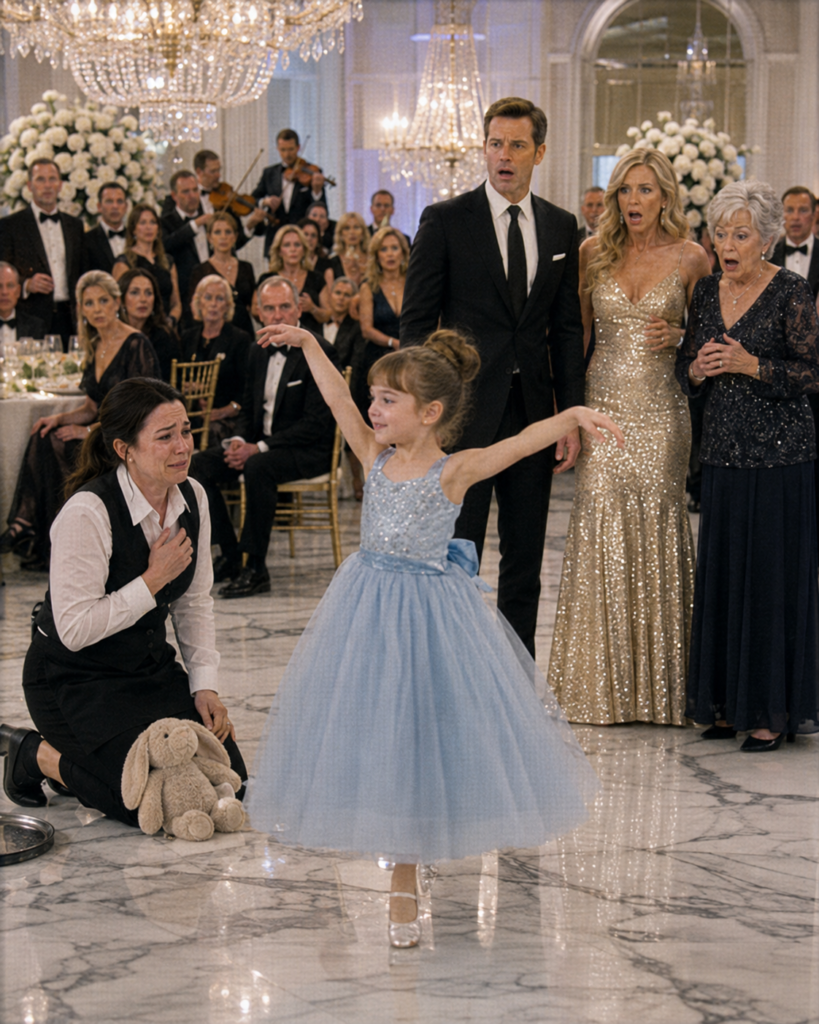
She completed the final turn of the dance with her arms lifted softly above her head, exactly as my mother had taught me. Then she lowered them, one hand resting over her heart.
The last violin note faded beneath the chandeliers.
There was no applause.
Not because Lucia had failed.
Because everyone was watching us.
Lucia looked uncertainly toward me.
“Mama?”
That one word brought me back into my body.
I crossed the floor quickly and wrapped my arms around her.
“You were beautiful.”
She smiled against my shoulder.
“Did I do the falling star right?”
“Perfectly.”
Only then did a few people begin clapping. Others followed, hesitant at first, until the ballroom filled with applause that felt strangely misplaced. Lucia peeked around me, pleased but confused.
She had no idea that while she danced, the ground beneath my entire life had shifted.
I picked up her stuffed rabbit and placed it in her arms.
“Stay close to me.”
She nodded.
When I turned, Adrian was still staring at her.
Up close, he looked less like the untouchable billionaire everyone in Boston seemed to recognize and more like a man trying to assemble pieces of a memory he had never expected to find.
The elderly woman beside him wiped her eyes with a folded handkerchief.
Celeste stood several feet away, her champagne glass untouched now.
“What exactly is going on?” she asked.
Her voice was quieter than before.
Adrian didn’t look at her.
He looked at me.
“Would you come somewhere private?”
Every instinct in me resisted.
I had spent years working events like this one. I knew the difference between belonging somewhere and being tolerated because I was carrying a tray.
A private conversation with Adrian Vale could mean anything.
Lucia slipped her hand into mine.
I tightened my grip around her fingers.
“Anything you have to say can be said here.”
The older woman stepped forward.
“No,” she said gently. “It cannot.”
There was something in her face that stopped me.
She was elegant without trying to be, silver hair swept back neatly, a simple strand of pearls at her throat. But beneath the careful makeup and expensive dress, grief seemed to have aged her in places money couldn’t soften.
She looked at me as though she already knew me.
That frightened me more than Adrian’s questions.
“My name is Eleanor Vale,” she said.
The name landed somewhere in my memory.
Not because I had met her.
Because everyone in Boston knew the Vale family.
Vale Holdings owned buildings, investment firms, foundations, hospitals, and half a dozen companies whose names appeared in newspapers regularly. Adrian’s grandfather had built much of the family fortune. Eleanor, his widow, rarely appeared publicly anymore.
And now she was crying because my daughter had performed my mother’s dance.
Eleanor looked down at Lucia.
Then she whispered, “You move like Rose.”
My chest tightened.
“You knew my mother?”
Eleanor closed her eyes.
“For most of my childhood.”
That answer made no sense.
“My mother grew up in Worcester.”
Eleanor looked at Adrian.
He gave the smallest shake of his head, as if telling her not to say too much here.
Around us, guests were whispering.
Phones were still raised.
Someone from the event staff had begun encouraging people toward the dining room. The conductor quietly signaled the orchestra to play something else, an elegant waltz that felt almost absurd against the silence inside me.
My manager appeared near the ballroom doors.
He looked terrified.
Not for me.
For the catering company.
I knew that look.
He was calculating whether one of his servers had just created the kind of scandal that got contracts canceled.
“I should go,” I said.
Adrian’s expression sharpened.
“Please.”
I hated how much weight that word carried.
Not because of who he was.
Because of the fear beneath it.
I looked at Lucia.
She was studying Eleanor’s face with the direct curiosity only children possess.
“Why are you sad?” Lucia asked.
Eleanor swallowed.
“Because you reminded me of someone I loved very much.”
“My grandma?”
Eleanor’s eyes filled again.
“Yes.”
Lucia considered this.
Then she held out her stuffed rabbit.
“You can hold Mr. Buttons if you want.”
For the first time, Eleanor smiled.
It was small and shaky.
“Thank you, sweetheart. But I think you should keep him.”
Lucia nodded seriously.
“He’s good for emergencies.”
Something in Eleanor’s face broke.
She turned away.
Adrian exhaled slowly.
“There is a sitting room down the hall,” he said to me. “Ten minutes. Then you can leave if you want.”
I wanted to refuse.
Instead, I heard my mother’s voice in my memory.
Some songs carry memories too painful to explain.
All my life, I had accepted that sentence as one of Rose Bennett’s mysteries.
My mother had been full of them.
She hated photographs of herself before the age of twenty.
She never attended school reunions.
She had no childhood friends.
She claimed her parents died when she was young but changed the subject whenever I asked where they were buried.
And every Christmas, no matter how little money we had, she placed a small silver star at the top of our tree.
Always the same star.
Always polished carefully.
Always handled like something sacred.
I turned to Adrian.
“Ten minutes.”
—
The sitting room was almost offensively beautiful.
A fire burned beneath a white marble mantel. Tall windows overlooked the dark gardens. Paintings that probably cost more than everything I had earned in my life hung casually on the walls.
Lucia climbed onto a velvet sofa, still holding Mr. Buttons.
I sat beside her.
Adrian remained standing.
Eleanor lowered herself into an armchair across from us.
Nobody spoke at first.
Finally, I said, “Tell me what you think you know.”
Eleanor folded her hands.
“My mother was named Margaret Vale.”
“Your mother?”
She nodded.
“She had two daughters. Me, and my younger sister.”
My throat tightened.
“What was your sister’s name?”
Eleanor looked directly at me.
“Rosalind.”
I stopped breathing.
My mother’s full name had been Rose Lynn Bennett.
Rose Lynn.
Rosalind.
I remembered teasing her once about having two first names.
She had laughed.
“My mother liked complicated things,” she’d said.
At the time, I thought she meant the woman who supposedly raised her in Worcester.
Eleanor continued.
“Rosalind was five years younger than I was. She was stubborn, bright, funny, impossible to keep still.”
A faint smile touched her face.
“She danced everywhere. Hallways. Kitchens. Gardens. My mother used to say Rosie believed the world was music that hadn’t decided what song it wanted to be yet.”
Rosie.
Nobody had called my mother that in front of me.
Yet hearing it made something ache deep inside my chest.
Adrian crossed to a cabinet and opened a drawer.
He removed a small leather portfolio.
“I was going to show Grandmother this tonight anyway,” he said.
Eleanor glanced at him.
“Why?”
“Because of the foundation archives.”
He brought the portfolio toward me.
Inside were copies of old photographs.
The first showed two girls standing beside a grand piano.
One was perhaps fourteen.
The other nine.
The younger girl had dark hair cut just below her chin.
She was smiling directly at the camera.
I knew that smile.
My hands began to shake.
Lucia leaned over.
“Mama, she looks like you.”
She didn’t.
She looked like my mother.
Not the mother I remembered from hospital rooms and unpaid bills and late nights balancing the books from her dance studio.
The girl in the photograph looked untouched by any of that.
She wore a white dress, polished shoes, and a ribbon in her hair.
But the tilt of her head was Rose.
The slightly crooked smile was Rose.
The dimple in her left cheek was Rose.
I touched the photograph.
“No.”
The word escaped without permission.
Eleanor leaned forward.
“That was taken in 1978.”
I stared at her.
“My mother was born in 1969.”
“So was Rosalind.”
I looked at Adrian.
Then back at the photograph.
“This doesn’t prove anything.”
“No,” Adrian said. “It doesn’t.”
His calmness surprised me.
He wasn’t trying to convince me.
Not yet.
I appreciated that more than I wanted to.
“People resemble each other,” I said. “Families lose contact. Names repeat.”
Eleanor nodded.
“Yes.”
“Rose never told me she came from money.”
A shadow crossed Eleanor’s face.
“She wouldn’t have.”
“You don’t know what she would have done.”
“No.” Eleanor’s voice softened. “I suppose I don’t.”
Lucia shifted beside me.
I realized my voice had risen.
I touched her shoulder.
“Sorry, baby.”
“It’s okay.”
She looked at Eleanor.
“Was my grandma your sister?”
Nobody answered.
Lucia frowned.
“That’s what we’re talking about, right?”
Adrian almost smiled.
“Yes.”
“Then that would make you…”
She stared at Eleanor.
“My great-aunt?”
Eleanor’s eyes filled.
“Possibly.”
Lucia seemed delighted by this possibility.
“I’ve never had a great-aunt before.”
I closed my eyes.
Of course that was how a six-year-old would understand it.
Not as betrayal.
Not as a buried family history.
As one more person she might get to love.
Eleanor pressed the handkerchief beneath one eye.
“I’ve never had a great-niece before.”
I stood.
I couldn’t sit anymore.
“What happened to Rosalind?”
The room became still.
Adrian looked toward his grandmother.
This time, Eleanor did not hesitate.
“She disappeared.”
“When?”
“August of 1987.”
My mother would have been eighteen.
“What does disappeared mean?”
Eleanor’s gaze fell to her hands.
“She left home one evening and never returned.”
“People don’t just vanish.”
“Sometimes they do.”
“Was there a police report?”
“Yes.”
“Did you search?”
“For years.”
Her voice cracked on the final word.
I felt a strange flash of anger.
Not at Eleanor exactly.
At everyone.
At my mother.
At myself.
At the fact that the woman who raised me could have contained an entire other life and never trusted me with it.
“Why would she run away?”
Eleanor looked toward the fire.
“Our family was different then.”
Different.
It was the kind of word wealthy families probably used to describe painful histories they didn’t discuss in public.
I waited.
Eleanor seemed to understand.
“My father was strict,” she said. “Controlling in ways that were considered ordinary by people around him. Rosalind resisted him constantly.”
“What did he control?”
“Her schooling. Her friendships. Her dancing. What she wore. Where she went.”
Eleanor’s mouth tightened.
“Eventually, who she was allowed to love.”
There it was.
Not a dramatic confession.
Just a truth carried too long.
“Who did she love?” I asked.
Eleanor’s expression changed.
“I don’t know.”
“You just said—”
“I knew there was someone. I never knew who.”
Adrian moved closer to the fireplace.
“My great-grandfather discovered letters,” he said. “According to the family records.”
I looked at him.
“What records?”
He tapped the portfolio.
“When my grandfather died, several sealed boxes went into storage. I began having them catalogued last year.”
“Why?”
“Because the Vale Foundation is preparing an archive for the family’s historical collection.”
I couldn’t help it.
I laughed once.
The sound was bitter even to my own ears.
“So your family’s secrets were being prepared for a museum.”
Adrian didn’t react defensively.
“Apparently not all of them.”
That stopped me.
Eleanor glanced at him.
“What do you mean?”
Adrian reached into the portfolio again.
He removed a photocopy of a letter.
“I found this three weeks ago.”
He handed it to his grandmother.
Eleanor read the first few lines.
All the color drained from her face.
“Where was this?”
“In your father’s papers.”
“What does it say?” I asked.
Eleanor looked at Adrian.
He answered.
“It was written the day after Rosalind disappeared.”
“By who?”
“My great-grandfather.”
“To whom?”
“A private investigator.”
I felt Lucia’s hand find mine again.
“What did he say?”
Adrian paused.
“He instructed the investigator to stop looking for her.”
Eleanor stood so quickly the chair shifted behind her.
“No.”
“I have the original.”
“No.”
“Grandmother—”
“He searched for her.”
Her voice shook.
“My father searched for years.”
Adrian looked devastated.
“I think he let you believe that.”
Silence filled the room.
Eleanor took the letter again.
Her lips moved as she reread it.
I watched disbelief collapse slowly into something heavier.
All these years, she had believed her sister vanished beyond anyone’s reach.
Now she was learning someone may have known more.
I sat again because my knees suddenly felt unreliable.
“What reason did he give?”
Adrian looked at me.
“He wrote that Rosalind had made her choice and should be allowed to live with the consequences.”
I stared at him.
“That could mean anything.”
“Yes.”
“Was there an address?”
“No.”
“A city?”
“No.”
“Anything?”
“One name.”
Eleanor looked up sharply.
Adrian took the letter from her.
“The investigator was instructed not to contact a man named Daniel Bennett.”
My heart stopped.
Bennett.
My mother’s surname.
Lucia whispered, “Mama?”
I realized I had squeezed her hand too tightly.
I let go immediately.
“Sorry.”
She rubbed her fingers.
“Who is Daniel?”
“I don’t know.”
But that wasn’t entirely true.
I knew one thing.
My mother had once mentioned him.
Only once.
I must have been eleven or twelve.
We were cleaning the dance studio after class when an old song came on the radio.
My mother had suddenly gone still.
I asked what was wrong.
She turned the music off.
“Daniel loved this song,” she said.
“Who’s Daniel?”
She’d stared at the stereo for a long time.
“Someone who gave me my life back.”
At eleven, I thought she meant a teacher.
A friend.
Maybe a doctor.
I had forgotten the conversation until now.
“Rose knew a Daniel Bennett,” I said slowly.
Eleanor gripped the back of the chair.
“How?”
“I don’t know.”
“Your father?”
The question landed like a stone.
“My father was named Thomas Reed.”
“Are you certain?” Adrian asked.
My eyes snapped toward him.
“Yes.”
But even as I said it, old memories stirred.
Thomas Reed existed in my childhood mostly as a name on a birth certificate and a photograph my mother kept in a kitchen drawer.
He had died in a construction accident when I was a baby.
At least that was what I’d been told.
I remembered asking my mother once why there were no pictures of their wedding.
“We didn’t have one,” she said.
“Why not?”
“Because life happened faster than paperwork.”
At the time, that answer seemed romantic.
Now it seemed carefully designed.
I stood again.
“This is too much.”
Adrian nodded.
“I understand.”
“No, you don’t.”
“I probably don’t.”
That simple answer disarmed me.
I looked at Eleanor.
She seemed older than she had twenty minutes earlier.
“I need to go home.”
“Of course.”
Eleanor took one step toward me.
“May I ask one thing before you leave?”
I almost said no.
Instead, I waited.
“Did Rose keep a silver star?”
Every hair on my arms rose.
I stared at her.
“What kind of star?”
“About this large.”
She held her fingers several inches apart.
“Five points. Engraved along one edge.”
I felt suddenly cold.
My mother’s Christmas star.
“Yes.”
Eleanor covered her mouth.
Adrian looked between us.
“What is it?”
Eleanor lowered her hand.
“My mother gave each of us one.”
“Why?”
“When we were children, she told us that if we were ever separated, we should hang them somewhere visible at Christmas.”
Her voice thinned.
“So the other sister would know where home was.”
I could not speak.
After my mother died, I packed most of her things into boxes.
The silver star was one of the few items I kept.
Every December, I placed it on our tree.
Just as she had.
I had thought it was tradition.
Maybe it had been something else.
A message.
A memory.
Or a promise that had failed.
Eleanor looked at me desperately.
“Do you still have it?”
“Yes.”
“Please don’t throw it away.”
“I wasn’t planning to.”
She nodded quickly.
“Of course.”
Her embarrassment softened something in me.
For the first time, I saw not Eleanor Vale, widow of a billionaire.
I saw a woman who had lost her little sister at eighteen and never stopped wondering where she went.
My anger did not disappear.
But it changed shape.
Lucia tugged my sleeve.
“Mama, are we still going home?”
“Yes.”
I glanced at the clock.
It was almost ten.
She should have been asleep an hour ago.
Adrian walked us toward the hallway.
Near the door, he stopped.
“You won’t hear from the press through me.”
I looked at him.
“What?”
“There were phones in that ballroom. Someone will post the dance. Possibly the conversation afterward.”
My stomach dropped.
I hadn’t even considered that.
“I can ask the event staff to request privacy, but I can’t guarantee it.”
“Lucia’s six.”
“I know.”
His expression hardened slightly.
“Anything involving her stays out of anything I say publicly.”
I studied him.
“Why are you helping?”
He glanced toward the sitting room, where Eleanor remained near the fire.
“Because whatever happened thirty-nine years ago has already hurt enough people.”
Then he added, “And because she may be family.”
I wasn’t ready for that word.
I opened the door.
“Goodnight, Adrian.”
“Goodnight.”
Celeste was waiting in the corridor.
Of course she was.
Her expression was no longer amused.
For the first time all evening, she looked uncertain.
“Can I speak to you?”
I almost kept walking.
Then I looked at Lucia.
She was leaning against me, exhausted.
“Briefly.”
Celeste folded her arms, then seemed to realize how defensive the gesture looked and lowered them.
“I owe you an apology.”
I said nothing.
She swallowed.
“What I did in there was thoughtless.”
“Yes.”
The directness startled her.
She nodded.
“Yes. It was.”
I expected an excuse.
Champagne.
Pressure.
A joke misunderstood.
Instead she said, “I was trying to be entertaining.”
Her gaze moved toward Lucia.
“And I made a child feel like entertainment.”
Lucia looked up at her.
“You were kind of mean.”
I closed my eyes.
“Lucia.”
“What?”
Celeste surprised me by giving a small, embarrassed laugh.
“She is right.”
Lucia considered her solemnly.
“Okay.”
Celeste looked back at me.
“The million dollars offer was absurd. I won’t mention it again.”
“Good.”
Her eyes flickered toward the closed sitting-room door.
“Is Adrian all right?”
There it was.
Not jealousy.
Not anger.
Concern.
I saw suddenly that whatever else Celeste was, she cared about him.
“He’s with his grandmother.”
She nodded.
“Thank you.”
I started to leave.
Celeste spoke again.
“For what it’s worth, your daughter was wonderful.”
Lucia brightened instantly.
“Thank you.”
I couldn’t help smiling.
Children were astonishingly efficient with forgiveness.
Adults collected it like debt.
—
We took the subway home.
I could have accepted the car Adrian offered.
I didn’t.
I needed normality.
Metal seats.
Fluorescent lights.
The screech of tracks.
People staring at their phones without knowing that my entire understanding of my mother had just been rewritten inside a ballroom.
Lucia fell asleep against me before we reached our stop.
I carried her the last two blocks.
Our apartment was on the third floor of an old brick building with unreliable heat and a front door that stuck whenever it rained.
Tonight it felt like sanctuary.
I changed Lucia into pajamas without fully waking her.
As I tucked her beneath the blanket, her eyes opened.
“Mama?”
“Yes?”
“Do you think Grandma was really that lady’s sister?”
I sat on the edge of the bed.
“I don’t know yet.”
“She looked happy when she saw me dance.”
“She did.”
Lucia hugged Mr. Buttons.
“Maybe she missed Grandma.”
I smoothed the hair from her forehead.
“Yes.”
“That’s sad.”
“It is.”
She thought for a moment.
“Can we see her again?”
I hesitated.
“Maybe.”
Lucia’s eyes closed.
“Good.”
Within seconds, she was asleep.
I stayed beside her for several minutes.
Then I went to the hallway closet.
My mother’s boxes were stacked behind winter coats and an old vacuum cleaner.
I hadn’t opened most of them in years.
After Rose died, grief had made every object dangerous.
Her scarf.
Her handwriting.
A coffee mug with a chipped handle.
Eventually, I learned to live around those boxes rather than inside them.
Tonight I pulled them all into the living room.
Three hours later, the floor was covered.
Photographs.
Dance programs.
Old bills.
Letters.
Receipts.
Nothing from before my mother turned nineteen.
That absence began to feel deliberate.
Then, near the bottom of the last box, I found the silver star.
Wrapped in tissue paper.
I held it beneath the lamp.
I had seen it every Christmas of my life.
I had never examined it carefully.
Five points.
Slightly tarnished.
A thin engraved border.
Along one edge were tiny letters.
R + E.
Rose and Eleanor.
My eyes burned.
I turned it over.
There was something else scratched faintly into the back.
Not professionally engraved.
Handwritten with some sharp object.
D.B.
Daniel Bennett.
I sat on the floor.
For a long time, I simply stared.
Then I noticed that one point of the star looked slightly thicker than the others.
I pressed it.
Nothing.
I turned the star sideways.
There was a seam.
My pulse quickened.
Using the edge of a butter knife, I carefully worked along it.
The back panel opened.
Inside was a folded piece of paper no larger than a postage stamp.
My hands shook so badly I almost tore it.
There were only six words written on it.
Not in my mother’s handwriting.
If Rose returns, tell Eleanor everything.
Below that was a date.
December 24, 1988.
More than a year after Rosalind Vale disappeared.
I read the words again.
Then again.
If Rose returns.
That meant whoever wrote the message expected my mother might come back.
Or had already left somewhere a second time.
I turned the paper over.
There was another line.
Three words.
Ask Daniel why.
I barely slept.
—
By nine the next morning, someone had posted the dance online.
By ten, clips from the ballroom had spread across social media.
Most focused on Lucia.
A little girl in a borrowed blue dress dancing beneath chandeliers.
Strangers called her graceful.
Sweet.
Brave.
A few posts mentioned Celeste’s challenge, but the video cut before the private conversation began.
For that, I was grateful.
I called my supervisor expecting to be fired.
Instead, he sounded exhausted.
“The venue says nobody’s blaming the staff.”
“Meaning?”
“Meaning Mr. Vale called personally.”
I closed my eyes.
Of course he had.
“You’re still scheduled Saturday.”
“Thank you.”
“Also…”
“What?”
“You’ve got reporters asking whether you work here.”
My stomach sank.
“Don’t tell them anything.”
“I wasn’t planning to.”
He paused.
“My wife saw the video.”
I waited.
“She says your kid’s got talent.”
Despite everything, I smiled.
“She does.”
After we hung up, I called Lucia’s school.
Then I called the only person who might know something about my mother’s past.
My mother’s former dance partner, Marianne Clarke.
Marianne was seventy-two now and lived in Rhode Island.
She answered on the fourth ring.
“Hello?”
“Marianne? It’s me.”
A pause.
“Oh, sweetheart. Is everything all right?”
“I need to ask you about my mother.”
Another pause.
Longer this time.
“What about her?”
“Did you know her name was Rosalind Vale?”
Silence.
Not confusion.
Silence.
My heart began pounding.
“Marianne?”
She exhaled.
“I wondered if this day would come.”
I stood so quickly my chair scraped the floor.
“You knew?”
“I knew some of it.”
“All these years?”
“Your mother made me promise.”
“She is dead.”
The words came out harsher than I intended.
“And I’ve spent my entire life not knowing who she was.”
Marianne’s voice softened.
“She knew exactly who she was. She just didn’t want the Vales deciding it for her.”
I closed my eyes.
“Tell me.”
“I can’t do it over the phone.”
“Why?”
“Because there are things Rose left with me.”
My breath caught.
“What things?”
“Letters.”
I gripped the phone.
“From who?”
“I never opened them.”
“Marianne.”
“I promised her.”
“She’s been gone eight years.”
“I know.”
Her voice trembled.
“She told me to give them to you only if someone from the Vale family found you first.”
Every thought in my head stopped.
“What?”
“That was her instruction.”
I stared out the window.
Cars moved along the street below.
Someone walked a terrier.
The world had the nerve to remain ordinary.
“She expected this.”
“I think she feared it.”
“Why?”
“I don’t know.”
“Who are the letters from?”
Marianne was quiet.
Then she said, “One is from Eleanor.”
My throat tightened.
“And the other?”
She hesitated.
“Daniel Bennett.”
I looked at the silver star on the table.
“Is Daniel my father?”
“I don’t know.”
“You knew my mother for thirty years.”
“Yes.”
“And you don’t know?”
“Rose kept some doors locked even from people who loved her.”
I sat down.
“When can I come?”
“This afternoon.”
“I’ll be there.”
Before I hung up, Marianne said my name.
I stopped.
“There is one more thing.”
“What?”
“When Rose gave me those letters, she made me promise something else.”
I waited.
“If the Vales ever found you, I was to ask whether Eleanor still had her star.”
Cold moved down my spine.
“She does?”
“I don’t know.”
“Why would that matter?”
Marianne’s voice became almost a whisper.
“Because Rose said the stars were never just keepsakes.”
I looked at mine.
“What are they?”
“I was hoping you could tell me.”
—
Adrian called twenty minutes later.
I almost didn’t answer.
Then I remembered Eleanor.
“Hello?”
“It’s Adrian.”
“I know.”
He paused.
“My grandmother wants to see you again.”
“I can’t today.”
“All right.”
His lack of pressure surprised me.
“I found something,” I said.
Another pause.
“What?”
“A note inside the silver star.”
His voice changed.
“What did it say?”
“Ask Daniel why.”
Silence.
Then Adrian said, “That’s strange.”
“Why?”
“Because I found Daniel Bennett.”
I stood.
“Where?”
“Not where. Who.”
My heart started racing.
“Adrian.”
“He wasn’t your mother’s father.”
“I didn’t think he was.”
“He wasn’t her husband either.”
I gripped the edge of the table.
“Then who was he?”
According to Adrian’s archivist, Daniel Bennett had worked for the Vale family.
Not as a driver.
Not as a groundskeeper.
Not as someone my mother’s father might have considered beneath her.
He had been Margaret Vale’s private music tutor.
The composer who helped arrange the melody Lucia danced to.
The melody the Vale family believed had never existed outside their home.
“Daniel taught Rose the song?” I asked.
“No.”
“Then what?”
“He helped my great-grandmother write it.”
I looked at the star.
“And after Rose disappeared?”
“He disappeared from Boston two weeks later.”
“Where did he go?”
“Worcester.”
The same city where my mother claimed to have grown up.
My skin prickled.
“Do you have an address?”
“I have an old one.”
“Send it.”
“He’s probably dead.”
“Send it anyway.”
Adrian was quiet.
Then he said, “He’s alive.”
I stopped.
“How old?”
“Eighty-six.”
“Where is he?”
“A care residence outside Worcester.”
I closed my eyes.
Daniel Bennett.
Someone who gave me my life back.
My mother’s words.
“I’m going there.”
“Today?”
“Yes.”
“I’ll drive.”
“No.”
“You shouldn’t walk into this alone.”
“I’ve been walking into my mother’s secrets alone my entire life.”
“That isn’t what I meant.”
I knew.
But the defensiveness came too easily.
I exhaled.
“I have to pick something up in Rhode Island first.”
“From who?”
“A friend of my mother’s.”
Another silence.
“Does she know about the Vales?”
“Yes.”
This time Adrian didn’t hide his surprise.
“She has letters.”
“What letters?”
“One from Eleanor.”
Adrian swore softly under his breath, then immediately apologized.
“Sorry.”
“There’s another from Daniel Bennett.”
“When were they written?”
“I don’t know.”
He was silent.
Then he said, “Take my number.”
“I have your number. You called me.”
“I mean my direct number.”
Despite myself, I laughed.
“Aren’t you calling from it?”
“No.”
“Do billionaires have secret telephones?”
“Mostly assistants.”
That laugh escaped before I could stop it.
For the first time since the ballroom, the tension loosened.
Only slightly.
Then Adrian said, “My grandmother didn’t sleep last night.”
Neither did I, I thought.
“She keeps asking whether your mother was happy.”
That question hurt more than anything else.
Because I knew the answer.
“Yes.”
I looked toward the framed photograph of Rose and Lucia on my bookshelf.
“My mother didn’t have an easy life. But she made a good one.”
Adrian was quiet.
“I’ll tell her.”
“Tell her something else.”
“What?”
“Rose opened a dance studio.”
His breathing changed.
“She taught for twenty-three years.”
I swallowed.
“She never stopped dancing.”
When Adrian answered, his voice was softer.
“I think my grandmother needs to hear that.”
—
Marianne lived in a cottage near Narragansett Bay.
Lucia came with me.
I considered leaving her with a neighbor, but after everything that had happened, I wanted her close.
Marianne opened the door before we knocked.
She looked older than the last time I’d seen her.
Smaller too.
But when she saw Lucia, her face lit.
“Well, there’s my little dancer.”
Lucia hugged her.
Marianne looked at me over Lucia’s shoulder.
Her expression changed.
“You found the star.”
I nodded.
She let us inside.
Tea was already waiting.
So was a wooden box.
It sat in the center of the dining table.
My mother’s handwriting was on the lid.
For my daughter, when the past comes looking.
My throat tightened.
Lucia climbed into a chair.
“Grandma wrote that?”
“Yes.”
Marianne sat beside her.
“Your grandmother wrote everything like it belonged in a movie.”
Lucia smiled.
“She did?”
“Oh, absolutely.”
Marianne looked at me.
“She also made terrible coffee.”
I laughed unexpectedly.
It felt good.
Painfully good.
Then Marianne placed the box in front of me.
I opened it.
Inside were two sealed envelopes.
One labeled Eleanor.
One labeled Daniel.
Beneath them lay a photograph.
Three people stood outside a bus station.
My mother was in the center.
Young.
Maybe eighteen.
Daniel Bennett stood beside her, tall and thin with dark-rimmed glasses.
On Rose’s other side stood a young man I had never seen before.
His arm was around her shoulders.
On the back, my mother had written:
The night we chose our own names.
I stared at the young man.
“Who is he?”
Marianne looked confused.
“You don’t recognize him?”
“No.”
She took the photograph.
Her face went pale.
“Oh.”
“What?”
She looked at me.
“I thought you knew.”
“Knew what?”
Marianne turned the photograph over again, as if hoping the answer might change.
Then she pointed to the young man.
“That’s Thomas Reed.”
My father.
Except the man in the photograph did not look like the photograph my mother had shown me growing up.
Not even close.
I felt the room tilt.
“That isn’t Thomas.”
Marianne frowned.
“Yes, it is.”
“No.”
I pulled out my phone.
I had scanned the old photograph years ago.
I found it.
A smiling blond man in a denim jacket.
Marianne stared at the screen.
“I’ve never seen that man before.”
My mouth went dry.
“Mother told me this was Thomas Reed.”
Marianne shook her head slowly.
“The man beside Rose in that photograph was Thomas.”
“Then who is this?”
“I don’t know.”
Lucia looked between us.
“Mama?”
I couldn’t answer.
My father had died before I knew him.
Or perhaps the man I believed was my father had never existed at all.
Marianne slid the envelope marked Daniel toward me.
“Open it.”
The seal cracked beneath my finger.
Inside were four pages.
The first line was enough to make my hands shake.
Rose,
If you’re reading this, then Eleanor has found your daughter.
I stopped.
Marianne leaned closer.
“What?”
I read aloud.
“Eleanor has found your daughter.”
Marianne frowned.
“That doesn’t make sense.”
The letter was dated May 2008.
I had been nineteen.
My mother had still been alive.
I kept reading.
Daniel wrote that Rose had been right to stay away.
That the Vale family had changed, but not enough.
That Eleanor deserved the truth.
Then came a sentence that made me read it twice.
You were never the one they were trying to protect.
You were the one they were trying to hide.
My pulse pounded in my ears.
The next paragraph referred to Margaret Vale.
Adrian’s great-grandmother.
The composer of the secret melody.
Daniel wrote:
Margaret made me promise I would never tell Eleanor what happened that summer unless you chose to return. She believed silence would keep both girls safe.
Both girls.
Rose and Eleanor.
I turned the page.
Then I stopped.
The bottom half had been torn away.
Not recently.
Years ago.
“Where’s the rest?”
Marianne stared at it.
“That is how Rose gave it to me.”
I searched the box.
Nothing.
I grabbed the second envelope.
Eleanor.
Inside was a shorter letter.
This one was written by Rose.
Not to me.
To her sister.
Ellie,
If you ever read this, then I failed to find the courage to tell you myself.
My vision blurred.
I kept going.
I didn’t leave because I hated you.
I left because Father told me the truth about the summer I was born.
I felt suddenly unable to breathe.
Lucia slipped her hand into mine.
I held it.
The next lines were written in darker ink, as though Rose had pressed the pen harder.
He told me our family would never survive what Mother had done.
He made me believe leaving was the only way to keep you from losing everything too.
I looked at Marianne.
“What did Margaret do?”
She shook her head.
“I don’t know.”
The final lines of the letter were worse because they answered nothing.
Ask Daniel about the music.
Ask him why Mother wrote two versions.
And Ellie, whatever Father told you after I disappeared, please remember this:
You were always my sister.
I folded the letter slowly.
Two versions.
I thought about the melody.
The one Lucia danced to.
The one Eleanor recognized instantly.
I called Adrian.
He answered almost immediately.
“What happened?”
“Does Eleanor still have her silver star?”
“Yes.”
“Are you sure?”
“She’s looking at it right now.”
I stood.
“Open it.”
“What?”
“There’s a hidden compartment.”
I heard movement.
Then Eleanor’s voice in the background.
A moment later, Adrian returned.
“There is.”
My heart raced.
“What’s inside?”
Silence.
“Adrian?”
He didn’t answer.
I could hear Eleanor crying.
Not loudly.
Almost laughing through it.
Then Adrian said, “A music key.”
I frowned.
“A what?”
“A small brass key. And a piece of paper.”
“What does it say?”
Another pause.
Adrian read the words slowly.
For the second song, find Margaret’s piano.
I looked at Rose’s letter.
Two versions.
Two sisters.
Two stars.
Two songs.
“Where is the piano?” I asked.
Adrian went quiet.
Then he said something I wasn’t expecting.
“It was removed from the Vale house in 1987.”
“The year Rose disappeared.”
“Yes.”
“Where did it go?”
“That is the problem.”
“What problem?”
“My grandmother says nobody removed it.”
I stared at the letter in my hand.
“What do you mean?”
“She woke up one morning and it was gone.”
A strange feeling settled over me.
Not fear.
Recognition.
As if my mother had spent decades leaving breadcrumbs she prayed no one would ever need.
I looked down at the photograph again.
Rose.
Daniel.
Thomas.
The night we chose our own names.
Then I noticed something I had missed.
Behind the three of them, partly obscured by the reflection on the bus-station glass, stood a fourth person.
A woman.
Elegant.
Young.
Watching them from several feet away.
I lifted the photograph closer to the window.
My breath caught.
I had seen that face the night before.
Older now.
Silver-haired.
But unmistakable.
Eleanor Vale.
I turned the photograph over.
There was faint writing beneath my mother’s caption.
So faint I almost missed it.
Four words.
Ellie knows where it is.
I raised the phone back to my ear.
“Adrian?”
“Yes?”
“Ask your grandmother something.”
“What?”
I stared at Eleanor’s younger face in the photograph.
“Ask her why my mother wrote that she knew where the piano was.”
Silence.
Then, in the background, I heard Adrian repeat my question.
For several seconds, nothing happened.
Finally Eleanor spoke.
Her voice was far away.
But clear enough.
“She wasn’t supposed to remember that.”
My hand tightened around the phone.
“Remember what?”
There was another pause.
Then Eleanor came onto the line herself.
When she spoke, her voice sounded nothing like the uncertain woman from the ballroom.
It sounded like someone standing at the edge of a secret she had spent almost forty years avoiding.
“Before you come to Worcester,” she said, “there is something you need to know about Daniel Bennett.”
I waited.
Eleanor inhaled slowly.
“Daniel didn’t help Rose disappear.”
My heart began pounding.
“Then what did he do?”
“He helped me.”
I stared at the photograph.
“You?”
“Yes.”
Her voice trembled.
“Because Rose wasn’t the first Vale daughter who tried to leave.”
The silver star had always looked ordinary in my mother’s hands.
That was what I couldn’t stop thinking about.
Every December, Rose Bennett would stand on a wooden kitchen chair because we never owned a proper step stool, stretch toward the highest branch of our crooked little Christmas tree, and fasten the silver ornament near the top.
Not on the top.
Never replacing the angel.
Just beneath it.
“Stars are for finding your way home,” she used to say.
As a child, I thought it was simply one of my mother’s sayings.
Rose had dozens of them.
When rain ruined our plans, she would say, “Then the sky has made different ones.”
When we had barely enough money for groceries, she would turn pancakes into dinner and announce that ordinary rules were taking the evening off.
And whenever I asked why the silver star was wrapped separately from every other ornament, tucked inside a faded velvet pouch, she would smile and answer, “Some things deserve to be remembered carefully.”
Now, standing in the guest library of the Vale mansion with Adrian Vale, Eleanor Vale, and my six-year-old daughter, Lucia, beside me, I wondered how many times my mother had told me the truth without actually explaining it.
The silver star lay in my palm.
It was heavier than I remembered.
Eleanor stared at it as though it were a piece of her own childhood returned from the dead.
Her fingers trembled.
“May I?” she whispered.
I hesitated before placing it into her hand.
The eighty-year-old woman cradled it with both palms.
Behind us, muted music still drifted from the ballroom where two hundred guests were undoubtedly inventing explanations for what they had witnessed.
Lucia sat curled in a leather chair near the fireplace, her stuffed rabbit tucked beneath one arm. Adrian had found her a plate of strawberries and a glass of sparkling water, and she seemed more interested in arranging the berries from smallest to largest than in the revelation that her grandmother might have been born into one of Boston’s wealthiest families.
Children had a remarkable talent for understanding which mysteries could wait.
Adults were not so lucky.
Eleanor traced the star’s engraved edge.
“There were three,” she said.
I looked at her.
“Three stars?”
She nodded.
“My mother had them made when we were girls. One for me. One for Rosalind. And one she kept herself.”
Rosalind.
The name still refused to belong to my mother.
My mother was Rose.
Rose Bennett, who wore drugstore perfume and repaired her own dance shoes with glue.
Rose Bennett, who taught ballet in a studio with peeling yellow walls.
Rose Bennett, who could turn leftover bread into French toast and an empty Saturday afternoon into an adventure.
Rosalind Vale sounded like someone from a framed portrait.
Someone raised beneath chandeliers.
Someone who belonged to this house.
Not my mother.
Eleanor turned the ornament over.
“There.”
A nearly invisible seam ran along one point of the star.
Adrian leaned closer.
“You’re certain?”
“I watched my father open them once.”
Eleanor pressed her thumbnail against the seam.
Nothing happened.
She tried again.
The star remained closed.
Lucia slid down from the chair.
“Maybe it needs the song.”
All three adults turned toward her.
She blinked.
“What?”
Adrian crouched beside her.
“Why would you think that?”
Lucia shrugged.
“Grandma Rose liked hiding things inside songs.”
My heart gave a small, painful tug.
“What do you mean, sweetheart?”
She came closer and touched the ornament.
“When Mama was sad, she played our song on the old piano. But Grandma taught me another part.”
I stared at her.
“Grandma died before you were born.”
Lucia frowned impatiently.
“I know.”
“Then how could she teach you anything?”
“You did.”
I must have looked completely confused, because Lucia sighed in the dramatic way only a six-year-old could.
“When you taught me the falling star, you said Grandma always counted it different.”
She lifted one hand.
“Slow, slow, quick, turn, wait.”
Eleanor’s eyes widened.
She whispered, “Five beats.”
Adrian looked at her.
“What?”
“The star mechanism.”
She turned it in her fingers.
“My father designed the clasp himself. He loved puzzles. There were five pressure points.”
Lucia beamed.
“I knew it.”
“You guessed it,” I said.
“That still counts.”
Despite everything, a laugh escaped me.
It startled all of us.
For one second the room became lighter.
Then Eleanor placed the star on the desk.
“Show me the count.”
Lucia positioned herself solemnly beside her.
“Slow.”
Eleanor pressed the first point.
“Slow.”
The second.
“Quick.”
The third.
“Turn.”
The fourth.
Lucia paused.
“Wait.”
Eleanor pressed the final point.
A tiny metallic click sounded in the library.
Nobody moved.
Then the silver star opened.
Inside was a narrow compartment no wider than my finger.
Something had been rolled tightly within it.
Not one thing.
Two.
Adrian reached toward them, then stopped.
“They’re yours.”
I looked at him.
For the first time since he had approached me in the ballroom, there was no authority in his voice.
No billionaire.
No powerful heir.
Only a man staring at a piece of his missing aunt’s life.
I lifted the first roll carefully.
It was a photograph.
The paper had yellowed at the edges.
A young woman stood outside a modest brick building with a dance bag hanging from one shoulder.
Her hair was long.
Her smile was unmistakable.
My breath caught.
“Mama.”
Rose looked no older than eighteen.
Beside her stood a young man with dark hair and a crooked grin.
He had one arm around her shoulders.
On the back, my mother had written three words.
**Rose and Daniel.**
Below them was a date.
October 17, 1989.
Eleanor sat down hard in the chair behind her.
“Oh, Rosalind.”
Adrian’s jaw tightened.
“Daniel Bennett.”
I looked at him sharply.
“You know the name?”
“No. But that must be the man from the message.”
The second item was a strip of thin paper.
Unlike the photograph, it had been folded rather than rolled.
My mother’s handwriting covered both sides.
I recognized it immediately.
The same handwriting that had signed permission slips, birthday cards, overdue notices, and little notes tucked inside my school lunch.
My hands began shaking before I read the first line.
**Mara, if you are reading this, then someone from the Vale family has finally recognized the star.**
I stopped.
Lucia came quietly to my side.
Her small fingers slipped into mine.
I kept reading.
**Before you decide whether to trust them, you need to know one thing. I did not leave because I stopped loving my family. I left because staying would have forced me to betray someone I loved.**
Eleanor closed her eyes.
Adrian looked toward the fire.
I swallowed and continued.
**Daniel Bennett gave me a life when I thought my own had already been decided for me. He gave me a name when I needed to disappear. He gave you his name because he believed one day you deserved to choose what your own would mean.**
My throat tightened.
My father.
Daniel Bennett.
The man whose absence had always been the largest blank space in my childhood.
Whenever I asked about him, my mother would say only that he had been brave, kind, and gone before he could know me.
I had assumed gone meant dead.
Children fill silence with whatever answer hurts least.
I read on.
**If Eleanor is with you, tell her I kept the blue ribbon. Tell her I remembered the summer at Cape Ann. Tell her I never blamed her.**
Eleanor covered her mouth.
A sound escaped her.
Not quite a sob.
Not quite my aunt’s name.
I lowered the paper.
“What blue ribbon?”
For several seconds she couldn’t answer.
Then she rose and crossed the room to a cabinet near the fireplace.
She unlocked the bottom drawer.
From beneath a stack of old photograph albums, she removed a small wooden box.
Inside lay a faded blue ribbon.
Cut cleanly in half.
Eleanor held one piece.
“Rosalind and I won a dance competition together when we were fourteen,” she said. “Mother tied this ribbon around our trophy. We argued over who should keep it, so Father cut it in two.”
Her eyes shone as she looked at me.
“When Rosalind disappeared, I searched her room. The other half was gone.”
My memories rushed backward.
A ribbon tucked inside my mother’s jewelry box.
Blue.
Frayed.
I had seen it a thousand times.
“I have the other half.”
Eleanor’s knees seemed to weaken.
I reached for her automatically.
She gripped my forearm.
For a moment we stood that way—two women separated by a generation of silence, holding each other upright because of a ribbon cut in half more than forty years earlier.
“I thought she hated me,” Eleanor whispered.
The words were so quiet I almost missed them.
“What?”
“The night she left.”
Her face changed.
The elegant woman who had entered the library with perfect posture and a lifetime of control suddenly looked very old.
Very human.
“We argued.”
Adrian straightened.
“Grandmother, you never told me that.”
“I never told anyone.”
She released my arm.
“Our father had arranged for Rosalind to join a summer program in Paris. It was prestigious. Important. Everything had already been decided.”
“That sounds familiar,” Adrian murmured.
Eleanor gave him a pointed look.
“Your grandfather learned certain habits honestly.”
Despite the tension, Adrian almost smiled.
Then Eleanor looked back at me.
“Rosalind didn’t want Paris. She wanted to teach. She wanted to choreograph. She had met someone.”
“Daniel.”
“I didn’t know his name then. Only that Father considered him unsuitable.”
I felt something harden inside me.
“Because he wasn’t wealthy?”
Eleanor’s silence answered first.
“Because he wasn’t one of us,” she finally said. “That was how my father would have put it.”
I glanced around the library—the carved shelves, marble fireplace, portraits in gold frames.
My mother had grown up here.
And still she had chosen a tiny apartment, a struggling dance studio, and a man named Daniel Bennett.
Eleanor continued.
“I was frightened for her. I told her she was being reckless. She told me I was becoming exactly like Father.”
Her voice cracked.
“She left before sunrise.”
“And you never heard from her again?”
“No.”
I looked down at the message.
“There’s more.”
Eleanor nodded.
I unfolded the bottom edge.
The next lines were written more tightly, as if my mother had been trying to fit too much truth into too little space.
**Daniel believed the past could not stay buried forever. He was right. There are records under his name that explain why we left Boston. Do not search for them alone.**
Adrian stepped closer.
“What records?”
I shook my head and continued.
**Start where Daniel taught me that being lost and being free were not always the same thing. Ask for Room 17.**
That was all.
No address.
No explanation.
Nothing about whether Daniel Bennett was alive or dead.
I turned the paper over twice.
“Room seventeen where?”
Eleanor looked pale.
Adrian took the note gently and studied it.
“There has to be another clue.”
“Maybe there isn’t.”
“There will be.”
I laughed once without humor.
“You sound very confident for someone who didn’t know my mother existed this morning.”
He absorbed the remark without flinching.
“You’re right.”
The immediate apology disarmed me.
Adrian handed the paper back.
“I’ve spent my entire life believing my family history was complete. Tonight proved it wasn’t. I shouldn’t pretend I understand your mother better than you do.”
Something in my chest loosened.
Not much.
But enough.
From the doorway came a cool voice.
“Well. This is touching.”
Celeste Winthrop stood beneath the carved arch.
I hadn’t heard her enter.
Her champagne glass was gone.
So was the playful smile she had worn while humiliating my daughter.
Now she looked angry.
And afraid.
Adrian’s expression hardened.
“This is private.”
“So private that half the ballroom is speculating that your aunt secretly joined the circus?”
“Leave.”
Celeste’s eyes went to the open silver star.
Then to the photograph.
Her face changed for the briefest instant.
Recognition.
I saw it.
“You know something,” I said.
She looked at me.
“I know your daughter turned a charity gala into a melodrama.”
Lucia stepped closer to me.
Adrian’s voice became ice.
“Do not speak about her that way again.”
Celeste stared at him.
It was not the warning itself that seemed to wound her.
It was how quickly he had given it.
“Adrian.”
“You publicly mocked a six-year-old.”
“It was a joke.”
“It stopped being a joke when she became the punchline.”
The room went silent.
Celeste’s cheeks flushed.
For the first time that evening, she had no audience to impress.
Only witnesses.
“I offered her a million dollars.”
“You tried to buy permission to humiliate her,” Adrian said.
Celeste looked at me as if I were somehow responsible for every word coming from his mouth.
Then Eleanor spoke.
“That will be enough.”
She did not raise her voice.
She didn’t need to.
Celeste straightened.
“Eleanor, I—”
“My family has spent too many years confusing cruelty with good manners.”
Eleanor’s gaze shifted briefly to me.
“We will not continue the tradition tonight.”
Celeste’s face went completely still.
Something in those words struck deeper than anger.
She placed one hand against the doorframe.
Then she laughed softly.
“You all think this woman appearing with a secret melody is some beautiful miracle?”
I froze.
Adrian turned.
“What does that mean?”
Celeste looked at him.
“Ask your lawyers.”
The room changed.
Eleanor narrowed her eyes.
“What have your lawyers got to do with Rosalind?”
“I didn’t say they did.”
“Yes,” Adrian said, “you did.”
Celeste realized her mistake.
She moved backward.
“Goodnight.”
Adrian followed her into the corridor.
“Celeste.”
She stopped.
He didn’t touch her.
He didn’t need to.
“Why would my lawyers know anything about Mara?”
Celeste glanced past him toward me.
For one strange second, the fury disappeared from her face.
What replaced it was fear.
Not fear of Adrian.
Fear of whatever she had almost revealed.
“Because powerful families investigate people,” she said. “That’s what they do.”
Then she walked away.
Adrian remained in the doorway.
I looked down at the silver star.
“Was she right?”
He turned.
“About what?”
“Did you investigate me?”
“No.”
The answer came instantly.
Too instantly.
I held his gaze.
“Did your family?”
Eleanor looked toward Adrian.
He frowned.
“To my knowledge, no.”
“To your knowledge,” I repeated.
“Mara—”
A knock interrupted us.
A man in a dark suit stood outside the library.
He was perhaps sixty, with silver hair and the careful expression of someone accustomed to delivering information no one wanted.
“Mr. Vale.”
Adrian exhaled.
“Not now, Arthur.”
The man’s eyes traveled to me.
Then to the open star.
He stopped breathing.
Adrian noticed.
“What?”
Arthur stepped inside.
“Where did you get that?”
My fingers curled around the ornament.
“It belonged to my mother.”
“What was her name?”
Adrian answered.
“Rose Bennett.”
Arthur’s face drained of color.
Eleanor gripped the desk.
“You knew.”
It wasn’t a question.
Arthur closed the library door behind him.
“I knew Daniel Bennett.”
The words struck the room like another opening note of that impossible song.
I moved toward him.
“You knew my father?”
His eyes met mine.
“I knew a Daniel Bennett.”
“When?”
“Thirty-six years ago.”
My heart pounded.
“Was he my father?”
Arthur looked at the photograph.
“Yes.”
Lucia’s hand slipped into mine again.
I squeezed it too tightly and forced myself to loosen my grip.
“What happened to him?”
Arthur looked toward Adrian.
“Perhaps Lucia should—”
“No,” I said.
Everyone turned toward me.
My voice shook, but I didn’t care.
“No more deciding what my family is allowed to hear because someone in this house thinks silence is kinder.”
Arthur studied me.
Something like regret crossed his face.
“You sound like Rose.”
The comparison nearly broke me.
I swallowed.
“Then answer me.”
Arthur walked to the fireplace.
“Daniel Bennett worked for the Vale family.”
Eleanor frowned.
“In what capacity?”
“Not for your father directly. He was an archival assistant at the Vale Foundation.”
Adrian’s brow furrowed.
“The foundation archives?”
Arthur nodded.
“He catalogued property files, correspondence, trust documents. Old records.”
The note in my hand suddenly felt heavier.
**There are records under his name that explain why we left Boston.**
“What did he find?” I asked.
Arthur said nothing.
“Arthur.”
Adrian’s voice carried a warning.
Arthur turned toward him.
“A discrepancy.”
“What kind?”
“In the family trust.”
Eleanor stiffened.
“My father’s trust?”
“Yes.”
The room seemed to narrow.
Arthur looked at me.
“Daniel discovered that someone had altered documents connected to Rosalind’s inheritance.”
I stared at him.
“My mother’s inheritance?”
“She was eighteen. The money was held in trust. Under the original terms, her share could not be transferred to another beneficiary simply because she disappeared.”
Adrian’s eyes sharpened.
“But it was.”
Arthur nodded.
I could barely form the words.
“To whom?”
He hesitated.
Then he said, “That is where this becomes complicated.”
A strange laugh escaped me.
“More complicated than learning my dead mother was secretly a Vale?”
No one answered.
Arthur removed his glasses.
“Daniel believed the alteration had been made before Rosalind disappeared.”
Eleanor went completely still.
“That’s impossible.”
“It shouldn’t have been possible.”
“Who authorized it?”
“We never found conclusive proof.”
“We?” Adrian said.
Arthur looked at him.
“Daniel and I.”
Silence.
Adrian stared.
“You helped him?”
“I helped him understand what he had found.”
“And then?”
“Then Daniel fell in love with Rosalind.”
Eleanor turned toward the fireplace.
The pieces were moving now.
Not fitting.
But moving.
I looked at the photograph again.
My mother smiling beside Daniel.
October 1989.
“What does Room 17 mean?”
Arthur’s eyes snapped to mine.
Every bit of restraint disappeared from his face.
“Where did you hear that?”
“My mother wrote it.”
I handed him the note.
He read it.
Then read it again.
“Oh, Rose.”
“What is Room 17?”
Arthur folded the note carefully.
“The old Vale Foundation building had storage rooms in the basement.”
Adrian said, “The Tremont Street property?”
“Yes.”
“I thought it was demolished.”
“The original building was renovated and sold.”
“And Room 17?”
Arthur glanced at me.
“That was Daniel’s archive room.”
My pulse jumped.
The message made sense.
**Start where Daniel taught me that being lost and being free were not always the same thing. Ask for Room 17.**
“Does it still exist?”
“I don’t know.”
Adrian was already taking out his phone.
I stopped him.
“No.”
He looked at me.
“No lawyers. No assistants. No calls.”
“Mara, if there are records—”
“They waited thirty-six years. They can wait until I decide what I want.”
Adrian lowered the phone.
It was such a small gesture.
But it mattered.
All night, decisions had been made around me.
Celeste had decided my daughter could be entertainment.
The guests had decided Lucia’s dignity was worth recording.
My mother had decided which truths I could survive.
The Vale family had apparently spent generations deciding things for one another.
I was done being decided for.
I turned toward Lucia.
She was yawning.
And suddenly the silver star, the trust, Room 17, Daniel Bennett, and thirty-six years of secrets seemed less important than the fact that my little girl was exhausted.
I knelt.
“You ready to go home?”
She nodded immediately.
“Can we take the strawberries?”
A laugh rippled through the room.
Even Eleanor smiled through her tears.
“Yes,” Adrian said. “All the strawberries.”
Lucia considered this.
“And the sparkly water?”
“That too.”
“And the tiny cakes?”
“Lucia.”
She looked at me innocently.
“They’re very small.”
Arthur actually chuckled.
The tension cracked.
Not vanished.
Just cracked enough to let us breathe.
Eleanor approached Lucia and crouched with some difficulty.
“May I ask you something?”
Lucia nodded.
“Would you dance that song for me again someday?”
Lucia looked at me first.
The question pierced me.
Not because she needed permission.
Because she was checking whether Eleanor belonged inside our circle yet.
I touched her shoulder.
“Your choice.”
Lucia studied Eleanor.
“Were you Grandma Rose’s sister?”
Eleanor’s eyes filled.
“Yes.”
“Did you love her?”
The room went still.
Eleanor’s answer came broken.
“Very much.”
Lucia thought about this.
Then she opened her arms.
Eleanor stared at her.
Lucia waited.
Finally, Eleanor bent forward and hugged her.
I had watched Lucia embrace dozens of people.
Teachers.
Friends.
Neighbors.
But this was different.
Eleanor’s face crumpled against my daughter’s pale-blue shoulder.
Her hands trembled as they rested against Lucia’s back.
“I’m sorry,” she whispered.
Lucia pulled away.
“For what?”
Eleanor brushed tears from her cheeks.
“For missing so much.”
Lucia looked puzzled.
Then she said, “You’re here now.”
Four simple words.
Children could make mercy sound obvious.
Eleanor looked at me.
I couldn’t promise her everything.
I couldn’t erase my mother’s silence or pretend trust had magically appeared because we shared blood.
But neither could I ignore the woman standing before me with half a blue ribbon hidden in a box for thirty years.
“We can start there,” I said.
Eleanor nodded.
“We can start there.”
That was enough for tonight.
Adrian walked us through the now-quiet ballroom.
Most of the guests had left.
A few remained in clusters, whispering.
Celeste was nowhere in sight.
Lucia carried a paper bag filled with strawberries, miniature cakes, and two bottles of sparkling water Adrian’s kitchen staff had packed for her.
Her stuffed rabbit rode beneath her arm.
Near the ballroom doors, she stopped.
“Mama.”
“Yes?”
“The million dollars.”
I closed my eyes.
Of course.
“What about it?”
“Do I get it?”
Adrian coughed into his hand.
I gave him a look.
He was definitely hiding a smile.
I crouched beside Lucia.
“Remember what I told Celeste?”
“That I wasn’t dancing for money.”
“Right.”
Lucia considered this deeply.
“Could I have ten dollars?”
Adrian turned away.
His shoulders shook.
“Adrian.”
“I didn’t say anything.”
Lucia sighed.
“Five?”
I kissed her forehead.
“We’ll discuss your performance fee tomorrow.”
She seemed satisfied with that.
Outside, the Boston night had turned cold.
The mansion’s lights glowed behind us.
A black car waited at the curb.
Adrian had insisted on having us driven home.
This time, I accepted.
Before I got into the car, he handed me the silver star.
“You should have this.”
I closed my fingers around it.
“Thank you.”
He hesitated.
“Mara.”
I waited.
“If Room 17 still exists, you don’t have to go alone.”
“I know.”
“I don’t mean because you need protection.”
I raised an eyebrow.
“That sounded exactly like what you meant.”
He almost smiled.
“I mean because whatever is there belongs to your mother’s story. And apparently part of mine.”
I studied him beneath the stone archway.
Hours earlier, he had been nothing more than the wealthy stranger standing beside a cruel woman while guests laughed at my daughter.
Now he might be my cousin.
Family.
The word felt too large.
Too early.
But not impossible.
“I’ll call you,” I said.
He nodded.
The car pulled away.
Lucia fell asleep before we reached the end of the street.
Her head rested against my arm.
I watched Boston pass beyond the window.
Streetlights.
Closed shops.
People carrying groceries.
A cyclist waiting at a red light.
Ordinary lives moving through an extraordinary night.
My mother had lived somewhere between those worlds.
Born into chandeliers.
Choosing ordinary streets.
I wondered whether she had spent her life hiding from the Vales.
Or protecting them.
When we reached our apartment, I carried Lucia upstairs.
I changed her into pajamas without fully waking her and tucked the stuffed rabbit beneath her chin.
“Love you, Mama,” she murmured.
“I love you too.”
I stood in the doorway longer than necessary.
All evening, adults had been shocked by Lucia’s dance.
But they had missed the most remarkable thing about her.
She had walked into a room full of people expecting her to fail and danced anyway.
Not angrily.
Not to prove she was better.
Simply because she loved the song.
Maybe resilience wasn’t always standing against something.
Sometimes it was remembering what belonged to you before anyone else had an opinion about it.
I returned to the kitchen.
The silver star sat on the table.
Beside it, my mother’s note.
Room 17.
Daniel Bennett.
Altered trust documents.
I opened a drawer and removed the old blue ribbon I had inherited from Rose.
It was still inside her jewelry box, exactly where I remembered.
I placed it beside Eleanor’s photograph, which Adrian had allowed me to bring home.
Half a ribbon.
Half a story.
I reached for the star.
Something rattled.
I froze.
I shook it gently.
There was still something inside.
My pulse quickened.
I opened the mechanism again, using Lucia’s five-count.
Slow.
Slow.
Quick.
Turn.
Wait.
The star separated.
The compartment looked empty.
But when I held it beneath the kitchen light, I saw that the interior lining was raised slightly near the center.
I pressed it.
A second panel released.
My heart stopped.
Hidden beneath my mother’s message was another folded piece of paper.
Much smaller.
I pulled it out.
This handwriting was not my mother’s.
It belonged to a man.
The ink had faded, but the words were clear.
**Rose, if they ever find you, do not let them open Room 17 until Mara knows who she really is.**
My chair scraped backward.
I stared at the sentence.
Then at the signature.
**Daniel.**
My father had written this.
My father knew about me before I was born.
And whatever waited in Room 17 was not merely about missing money or a family trust.
It was about me.
I unfolded the final crease.
There was one more line.
A line that made every sound in the apartment disappear.
**Most of all, do not trust the story they told Eleanor about the night you vanished. I was there. Rosalind Vale did not leave that house willingly.**
I read it again.
And again.
My mother had always told me she chose to leave.
Eleanor believed Rose had run away before sunrise.
Arthur said Daniel helped her disappear.
Three versions of the same night.
And now my father was saying none of them were true.
Behind me, the old radiator clicked.
I turned toward the darkened window.
For the first time since hearing the secret melody in the ballroom, I understood something terrifying in its simplicity.
The mystery was no longer why my mother had hidden from the Vale family.
The mystery was who, all those years ago, had made sure she had to.
And somewhere beneath an old building on Tremont Street, Room 17 might contain the answer.