Emily made a faint sound.
Her eyes fluttered.
“Daniel…”
He immediately turned toward her.
“I’m here, sweetheart.”
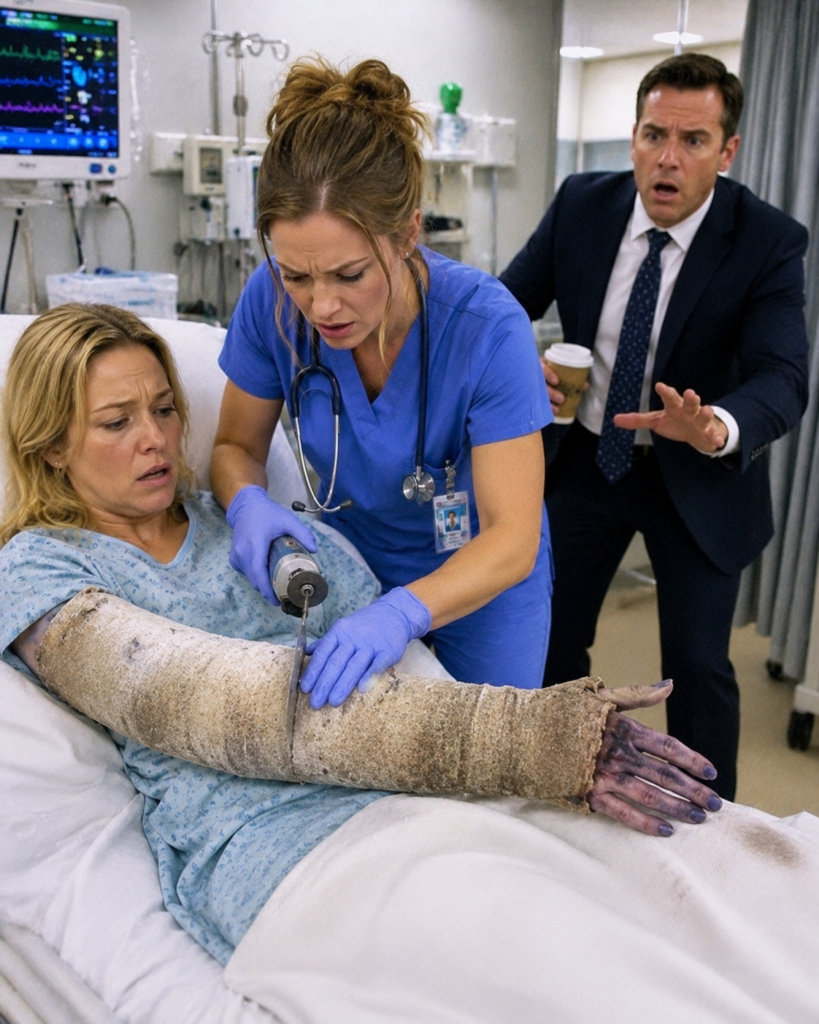
She looked at him, but there was something uncertain in her expression.
Then her gaze moved to me.
“Please…”
Her voice was barely audible.
I leaned closer.
“Emily, can you tell me what happened to your arm?”
Daniel answered before she could.
“She fell.”
I looked at him.
“I asked Emily.”
His jaw tightened.
Emily swallowed.
“I…”
She closed her eyes.
“It’s okay,” I said gently. “You don’t have to explain everything right now. Just tell me whether the cast was supposed to stay on.”
A long pause followed.
Then Emily whispered, “No.”
Daniel’s face changed.
It wasn’t anger.
It was fear.
Real fear.
Marcus noticed it too.
“Sarah,” he said quietly, “we need to move.”
I nodded.
“Start broad-spectrum antibiotics. Two large-bore IVs. Blood cultures before antibiotics if we can get them without delaying treatment. Labs, lactate, renal function, coagulation panel. Call orthopedics and surgery.”
Marcus moved immediately.
I reached for the cast saw.
Daniel blocked my path.
“You’re making a mistake.”
“Step back.”
“She needs her orthopedic surgeon.”
“Her orthopedic surgeon can examine her after we remove this.”
“You don’t know what’s under there.”
The words hung in the air.
I stared at him.
Neither did he, apparently.
At least, not in the way he wanted me to believe.
“Exactly,” I said. “Which is why we’re removing it.”
The saw started.
The mechanical vibration filled the room.
Emily flinched.
“Easy,” I told her. “We’re almost there.”
The first section opened.
A foul smell immediately filled the room.
Marcus turned his head.
I didn’t.
The skin beneath the cast was swollen and discolored. There were areas of irritation where the fiberglass had pressed into the flesh. Several fingers were badly swollen, and the skin had taken on a dusky color.
But the most important thing was not what I saw.
It was what I didn’t see.
There was no clean surgical dressing.
No evidence of the neat healing expected from a straightforward fracture.
Instead, beneath the cast was a poorly protected wound extending along the forearm.
I felt my stomach tighten.
“Get another set of eyes in here,” I said.
A nurse called for the surgical team.
Daniel took a step backward.
Emily stared at the ceiling.
“Emily,” I said softly, “did you have surgery?”
Her lips trembled.
“Yes.”
“When?”
She didn’t answer.
Daniel did.
“Three weeks ago.”
I looked at him.
“What hospital?”
He hesitated.
“St. Matthew’s.”
“Which surgeon?”
Another hesitation.
“Dr. Robert Vale.”
I knew the name.
I also knew St. Matthew’s orthopedic department.
Something didn’t fit.
“Why isn’t there a surgical dressing?”
Daniel’s expression hardened.
“The cast was changed.”
“When?”
“Last week.”
“By whom?”
“My wife had an appointment.”
“Where?”
He didn’t answer.
Emily whispered, “At home.”
The room went silent.
I looked at her.
“Who changed it?”
She stared at her husband.
Daniel looked away.
“Emily,” I said, “I need you to tell me the truth. Not because anyone is in trouble. Because I need to know what happened so we can treat you correctly.”
Her eyes filled with tears.
“Daniel changed it.”
I looked at him.
“You changed your wife’s cast?”
“He was helping me,” Emily said quickly. “He was trying to help.”
Daniel’s shoulders lowered slightly.
“Her surgeon gave us instructions.”
“Did he?”
“Yes.”
“Written instructions?”
“I don’t have them with me.”
I looked down at Emily’s arm.
There were already too many unanswered questions.
A month-old cast.
A surgical wound.
A home cast change.
A dangerously infected arm.
And a husband who had arrived with an explanation prepared before anyone had examined her.
“Let’s get imaging,” I said.
Daniel shook his head.
“Her surgeon already did imaging.”
“I’m not asking what happened last month. I’m asking what is happening now.”
The nurse returned with the first lab results.
“Sarah.”
I turned.
Her expression told me enough.
“What?”
“White count is very high. Lactate is elevated. Creatinine is up.”
I nodded.
“Start fluids.”
Emily’s blood pressure dropped again.
Daniel sat down.
For the first time since arriving, he looked like a husband rather than a man trying to control a situation.
He took Emily’s hand.
“Please don’t let her die.”
I watched him.
“I don’t intend to.”
His eyes met mine.
“She’s everything I have.”
Emily opened her eyes.
“No,” she whispered.
Daniel looked at her.
She seemed confused.
“No what?”
Emily turned her face toward him.
“You have… the house.”
His expression froze.
I pretended not to notice.
There were more urgent matters.
The surgical team arrived.
Dr. Patel, our orthopedic surgeon on call, examined the arm.
He looked at the cast.
Then at the wound.
Then at me.
“How long?”
“About a month, according to the husband.”
Dr. Patel frowned.
“And the surgery?”
“Three weeks ago.”
“Where?”
“St. Matthew’s.”
He looked at Emily.
“Who operated?”
“Dr. Vale.”
Dr. Patel’s expression became thoughtful.
“That’s strange.”
“What?”
“I don’t remember Vale operating on a case like this.”
Daniel immediately spoke.
“Records can take time to transfer.”
“Of course,” Dr. Patel said.
But he didn’t sound convinced.
He examined Emily’s fingers.
“We need the cast completely off.”
Daniel stood.
“No.”
Dr. Patel looked at him.
“Mr. Harris, your wife may have a serious infection beneath this cast. The longer we wait, the greater the risk.”
Daniel looked toward Emily.
“Emily?”
She closed her eyes.
“Take it off.”
His shoulders dropped.
“Okay.”
The remainder of the cast came away.
The room became very quiet.
Not because what we saw was shocking.
Because it was sad.
This was not an old, healing injury.
The wound looked as though it had never been given the opportunity to heal properly.
There were sutures.
Some had loosened.
The surrounding tissue was inflamed.
There was drainage.
And along the forearm was a faint line of discoloration extending farther than I expected.
Dr. Patel frowned.
“This needs surgery.”
Daniel swallowed.
“What kind?”
“Exploration and cleaning of the wound. Possibly more, depending on what we find.”
“Will she lose her arm?”
Dr. Patel answered carefully.
“We don’t know.”
Daniel closed his eyes.
Emily began to cry.
I moved closer.
“We’re going to do everything we can.”
She looked at me.
“Doctor…”
“Yes?”
“Can I tell you something?”
“Of course.”
She glanced at Daniel.
He was staring at the floor.
“I didn’t fall down the stairs.”
Nobody spoke.
Daniel slowly looked up.
Emily continued.
“I fell in the kitchen.”
I waited.
“It wasn’t a big fall. I slipped. I landed badly.”
“That can still cause a serious fracture,” I said.
She nodded.
“I know.”
“Then why did you tell everyone it was the stairs?”
Her eyes moved toward Daniel.
“Because…”
She stopped.
Daniel stood.
“Emily is confused.”
I turned toward him.
“She’s febrile and critically ill, but she is answering questions appropriately. Let her speak.”
Daniel looked at his wife.
Emily took a shaky breath.
“Because the insurance company asked questions.”
I frowned.
“What questions?”
“About how it happened.”
“And?”
“They said the claim might not cover everything if it was an accident.”
Daniel said quietly, “That isn’t what they said.”
Emily looked at him.
“You told me it was.”
“I was trying to protect you.”
“From what?”
He didn’t answer.
I realized something then.
The mystery might not be one terrible secret.
It might be several ordinary mistakes, each one becoming worse because nobody wanted to admit the first one.
A missed appointment.
A misunderstood instruction.
A cast that shouldn’t have been changed at home.
A wound that had begun to worsen.
And now a critically ill woman.
But there was still something that bothered me.
Dr. Patel examined the sutures again.
“Sarah.”
“What?”
He pointed.
“This isn’t the kind of closure I would expect for a routine fracture.”
I looked closer.
“What do you mean?”
“The incision is longer than it should be.”
Daniel’s face drained of color.
Emily whispered, “There was another procedure.”
I looked at her.
“What procedure?”
She shook her head.
“I don’t know.”
Daniel said, “She had complications.”
“Which complications?”
He rubbed his forehead.
“It’s complicated.”
“That is why we’re asking.”
He looked at the surgical team.
“Her surgeon said there was a small infection.”
“When?”
“About two weeks ago.”
“Then why wasn’t she admitted?”
“He said antibiotics would be enough.”
“Which antibiotics?”
Daniel didn’t answer.
I looked at Emily.
“Do you remember?”
“Something white.”
Marcus checked the medication list.
“There are no antibiotics listed.”
I turned to Daniel.
“Did she take them?”
“Yes.”
“Which one?”
“I don’t know.”
I stared at him.
He had answered almost every question until specifics were required.
That was when I noticed the phone.
It was sitting on the chair beside him.
He picked it up quickly when it buzzed.
“Who is that?” I asked.
“Work.”
“At five in the morning?”
He looked uncomfortable.
“I have clients overseas.”
He stepped into the hallway.
I didn’t follow.
Instead, I returned to Emily.
“Can you tell me what happened after your surgery?”
She looked exhausted.
“They told me to come back in a week.”
“Did you?”
“Yes.”
“Where?”
She hesitated.
“Dr. Vale’s office.”
“And?”
“He said the wound looked fine.”
“Did he?”
“I thought so.”
“What happened after that?”
Emily looked toward the door.
“Daniel said the cast was too tight.”
I nodded.
“He tried to loosen it.”
“He couldn’t.”
“So he changed it?”
Emily nodded.
“He said he’d watched them do it.”
“Was a medical professional present?”
“No.”
I felt a quiet frustration rising.
But Emily’s expression was apologetic.
“He was trying to help.”
“I believe you.”
She squeezed her eyes shut.
“I didn’t want to go back to the hospital because…”
“Because what?”
“I was embarrassed.”
“About the fall?”
She shook her head.
“About the money.”
That answer changed the room.
She opened her eyes.
“We were already behind on bills.”
Daniel returned.
I looked at him.
“Emily says money was part of why she didn’t come back.”
He looked down.
“She worries too much.”
“No,” Emily whispered. “I don’t.”
Daniel sat beside her.
“Emily, we’ll figure it out.”
She looked at him.
“You always say that.”
There was no anger in her voice.
Only exhaustion.
The surgical team prepared to take her upstairs.
Before they moved her, I asked Daniel to step outside.
He followed me reluctantly.
The hallway was quieter now.
I kept my voice low.
“Mr. Harris, I need you to understand something. Your wife is seriously ill. I don’t care about the insurance story, the cast, the bills, or who made what decision. Right now I care about saving her hand and treating the infection.”
“I understand.”
“Then give us everything.”
“I have.”
“No.”
He looked at me.
“You’ve given us pieces.”
He said nothing.
“What aren’t you telling me?”
His eyes moved toward the trauma room.
“Nothing.”
“Then why did you try to stop us from removing the cast?”
He looked down.
After a moment, he said, “Because she didn’t want anyone to see it.”
“See what?”
He rubbed his hands together.
“I don’t know.”
That was the first honest answer he’d given me.
I softened.
“Daniel, if you made a mistake, tell us. If Emily made a mistake, tell us. If the surgeon made a mistake, tell us. None of that changes what we need to do now.”
He looked at me.
“I was scared.”
“Of what?”
“That they would blame me.”
“For what?”
He swallowed.
“I changed the cast.”
“I know.”
“I thought I could fix it.”
“You should have brought her back when the pain increased.”
“I know.”
“And when she developed fever?”
“I thought it was the flu.”
“You knew about the wound.”
He nodded.
“I knew it wasn’t right.”
“Then why did you say it was the flu?”
His eyes filled.
“Because I didn’t know what else to say.”
That answer stayed with me.
Not because it excused anything.
It didn’t.
But because fear often makes ordinary people make terrible decisions.
Not dramatic ones.
Small ones.
The kind that seem manageable until they aren’t.
Emily was taken upstairs.
Daniel followed.
I returned to the emergency department.
An hour later, Dr. Patel came back.
“She made it through the procedure,” he said.
I exhaled.
“How bad?”
“Serious, but treatable. There was infected tissue around the surgical site. We cleaned it thoroughly. The hand is still perfused.”
“That’s good.”
“It is.”
“Cultures?”
“Pending.”
I nodded.
“Any hardware?”
“Yes.”
“Did it look infected?”
“Not clearly. We’ll know more.”
I thought about the longer incision.
“Did you find anything unusual?”
Dr. Patel hesitated.
“We found a small piece of medical tubing.”
I frowned.
“Tubing?”
“About two inches.”
“Drain?”
“Possibly.”
“Was that expected?”
“No.”
I stared at him.
“Could it have been left from the original surgery?”
“That’s what we need to determine.”
The next morning, Emily was awake.
Her fever had begun to come down.
Daniel sat beside her bed.
For the first time, he looked exhausted.
Not polished.
Not controlled.
Just tired.
I entered the room.
“Good morning.”
Emily smiled faintly.
“Am I still here?”
“You are.”
“That’s good.”
“It is.”
Daniel stood.
“Doctor.”
I checked her vitals.
“Your hand is doing better.”
She looked at it.
“Will I keep it?”
“We’re optimistic.”
She closed her eyes.
“Thank God.”
Then she looked at Daniel.
“I need to tell her.”
He didn’t respond.
“Tell me what?”
Emily looked at me.
“The doctor who operated on me wasn’t Dr. Vale.”
Daniel’s face changed.
“What?”
Emily nodded.
“I thought he was.”
“Then who was it?” I asked.
“I don’t know.”
“How can you not know?”
“I was sedated.”
Daniel sat down slowly.
“Emily…”
She continued.
“Daniel told me it was Dr. Vale.”
I turned toward him.
He looked at the floor.
“Why?”
He didn’t answer.
Emily did.
“Because Dr. Vale was supposed to be there.”
“Supposed to?”
She nodded.
“Daniel arranged everything.”
I looked at him.
“Where did the surgery actually happen?”
His silence was answer enough.
But eventually he whispered:
“An outpatient surgical center.”
“Which one?”
He looked at Emily.
Then at me.
“Northbridge.”
I knew the name.
It was a small private facility across town.
I also knew something else.
Northbridge had recently been acquired by a medical group that employed several orthopedic specialists.
“Why did you tell everyone St. Matthew’s?”
Daniel rubbed his face.
“Because the surgeon told me to.”
“Who?”
He hesitated.
“Dr. Michael Reed.”
I wrote the name down.
“Why would he tell you to use another doctor’s name?”
“I don’t know.”
“Daniel.”
“I swear.”
He looked at me with tears in his eyes.
“I thought he was helping us.”
Emily reached for his hand.
He took it.
Neither of them spoke.
The mystery had changed.
It wasn’t simply about a husband hiding a mistake.
There was another question now.
Who had operated on Emily?
And why had someone wanted the name of that surgeon hidden?
That afternoon, the hospital received the first culture results.
The infection was responding to antibiotics.
Emily was improving.
But the medical records department called me before lunch.
“Dr. Jenkins?”
“Yes?”
“We have a problem.”
“What kind?”
“The records from St. Matthew’s don’t exist.”
I frowned.
“What do you mean?”
“There is no admission for Emily Harris.”
I looked toward Emily’s room.
Daniel was sitting beside her.
I asked the clerk to check again.
She did.
Then she said something that made my stomach tighten.
“There is a record.”
“Of what?”
“An appointment.”
“With Dr. Robert Vale?”
“No.”
She paused.
“An appointment for Emily Harris with Dr. Michael Reed.”
I stared at the screen.
“What date?”
“The day after her surgery.”
I felt the pieces shifting again.
“Is there a note?”
“Yes.”
“What does it say?”
The clerk read slowly.
“Patient advised to return immediately if fever develops.”
I closed my eyes.
Emily had developed fever days later.
But someone had known enough to warn her.
Someone knew what had been done.
Someone knew there was risk.
And yet Emily had never been told the full truth.
I walked back toward her room.
Daniel looked up.
“You found something,” he said.
I stopped.
“How did you know?”
His expression changed.
“I could tell.”
I entered the room.
Emily looked at me.
“What happened?”
I pulled a chair closer.
“Your medical records are incomplete.”
She looked confused.
“Why?”
“I don’t know yet.”
Daniel stood.
“I can explain.”
I looked at him.
“Then explain.”
He stared at the floor.
“Dr. Reed wasn’t supposed to operate.”
“Who was?”
“Dr. Vale.”
“Then why didn’t he?”
“Because he wasn’t available.”
“What happened?”
Daniel hesitated.
“The surgery was moved.”
“To Northbridge?”
“Yes.”
“Why didn’t you tell Emily?”
“I thought I did.”
Emily shook her head.
“You didn’t.”
Daniel looked at her.
“I was trying to protect you.”
She gave him a tired smile.
“You keep saying that.”
He looked away.
Then his phone rang.
He checked the screen.
His face went pale.
“Who is it?” I asked.
He didn’t answer.
The phone stopped.
A message appeared.
Daniel read it.
Then he locked the screen.
Emily watched him.
“Who was that?”
“Nobody.”
She looked at me.
I looked at him.
And for the first time, Daniel seemed to realize that the truth was no longer something he could postpone.
He sat beside his wife.
“It’s Dr. Reed.”
Emily stiffened.
“What does he want?”
Daniel opened the message.
His voice was barely audible.
“He says we need to talk before anyone else looks at the surgical records.”
I stared at him.
“Why?”
Daniel looked at me.
“I don’t know.”
But his expression said he had a suspicion.
And I had one too.
Whatever happened in that operating room was not finished with Emily’s surgery.
Something had been left behind.
Not just in her arm.
In the story everyone had been told.
And now, finally, someone was beginning to ask why.
-END OF PART 2 –PRESS NEX PART IN BOTTOM OF PAGE TO READ NEXT PART
The message from Dr. Reed remained on Daniel’s phone for several minutes before anyone spoke.
Emily was the first.
“Don’t delete it.”
Daniel looked at her.
“I wasn’t going to.”
“Then show us.”
He hesitated.
I didn’t say anything.
This was no longer simply a medical question. Whatever had happened before Emily arrived at our emergency department involved decisions made outside the hospital, and I had no authority to conduct an investigation.
But Emily had every right to understand what had happened to her.
Daniel finally turned the phone around.
The message was short.
We need to discuss the documentation before this becomes more complicated. Please don’t make assumptions about what happened.
I read it twice.
There was nothing openly threatening.
Nothing dramatic.
But the wording bothered me.
“What documentation?” Emily asked.
Daniel shook his head.
“I don’t know.”
“You do.”
“I don’t.”
She looked at him for several seconds.
Then she said quietly, “Daniel, I’m tired of being protected from the truth.”
He looked wounded.
“I wasn’t trying to hurt you.”
“I know.”
“I thought I was helping.”
“I know that too.”
“Then why are you looking at me like that?”
“Because helping me would have meant telling me.”
He lowered his eyes.
I left them alone for a few minutes.
When I returned, Daniel was sitting quietly beside the window.
Emily was looking at the ceiling.
“Sarah,” she said.
“Yes?”
“Can I ask you something?”
“Of course.”
“Did I do something wrong?”
“No.”
She turned toward me.
“I kept thinking maybe I caused all of this.”
“You fell and injured your arm. That’s what caused the original injury. Everything after that involved decisions made by other people, including decisions you weren’t fully informed about.”
She was silent.
“That doesn’t mean anyone intended this,” I added. “But you deserve clear information about your own care.”
She nodded.
“That’s all I want.”
Later that morning, the hospital’s patient advocate, Linda Morales, came to see her.
Linda had worked with patients and families for nearly twenty years. She had a remarkable ability to make complicated situations feel manageable.
She sat beside Emily.
“You don’t have to decide anything today,” Linda said. “You can ask questions. You can request records. You can have someone help you understand them.”
Emily looked relieved.
“I thought asking questions would get people angry.”
Linda smiled.
“Questions are what records are for.”
Daniel listened quietly.
Linda looked at him.
“And Mr. Harris, you can ask questions too.”
He nodded.
For the first time, I saw something change in him.
He wasn’t trying to control the room anymore.
He was simply listening.
That afternoon, the orthopedic team explained the situation.
The infection was improving.
The swelling was decreasing.
The blood flow to Emily’s fingers had returned.
But recovery would take time.
Physical therapy would likely be necessary.
There was no guarantee she would regain full strength.
Emily listened carefully.
“What can I do?”
“Rest initially,” Dr. Patel said. “Then rehabilitation when the wound allows.”
“How long?”
“Months rather than weeks.”
She nodded.
“I can handle that.”
Daniel reached for her hand.
“You don’t have to do it alone.”
Emily looked at him.
“I know.”
The words sounded different this time.
Not forgiveness.
Not yet.
Just possibility.
That evening, I received a call from the medical records office.
“Dr. Jenkins?”
“Yes?”
“We found something.”
“What?”
“A transfer document.”
“From Northbridge?”
“Yes.”
“What’s unusual?”
“It was never completed.”
“What does that mean?”
“The document lists the surgeon as Dr. Michael Reed. But the signature field is blank.”
I frowned.
“Anything else?”
“There is an operative summary attached.”
“Can you send it to the surgical team?”
“We already did.”
“Who performed the procedure?”
The clerk hesitated.
“That’s the problem.”
I waited.
“The summary says Dr. Reed.”
“Then what’s wrong?”
“The billing record lists another physician.”
“Who?”
“Dr. Daniel Foster.”
I wrote down the name.
“Do we know who Daniel Foster is?”
“Yes.”
The answer came from behind me.
Dr. Patel.
He had been walking past the nurses’ station.
“Who?” I asked.
“Foster is a locum orthopedic surgeon,” he said. “He occasionally works at private facilities.”
“Does he work at Northbridge?”
“Sometimes.”
“Would he have been qualified to perform Emily’s procedure?”
“Yes.”
“So why would the paperwork name Reed?”
Dr. Patel looked thoughtful.
“That’s what we need to find out.”
The next morning, Emily asked me to come into her room.
She looked stronger.
Her fever was gone.
The color in her fingers had improved.
“How are you feeling?”
“Like I’ve been asleep for a year.”
I smiled.
“That can happen after a serious infection.”
She looked toward the window.
“Daniel left.”
“For the morning?”
“I think so.”
She paused.
“He said he needed to talk to someone.”
“About the records?”
She nodded.
Then she reached beneath her pillow.
“I found this.”
She handed me a small envelope.
I didn’t open it.
“What’s inside?”
“A receipt.”
“For what?”
“I don’t know.”
She looked embarrassed.
“I found it in Daniel’s coat.”
I didn’t want to become involved in a private dispute.
“Emily, you should give that to the patient advocate if you think it’s relevant.”
“I don’t know if it is.”
“Then let Linda decide.”
She nodded.
When Linda arrived, Emily handed her the envelope.
Linda opened it.
Her expression changed slightly.
“What is it?”
“A payment receipt.”
“For?”
“A medical consultation.”
“Whose?”
Linda looked at the paper.
“Dr. Daniel Foster.”
Emily closed her eyes.
“He paid him.”
“Apparently.”
“How much?”
Linda told her.
Emily was silent.
“That doesn’t necessarily mean anything improper,” Linda said carefully. “Private consultations can be legitimate.”
“I know.”
“Let’s not assume.”
Emily nodded.
Then she said something unexpected.
“I think Daniel was trying to save us money.”
Linda looked at her.
“What makes you think that?”
“Because that’s what he does.”
She gave a tired smile.
“He thinks every problem can be solved by finding the cheaper option.”
Linda waited.
“He grew up with nothing,” Emily continued. “His father lost his business when Daniel was young. They moved three times in two years. Daniel decided he would never be helpless again.”
“That sounds difficult.”
“He became obsessed with planning.”
“And you?”
“I used to think it was sweet.”
Emily looked at her hands.
“Then it became exhausting.”
There was no bitterness in her voice.
Only recognition.
“After I broke my arm, he took over everything. Insurance. appointments. bills. He said I needed to rest.”
“And you let him?”
“I was grateful.”
She smiled faintly.
“Until I realized I wasn’t making any decisions anymore.”
Linda nodded.
“That’s an important distinction.”
Emily looked toward the door.
“Do you think he knew the surgeon wasn’t Dr. Vale?”
“I don’t know.”
“I think he did.”
The door opened.
Daniel entered.
He looked at Emily.
“Are you okay?”
She nodded.
“We found a receipt.”
He stopped.
His eyes moved toward Linda.
“You went through my things?”
“No,” Emily said. “It fell out of your coat.”
Daniel sat down.
“What receipt?”
“Dr. Foster.”
He stared at the floor.
“Okay.”
“That’s all you have to say?”
He sighed.
“I met him.”
“When?”
“Before the surgery.”
“Why?”
“Because Dr. Vale wasn’t available.”
“Why didn’t you tell me?”
“Because you were scared.”
“I was scared because I didn’t know what was happening.”
“I know.”
He looked at her.
“I made a mistake.”
Emily’s eyes filled.
“What kind?”
Daniel took a long breath.
“I was given two options. Wait three weeks for Dr. Vale or have the procedure sooner with Dr. Foster.”
“And you chose Foster.”
“Yes.”
“Why?”
“Because you were in pain.”
Emily stared at him.
“You told me Dr. Vale was doing it.”
“I know.”
“Why?”
“Because I thought you’d refuse if you knew.”
The room went quiet.
Daniel immediately shook his head.
“That sounds terrible.”
“It does,” Emily said.
“I was afraid you’d think I was putting you at risk.”
“Were you?”
“I didn’t think so.”
“Did you ask?”
“Yes.”
“Who?”
“Dr. Reed.”
“And what did he say?”
“He said Foster was qualified.”
Emily looked at Linda.
Then at me.
It was becoming clearer.
Daniel had made decisions without telling Emily.
But there was still a missing piece.
“Why did you change the cast yourself?” Emily asked.
Daniel looked ashamed.
“Because it was hurting you.”
“You could have called the surgeon.”
“I did.”
“When?”
“The night before.”
“What did they say?”
“They told me to bring you in.”
“Why didn’t we go?”
Daniel looked at her.
“You refused.”
Emily frowned.
“I don’t remember that.”
“You were upset.”
“Because of the bills?”
“Yes.”
She closed her eyes.
“I was scared.”
“I know.”
“And you thought you could fix it.”
“Yes.”
He looked at her.
“I was wrong.”
It was the simplest sentence he had spoken all week.
Emily turned her face away.
For a while, nobody spoke.
Then she said, “I need you to stop deciding what I can handle.”
Daniel nodded.
“I will.”
“I mean it.”
“So do I.”
Linda stood.
“I’ll give you both some space.”
After she left, Daniel remained seated.
Emily looked at him.
“Are you angry with me?”
“No.”
“Disappointed?”
“Yes.”
He nodded.
“That’s fair.”
She looked surprised.
“I expected you to defend yourself.”
“I’ve done enough of that.”
He rubbed his eyes.
“I thought if I could make everything look normal, it would become normal.”
Emily’s expression softened.
“It doesn’t work that way.”
“I know.”
He reached for her hand.
She let him hold it.
Not because everything was forgiven.
But because trust sometimes begins with something much smaller.
A person admitting they were wrong.
That afternoon, the hospital received confirmation from Northbridge.
Dr. Foster had performed Emily’s procedure.
Dr. Reed had been the supervising physician.
The medical record had been entered incorrectly.
The missing tubing turned out to be part of a temporary surgical drain.
It had been documented in the original operative notes but not in the discharge paperwork.
That explained one mystery.
But not all of them.
Why had the cast been replaced at home?
Why had the infection not been identified sooner?
And why had Daniel believed he needed to hide the surgeon’s identity?
The answers, as it turned out, were less dramatic than anyone had feared.
And perhaps more painful because they were so ordinary.
Northbridge had given Daniel verbal instructions.
Daniel misunderstood them.
The clinic had assumed the hospital would provide follow-up.
The hospital assumed Northbridge had.
Insurance had delayed approval for one appointment.
A medication had been prescribed electronically, but the pharmacy had sent it to a location Daniel rarely used.
No single mistake had caused Emily’s crisis.
A chain of small failures had.
And somewhere in that chain, Daniel had stopped asking questions because he was afraid of what the answers might cost.
Two weeks later, Emily was discharged.
Her recovery was slow.
She learned to do simple things again.
Holding a cup.
Buttoning a shirt.
Turning a key.
She hated physical therapy at first.
“I thought hospitals were supposed to make people better,” she told me during one follow-up visit.
“They do.”
“Then why does getting better hurt?”
“Because your body has work to do.”
She smiled.
“You always have an answer.”
“Occupational hazard.”
Her progress was steady.
Daniel came to most appointments.
At first, he hovered.
Then, after Emily corrected him several times, he stopped.
He learned to ask.
“Do you want help?”
Instead of simply helping.
It seemed like a small change.
But small changes were becoming the theme of their lives.
Three months after the emergency visit, Emily returned for one final evaluation.
Her hand was not completely back to normal.
It probably never would be.
But she could move her fingers.
She could drive.
She had returned to work part-time.
And she had begun making her own medical decisions again.
Daniel was waiting in the hallway.
“How is she?” he asked.
“She’s doing very well.”
He smiled.
“She’ll tell you that herself.”
Emily came out of the examination room.
“How did I do?”
“Excellent.”
She looked at Daniel.
“Dinner?”
“Your choice.”
She smiled.
“My choice?”
“Absolutely.”
She raised an eyebrow.
“You’re learning.”
“I am.”
They walked away together.
I watched them disappear around the corner.
Their story hadn’t ended perfectly.
Real life rarely does.
There were still bills.
Appointments.
Physical therapy.
Hard conversations.
And trust that needed to be rebuilt one decision at a time.
But sometimes resilience doesn’t look like a dramatic transformation.
Sometimes it looks like a husband finally asking his wife what she wants.
Sometimes it looks like a patient opening an envelope instead of being afraid of what’s inside.
Sometimes it looks like admitting, I was wrong.
And sometimes healing begins long before the body is completely recovered.
A week later, I received a handwritten note from Emily.
It wasn’t long.
She thanked the nurses.
She thanked Dr. Patel.
She thanked me.
At the bottom she had written:
When I came into the hospital, I thought the worst thing beneath that cast was the infection.
I was wrong.
The infection was only one part of the story.
The other thing underneath it was everything we had been afraid to say.
And strangely, once we finally said it, we could begin healing.
I kept the note.
Not because I believed every difficult story had a neat ending.
But because Emily reminded me of something medicine sometimes forgets.
We treat wounds.
We treat infections.
We repair bones.
But people also need the truth.
They need the freedom to ask questions.
And sometimes, more than anything else, they need someone to tell them:
“You don’t have to carry this alone.”
-END OF PART 3-LET SAY YES AND LIKE, SHARE THIS POST IN FACEBOOK SO THAT WE HAVE THE MOTIVATION TO SHARE MORE STORIES