“Your sister.”
My fingers tightened around the armrest.
“I don’t have a sister.”
It came out too quickly.
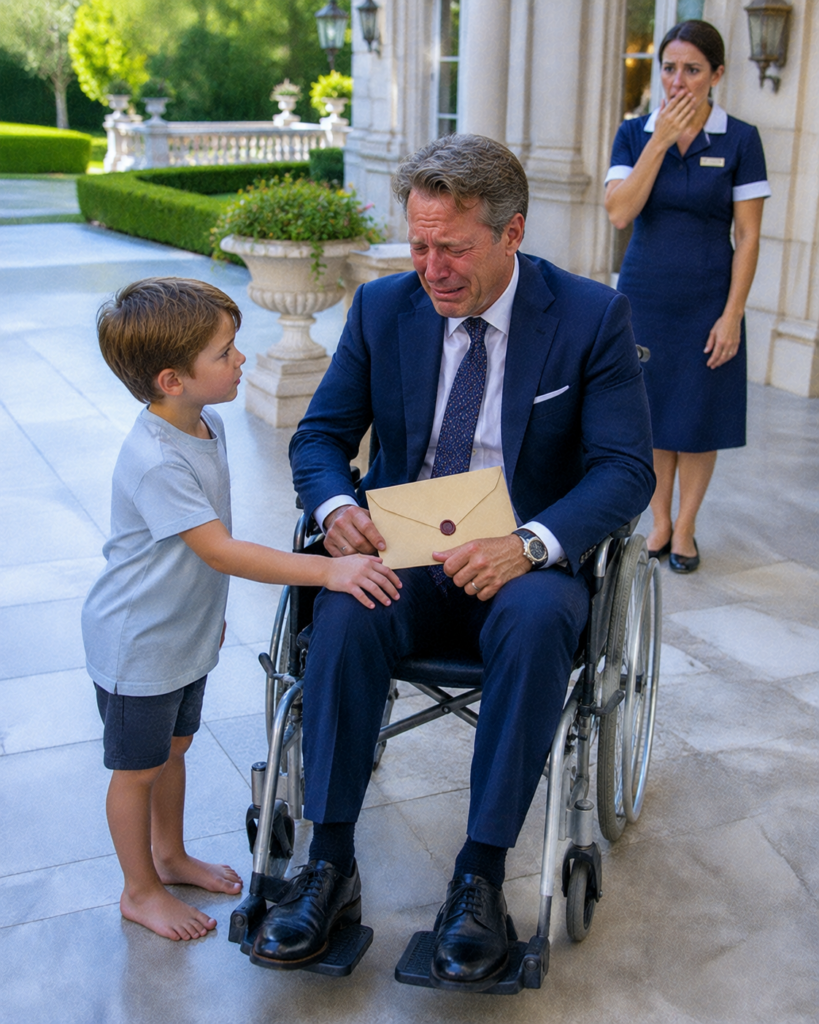
Rebecca looked at me.
Sammy frowned.
“Yes, you do.”
Something cold moved through my chest.
There were perhaps twenty people in Chicago who knew I had a younger sister.
Maybe fewer.
Claire Caldwell had not been mentioned in my house for eight years.
There were no photographs of her on display. No Christmas cards. No framed family portraits in the hall where guests might notice that another Caldwell had once existed beside me.
Even people who had worked for me for years assumed I was an only child.
I had encouraged that assumption.
“Sammy,” Rebecca said quietly, “come here, please.”
He hesitated.
I lifted one hand.
“No.”
Rebecca stopped.
I looked at the boy.
“How do you know about Claire?”
His eyes brightened with recognition.
“That’s her name.”
Rebecca closed her eyes briefly.
I felt the first small stirrings of anger, the reflex that had served me so well for decades. Anger was useful. It was cleaner than confusion. It gave me something to do with fear.
But Sammy was six.
And he had placed his hand on my knee five minutes earlier because he had seen me crying.
So I swallowed the anger before it could become a weapon.
“Where did you hear that name?”
Sammy pointed toward the house.
“In the blue room.”
The blue room was what Rebecca called the small sitting room beside the library. It had been my mother’s favorite place. After she died, I had changed almost nothing except the curtains.
“What were you doing in there?”
“I wasn’t touching anything.”
“I didn’t say you were.”
“Mom was cleaning.”
Rebecca finally put the broom against the stone wall.
“Mr. Caldwell, I can explain.”
“Then explain.”
She looked at Sammy first.
“Go inside and wash your hands. Mrs. Porter made lemonade.”
Sammy studied both of us with the solemn attention children sometimes give adults when they sense that a conversation has become important.
“But we didn’t pray yet.”
That stopped me.
I had almost forgotten.
Rebecca’s expression softened.
“We can do that afterward.”
Sammy shook his head.
“He was sad now.”
I looked away.
There was something unbearable about being defended by a child against postponement.
“All right,” I said.
Rebecca looked surprised.
Sammy closed his eyes immediately and bowed his head.
I did not.
Not at first.
He kept one hand on my knee and the other folded into his lap.
“God,” he began, “please help Mr. Ethan not be so sad. And if his legs get better, that would be good too. But if they take a long time, please make him not lonely while he waits.”
My throat tightened.
Sammy continued in the uncomplicated voice of someone asking for exactly what he believed mattered.
“And help him call his sister, because maybe she is lonely too. Amen.”
He opened his eyes.
Rebecca whispered, “Amen.”
I said nothing.
Sammy smiled at me.
“There.”
As though the problem had been submitted to the proper department.
Then he ran toward the house.
I watched him disappear through the open terrace doors.
For a while, Rebecca and I remained in silence.
Finally, I said, “The blue room.”
She nodded.
“There’s a photograph.”
“No, there isn’t.”
“There is now.”
I turned toward her.
Rebecca was in her early thirties, quiet but not timid. She had been working in my house for just under a year. Unlike some employees, she never became flustered by wealth. She treated expensive furniture carefully because it belonged to someone else, not because she worshipped it.
That steadiness was one reason I trusted her.
At least, I had thought I did.
“What does that mean?”
“A few weeks ago, I was dusting the cabinet beside your mother’s writing desk. One of the lower drawers was stuck. When I opened it, an envelope fell behind the cabinet. I moved it out enough to reach underneath.”
“And?”
“There was an old photograph behind it.”
My heartbeat changed.
“What photograph?”
“You and a young woman.”
I already knew.
I could see it without seeing it.
Claire was twenty-two in the photograph, standing beside me on the dock at our parents’ lake house in Wisconsin. I was thirty. She had stolen my sunglasses and was wearing them crookedly while laughing at something outside the frame.
It had been taken three summers before our father died.
Before everything became complicated.
Before I turned grief into work and work into an excuse.
Rebecca continued.
“There was writing on the back.”
I looked at her sharply.
“What did it say?”
“Ethan and Claire. Summer at Lake Geneva.”
My mother’s handwriting.
I could hear it in the shape of the words.
“Why was Sammy looking at it?”
“He came in while I was cleaning. He asked who the people were.”
“And you told him?”
“I read the names on the back. That’s all.”
“You didn’t ask anyone?”
“No.”
“You didn’t search for her?”
Rebecca’s face changed.
“No.”
The answer came with enough quiet offense that I believed her.
I looked across the lawn again.
“Where is the photograph?”
“On your mother’s desk.”
“You left it out?”
“I thought someone had probably placed it behind the cabinet by accident.”
I almost laughed.
Nothing about Claire had been accidental.
But Rebecca could not have known that.
“I put it there,” I said.
She waited.
“Years ago.”
“Why?”
I had no answer I could explain quickly.
Perhaps because I had been unable to throw it away.
Perhaps because looking at Claire had once reminded me of the last conversation we had, and that memory had made me angrier than grief had any right to make a person.
Perhaps because hiding something is not the same as letting it go.
Rebecca sat on the stone bench a few feet away.
“I’m sorry.”
“For what?”
“For leaving it out.”
“That isn’t your fault.”
The words surprised both of us.
I had spent months finding fault everywhere.
With doctors.
With therapists.
With board members.
With myself.
Somehow, saying those four words felt unfamiliar.
Rebecca looked toward the terrace doors.
“Sammy remembers everything. Names, especially.”
“He asked whether I could call her.”
“Yes.”
“Why?”
She hesitated.
“I think because he saw two people smiling in the picture.”
“That’s all?”
“He asked me where she was. I said I didn’t know.”
I let out a slow breath.
“And from that he decided she was lonely?”
“Sammy decides many things.”
Despite myself, I nearly smiled.
Rebecca saw it.
She was tactful enough not to mention it.
Instead she said, “Would you like me to put the photograph away?”
“No.”
The answer came before I had considered it.
“Leave it.”
Rebecca stood.
She was halfway to the doors when I called her name.
“Rebecca.”
She turned.
“Why didn’t you ask me about Claire?”
There was a brief pause.
“Because everyone in this house knows there are things you don’t want mentioned.”
The sentence was not cruel.
That was what made it land so heavily.
She went inside.
I remained in the garden for another twenty minutes.
Then I wheeled myself into the house.
The blue room smelled faintly of furniture polish and lavender.
My mother had chosen the wallpaper herself, pale blue with a pattern so subtle it vanished from a distance. Sunlight lay across the old desk.
The photograph waited there.
I stopped in the doorway.
For eight years I had successfully avoided looking at Claire’s face.
Now there she was.
Laughing.
Alive with sunlight.
Her dark hair was tied in a careless knot. One hand rested on my shoulder. I looked younger too, although the difference had nothing to do with wrinkles.
I looked easier.
Less defended.
I picked up the photograph.
On the back, my mother had written:
Ethan and Claire. Lake Geneva, 2009. Neither of them knows how lucky they are to have each other.
I sat motionless.
I had forgotten the second sentence.
That evening, I asked my assistant, Daniel Ross, to cancel my dinner meeting.
Daniel had worked with me for eleven years and had long ago learned not to react visibly to unusual requests.
But this one made him look up from his tablet.
“You want me to cancel?”
“Yes.”
“With Hargrove?”
“Yes.”
“He flew in from New York.”
“He owns a return ticket.”
Daniel watched me.
“What happened?”
“I don’t owe you a medical report every time I change my schedule.”
“No.”
He waited.
“But you haven’t canceled a business dinner for a nonmedical reason since I’ve known you.”
“I’m trying something new.”
“That sounds dangerous.”
I looked at him.
He looked back.
Daniel was one of the few employees who had stopped fearing me years ago.
“You can go home,” I said.
“It’s four-thirty.”
“You have a family.”
“I’ve always had a family.”
The quiet meaning was not lost on me.
I used to keep him working until nine.
Ten.
Later, when negotiations demanded it.
I had told myself that because I paid exceptionally well, I had purchased the right to other people’s evenings.
Now I found myself thinking of Sammy’s prayer.
Please make him not lonely while he waits.
“Go home, Daniel.”
He closed the tablet.
“You sure?”
“Yes.”
He reached the doorway.
“Daniel.”
He turned.
“Do you know where Claire lives?”
His face became perfectly still.
“I could find out.”
“That wasn’t the question.”
“I know.”
He had always known.
Of course he had.
My closest employees had spent eight years pretending not to know the one subject that could end a conversation.
“Where?”
“Seattle.”
That surprised me.
“She left Boston?”
“Three years ago.”
“What does she do?”
Daniel hesitated.
I almost snapped at him.
Then I realized what the hesitation meant.
He was wondering how much I wanted to know.
“All of it,” I said.
“She works for a nonprofit arts foundation. Community programs, grants, school partnerships. She’s their operations director.”
“Married?”
“Yes.”
I looked down.
“To whom?”
“His name is Marcus Bennett. Architect.”
“Children?”
“One.”
Something inside me shifted.
“A boy or a girl?”
“A girl.”
“How old?”
“Five.”
I stared at him.
Daniel’s expression held no satisfaction.
No accusation.
He simply gave me the truth I had requested.
“What’s her name?”
“Lily.”
I had a niece named Lily.
Five years old.
And until that moment, I had not known she existed.
“Why didn’t anyone tell me?”
Daniel leaned one shoulder against the doorframe.
“Would you have wanted us to?”
I opened my mouth.
Closed it again.
He nodded once.
“That’s what I thought.”
After he left, I remained in my study until sunset.
The photograph sat on the desk beside me.
At six-thirty, Rebecca knocked.
“Dinner is ready whenever you want it.”
“I’m not hungry.”
She glanced at the untouched lunch tray.
“You weren’t hungry at noon either.”
“I employ a housekeeper, not a supervisor.”
“That’s true.”
She turned to go.
“Rebecca.”
“Yes?”
“Do you have siblings?”
“One brother.”
“Do you speak?”
“Every Sunday.”
I almost regretted asking.
“Were you always close?”
“No.”
That surprised me.
Rebecca stepped farther into the room.
“When our father was sick, we argued about almost everything. Money. Appointments. Who was doing more. Who wasn’t doing enough. Sometimes the real argument wasn’t even about the thing we thought we were arguing about.”
“What was it about?”
“Fear, probably.”
She gave a small shrug.
“We both thought we were losing something and blamed each other because blaming the illness wouldn’t change it.”
I looked at Claire’s photograph.
“How did you fix it?”
“We didn’t, exactly.”
I glanced up.
“One Sunday he called me and asked whether I wanted coffee. Neither of us apologized properly. We just started again.”
“That sounds convenient.”
“It was.”
She smiled faintly.
“Sometimes convenient is useful.”
Then she left.
I had spent years expecting reconciliation, if it ever came, to require a courtroom.
Evidence.
Arguments.
A complete accounting of old wounds.
The idea that two people could simply begin again felt almost insulting in its simplicity.
That night, I dreamed about the lake house.
Not about Claire.
About my father.
He was standing on the dock tying a boat rope while telling me something I could not hear.
When I woke, my hand was resting on the photograph.
The next morning, I did something I had not done since the accident.
I attended physical therapy without arguing.
My therapist, Dr. Maya Patel, noticed immediately.
She was forty-one, patient, precise, and unimpressed by my ability to purchase equipment more sophisticated than some hospitals owned.
“Who are you,” she asked, “and what have you done with Ethan Caldwell?”
“I’m conserving energy.”
“For what?”
“Complaining later.”
“Good. I was worried.”
She adjusted the resistance band.
“Again.”
I lifted.
The movement was small.
Painfully small.
Months earlier, I would have hated it for being insignificant.
That morning, I completed it twice.
Then a third time.
Maya wrote something down.
“What?”
“Progress.”
“That?”
“Yes.”
“It barely moved.”
“It moved.”
I looked at my leg.
She crouched beside the chair.
“You keep waiting for one dramatic moment where everything changes.”
“Would be efficient.”
“Bodies are rarely interested in efficiency.”
I gave her a tired look.
She continued.
“You had a serious spinal injury. Recovery is uncertain. We’ve talked about that. Some functions have improved. Some haven’t. What matters now is what your body can do today, not whether today resembles the future you want.”
I hated that answer because I knew she was right.
After the session, I returned to my study and told Daniel to bring me Claire’s number.
He placed it on my desk within three minutes.
Of course he did.
The number sat on a small white card.
I stared at it until lunch.
Then until two.
At three, I picked up my phone.
Put it down.
At four fifteen, Sammy appeared at the study door.
He had finished kindergarten for the day and was carrying a construction-paper rocket.
“Mom says I have to stay in the kitchen.”
“Then why aren’t you in the kitchen?”
“I came to show you.”
He held up the rocket.
It had one crooked window, two orange flames, and my name written across the side in uneven letters.
ETHAN.
“What is that?”
“A rocket.”
“I can see that.”
“It’s yours.”
“Why do I need a rocket?”
“For going places.”
I looked at him.
“You know I own an airplane.”
“This one is faster.”
“Obviously.”
He placed it on my desk beside Claire’s number.
His eyes immediately found the card.
“Is that your sister?”
“No. It’s her phone number.”
“Did you call?”
“Not yet.”
“Why?”
Adults had spent years accepting complicated explanations from me because complicated explanations sounded intelligent.
Sammy never did.
“Because we haven’t spoken in a long time.”
“How long?”
“Eight years.”
His mouth fell open.
“That’s more than me.”
“Yes.”
“Did your phones break?”
“No.”
He considered this.
“Were you mad?”
“Yes.”
“Is she still mad?”
“I don’t know.”
He pointed at the phone.
“You could ask.”
“I’m beginning to understand why your mother sends you to the kitchen.”
He grinned.
Then his expression turned serious.
“What if she misses you?”
That question stayed after Rebecca arrived and escorted him away.
At six o’clock, I finally called.
It rang once.
Twice.
Three times.
A woman answered.
“Hello?”
Eight years disappeared.
Claire’s voice had changed and had not changed at all.
My throat closed.
“Claire.”
Silence.
Long enough that I wondered whether the call had dropped.
Then she said my name.
“Ethan?”
I gripped the phone.
“Yes.”
Another silence.
“Are you all right?”
There was no anger in the question.
Only alarm.
She assumed that after eight years, I would call only because something had happened.
The realization hurt more than I expected.
“I’m alive.”
“That wasn’t what I asked.”
Despite everything, that sounded so much like her that I shut my eyes.
“I’m not entirely all right.”
“I heard about the accident.”
My eyes opened.
“You knew?”
“It was in the news.”
“Of course.”
“I almost called.”
Almost.
The word carried years inside it.
“Why didn’t you?”
She took a breath.
“Because the last time we spoke, you told me never to contact you again.”
There it was.
Not dramatic.
Not distorted.
Simply true.
I had said it.
At our mother’s funeral.
Claire had accused me of forcing the sale of the lake house too quickly.
I had accused her of appearing only when decisions had already been made.
She had told me that I treated grief like another business problem.
I told her she treated responsibility like something other people could handle for her.
Then we had reached backward through childhood and pulled forward every old grievance we could find.
By the end, neither of us had been arguing about the house.
We were arguing about who had loved our parents correctly.
As though love were an invoice.
“I remember,” I said.
“Why are you calling?”
I looked toward the photograph.
“I found something.”
“What?”
“A picture of us.”
She did not answer.
“Lake Geneva,” I added.
“I know the one.”
“How?”
“Mom had copies.”
I almost smiled.
Of course she did.
Claire asked, “Is that why you called?”
“No.”
The honest answer came slowly.
“I called because a six-year-old told me to.”
For the first time, Claire laughed.
It was brief.
Careful.
But unmistakable.
“Somehow that sounds like exactly what it would take.”
I smiled before I could stop myself.
We talked for eleven minutes.
Not eight years.
Not childhood.
Not the funeral.
Eleven minutes.
She told me Marcus was making dinner.
I told her I was still in the wheelchair.
She asked about rehabilitation without asking for guarantees.
I asked about Lily.
Claire became quiet.
“How did you know about her?”
“Daniel.”
“Of course.”
“Why didn’t you tell me?”
“Ethan.”
One word.
Enough.
“I know,” I said.
She softened.
“She’s five. She loves sea animals, hates tomatoes, and believes every building should have a rooftop garden because Marcus told her cities need more green spaces.”
I tried to imagine her.
Could not.
That hurt too.
Before we hung up, Claire said, “I’m glad you called.”
I almost answered with something safe.
Instead I said, “Me too.”
For the next two weeks, small things began changing.
Not miracles.
Small things.
I ate breakfast at the dining table instead of in my study.
I learned that Mrs. Porter, who had cooked for me for nine years, had a daughter studying nursing.
I stopped scheduling meetings after seven unless absolutely necessary.
At physical therapy, Maya began transferring more responsibility to me instead of allowing assistants to anticipate every movement.
Some days I hated her for it.
Other days I understood.
My strength improved.
My legs still did not behave like the legs I remembered.
There was sensation in places where sensation had once disappeared. There were tiny movements the doctors considered encouraging but not predictive.
I wanted certainty.
They gave me work.
Gradually, I began to understand that work was not the lesser gift.
Claire and I spoke again.
Then again.
The third call lasted forty minutes.
We discussed our father’s habit of hiding cash in books because he distrusted banks despite owning stock in several.
She reminded me of the summer I tried to teach her to water-ski and nearly lost patience after ten minutes.
“You shouted instructions from the boat like you were commanding a military operation.”
“I was fourteen.”
“You were already unbearable.”
“You eventually learned.”
“From Dad.”
“Revisionist history.”
She laughed.
I sat alone afterward, realizing that for years I had remembered Claire only through the lens of our final argument.
One terrible afternoon had swallowed three decades.
It occurred to me that resentment was an efficient archivist.
It preserved exactly what justified keeping the door closed.
One Friday morning, Daniel entered my study carrying a folder.
“I found something you should see.”
“That sentence is rarely promising.”
“This one might be.”
He put the folder down.
Inside were old estate records from my mother.
“Why are you reviewing these?”
“You asked me last year to consolidate the family holdings.”
“I don’t remember asking you to reopen my mother’s estate.”
“I didn’t. Accounting found a discrepancy while preparing archival documents for the foundation audit.”
I looked up.
“What discrepancy?”
“A trust account.”
I flipped through the papers.
The Caldwell Family Education Trust had been created by my mother seventeen years earlier.
I remembered it vaguely.
It had funded scholarships through one of our family charities.
“This was closed after she died.”
“That’s what everyone thought.”
I looked at the final page.
A small secondary account remained open.
The current balance was substantial.
Not by my standards.
But enough to transform a small nonprofit.
“What is this?”
Daniel pointed to a handwritten notation scanned from one of my mother’s files.
Contingent family designation. See personal letter.
“Where’s the letter?”
“Missing.”
My chest tightened.
“Who was the contingent beneficiary?”
“That’s the problem. It isn’t listed in the electronic copy.”
“Then find the paper records.”
“We are.”
I turned the document over as though the answer might be hiding behind it.
“Why bring this to me now?”
“Because there’s one other thing.”
Daniel gave me a photocopy of a bank instruction form.
My mother’s signature appeared at the bottom.
Beside it was another signature.
Claire Caldwell.
I looked up slowly.
“Claire knew about this?”
“Possibly.”
“Did she take money from it?”
“No.”
“How do you know?”
“There have been no distributions since your mother’s death.”
“Then why is Claire’s signature there?”
“She was designated as an authorized co-trustee six months before your mother died.”
I stared at the page.
That made no sense.
After our mother’s death, Claire had insisted she wanted nothing from the estate.
I had believed she was being dramatic.
Then she moved away without contesting anything.
“Did she know the account still existed?”
“I don’t know.”
I called her that evening.
She went quiet when I mentioned the trust.
“Yes,” she said finally. “I remember it.”
“Why were you co-trustee?”
“Mom asked me.”
“For what purpose?”
“I don’t know.”
“You signed a legal document without asking?”
“She was sick, Ethan.”
“I was there.”
“You were traveling constantly.”
The old defensiveness rose between us.
We both felt it.
Claire stopped.
So did I.
A year earlier, I would have continued.
I would have proven my point until nothing remained but victory.
Instead I said, “You’re right. I was traveling.”
She exhaled.
“I’m not saying you didn’t care.”
“I know.”
Another silence.
Then she said, “Mom told me there was something she wanted to set aside separately. I assumed it was for scholarships.”
“There’s a missing letter.”
“I never saw it.”
“Could it be at the lake house?”
“The lake house was sold.”
“I remember.”
Her voice softened.
“I know you do.”
That weekend, Claire did something I had not expected.
She came to Chicago.
Alone.
Marcus stayed with Lily because, as Claire explained over the phone, introducing a five-year-old to an uncle she had never met should probably wait until the adults could be trusted to behave normally.
I agreed.
When Claire arrived at the mansion Saturday afternoon, Rebecca opened the door.
I waited in the blue room.
That had been my choice.
Perhaps because the photograph was there.
Perhaps because I needed my mother, in whatever form memory could provide, to witness what happened.
I heard footsteps in the hall.
Then Claire appeared.
For a moment, neither of us spoke.
She was forty now.
Her hair was shorter.
There were faint lines around her eyes.
She wore jeans, flat shoes, and the blue scarf she always used to complain our mother had chosen for her because “every Caldwell woman apparently needs one respectable scarf.”
She looked at the wheelchair.
Only once.
Then she looked at me.
“Hi.”
My chest tightened.
“Hi.”
She walked into the room.
I did not know whether to offer my hand.
She solved it by bending and hugging me.
The embrace lasted three seconds.
Maybe four.
It was not cinematic.
Neither of us cried.
But when she pulled away, I could not remember why I had thought eight years of silence had ever been easier than this.
She noticed the photograph.
“You found it.”
“Rebecca did.”
Claire picked it up.
“Oh, wow.”
“What?”
“Your hair.”
“My hair was fine.”
“You had enough product in it to waterproof the dock.”
I laughed.
Actually laughed.
From the doorway came a small gasp.
Sammy stood there holding a toy truck.
Rebecca appeared behind him.
“I told you to stay in the kitchen.”
Sammy ignored her.
He looked at Claire.
“Are you the sister?”
Claire glanced at me.
“The famous adviser,” I said.
Sammy walked in.
“I told him to call you.”
“So I heard.”
“Were you lonely?”
Rebecca looked horrified.
“Sammy.”
Claire surprised all of us by crouching in front of him.
“Sometimes.”
Sammy nodded as though this confirmed something important.
“Mr. Ethan was too.”
I looked at Rebecca.
“He gives away confidential information very freely.”
Claire stood, smiling.
“I like him.”
Naturally.
For most of Saturday, Claire and I went through our mother’s archived records.
Daniel joined us for an hour.
Then Rebecca brought sandwiches.
At some point, searching old boxes became remembering.
A receipt from a hotel in Paris reminded Claire of the trip where our father had refused to speak French because he believed confidence was a universal language.
A handwritten recipe made us argue about whether our mother actually knew how to cook.
By evening, the mystery of the trust remained unresolved.
But something else had become clearer.
Claire had not returned for money.
She had not returned to reopen the estate.
She had come because I asked.
That realization followed me to bed.
The next morning, Claire joined me for physical therapy.
I had not invited her.
She simply appeared with coffee and sat in the corner.
Maya looked from her to me.
“Sister?”
Claire nodded.
“Unfortunately.”
Maya smiled.
“Good. He needs witnesses.”
“To what?”
“His terrible attitude.”
Claire looked delighted.
“I have decades of supporting documentation.”
“Traitor,” I muttered.
The session was difficult.
Maya had been working on assisted standing using parallel bars, braces, and support.
My upper body did most of the work.
My legs contributed inconsistently.
For months, I had refused to let anyone outside the medical team watch.
Failure felt private.
Claire’s presence changed that.
At first, I hated being seen.
Then I remembered she had seen me fail before.
At school.
At baseball.
At being a brother.
She had survived all of it.
I gripped the bars.
Maya counted.
I pushed.
My body lifted.
Not fully.
Not independently.
But enough.
Claire did not cheer.
Thank God.
She simply said, “Again.”
I looked at her.
She shrugged.
“You always made me try twice.”
So I did.
By Monday, we still had not found my mother’s missing letter.
Claire was scheduled to fly home that afternoon.
Before leaving, she asked to speak privately.
We went to the blue room.
She stood beside the window.
“I need to tell you something.”
My stomach tightened.
“All right.”
“I lied when you asked whether I knew why Mom created that secondary trust.”
I said nothing.
Claire faced me.
“I didn’t know exactly. That part was true. But she did tell me something before she died.”
“What?”
“She said there was money she wanted protected from the estate.”
“For you?”
“No.”
“Then for whom?”
“She wouldn’t tell me.”
“That sounds like Mom.”
Claire nodded.
“But she said something else.”
I waited.
“She said, ‘Someday Ethan will understand why I did it.’”
My pulse quickened.
“What does that mean?”
“I don’t know.”
“You never asked?”
“I did.”
“And?”
“She said it wasn’t about inheritance.”
I looked toward the desk.
The photograph sat where we had left it.
“Then what was it about?”
Claire opened her bag.
“There’s more.”
She removed a small brass key.
I recognized it instantly.
It belonged to my mother’s private writing box.
The box had been empty when we inventoried the estate.
“Where did you get that?”
“Mom gave it to me.”
“Why?”
“She told me to keep it until you were ready to hear something without trying to control what it meant.”
I almost laughed.
“That sounds suspiciously specific.”
“It was.”
“Where’s the box?”
“I thought you had it.”
“I do.”
Claire frowned.
“Then maybe we never looked properly.”
We found the writing box in the archive room upstairs.
It was walnut, worn at the corners, with a brass lock.
Daniel brought it down.
Claire inserted the key.
Inside were old stationery cards, photographs, and envelopes I had already seen years ago.
Nothing unusual.
Then Claire ran her fingers along the velvet lining.
“Mom used to hide jewelry under false bottoms when we traveled.”
I remembered.
She lifted the insert.
Underneath it lay a single cream envelope.
My name was written across the front.
Ethan.
No date.
No instructions.
Only my name.
For once, I did not reach for it immediately.
Claire sat across from me.
“You should read it.”
My fingers shook slightly as I opened the envelope.
The letter was short.
My mother’s handwriting became less steady toward the bottom.
Ethan,
If you are reading this, perhaps enough time has passed for you to understand something I was never able to explain while you were busy trying to protect all of us.
You have always believed your greatest responsibility is to hold the family together by carrying everything yourself.
It isn’t.
Your responsibility is to remember that a family is not something one person carries.
It is something people carry together.
The money in the secondary trust is not for Claire, and it is not for you.
It is intended for a promise your father and I made many years ago.
Claire knows only part of this because I asked her not to carry the rest before you were ready.
There is another person you need to find.
Start with St. Matthew’s Community Center.
Ask for the records from 1998.
And Ethan, before you assume this is another responsibility being placed on your shoulders, please understand:
This is not a debt.
It is a door.
Whether you open it is your choice.
Love,
Mom
I read it twice.
Claire had gone completely still.
“Another person?” she whispered.
I looked at her.
“You didn’t know?”
“No.”
Daniel stood near the window, saying nothing.
I stared down at the letter.
St. Matthew’s Community Center.
I had been nineteen.
Claire had been eleven.
Our father had still been alive.
“What promise?” Claire asked.
I shook my head.
“I have no idea.”
That afternoon, Claire missed her original flight.
We drove to St. Matthew’s.
It occupied a redbrick building on the South Side, renovated since 1998 but still bearing the same carved stone name above the entrance.
A woman named Mrs. Alvarez met us in the records office.
When I showed her my mother’s letter, she studied our names carefully.
“Caldwell.”
“Yes.”
Her expression changed.
“I remember your parents.”
Claire leaned forward.
“You knew them?”
“Not well. But everyone here knew their names.”
I expected her to mention donations.
She did.
But not the way I expected.
“They volunteered here.”
I stared at her.
“My father?”
“Every Thursday for several years.”
I looked at Claire.
She looked equally stunned.
Our father, who had barely managed to attend school concerts without checking his pager, had volunteered every Thursday at a community center.
Mrs. Alvarez searched an old database.
Finally, she stopped.
“There.”
She turned the monitor slightly.
A scanned document filled the screen.
1998 Youth Mentorship Fund.
Donors: Thomas and Margaret Caldwell.
Then another line.
Designated educational sponsorship: Julian Reyes.
Claire read the name aloud.
“Who is Julian Reyes?”
Mrs. Alvarez looked at us.
“I thought you knew.”
“No.”
She studied my mother’s letter once more.
Then she opened an archived file.
Inside was a photograph.
My father stood beside a teenage boy.
The boy looked perhaps sixteen.
Tall.
Thin.
Uncertain in front of the camera.
My father had one hand on his shoulder.
I had seen that exact expression on my father’s face hundreds of times.
Pride.
Mrs. Alvarez placed the photograph in front of us.
“Julian was part of the youth program. Your father mentored him for years.”
“Where is he now?” I asked.
She searched the file.
“I’m not sure.”
Then she paused.
“There’s an emergency contact from the final scholarship paperwork.”
She read the address.
Claire drew a breath.
“What?”
I asked.
She pointed at the city listed beside Julian’s last known contact.
Seattle, Washington.
The same city where Claire now lived.
And beneath the address was one handwritten note from my mother.
Please make certain Ethan meets him someday.
I looked at Claire.
She looked at me.
For the first time since opening the letter, neither of us had any idea what our mother had been trying to repair.
But one thing was suddenly clear.
The trust, the hidden letter, and the name Julian Reyes were connected.
And somehow my parents had spent years protecting a promise they had never told us about.
-END OF PART 2 –PRESS NEX PART IN BOTTOM OF PAGE TO READ NEXT PART
She did not smile.
Neither did I.
Fair enough.
I looked again at the photograph.
Our father stood beside Julian outside St. Matthew’s.
The date printed on the back was June 1998.
Our father looked younger than I remembered him.
Less formal.
No tie.
His sleeves were rolled to his elbows.
Julian held a folder against his chest.
“Educational sponsorship,” Claire said. “Maybe that’s all it was.”
“Then why hide a trust?”
“Maybe Mom didn’t hide it.”
“She put the letter under a false bottom.”
“Okay. She hid the letter.”
“What was the promise?”
“I don’t know.”
“What did she mean by saying I had to meet him?”
“I don’t know, Ethan.”
Her tone sharpened.
I recognized what I was doing.
Turning uncertainty into interrogation.
I looked out the window.
“Sorry.”
Claire leaned back.
“That may be the first time in recorded history you apologized before I demanded it.”
“I’m evolving.”
“Slowly.”
“Don’t ruin it.”
She smiled.
By the time we reached the mansion, the rain had become steady.
Rebecca was in the front hall with Sammy, helping him pull on yellow rain boots.
He spotted Claire first.
“You’re still here!”
“My plane and I had a disagreement.”
“Did you win?”
“I think the airline did.”
Sammy accepted this.
Then he looked at me.
“Did you find the secret?”
Rebecca frowned.
“What secret?”
Sammy pointed at us.
“They had secret faces this morning.”
Claire laughed.
“I’m learning that nothing gets past him.”
“Unfortunately,” Rebecca said.
Sammy came closer to my chair.
“So did you?”
“We found another question.”
He nodded wisely.
“Questions do that.”
Claire looked at me.
“I may take him to Seattle. He’d improve staff meetings.”
Rebecca shook her head.
“Please don’t encourage him.”
That evening, Claire called Marcus and explained that she needed another day in Chicago.
I heard only her side of the conversation from across the sitting room.
“Yes, I know.”
A pause.
“No, he’s behaving.”
She looked at me.
“Mostly.”
Another pause.
Then she smiled in a way I had never seen before.
Not the smile of my younger sister.
The smile of someone whose life had continued while I was not watching.
A wife.
A mother.
A person with an entire world beyond the old Caldwell orbit.
That realization brought sadness.
But not the bitter kind.
I was beginning to understand that grief over lost years did not have to become punishment for the years that remained.
The next morning Daniel located Julian.
He did it legally, carefully, through public professional records connected with the scholarship foundation.
Julian Reyes was forty-four.
He lived outside Seattle.
He taught history at a public high school and served on the board of a nonprofit that helped first-generation students navigate college applications.
Claire read the biography on her phone.
“He stayed in education.”
“Apparently.”
“He has a wife. Two children.”
“Adults?”
“One in college. One finishing high school.”
I absorbed that.
An ordinary family.
An ordinary life.
No secret empire.
No hidden scandal.
Somehow that made the mystery more compelling.
“There’s an email address,” Daniel said.
I looked at Claire.
She looked at me.
“You’re the one Mom addressed the letter to.”
“That sounds like a convenient way to avoid responsibility.”
“It is.”
I wrote the email.
It took twelve drafts.
The final version contained five sentences.
My name is Ethan Caldwell. My parents were Thomas and Margaret Caldwell. I recently learned that my father knew you through St. Matthew’s Community Center. My mother left a letter asking me to find you. If you are comfortable speaking with me, I would be grateful.
I almost added explanations.
I almost mentioned the trust.
I almost asked thirty questions.
Instead I sent it.
Julian replied four hours later.
Mr. Caldwell,
I wondered whether this day would ever come.
Yes. I would be willing to speak.
Julian.
I read the second sentence three times.
He had been waiting.
The video call was scheduled for that evening.
Claire sat beside me.
Daniel offered to stay.
I told him to go home.
At seven, the screen lit.
Julian appeared in what looked like a home office lined with books.
His hair was threaded with gray.
He wore glasses.
For several moments he said nothing.
Then he smiled faintly.
“You look like your father.”
I had heard that all my life.
It had never felt like a question before.
“You knew him well?”
“Well enough.”
Claire leaned toward the screen.
“I’m Claire.”
Julian smiled.
“I know.”
She blinked.
“You know?”
“Your father talked about both of you constantly.”
I felt something inside me loosen.
All those Thursdays.
All those years.
Our father had been speaking about us in rooms we had never entered.
“What did he say?” Claire asked.
Julian laughed.
“That Ethan believed every board game required a written constitution.”
Claire pointed at me.
“Accurate.”
“And that you once tried to rescue a duck by bringing it into the kitchen.”
“I was nine.”
“You were eleven,” I said.
She stared at me.
“You remember?”
“Of course I remember.”
The words came out before I could prepare for them.
Claire looked away.
Julian waited.
Then I asked the question that had brought us there.
“Why did my mother want me to find you?”
His expression grew thoughtful.
“I can tell you what I know.”
“That’s all I’m asking.”
“My mother died when I was fifteen. My father had been gone for years. I moved in with my aunt, but she was already supporting three children.”
He spoke calmly.
No drama.
No invitation for pity.
“I started working after school. My grades fell. I decided college wasn’t realistic.”
“And my father?”
“He was volunteering at St. Matthew’s career program.”
I tried to imagine him there.
“He became your mentor.”
“He became one of them.”
Julian was careful with that distinction.
“He helped me with applications. Your mother helped me find scholarships. When I was accepted to college, there was still a gap between aid and what I could afford.”
“The trust.”
“Eventually.”
I frowned.
“Eventually?”
“Your father paid the first year personally.”
“Why?”
“Because I refused a loan.”
Claire smiled faintly.
“That sounds like Dad.”
Julian smiled too.
“He told me it wasn’t a loan. I told him I didn’t want charity. We argued for almost an hour.”
“That definitely sounds like Dad.”
“He finally offered me a deal.”
“What deal?”
“I would accept the help, finish college, and someday help someone else when I was able.”
I looked at the files on my desk.
“That was the promise.”
“Part of it.”
I waited.
Julian folded his hands.
“Your parents later created a small education fund so I could finish without depending on their personal accounts. After I graduated, I told them to use whatever remained for other students.”
“That became the trust.”
“I believe so.”
“Why keep your name attached?”
“Your mother said she wanted the original purpose remembered.”
Claire leaned closer.
“But why tell Ethan to find you?”
Julian looked at me.
For the first time, he seemed uncertain.
“Because of a conversation we had shortly before she died.”
My chest tightened.
“What conversation?”
“She called me.”
“When?”
“About two months before.”
I had been in London then.
Negotiating an acquisition.
I remembered because I had missed three days with my mother and returned furious when Claire suggested I should cancel the transaction.
“What did she say?”
Julian’s voice remained gentle.
“She was worried about you.”
“Because of the company?”
“Because you believed being needed was the same as being loved.”
I looked away from the screen.
Claire did not move.
Julian continued.
“She said your father had been similar when he was young. He thought providing for people meant he didn’t have to let them provide anything for him.”
My father.
Again.
I could see him at the head of the dining table, cutting his steak while asking everyone about school and work but rarely volunteering anything about himself.
“She wanted you to understand why he volunteered,” Julian said.
“Why?”
“Because he had spent years measuring his worth by what he owned and accomplished.”
I almost laughed at the familiarity of it.
“What changed him?”
“You did.”
I looked at the screen.
“What?”
“You and Claire.”
Claire’s face softened.
Julian continued.
“He told me that becoming a father frightened him because suddenly success wasn’t something he could calculate. He could build a business plan. He couldn’t guarantee you would be happy.”
That sounded so unlike the man I remembered that for a moment I wondered whether Julian had known another Thomas Caldwell.
Then he said something that changed the picture.
“He said that when you were ten, you asked him whether he liked going to work more than coming home.”
I remembered.
Not the exact day.
Only the feeling.
My father had missed a school ceremony.
I had been angry.
I asked the question while he was helping me tie a tie for church.
He had gone silent.
“You remember?” Julian asked.
“Yes.”
“He told me that question stayed with him for years.”
I said nothing.
“He didn’t stop working. He didn’t become a different man overnight. But he started giving one afternoon a week to something that could never improve his company.”
“St. Matthew’s.”
“Yes.”
Claire wiped beneath one eye.
Not dramatically.
Just once.
“So Mom wanted Ethan to know this?”
“I think she wanted both of you to know that your father changed in ways you didn’t always see.”
I stared at the photograph again.
For years, I had thought my father’s life had been a blueprint.
Build.
Provide.
Protect.
Never fail publicly.
Never need anyone.
Now I discovered he had spent years quietly questioning the same blueprint.
“Why the trust?” I asked.
Julian leaned back.
“Your mother asked me to help redesign it after your father died. She wanted it to support families, not just tuition.”
“What kind of families?”
“People rebuilding their lives after illness, job loss, caregiving, disability. Especially when children were involved.”
Claire looked at me.
I understood.
Not because my mother had predicted my accident.
Because she understood uncertainty.
She had watched my father become ill.
She had seen families at St. Matthew’s survive things money could soften but not solve.
“Then why leave the decision to me?”
Julian smiled sadly.
“Because she knew you.”
“That is becoming an inconvenient explanation.”
“She said if she ordered you to continue the fund, you would do it out of duty.”
“That sounds possible.”
“She didn’t want duty.”
“What did she want?”
“Choice.”
The word settled quietly in the room.
My mother’s letter returned to me.
This is not a debt.
It is a door.
Whether you open it is your choice.
Julian explained that after Margaret died, he had assumed the Caldwell estate would eventually locate the remaining trust.
When it did not, he chose not to pursue it.
“It wasn’t mine,” he said.
“You could have contacted me.”
“I considered it.”
“Why didn’t you?”
He smiled.
“Your mother asked me not to.”
Claire laughed softly.
“She was managing us from beyond the grave.”
“She was very organized.”
“That she was.”
We spoke for nearly two hours.
Not once did Julian ask for money.
Not once did he suggest what I should do with the trust.
Before hanging up, he said something that stayed with me.
“Your parents changed my life. But not because they paid for college.”
I looked at him.
“Then why?”
“Because your father kept showing up after there was nothing left for him to fix.”
After the call ended, Claire and I sat in silence.
I thought about how many relationships in my life had been built around usefulness.
Employees needed decisions.
Investors needed performance.
Boards needed confidence.
Doctors needed compliance.
I had become so accustomed to being useful that uselessness terrified me.
The accident had not simply taken my ability to walk.
It had taken the identity I trusted most.
The man who could solve everything.
Perhaps that was why Sammy’s prayer had unsettled me.
He had not asked me to solve anything.
He had simply stayed.
Claire spoke first.
“What are you thinking?”
“That Mom was annoyingly perceptive.”
“She’d enjoy hearing that.”
“I’m not putting it on her headstone.”
Claire smiled.
Then she grew serious.
“What are you going to do with the trust?”
I surprised myself.
“I don’t know yet.”
She studied me.
“That might be progress.”
Before the accident, I would have had a plan within fifteen minutes.
A foundation structure.
A board.
A five-year funding model.
A press strategy.
Now I understood that speed was sometimes another form of avoidance.
So I waited.
I spoke to Julian again.
I met with St. Matthew’s.
I asked Rebecca what kinds of problems working families encountered when illness suddenly changed their routines.
At first, she thought I was asking as her employer.
Then I explained the trust.
She thought for a long time.
“Transportation,” she said.
“To hospitals?”
“Anywhere. Appointments. Therapy. School. Work.”
“What else?”
“Childcare that doesn’t disappear when schedules change.”
I wrote it down.
“Meals.”
“Already on the list.”
“Paperwork.”
I looked up.
“Paperwork?”
“You’d be amazed how exhausting forms become when someone is already tired.”
I wrote that down too.
She continued.
“Sometimes people don’t need someone to rescue them. They need one problem made smaller.”
That sentence became the principle behind the new Caldwell Family Bridge Fund.
Not rescue.
Not charity as spectacle.
One problem made smaller.
Transportation vouchers.
Temporary childcare support.
Meal assistance.
Small educational grants.
Navigation help for families dealing with sudden medical or employment disruptions.
Julian agreed to serve as an adviser.
Claire joined the board reluctantly.
“You already bossed me around enough in childhood.”
“You stole my records.”
“They were terrible records.”
“You scratched Abbey Road.”
“It was already scratched.”
It became an argument so ordinary that halfway through it, we both started laughing.
Meanwhile, my rehabilitation continued.
There was no sudden miracle.
No morning where I woke and discovered my body had repaired itself because I had learned an emotional lesson.
Bodies do not negotiate in metaphors.
Maya reminded me of that often.
Some weeks brought improvement.
Others did not.
I gained strength.
With braces and support, I could stand for longer periods.
Eventually I took assisted steps between the parallel bars.
The first time, Rebecca was not there.
Neither was Sammy.
Only Maya and two members of the rehabilitation team saw it.
I was grateful.
It was ugly.
Exhausting.
One step took more concentration than a hundred steps once had.
I moved my right foot.
Then rested.
Then the left.
Maya said, “Good.”
I looked down.
“That looked terrible.”
“It looked like a step.”
“I used to run five miles.”
“You’re not negotiating with your old body.”
I hated that sentence.
Then I accepted it.
By late autumn, Claire returned to Chicago with Marcus and Lily.
I met my niece in the blue room.
She was smaller than I expected and carried a stuffed octopus under one arm.
Claire had clearly prepared her.
Lily walked toward my wheelchair without hesitation.
“Mom says you’re Uncle Ethan.”
“That’s what I’m told.”
“She says you’re stubborn.”
I looked at Claire.
“She’s very observant.”
Lily held up the octopus.
“This is Blue.”
The octopus was purple.
“I see.”
“He’s called Blue because purple was too obvious.”
I nodded.
“Reasonable.”
Sammy arrived an hour later.
Within fifteen minutes, he and Lily were sitting safely on the floor building a block city while three adults debated whether the children were allowed to place a library on top of a parking garage.
“They need more green space,” Lily insisted.
Marcus looked proud.
Claire rolled her eyes.
I watched from the sofa.
I had transferred there from my wheelchair with assistance.
Months earlier, I would have hated anyone seeing the effort it took.
Now Marcus asked if I needed help moving a cushion.
I said yes.
One word.
No shame.
That evening, we ate together.
Rebecca and Sammy joined us because Sammy had declared that Claire’s visit was “partly his idea,” which was not entirely false.
Mrs. Porter made roast chicken.
Daniel stopped by with his wife and teenage son.
My dining room had seated twenty-four people for corporate dinners.
I had spent years filling it with people whose names sometimes disappeared from memory before dessert.
That night there were ten of us.
It felt full for the first time.
After dinner, Claire found me alone near the window.
“You okay?”
“Yes.”
“You disappeared.”
“I moved fifteen feet.”
“You know what I mean.”
I looked at the table.
Marcus was helping Lily fold a napkin into something resembling a bird.
Sammy was telling Daniel’s son a story with increasingly implausible details.
Rebecca was laughing with Mrs. Porter.
“I spent years thinking this house was too quiet because people had stopped coming.”
Claire stood beside me.
“It was quiet before that.”
I knew what she meant.
People had been here.
But very few had been allowed close.
“I’m sorry,” I said.
Claire looked at me.
“For what?”
“For making you carry all eight years as though you were the one who left.”
She took a slow breath.
“I did leave.”
“After I told you to.”
“I could have called.”
“I could have too.”
She nodded.
We stood quietly.
Then she said, “I’m sorry about Mom’s funeral.”
“So am I.”
“I said things I shouldn’t have.”
“So did I.”
“I thought you sold the lake house because you didn’t care.”
“I sold it because I cared too much.”
She looked at me.
I had never told her.
“Every room felt like someone was missing,” I said.
Claire’s eyes filled.
“I couldn’t stand being there.”
“I wish you had told me.”
“I didn’t know how.”
“That’s the problem with us.”
“What?”
“We always assume the other person knows the things we never say.”
I smiled faintly.
“That does seem inefficient.”
She laughed through the tears she was refusing to let fall.
“There he is.”
At Christmas, I traveled to Seattle.
It was my first personal trip since the accident.
The logistics irritated me.
The airport exhausted me.
The accessible van Marcus rented had a ramp that squeaked every time it opened.
I loved all of it.
Claire’s house was smaller than mine by a factor I considered mathematically offensive.
It was also warm.
There were shoes near the door.
Children’s drawings on the refrigerator.
Books stacked sideways because the shelves were full.
A chipped bowl held keys on the kitchen counter.
Nothing matched.
Everything belonged.
Julian and his wife came to dinner on the second night.
He brought his daughter, Sofia, who was finishing college and planning to become a school counselor.
At one point I looked around the table.
My father had helped Julian stay in school.
Julian had spent his career helping students.
His daughter wanted to help children find their way through difficult years.
No one had planned the chain.
No one owned it.
One act had simply become another.
I finally understood what my father meant by asking Julian to help someone else someday.
It had never been repayment.
It was continuation.
In January, the Bridge Fund made its first grants.
We did not hold a gala.
I refused press coverage.
Daniel nearly dropped his coffee when I said that.
“Are you ill?”
“Technically.”
“You know what I mean.”
“No press.”
“Why?”
“Because I don’t want applause for giving away money my mother hid from me.”
He laughed.
“That is an excellent sentence.”
The fund began quietly.
A single mother undergoing rehabilitation after surgery received temporary transportation support so she could keep working remotely while attending appointments.
A family whose father had lost work during a prolonged illness received short-term childcare assistance.
A community-college student caring for a recovering parent received a small emergency grant that allowed her to remain enrolled.
Ordinary problems.
Made slightly smaller.
One afternoon, Rebecca came into my study carrying a letter.
“This came for you.”
“No return address?”
“St. Matthew’s.”
Inside were thank-you notes from several families.
I read them.
Then closed the folder.
Rebecca watched me.
“What?”
“You’re crying.”
“I am not.”
“You are.”
“Do you enjoy your employment here?”
“Mostly.”
She smiled.
I touched the corner of one letter.
“I used to think gratitude meant someone owed you something.”
Rebecca considered that.
“And now?”
“Now I think sometimes it means something mattered.”
She nodded.
“That sounds better.”
Sammy was seven by then.
He had lost one front tooth and acquired an interest in dinosaurs so comprehensive that he corrected everyone’s pronunciation regardless of whether they had requested instruction.
He still came to the mansion after school some afternoons.
One day he found me practicing in the rehabilitation room.
I was between the parallel bars.
Maya stood beside me.
My wheelchair waited behind.
Sammy froze in the doorway.
“You’re standing!”
“Technically.”
“You’re standing!”
His excitement nearly knocked the roof off.
Maya pointed at him.
“No running in here.”
He immediately slowed to an exaggerated tiptoe.
I laughed.
Then my arms began to shake.
Maya noticed.
“Sit.”
“I can do another ten seconds.”
“Sit.”
Months earlier, I would have argued.
I sat.
Sammy came over.
“Does that mean you’re fixed?”
Maya looked at me.
She left the answer to me.
“No.”
Sammy frowned.
“But you stood.”
“I did.”
“So your legs are better.”
“Some things are better.”
He waited.
I thought about how to explain uncertainty to a child.
“I might walk more someday. I might always use the chair sometimes. The doctors don’t know.”
Sammy considered this.
Then shrugged.
“Okay.”
That was it.
Okay.
Adults had built entire conversations around my prognosis.
Sammy accepted the information and moved forward.
He pointed toward the construction-paper rocket I had taped to the wall months earlier.
“You still have it.”
“Of course.”
“Why?”
“You gave it to me.”
He smiled.
Then he remembered something.
“Did I save you?”
The question struck me with almost comic force.
Months ago, I had promised him everything I owned if he could save me.
He had not forgotten.
I leaned back.
“What do you think?”
He examined me.
“You’re not crying outside anymore.”
“Not as often.”
“You called your sister.”
“Yes.”
“You stand sometimes.”
“Sometimes.”
“And you gave people money.”
“That was my mother’s idea.”
“But you did it.”
I nodded.
He thought hard.
“Maybe.”
I laughed.
“Maybe?”
“You still get grumpy.”
Maya turned away to hide a smile.
“Thank you for the assessment.”
Sammy sat on the mat.
“You said you’d give me everything.”
“I did say that.”
Maya suddenly became very interested in reorganizing resistance bands.
I looked at Sammy.
“Do you want everything?”
He shook his head.
“No.”
“Why not?”
“That’s too much stuff.”
I smiled.
“What do you want?”
He considered the question with serious concentration.
“A telescope.”
“A telescope?”
“And Mom says I need to ask nicely.”
“Anything else?”
“Can we go to the planet place?”
“The planetarium?”
“Yes.”
“That’s it?”
“And hot chocolate.”
I stared at him.
Months earlier, I had offered a child houses, cars, education, wealth.
He wanted a telescope and an afternoon.
“Done.”
He grinned.
Then he leaned closer.
“You know what Mom says?”
“I’m becoming increasingly nervous about sentences that begin that way.”
“She says people say big things when they’re sad.”
I looked through the glass wall toward the hallway.
Rebecca was standing there.
She had clearly heard him.
She looked embarrassed.
I smiled at her.
“Your mother is usually right.”
Sammy nodded.
“I know.”
A week later, I asked Rebecca to come to my study.
She arrived with an expression that suggested she suspected trouble.
“Close the door.”
She did.
“I want to talk about your job.”
Her face changed.
I immediately understood why.
“No. You’re not being fired.”
She exhaled.
“I wish people would begin conversations with that.”
“I’ll make a note.”
I slid a document toward her.
“What is this?”
“An offer.”
She read.
Her eyebrows lifted.
“Family services coordinator?”
“For the Bridge Fund.”
She looked up.
“You’re serious?”
“You understand what families need in ways the rest of us don’t.”
“I’m a housekeeper.”
“You are currently a housekeeper.”
“I don’t have a social-work degree.”
“The position doesn’t require one. We already have licensed professionals for case management. This role would work with families to identify practical gaps, coordinate vendors, and make sure our brilliant systems don’t become impossible for normal human beings to use.”
Rebecca kept reading.
“I don’t know.”
“You don’t have to decide now.”
She looked at me suspiciously.
“You’re giving me time?”
“I’m growing.”
“So I’ve heard.”
She took the papers home.
Three days later, she accepted.
Not because I pressured her.
I made certain of that.
She negotiated her salary.
Hard.
I was absurdly proud.
“You taught her too well,” Daniel told me.
“I never taught Rebecca anything.”
“That may be why she learned.”
By spring, she had become one of the most useful voices in the program.
She questioned unnecessary forms.
She challenged assumptions.
She once informed a room full of attorneys that their application process required “a law degree and half a free afternoon, which is exactly what the applicants don’t have.”
They simplified it within a week.
Sammy announced that his mother was now “a boss.”
Rebecca corrected him.
“I work with a team.”
He ignored this.
“You’re a boss.”
On the first anniversary of my accident, I returned to the garden.
Same stone path.
Same pale morning light.
Different man.
I sat in my wheelchair near the place where Sammy had found me crying.
Claire was visiting again.
She came outside carrying two coffees.
“One year.”
“Yes.”
“How does it feel?”
I looked across the lawn.
“I thought I’d have an answer.”
“You always think you should have an answer.”
“Occupational hazard.”
She handed me the coffee.
I had progressed further physically than the earliest doctors had predicted, though not as far as I once demanded.
With braces and a walker, I could cover short distances with assistance and concentration.
For longer distances, I used my wheelchair.
I no longer regarded that sentence as failure.
It was simply the truth of my life at that moment.
Maybe it would change.
Maybe it would not.
I had stopped postponing my life until certainty arrived.
Claire sat beside me.
“Mom would be happy.”
“You don’t know that.”
“She’d complain about the fund’s logo.”
“Definitely.”
“And she’d say the board meetings are too long.”
“They are.”
“And then she’d tell everyone she always knew you’d figure it out.”
I smiled.
“She absolutely would.”
We sat quietly.
Then I said, “Claire.”
“Yeah?”
“Why did you really come when I called?”
She looked at me.
“The first time?”
“Yes.”
“I almost didn’t.”
I nodded.
“That would have been fair.”
“No.”
She considered her words.
“I didn’t come because it was fair. I came because after eight years, I was tired of asking who had been right.”
I looked at her.
“So was I.”
She smiled.
“That’s probably why it worked.”
Behind us came rapid footsteps.
Sammy.
Seven years old now.
Missing another tooth.
Holding a small cardboard box.
Rebecca followed at a more reasonable pace.
“I told you not to run.”
“I forgot!”
He reached us.
The box contained a model solar system.
“This is for the telescope trip.”
“Our trip was four months ago.”
“We need another one.”
“Convenient.”
Claire looked at him.
“You’re the reason I’m here, you know.”
Sammy nodded.
“Yes.”
She laughed.
“Modest too.”
I looked at him.
There was one question I had never asked.
“Sammy.”
“What?”
“When you saw that photograph of Claire, why did you remember her?”
He looked confused.
“I remember lots of things.”
“No. I mean why did you tell me to call her that morning?”
He thought.
Then gave the simplest answer imaginable.
“Because you were smiling in the picture.”
I waited.
“That’s it?”
He nodded.
“You looked happy.”
The entire mystery collapsed into something small enough to fit inside a child’s observation.
No supernatural knowledge.
No extraordinary secret.
He had seen an old photograph.
He had seen me crying.
He had connected the two.
Adults had spent years treating my estrangement from Claire as private, complicated, untouchable.
Sammy had looked at the picture and seen only two people who once loved being together.
I glanced at Claire.
Her eyes had filled.
She pretended to examine the model planets.
I looked back at Sammy.
“You know,” I said, “I offered you everything I owned that day.”
“Yes.”
“And you asked for a telescope.”
“And hot chocolate.”
“Right.”
“Can I have a dog now?”
Rebecca immediately said, “No.”
Sammy sighed.
“I tried.”
Claire burst out laughing.
So did I.
Later that afternoon, after everyone had gone inside, I stayed in the garden alone.
Not because I was lonely.
Because solitude no longer meant the same thing.
The lawn stretched toward the trees.
The mansion stood behind me.
My companies continued.
The markets rose and fell.
Deals happened without my presence.
My fortune still existed.
It could buy excellent medical care.
It could build programs.
It could remove obstacles.
Money mattered.
I had been foolish to pretend otherwise.
But it was a tool.
Not an answer.
The answer had begun with a six-year-old placing one hand on my knee and refusing to be impressed by everything I owned.
He had asked why I was crying.
Then, when I offered him a fortune, he had quietly pointed toward something wealth could never purchase on my behalf.
A phone call.
An apology.
A relationship.
A willingness to be seen when I was not strong.
None of those things restored my old life.
That was the point.
I did not need my old life restored.
I needed to stop believing it was the only life worth having.
Through the open terrace doors, I heard Claire arguing with Sammy about whether Pluto belonged in his model.
Rebecca was telling both of them to stop moving the furniture.
Somewhere in the kitchen, Mrs. Porter laughed.
My phone buzzed.
Daniel had sent a message.
Board meeting moved to Tuesday. Go enjoy your family.
A year earlier, I would have answered immediately.
I turned the phone facedown.
Then I wheeled toward the house.
At the doorway, Claire saw me.
“You coming?”
“Yes.”
She stepped aside.
Not to pull me.
Not to push me.
Just to make room.
And for the first time in a very long while, I understood that making room for someone might be one of the simplest forms of love.
I crossed the threshold on my own.
Not walking.
Not defeated.
Just moving forward.
-END OF PART 3-LET SAY YES AND LIKE, SHARE THIS POST IN FACEBOOK SO THAT WE HAVE THE MOTIVATION TO SHARE MORE STORIES