The first knock was so weak I almost folded it into the dream I had been having.
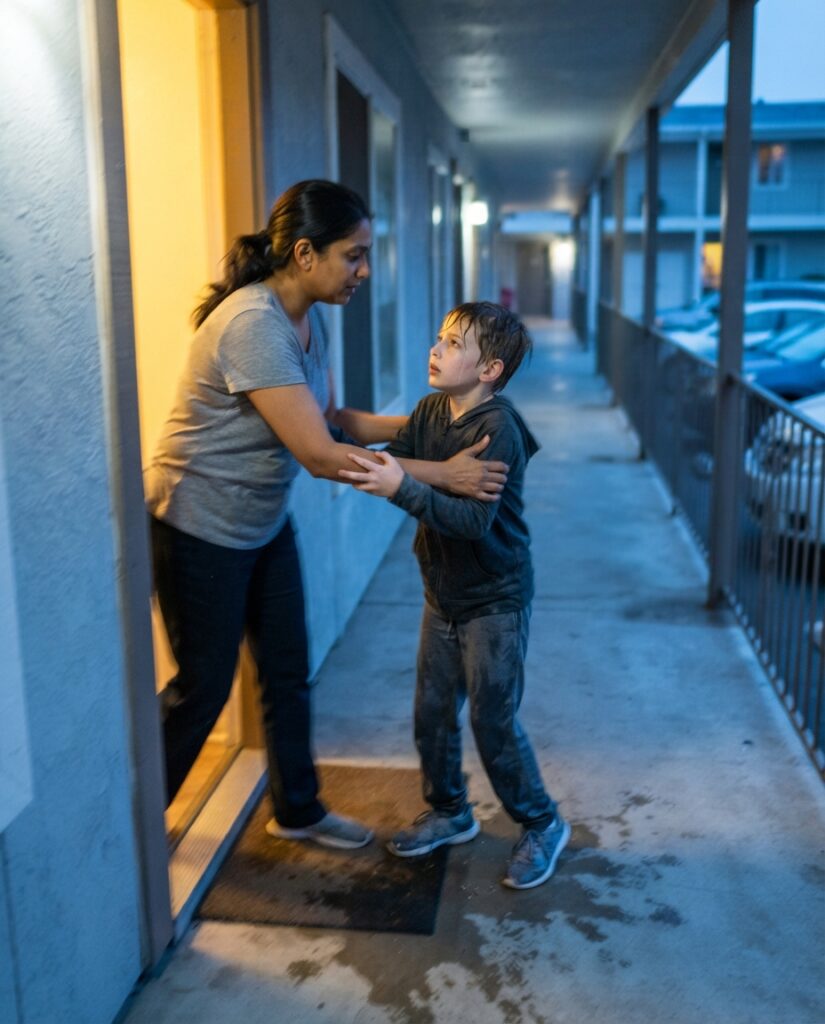
The second one pulled me halfway awake.
The third made me sit up because it did not sound like a neighbor, a delivery, or somebody at the wrong apartment.
It sounded careful.
It sounded like whoever stood outside was afraid that knocking too loudly might make things worse.
My alarm clock glowed 4:58 a.m. beside the bed, throwing red numbers across the dark room while February wind scraped against the building.
I had spent eleven years answering emergency calls, and my body had learned to wake quickly when something felt wrong.
At work, I listened for details other people missed.
A caller saying “I’m fine” too fast.
A child whispering because an adult was nearby.
The hollow pause before someone admitted there was a weapon in the house.
The wet drag of breath that meant a person was trying not to cry.
I knew what panic sounded like.
At least, I thought I did.
Then my phone lit with the doorbell-camera alert, and I saw my ten-year-old nephew standing under the porch light.
Noah wore a thin gray hoodie, sweatpants, and sneakers so wet they looked black.
His shoulders jerked with every shiver.
One hand hovered near the door, not quite making a fist, as though he wanted to knock again but could no longer command his fingers to do it.
For one second, I stared at the screen because my brain refused to place him there.
Noah lived with my brother, Grant, and Grant’s wife, Celeste, in a house with more square footage than they needed, two expensive cars, and a front entry Grant once spent twenty minutes explaining to me because the lock could be controlled from his phone.
They did not live close enough for a ten-year-old to appear at my door before dawn by accident.
I crossed the apartment barefoot and pulled the door open.
The wind came in first.
Then I saw Noah’s face.
His lips were blue-tinged, his eyelashes were wet, and there was a dazed look in his eyes that frightened me more than tears would have.
“Aunt Meera,” he whispered.
His knees gave out.
I caught him under the arms before he hit the floor, and the cold in his clothes went straight through my shirt.
His hoodie was soaked through.
His socks squished inside his shoes.
His fingers were so stiff they would not close around mine.
I pulled him across the threshold, kicked the door shut, and wrapped him in the blanket from my couch.
Then I grabbed the comforter from my bed, two bath towels, and the old quilt I kept folded in the hall closet.
Nothing felt like enough.
Noah shook so hard his teeth clicked.
I had coached strangers through house fires, highway crashes, overdoses, and the longest minutes of their lives, but when I reached for my phone that morning, my hands were not steady.
I called 911 and gave my address.
I described his condition.
I answered the dispatcher’s questions even though part of me wanted to say, I know this script, please skip to the part where somebody gets here.
The professional part of my mind counted Noah’s breaths and watched the color around his mouth.
The rest of me kept staring at his face, trying to understand how my brother’s child had reached my apartment alone in the middle of a freezing night.
“Stay with me,” I told him.
His eyes moved toward mine.
“I’m sorry.”
The words landed harder than they should have because a child who had arrived half-frozen was apologizing for needing help.
“You have nothing to be sorry for,” I said.
He looked toward the door.
“Is Dad mad?”
I tucked the blanket closer around his shoulders.
“Where is your dad?”
Noah swallowed.
“They left me.”
The room seemed to contract around those words.
“Who left you?”
“Dad and Celeste.”
His voice broke on her name.
I kept my tone level because children notice panic even when adults think they are hiding it.
“Where did they leave you, Noah?”
“At home.”
“Why did you come here?”
He stared at his hands under the blanket.
“Grant changed the code.”
He did not say Dad that time.
He said Grant.
I had heard frightened children do that before, shift from a family name to a regular name when the person they depended on stopped feeling like family.
The emergency crew arrived quickly, bringing cold air, bright equipment, and the calm efficiency I had always been grateful to hear through a headset.
One responder knelt in front of Noah and asked permission before touching his wrist.
Another took in the soaked clothing, the shaking, and the pile of blankets around him.
They spoke gently, but their faces changed when I explained that he had arrived alone.
Noah asked again whether his father would be angry.
Nobody in the room answered right away.
Not because we did not hear him.
Because every adult there understood what the question meant.
He was not thinking first about what had happened to his body.
He was thinking about the reaction of the person who had left him outside.
I rode with him to the hospital.
The sky had begun to lighten by then, but the streets still held that empty pre-dawn look, when traffic lights change for cars that are not there and every closed storefront feels farther away than usual.
Noah lay beneath warmed blankets while a responder monitored him.
His eyes closed once, and I touched his shoulder until he opened them again.
“I’m here,” I said.
He nodded as if he needed to hear it but did not quite believe it yet.
Grant and I had not always been distant.
When we were kids, he used to walk me home from school if rain started, even though he complained the whole way.
He had fixed the chain on my first bike.
He had once punched a boy for calling me strange because I preferred library books to parties.
For years, I carried those memories like evidence that the brother I loved still existed beneath the man he became.
Money changed the way Grant measured people.
At first, it showed up in small comments.
He would ask what my annual salary was, then tell me what one of his clients made in a month.
He laughed at my old car and sent me listings for vehicles I could not afford.
When I bought my apartment instead of stretching for a house, he called it “thinking small.”
The worst comment came at a family gathering after he had been drinking just enough to become honest.
“You spend your life helping strangers through problems they created,” he said.
I told him emergencies did not care who deserved compassion.
Grant smiled and said, “That’s why you’ll always be broke.”
I stopped explaining myself after that.
I still showed up for Noah.
I went to school events when Grant was traveling.
I remembered which books Noah liked.
I kept his favorite cereal in my kitchen even though he visited less often after Grant married Celeste.
Whenever Noah stayed with me, he slept with the hallway light on.
The first time, he said he simply liked it that way.
The second time, he asked whether my front door could be locked from outside while he was still inside.
I had looked at him then, but he changed the subject before I could ask more.
That memory returned in the hospital with such force that I had to sit down.
A nurse took Noah into a treatment area and replaced the wet layers with dry clothing and heated blankets.
The hospital lights were too bright, the chairs were too firm, and the air smelled faintly of disinfectant and coffee that had been sitting too long.
I sat beside the bed while doctors checked him for complications from the cold.
Noah watched their hands.
Every time someone new entered, his eyes moved to the doorway.
A police officer arrived and spoke to him in a voice that never became sharp.
The officer asked where Noah had started walking, what route he remembered, and whether anyone had told him where to go.
Noah answered in short pieces.
He said there had been a party.
He said Grant and Celeste were going out.
He said he could not get back inside.
He said the code did not work.
He said he came to me because he knew my building and because I had once told him he could knock on my door at any hour.
I had meant it in the casual way adults often say permanent things to children.
Noah had remembered it as a promise.
My phone buzzed while the officer was still speaking with him.
Grant’s name appeared first.
Did you take my son?
The wording made my jaw tighten.
Not Is Noah with you?
Not Is he safe?
Did you take him?
Celeste’s message came seconds later.
Where is Noah?
I read both messages twice.
Then I turned the phone face down.
The officer noticed but did not ask me to respond.
Instead, he asked whether my building had exterior cameras.
I opened the doorbell application.
The clip began at 4:58 a.m.
At first, the screen showed only the empty breezeway and the porch light reflecting on the railing.
Then Noah entered the frame.
He moved slowly, one hand trailing along the wall for balance.
His shoes left dark wet prints behind him.
He stopped in front of my door and looked back toward the stairs.
Even on the small screen, I could see how hard he was shaking.
He knocked once.
Waited.
Knocked again.
Waited longer.
Then he knocked a third time and lowered his head.
I watched the footage in the hospital hallway with the officer beside me, and the helplessness of it made my stomach turn.
No child should have to stand outside a closed door wondering whether the last person he trusts will wake up.
The officer asked me to send him the clip.
I did.
That was all.
I did not add commentary.
I did not tell him what kind of man I thought Grant was.
I let the video show Noah arriving alone, wet, shaking, and barely able to stand.
Grant and Celeste reached the hospital later that morning.
I knew they had come from the party before either of them spoke.
Grant still wore a dark jacket over a wrinkled shirt.
Celeste had on the same dress I had seen in a photo she posted the previous evening, along with earrings that caught the hospital lights every time she turned her head.
They walked fast when they entered the corridor, but neither one went directly to Noah’s room.
Grant saw me first.
His entire posture changed.
He came toward me with the controlled anger he used when he believed confidence could substitute for innocence.
“What did you tell them?”
For a moment, I could only look at him.
Behind him, Celeste glanced toward Noah’s doorway, then back at Grant as if she was waiting to learn which version of the morning they were using.
I thought of Noah asking whether his father was mad.
I thought of his wet socks.
I thought of the way his hand had hovered near my door because he did not have the strength to knock again.
“I didn’t tell them anything,” I said.
Grant’s eyes narrowed.
“Don’t play games with me, Meera.”
“I showed them what happened.”
His gaze dropped to my phone.
For the first time since entering the hospital, he looked uncertain.
It lasted less than a second.
Then he straightened his shoulders.
“You have no idea what happened.”
“I know he arrived at my door at 4:58 in the morning.”
“It was a misunderstanding.”
“He was soaked through.”
“We thought he was with someone.”
“He is ten.”
Celeste stepped closer.
“Everyone was leaving at the same time,” she said. “It was chaotic.”
The explanation came too smoothly.
I had spent years listening to people shape stories around facts they could not erase.
They often added unnecessary details first.
They explained the atmosphere.
They described confusion.
They talked about intentions before anyone asked what they had done.
The officer came out of Noah’s room and stopped a few feet away.
Grant lowered his voice immediately.
“This is a family matter.”
The officer looked at him, then at the phone in my hand.
“A child arriving alone with signs of dangerous cold exposure is not being treated as a private disagreement,” he said.
Grant’s mouth tightened.
He turned back to me.
“You always wanted to prove you were better than me.”
That accusation would once have hurt.
Standing in that hallway, it only sounded small.
“This isn’t about me,” I said.
“It’s always about you with you.”
“No, Grant.”
I pointed toward the room.
“It is about the child you still haven’t asked to see.”
Celeste’s face changed then.
She looked toward Noah’s door again, and this time she took half a step in that direction.
Grant reached for her elbow.
It was not a violent movement.
It was quiet.
Possessive.
A reminder to stay beside him.
The officer saw it.
So did I.
Celeste stopped.
Nobody said anything for several seconds.
A monitor beeped behind the curtain.
Rubber soles squeaked somewhere at the far end of the hallway.
A paper coffee cup sat untouched on a windowsill, the lid bent where someone had pressed a thumb into it.
The ordinary hospital sounds kept going while my brother stood between his wife and his son’s room.
Then another woman came down the corridor carrying a plain folder and wearing an identification badge clipped to her jacket.
She introduced herself as the CPS investigator assigned to speak with Noah and the adults responsible for him.
Grant immediately began talking.
He said there had been confusion about transportation.
He said Noah had wandered away.
He said the code issue was probably a technical problem.
He said I had a history of resenting his success.
The investigator did not react to the last part.
She asked one question.
“Do you have the video?”
I handed her my phone.
Grant stopped talking.
The investigator watched the clip from the beginning.
She saw Noah enter the frame.
She saw him steady himself against the wall.
She saw the soaked shoes, the shaking hand, and the three weak knocks.
She watched until the moment I opened the door and Noah collapsed toward me.
Then she replayed the final seconds.
Grant shifted his weight.
Celeste folded her arms, unfolded them, and pressed one hand against the side of her neck.
The investigator handed the phone back to me.
She looked through the open doorway toward Noah, wrapped in warm blankets beneath hospital lights.
Then she looked at Grant and Celeste.
Her voice stayed calm, but something in her face had hardened.
She said—