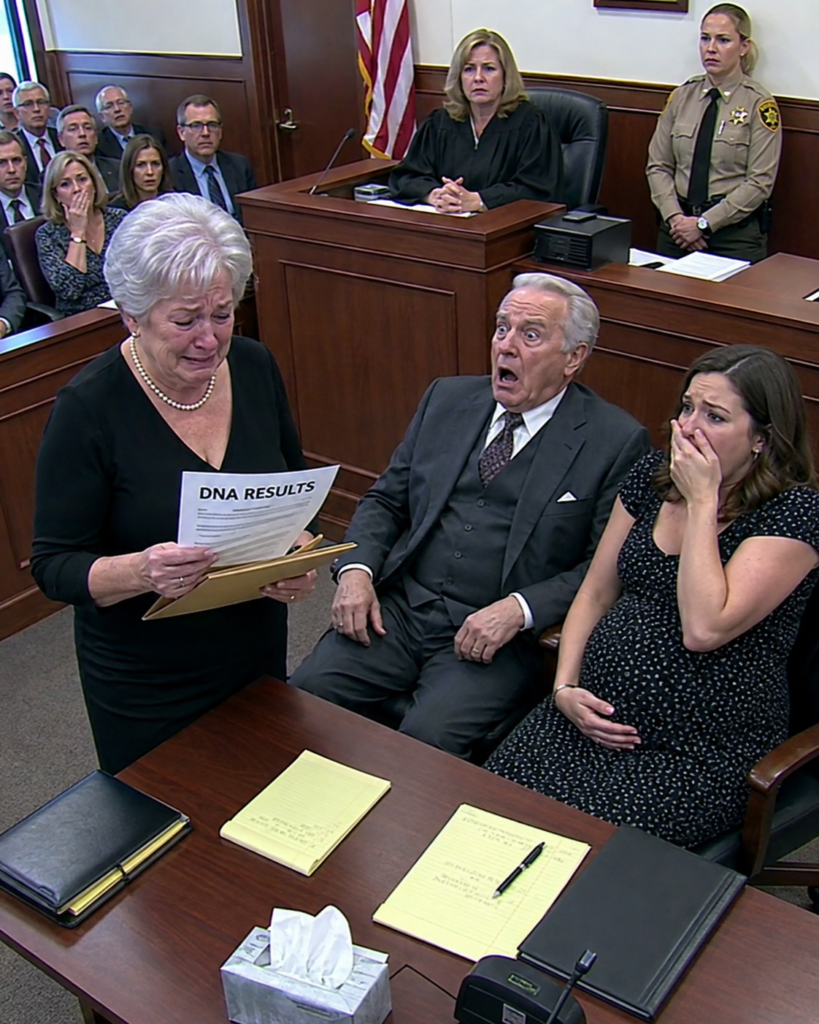
The laboratory director slid his thumb beneath the seal while Grant Ashford sat beside his pregnant mistress with the calm confidence of a man expecting the truth to humiliate someone else.
Across the courtroom, Dorothy Brennan watched him squeeze Valerie Vale’s hand.
The gesture was small, almost tender.
It was also calculated.
Grant wanted the judge to see a grieving widower supported by the woman who intended to help him raise his children.
He wanted everyone to forget that his wife had been buried less than three weeks earlier.
The laboratory director unfolded the report.
“The tested man, Grant Ashford, is excluded as the biological father of Margot Ashford, Bridget Ashford, and Theodore Ashford.”
Silence pressed against the courtroom walls.
Valerie’s lips curved first.
Grant released her hand and struck both palms against the table.
“I knew it.
Colleen was sleeping with someone else.”
Dorothy did not move.
For one terrible second, she pictured her daughter alone in the nursery, heavily pregnant, collecting documents while the man she had married prepared to use those same children against her.
Grant turned toward the judge.
“Your Honor, this proves my mother-in-law has been lying.
Those babies are not mine.
Colleen deceived me, and now Dorothy is trying to steal my property by pretending I have parental obligations.”
Mara Vance rose slowly from the chair beside Dorothy.
“No,” she said.
“It proves Mr.
Ashford believed we would arrive unprepared.”
She placed a thick fertility-clinic file on the evidence table.
The first page bore Grant’s signature.
So did the second, the fifth, and the final consent form.
Mara faced the judge.
“Three years ago, Mr.Ashford was diagnosed with non-obstructive azoospermia.
His physicians informed him that he was not producing viable sperm.
After counseling, he and Colleen chose donor conception.
Mr.Ashford signed an intended-parent agreement acknowledging that any resulting children would legally be his.”
Grant’s face changed.
It was not grief Dorothy saw.
It was recognition.
Mara continued.
“He attended the appointments.
He approved the donor profile.
He signed the embryo-transfer authorization.
He later attended ultrasounds and publicly announced that he was expecting triplets.
He knew from the beginning that DNA testing would exclude him.”
“That file is private,” Grant snapped.
“She had no right to obtain it.”
“Your wife had a copy,” Mara replied.
“She placed it with her estate documents because she anticipated exactly this accusation.”
The judge looked down at Grant over the rim of her glasses.
“Did you sign these forms?”
Grant glanced at his attorney.
His attorney did not answer for him.
“I signed a great deal of paperwork,” Grant said.
“The clinic rushed us.”
The laboratory director shifted uncomfortably.
Mara did not.
She called Dr.Elias Monroe, the reproductive endocrinologist who had treated the couple.
He testified by video that he personally explained the diagnosis to Grant twice.
He also confirmed that Grant had completed mandatory counseling before signing the donor agreement.
“We do not proceed without informed consent from both intended parents,” the doctor said.
“Mr.Ashford asked specific questions about whether his name would appear on the birth certificates.
He was assured that it would.”
Grant stared at the screen as though he could silence the doctor through force alone.
The judge turned to Mara.
“Why is this relevant to the emergency custody petition beyond establishing intended parentage?”
“Then, minutes after hearing that no genetic connection exists, he attempted to renounce those same children.
His interest changes according to whether he believes they provide access to Colleen Brennan Ashford’s trust.”
Grant’s attorney stood.
“That is argument, not evidence.”
“Then let us move to the evidence.”
Mara lifted the second sealed envelope.
Valerie’s posture stiffened.
Until that moment, she had seemed pleased by the first result.
She had heard Grant denounce the triplets and apparently believed it cleared space for the child she carried.
During the first hearing, Valerie had sworn that Grant was the father of her unborn baby.
She had described their future household in polished detail: Grant at the head of the family, Valerie caring for all four children, and Dorothy restricted to supervised visits.
When Mara questioned the claim, Valerie volunteered for noninvasive prenatal paternity testing.
She had smiled while signing the consent.
Now that smile was gone.
Mara handed the envelope to the laboratory director.
He opened it and read silently before lifting his eyes.
“Grant Ashford is excluded as the biological father of Valerie Vale’s fetus.”
Valerie made a sound like air escaping a punctured tire.
Grant turned toward her so sharply that his chair legs scraped the floor.
“What?”
She shook her head.
“That is impossible.”
“It is not,” Mara said.
“Mr.Ashford’s medical diagnosis did not change merely because you wanted his money.”
Grant grabbed Valerie’s wrist.
“Whose child is it?”
The bailiff stepped forward.
“Release her.”
Grant obeyed, but only after the judge repeated the command.
Valerie rubbed the pale marks his fingers had left.
Her eyes moved rapidly between Grant, Mara, and the courtroom doors, measuring possible exits.
Dorothy remembered seeing that same woman in the hospital parking garage while Colleen’s body was still warm.
Valerie had held Grant’s hand beneath the yellow lights as if they had survived something together.
At the funeral, she had signed the guest book as a close family friend.
At Colleen’s house, she had stood over three premature infants and whispered that everything would soon belong to her.
Now she looked very young.
Not innocent.
Just frightened.
Grant’s attorney requested a recess.
The judge denied it.
Mara placed Colleen’s amended trust on the table.
The house on Birchwood Lane had been purchased by Colleen before the marriage.
The investment accounts funding the children’s medical care came from a trust established by Colleen’s grandfather.
Grant had never owned either asset, although he had repeatedly referred to both as his.
Six weeks before the delivery, Colleen had amended the trust.
Dorothy and her son, Fletcher, would serve as co-trustees.
Any distributions for the children required independent approval.
No spouse, guardian, or intended parent could borrow against the principal or transfer the house.
Colleen had also nominated Dorothy and Fletcher as temporary guardians if she died and Grant was under investigation for financial misconduct, coercion, or abandonment.
The nomination could not automatically erase Grant’s parental status.
Mara acknowledged that immediately.
But it gave the court a clear record of Colleen’s fears, and the documents hidden with it explained why those fears existed.
Mara inserted Colleen’s flash drive into a courtroom computer.
The first file contained photographs of Grant and Valerie entering hotels together.
Another contained copies of bank transfers from a company account to a consulting business registered in Valerie’s name.
Then came the messages.
Grant had written, “Once the babies arrive, she will be too weak to fight about the trust.”
Valerie replied, “And if she changes the paperwork?”
“She won’t know until it is done.”
A later exchange was colder.
Valerie wrote, “I am tired of waiting while you play devoted husband.”
Grant answered, “Triplets give us leverage.
Whoever controls the children controls the distributions.”
The judge read the messages twice.
Grant leaned toward his attorney and whispered furiously.
His attorney’s expression grew more distant with each sentence.
Mara opened one final file.
It was an audio recording made ten days before Colleen went into labor.
Colleen’s voice came first, tired but steady.
“You moved money from the foundation.”
Grant answered, “I moved money that I earned.”
“It was restricted.”
“You do not understand how my business works.”
“I understand Valerie’s company received two hundred thousand dollars.”
A long pause followed.
Then Grant spoke in the careful tone Dorothy recognized from the hospital.
“You are carrying three babies.
You are emotional.
Sign the power of attorney and let me handle things until after the delivery.”
“No.”
“You may not be in a condition to make decisions afterward.”
“Is that a threat?”
“It is reality.”
The recording ended.
Dorothy closed her eyes.
She had spent every night since Colleen’s death wondering whether Grant had somehow caused the hemorrhage.
The thought had hollowed out her sleep.
Mara had investigated that fear before the hearing.
The hospital’s review showed that Colleen’s death resulted from a catastrophic obstetric complication.
Her physicians had acted quickly.
There was no evidence that Grant or Valerie had caused the medical emergency.
Grant had not killed Colleen.
He had simply expected to profit from whatever left her vulnerable.
That truth was less monstrous than murder and somehow more recognizable.
He had watched his wife approach a dangerous delivery and treated her fear as a business opportunity.
The judge ordered Grant to surrender his phone and financial records.
She granted Dorothy and Fletcher temporary physical guardianship of the triplets pending a full parental-fitness investigation.
Grant received supervised visitation, but no authority over the trust, the house, or the children’s medical decisions.
She also referred the altered power-of-attorney document in Grant’s custody filing to the district attorney.
Grant rose before the judge had finished speaking.
“You cannot give my children to her.”
“Five minutes ago, you told this court they were not your children,” the judge replied.
Grant opened his mouth.
Nothing came out.
Valerie began crying beside him.
He did not look at her.
Outside the courtroom, reporters waited near the elevators.
Grant attempted to walk past them with his usual composed expression, but Valerie seized his sleeve.
“You said the test would prove everything,” she hissed.
“It did.”
“You told me you could have children.”
Grant pulled his arm free.
“You told me that baby was mine.”
Valerie looked toward Dorothy, perhaps hoping for sympathy.
Dorothy had none to offer.
“Who is the father?” Grant demanded.
Valerie’s silence answered more effectively than any confession.
The identity became public several weeks later.
Valerie had been involved with Ian Pike, Grant’s business partner, during the same period.
Messages recovered during the financial investigation showed that she had allowed Grant to believe the baby was his because Grant had promised her the Birchwood house and access to the children’s trust.
Ian provided a voluntary sample after being contacted by his own attorney.
The result established his paternity.
By then, Grant had more serious problems.
Forensic accountants discovered that he had routed restricted foundation money through Valerie’s consulting company.
He had also submitted a power of attorney containing a signature that a handwriting expert concluded was not Colleen’s.
His company placed him on leave.
The charitable board removed him.
The district attorney charged him with attempted fraud, forgery, and perjury connected to his custody filings.
Grant continued insisting that Colleen had authorized everything verbally.
The recordings contradicted him.
Valerie avoided criminal charges on the financial transfers by cooperating with investigators.
She admitted that the consulting company had performed no legitimate work.
She also admitted entering Colleen’s house after the funeral and leaving the card Dorothy found beside the coffee maker.
“The hardest part is over.
Now we begin.”
Valerie claimed she had meant the funeral was over and they could begin building a family.
No one believed that explanation improved the message.
During the parental-fitness investigation, Grant visited the triplets four times.
On the first visit, he complained that the hospital-grade formula was too expensive.
On the second, he spent most of the hour speaking to his lawyer by phone.
During the third, Theodore began crying, and Grant handed him to the supervising nurse after less than a minute.
He canceled the fourth visit halfway through because of a media interview.
When the court made Dorothy and Fletcher’s guardianship long-term, Grant did not appeal.
Instead, he asked through his attorney whether relinquishing his parental rights would end his financial obligations.
It would not erase what he already owed, but it revealed the final truth about his custody battle.
He had never wanted the children without the money attached to them.
Several months later, after extensive review and with the court’s approval, Grant consented to Fletcher adopting the triplets.
Fletcher moved into Birchwood Lane while Dorothy took the downstairs guest room.
Together they learned the exhausting choreography of three bottles, three medication schedules, and three different cries in the middle of the night.
Margot cried angrily when she was hungry.
Bridget made a soft, wounded sound whenever her blanket slipped away.
Theodore rarely cried at all.
He stared at faces with solemn concentration, as though evaluating whether the adults around him could be trusted.
Dorothy understood the impulse.
One evening, while organizing the nursery closet, she found a final envelope inside Colleen’s folder.
It had slipped behind the amended trust.
The front said, “For Mom, after everyone is safe.”
Dorothy sat in the rocking chair before opening it.
Colleen’s handwriting remained neat for the first page and became shakier toward the end.
She wrote that she had discovered Grant’s affair after seeing a hotel charge.
She had then uncovered the transfers to Valerie’s company and realized he was attempting to position himself to control the trust.
She had not expected to die.
That sentence mattered most.
Colleen had prepared the folder because carrying triplets made every risk feel larger, not because she believed death was inevitable.
She had planned to confront Grant after the babies were safely delivered.
She intended to file for divorce, keep the house, and raise her children surrounded by people who loved them without calculating their value.
“I am scared,” Colleen had written.
“But I am not helpless.
If anything happens before I can finish this, please do not let Grant turn my children into keys for doors he was never entitled to open.”
The final paragraph was for Dorothy.
“You taught me that calm is not surrender.
Sometimes calm is how a woman keeps her hands steady while she saves what matters.”
Dorothy pressed the letter against her chest and wept for the first time since the hospital.
Not the stunned tears that had come in public.
Not the silent leaking of grief while washing bottles at dawn.
These tears came from the place where sorrow and pride had become impossible to separate.
A year after the triplets were born, Fletcher planted peonies across the wet stretch of lawn beneath the kitchen window.
Colleen had once planned to plant them herself.
Margot, Bridget, and Theodore sat on a blanket nearby, grabbing at the grass and each other’s sleeves.
Dorothy carried Colleen’s letter in her pocket.
The house no longer felt paused in the middle of a sentence.
It was noisy again.
Bottles crowded the sink.
Toys appeared beneath chairs.
Three highchairs stood around the kitchen table where Grant had once poured coffee and warned Dorothy that the house belonged to him.
Grant never crossed its threshold again.
When the first peony opened, Dorothy carried the babies outside one by one.
She placed Margot’s hand against the soft pink petals.
Bridget tried to pull the flower toward her mouth.
Theodore stared at it with his usual serious expression.
“Your mother chose these,” Dorothy told them.
They were too young to understand.
One day they would.
They would learn that Colleen had been frightened but attentive, betrayed but not defeated.
They would know she had protected them before they were born, not with dramatic speeches or reckless revenge, but with signatures, copies, witnesses, and one carefully hidden folder.
Grant and Valerie had mistaken her silence for ignorance.
They had mistaken Dorothy’s grief for weakness.
Most of all, they had mistaken three vulnerable babies for access to a fortune.
The DNA reports exposed their lies, but Colleen’s preparation delivered the real reversal.
She had made certain that biology could not be used to abandon her children, that legal parenthood could not be twisted into ownership, and that the wealth intended for the triplets would remain beyond the reach of anyone who valued it more than they valued them.
Dorothy sat on the lawn as the afternoon light warmed the house.
Margot wrapped her hand around Dorothy’s finger with the same fierce grip she had shown inside the hospital isolette.
“I’m here,” Dorothy whispered.
This time, she knew exactly who she was speaking to.