PART 2
Lucian looked down at the envelope as if the paper had burned him.
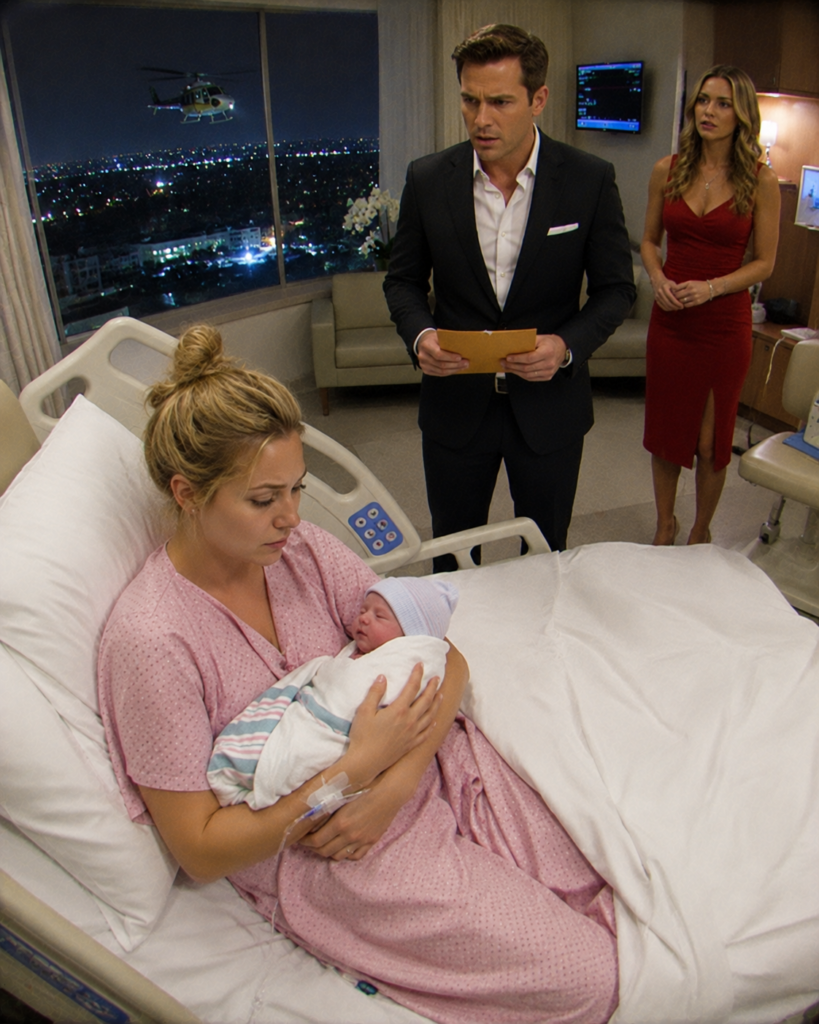
For a long moment, the only sound in room 412 was the rain tapping against the hospital window and Nico’s small, sleepy breaths against my chest. The city beyond the glass had turned gray and blurred, the skyline swallowed by weather, the streets shining black beneath the storm.
Lucian had faced prosecutors, rivals, traitors, and men who had once promised to bury him beneath the Hudson.
But he had never looked as frightened as he did holding my divorce papers.
“What have you done, Serena?” he repeated, softer this time.
I kept my eyes on Nico. His tiny hand had curled around the edge of my hospital gown, his fingers no bigger than rosebuds. He did not know the man standing at the foot of the bed. He did not know the empire attached to his last name, or the women who whispered about his father in private rooms, or the promises Lucian had made and broken before our son was even born.
“I chose peace,” I said.
Lucian’s jaw tightened. “You chose this while carrying my child?”
“I chose this because I was carrying your child.”
His eyes flicked toward Elena. My sister stood near the cabinet, arms folded, her face pale from two sleepless nights but steady with the kind of anger that did not need volume.
“You had no right to involve her,” Lucian said.
Elena’s chin lifted. “I had every right to protect my sister.”
“She is my wife.”
“She is not your possession.”
A muscle moved in Lucian’s cheek. Years ago, that small sign would have made me rush to soften the room, calm the temperature, save everyone from the storm building inside him. I had spent my marriage translating his silences, predicting his moods, smoothing the sharp edges of his life before they cut me.
But that morning, I simply shifted Nico higher against my shoulder and let the silence breathe.
Lucian noticed.
His expression changed again, not with anger this time, but with recognition. He was searching for the woman who used to meet him halfway. The woman who asked fewer questions when he came home smelling of smoke and cold air. The woman who accepted pearls after long absences, diamonds after whispered scandals, and apologies delivered without explanations.
He could not find her.
“Serena,” he said, and the sound of my name in his mouth was almost careful. “I made a mistake.”
I laughed once. It was small and empty.
“A mistake is missing dinner. A mistake is forgetting an anniversary. You disappeared across the ocean while I was days away from giving birth, and when your son came into the world, you were sitting on a terrace with Bianca Romano.”
His face lost color.
So it was true.
I had known it already. I had seen the photograph, seen the white villa and the lemon trees, seen Bianca in silk looking at the man across from her as if she had already won something. But some wounded part of me had still waited for Lucian to deny it convincingly enough that I could pretend for one more hour.
He did not deny it.
Instead, he took one step closer.
“It wasn’t what you think.”
“That sentence has carried this marriage farther than love ever did.”
He flinched.
I had never seen Lucian flinch before.
Elena moved nearer to my bed, but I lifted one hand slightly, asking her to stay where she was. This was not a battlefield. I would not let our son’s first morning become one.
Lucian looked at Nico again.
His voice lowered. “Please let me hold him.”
Something in me trembled.
It would have been easier if he had shouted. Easier if he had threatened or slammed the divorce papers onto the floor. Then I could have hated him cleanly. But the man standing before me was not the feared Lucian Moretti of Manhattan. He was just a father seeing his child for the first time through the glass wall of his own choices.
And still, I said, “No.”
His eyes closed briefly.
“When?” he asked.
“When what?”
“When will I be allowed to hold my son?”
I looked out at the rain. A yellow taxi slid past below, its roof light glowing like a match in the storm.
“When I believe you understand that being his father is not a title you can demand,” I said. “It is a responsibility you have already failed once. He is one day old, Lucian. I will not let him become another person waiting at a window for you.”
The divorce papers bent slightly in his hand.
“I will fight this.”
“I know.”
“You know what my name means.”
“Yes.” I finally met his eyes. “And you know what mine means too.”
For a moment, his expression turned unreadable.
Serena Bellandi had become Serena Moretti seven years earlier in a candlelit cathedral filled with roses, marble saints, and men who carried guns beneath tailored jackets. But before I was his wife, I had been the granddaughter of Francesca Bellandi, the woman who built three restaurants from nothing and taught me that softness was not the same thing as weakness.
Lucian knew my family. He knew we did not rule courts or frighten bankers. But we remembered everything. We survived quietly. And when we left, we did not come back empty-handed.
The door opened before he could answer.
A nurse stepped in with a clipboard, took one look at the room, and paused. Her gaze moved from Lucian’s dark coat to Elena’s folded arms to me sitting upright in the bed, holding Nico like the last light in the world.
“Mrs. Moretti?” she asked gently. “Everything all right?”
“Yes,” I said.
Lucian’s eyes stayed on me.
The nurse glanced at him. “We need to check the baby.”
“No,” Lucian said suddenly.
The word came too fast.
The nurse froze.
My body went cold.
Lucian seemed to realize how he sounded. He lifted a hand, lowered his voice, and forced calm into it. “I mean—can it wait a moment?”
The nurse’s professional smile thinned. “It is a routine newborn exam.”
Elena stepped forward. “Then we’ll do it now.”
I watched Lucian carefully. Something had shifted in him. Not anger. Not grief.
Fear.
It passed across his face so quickly that another person might have missed it. But I had spent seven years studying Lucian Moretti’s face, learning the difference between danger and worry, between strategy and regret.
This was fear.
“Lucian,” I said quietly. “Why don’t you want the nurse to examine Nico?”
His gaze snapped to mine.
“I didn’t say that.”
“You did.”
The nurse shifted uncomfortably. “I can come back in a few minutes.”
“No,” I said. “Please stay.”
Lucian looked at the nurse, then at Elena, then at me. A wall came down behind his eyes.
“Serena, we need to talk privately.”
“We are talking now.”
“Not here.”
“Anything involving my son can be said in front of the woman who held my hand when his father was absent.”
Elena’s face softened for a second, but she said nothing.
Lucian swallowed. It was a small movement, barely visible. But I saw it.
Then he folded the divorce papers with slow precision and slid them back into the envelope.
“I’ll be downstairs,” he said.
“You can leave the papers.”
He did not.
He placed the envelope on the table beside my water glass, then turned toward the door. Before leaving, he looked at Nico one last time. His expression was so raw that for one heartbeat I almost called him back.
Almost.
The door closed behind him.
The nurse exhaled softly. “I’m sorry. I didn’t mean to interrupt anything.”
“You didn’t,” Elena said. “You may have saved us from something.”
The nurse gave her a cautious look but began the exam. She lifted Nico with practiced hands, checked his heartbeat, his breathing, his reflexes. He cried when she unwrapped him, furious at the cold air, and the sound pierced me in a way nothing else had.
I wanted to protect him from everything.
From Lucian’s world.
From my own bitterness.
From becoming a battlefield.
The nurse smiled. “He’s perfect.”
The same words everyone kept using.
Perfect.
As if perfection could protect anyone.
When she finished, she placed Nico back in my arms and left with the promise to return later. Elena closed the door and leaned against it.
“What was that?” she whispered.
“I don’t know.”
“He looked scared.”
“I know.”
Elena came to my bedside. “Serena, did he say anything to you before he left for Sicily? Anything strange?”
I shook my head. “Only that it was urgent.”
“And Bianca?”
“He didn’t mention her.”
“Of course he didn’t.”
I looked down at Nico. His eyes were closed again, his lashes dark against his cheeks. “Why would he panic over a routine exam?”
Elena’s mouth pressed into a line.
“What?” I asked.
“I don’t want to upset you.”
“I gave birth without my husband and served him divorce papers before breakfast. I think I’m past delicate.”
She sat on the edge of the bed. “Marco called me while you were sleeping.”
I turned slowly toward her. “Marco called you?”
“He said Lucian was on his way. He asked if the baby was healthy.”
“That is normal.”
“Then he asked if anyone had taken blood.”
The room seemed to narrow.
“What?”
“He asked if the hospital had done any blood work on Nico.”
My grip tightened around the blanket. “Why would Marco ask that?”
“I don’t know. He sounded tense. When I asked, he said it was nothing.”
“With men like Marco, nothing usually means there is a fire somewhere.”
Elena nodded.
Marco Vitale had been Lucian’s closest friend since they were boys. He was quieter than Lucian, gentler in public, but there was a steeliness in him that made people listen when he spoke. He had always treated me with respect, never crossing lines, never pretending not to notice when Lucian wounded me.
Three months earlier, at a family dinner, Marco had watched Lucian leave the table to take a call. When I looked down at my untouched plate, Marco said, almost sadly, “One day he will understand the cost of being unreachable.”
I had thought he was speaking about me.
Now I wondered if he had meant something else.
By noon, the rain had stopped.
A pale light spread through the room, thin and silver, turning Nico’s skin warm where it touched his cheek. The city outside looked washed clean, though I knew better. New York never became clean. It only dried.
Lucian did not return that afternoon.
His absence should have relieved me, but instead it hovered over the room like an unfinished sentence. Every time footsteps slowed outside my door, my body stiffened. Every time a nurse entered, I looked past her shoulder.
Elena noticed.
“You’re waiting for him,” she said.
“I’m waiting to understand.”
“That is not the same thing?”
“No.”
She gave me a look that said she did not believe me but loved me enough not to argue.
Later, after Nico fed and slept, Elena went downstairs for coffee. I was alone for the first time since the birth. The room felt too quiet. Without my sister’s voice, without nurses moving in and out, my thoughts grew louder.
I reached for my phone.
There were forty-seven missed calls from Lucian.
None from the night before.
I scrolled through them. The first had come at 8:12 that morning, almost an hour and a half after Nico was born. Then another. Then another. Panic arranged itself in timestamps.
Below the missed calls was a message from an unknown number.
I almost deleted it.
Then I saw the preview.
Ask your husband why Bianca was really in Sicily.
My pulse slowed.
I opened the message.
There was no name. No explanation. Just that single sentence and a photograph.
Not the terrace photograph I had seen before.
This one was darker, grainier, taken at night through what looked like a car window. Bianca Romano stood outside the white villa, her hair pulled back, her white silk replaced by a black coat. Beside her was a man I did not recognize. Older, broad-shouldered, with a scar near his mouth.
Between them stood Lucian.
But Lucian was not touching Bianca. He was looking at the older man. And in his hand was a small folder tied with red string.
I stared at the image until my eyes blurred.
The door opened.
I nearly dropped the phone.
Elena entered carrying two coffees and a paper bag. “I got you a muffin even though hospital muffins are basically sadness wrapped in plastic.”
“Elena.”
She stopped. “What happened?”
I handed her the phone.
She set the coffee down and studied the photo. The color drained from her face.
“Who sent this?”
“I don’t know.”
“When?”
“Just now.”
She zoomed in on the image, then frowned. “This man.”
“You know him?”
“No. But I saw him.”
“When?”
“At the hospital. Last night.”
A chill slid along my arms.
“Elena.”
“I didn’t want to worry you during labor.”
“Tell me.”
She lowered her voice. “There was a man near the elevators. He wasn’t staff. He stood there for almost an hour. I thought maybe he was with another family. But every time someone entered your room, he looked over.”
My heart began to pound. “Why didn’t you call security?”
“I did. By the time they came, he was gone.”
I looked at Nico sleeping in the bassinet beside me.
My son was one day old.
One day.
And already strangers were watching doors.
“Elena, lock the room.”
She crossed to the door and did it immediately.
For the next few minutes, neither of us spoke. The cheerful noises of the maternity ward continued outside—rolling carts, soft laughter, a baby crying somewhere down the hall—but inside room 412, the air had changed.
I called the unknown number.
It rang once, then disconnected.
I tried again.
This time, a message appeared.
Number unavailable.
Elena stared at the screen. “We have to tell Lucian.”
“No.”
“Serena—”
“No.”
Her eyebrows lifted. “You cannot protect Nico from Lucian’s world by pretending Lucian does not exist.”
The truth in her words stung.
“I know.”
“Then call him.”
“I don’t trust him.”
“You don’t have to trust him to ask what danger he brought to your door.”
Before I could answer, someone knocked.
Three soft taps.
Elena and I looked at each other.
“Who is it?” she called.
“Marco.”
Relief and suspicion arrived together.
Elena unlocked the door but did not open it fully. Marco Vitale stood in the hallway wearing a charcoal suit and no overcoat, his dark hair damp from the weather. He looked exhausted. Not physically—Marco never looked untidy—but there was a heaviness around his eyes that made him seem older than he had two days ago.
“I need to speak to Serena,” he said.
Elena did not move. “About what?”
Marco looked past her at me. “About Sicily.”
The room went silent.
I said, “Let him in.”
Elena stepped aside, though reluctantly. Marco entered and closed the door behind him. His gaze moved to Nico’s bassinet and softened briefly.
“He’s beautiful,” he said.
“Don’t,” I replied.
He accepted that with a small nod. “Fair enough.”
I held up my phone. “Did you send this?”
Marco crossed the room, looked at the image, and went utterly still.
That was answer enough.
“Who is the man?” I asked.
Marco’s voice became careful. “His name is Dante Romano.”
“Bianca’s father?”
“Her uncle.”
“And why was my husband meeting him while I was in labor?”
Marco looked toward the door, then back to me. “Because Dante claimed he had proof that someone inside Lucian’s circle had been selling information to federal investigators.”
Elena folded her arms. “And Bianca?”
“She was the messenger.”
I laughed softly, but there was no humor in it. “How convenient.”
Marco’s eyes moved to mine. “Serena, Lucian was not with Bianca romantically.”
“Were you there?”
“No.”
“Then you do not know that.”
“I know what he went there to do.”
“I know where he chose to be.”
Marco absorbed that without argument. It made me angrier than if he had defended Lucian.
“What did Dante give him?” I asked.
“I don’t know.”
“You expect me to believe Lucian flew across the world, missed his son’s birth, met Bianca and her uncle in secret, received a mysterious folder, and never told his own second-in-command what was inside?”
Marco’s mouth tightened. “I am not his second-in-command when the matter concerns family.”
The word landed strangely.
Family.
I looked at him more closely. “What does that mean?”
Marco glanced at Elena. “This is private.”
Elena’s laugh was sharp. “You men and your private conversations. Privacy seems to be where all the disasters are born.”
“She stays,” I said.
Marco looked as though he wanted to object, then thought better of it.
He moved closer to the bed but kept a respectful distance. “Dante Romano did not ask Lucian for money. He asked for protection.”
“For Bianca?”
“No.”
“Then for whom?”
Marco’s eyes dropped to Nico.
The room tilted.
“No,” I said immediately.
“Serena—”
“No. Do not look at my son when you say that man’s name.”
Marco’s expression tightened with regret. “Dante claimed there was a threat against Lucian’s firstborn.”
Elena’s hand flew to her mouth.
I felt nothing for one suspended second.
Then Nico made a soft sound in his sleep, and my body snapped back into itself with terrifying force.
“What threat?”
“Dante said old debts were resurfacing. He claimed someone wanted leverage over Lucian.”
“Everyone wants leverage over Lucian.”
“Not like this.”
The walls seemed too close. I wanted the window open. I wanted air. I wanted to stand, but my body still ached from labor, and Nico was asleep beside me, impossibly small beneath a blue blanket.
“Is that why Lucian panicked when the nurse mentioned blood work?” I asked.
Marco looked away.
My skin prickled.
“What does blood have to do with this?”
“Serena, Lucian needs to tell you.”
I spoke each word clearly. “Lucian lost the privilege of deciding what I need to know.”
Marco closed his eyes briefly. When he opened them, they were filled with something I had never seen in him before.
Guilt.
“Before Lucian married you, there was a contract between the Moretti family and the Romanos.”
Elena whispered, “A marriage contract.”
Marco nodded once.
The name Bianca burned in the air.
I looked toward the window. For a moment, I was twenty-two again, standing in the cathedral in my ivory dress while Lucian waited at the altar. I remembered the way he had looked at me that day, not softly exactly, but intensely, as if the whole world had narrowed to the space between us.
Had I been loved?
Or chosen?
“What contract?” I asked.
“Lucian was expected to marry Bianca.”
My heart did not break.
That had happened already.
This was something colder.
“But he married me,” I said.
“Yes.”
“Why?”
Marco hesitated.
“Answer me.”
“Because he loved you.”
Elena looked skeptical, but Marco’s face did not change.
“He refused the arrangement,” Marco continued. “It humiliated the Romanos. Dante never forgave him.”
“And now Dante suddenly warns him about a threat to Nico?” I asked. “Why?”
“We don’t know.”
“Then why did Lucian go?”
“Because Dante sent proof that someone had accessed your medical records.”
I stopped breathing.
Elena gripped the foot of the bed. “What?”
Marco’s voice dropped. “Two weeks ago, someone requested records from your obstetrician’s office. Insurance information, due date, hospital preference.”
My hand went instinctively to my stomach, though Nico was no longer there. An old protective motion, useless now.
“And Lucian didn’t tell me?”
“He didn’t want to frighten you before delivery.”
A laugh rose in my throat, wild and disbelieving. “So he protected me by lying, leaving, and making sure I gave birth thinking he had abandoned me for another woman?”
Marco looked pained. “He made the wrong choice.”
“He made all the choices.”
No one answered.
That was the truth of my marriage, distilled into one sentence.
Lucian chose when to speak. Lucian chose when to disappear. Lucian chose what I could bear and what I could not. He had mistaken secrecy for protection so many times that he no longer recognized the difference.
I looked at my son.
“He will not do that to Nico,” I said.
Marco’s voice was quiet. “That is why I’m here.”
I looked up.
“Lucian wants you moved,” he said. “Not to the penthouse. Somewhere neutral. Somewhere secure.”
“No.”
“Serena, listen—”
“No. I will not be moved like a chess piece.”
Elena touched my arm. “But if there’s danger—”
“There has always been danger. The difference is that now they are admitting it.”
Marco’s face hardened slightly, not with anger, but urgency. “The man Elena saw last night may be connected to Dante. Or he may be connected to whoever Dante warned us about. Either way, this hospital is not safe enough.”
I hated that he was right.
I hated that the world outside this room had already reached for Nico with invisible hands.
“What does Lucian want?” I asked.
“To place you and Nico under protection until he identifies the leak.”
“And Bianca?”
Marco paused.
I noticed.
“Elena,” I said, “take Nico.”
She understood immediately and lifted him carefully from the bassinet. He stirred, made a tiny sound of protest, then settled against her shoulder.
I turned back to Marco. “What about Bianca?”
“She is in New York.”
The room sharpened.
“When?”
“This morning.”
“Did Lucian bring her?”
“No.”
“But he knows.”
“Yes.”
A silence settled between us.
Something old and weary opened inside me. “Of course he does.”
Marco leaned forward slightly. “Serena, she may be in danger too.”
“She is not my concern.”
“No. But she may be part of this.”
“Elena saw a strange man in the hospital. My medical records were accessed. My husband missed my son’s birth because of a secret involving the woman he was supposed to marry. And now that woman is in New York.” I smiled without warmth. “I think Bianca is more than part of this.”
Marco looked at me for a long time.
Then he reached into his jacket and removed a folded paper.
“I wasn’t supposed to give you this.”
“From Lucian?”
“No.”
He held it out.
I took it slowly.
It was a photocopy of a hospital intake form. My name appeared near the top. Serena Moretti. Date of birth. Address. Emergency contact.
But my emergency contact had been changed.
Not Elena.
Not Lucian.
Bianca Romano.
For several seconds, I simply stared.
Then the world narrowed to the sound of my own heartbeat.
“That is impossible,” I said.
“I checked with the hospital administrator. The change was submitted online using your patient portal login two nights ago.”
“I didn’t do it.”
“I know.”
Elena’s voice shook. “Someone hacked her account?”
“Or had access to her personal information,” Marco said.
I looked at the name again.
Bianca Romano.
It sat on the page like a hand placed where it did not belong.
“Why would she make herself my emergency contact?” I whispered.
Marco did not answer.
Because he did not know.
Or because he was afraid I would understand before he said it.
At four o’clock that afternoon, Lucian returned.
Not alone.
Two men I recognized waited outside the room, quiet and watchful. They did not enter. Lucian did.
He had removed his coat. His white shirt was open at the collar, his sleeves rolled to his forearms. He looked less like a boss and more like a man who had spent the day tearing through every locked door in the city and still had not found what he needed.
His eyes went first to Nico, asleep again in the bassinet. Then to me.
“Marco told you,” he said.
“He told me enough to prove you should have told me yourself.”
Lucian’s gaze flicked to Marco, who stood near the wall.
“Leave us,” Lucian said.
“No,” I replied.
He looked back at me.
“Everyone stays unless I say otherwise.”
Something passed through his eyes—frustration, then surrender.
The surrender unsettled me more than the frustration.
“I thought I could fix it before you knew,” he said.
“You always think that.”
“I was wrong.”
There it was.
Simple. Bare. Almost unrecognizable coming from him.
Elena shifted slightly, as though she too had heard something impossible.
Lucian looked at Nico again. “When Dante contacted me, I thought it was a trap. But then he sent copies of your medical records. Your due date. Your doctor. The hospital. Someone had collected everything.”
“So you went to Sicily.”
“I went because he refused to speak on the phone. He said if I cared about my child, I would come in person.”
“And Bianca?”
“She was there when I arrived.”
“Did you know she would be?”
“No.”
“Did you leave when you saw her?”
His silence answered.
I looked away.
“Serena,” he said, taking one step closer. “I stayed because Dante had information.”
“You stayed because you still believe every crisis is yours to manage alone.”
“Yes.”
The admission silenced me.
Lucian’s voice roughened. “I have lived that way since I was sixteen. My father taught me that telling someone the truth only gives your enemies another person to use. I thought silence was how I kept you safe.”
“No,” I said quietly. “Silence is how you kept me outside my own life.”
He absorbed that like a blow.
“I know.”
I had wanted those words for years.
Now that he said them, they did not heal anything.
Perhaps some words arrive too late to become medicine.
I reached for the divorce envelope and placed it on the blanket between us. “Then understand this truth. I am leaving you.”
Lucian’s eyes lowered to the envelope.
“No,” he said.
Not loud. Not commanding.
Broken.
“Yes.”
“I won’t contest custody.”
That stunned me.
Elena looked at him sharply. Marco’s expression did not change, but his eyes lowered.
Lucian continued, “I will ask for supervised visits until you decide otherwise. I will provide protection without forcing you to return home. I will sign whatever temporary arrangement your attorney prepares.”
I stared at him, searching for the trick.
Lucian Moretti did not surrender ground. He bought it, defended it, or burned bridges behind anyone who tried to take it.
“What are you doing?” I asked.
“Trying not to lose whatever is left.”
“You already lost me.”
“I know.”
The quietness of it hurt.
Outside, voices passed down the hallway. Someone laughed softly. A baby cried and was soothed.
Lucian looked at Nico again. “But I don’t want him to grow up hearing that his father loved control more than he loved him.”
His words settled over the room.
For one dangerous second, I remembered the man I had loved. The man who taught me to dance in our kitchen at midnight because I had once confessed I was too embarrassed to dance in public. The man who stood outside my grandmother’s restaurant for three hours in February because I had refused to see him after our first argument. The man who, before power hardened him, had looked at me like I was the only honest thing he had ever been allowed to touch.
Then I remembered the empty chair beside my hospital bed.
I folded the blanket over Nico’s feet. “Words are easy after the damage is done.”
“Yes,” he said. “So I’ll stop speaking and start proving.”
Marco’s phone buzzed.
He looked at it, and his face changed.
Lucian noticed immediately. “What?”
Marco moved toward him and showed him the screen.
Whatever Lucian read there drained the last softness from his expression.
“What is it?” I asked.
Lucian looked at me.
“Bianca is downstairs.”
Elena straightened. “Here?”
“At the hospital,” Marco said.
My mouth went dry.
“Why?”
Marco’s phone buzzed again.
This time, he read the message aloud.
“She says she needs to see Serena. Alone.”
Lucian’s response was immediate. “No.”
I almost laughed.
Even now, his instinct was to decide.
I looked at Marco. “Bring her up.”
Lucian turned to me. “Absolutely not.”
“You don’t get to say that anymore.”
“She could be involved.”
“That is why I want to look her in the eye.”
“She could be dangerous.”
“She is a woman who managed to insert herself into my hospital paperwork while I was giving birth. Dangerous or not, she has answers.”
Lucian leaned closer. “Serena, I am asking you not to do this.”
The word asking mattered.
I heard it. So did he.
But it did not change my answer.
“Bring her up,” I said again.
Marco looked to Lucian.
Lucian held my gaze for a long moment, then gave the smallest nod.
Ten minutes later, Bianca Romano entered room 412.
She was beautiful in the way some women are beautiful from a distance—composed, elegant, almost unreal. In photographs, she looked untouchable. In person, I saw the shadows beneath her eyes, the nervous tightness around her mouth, the rain dampening the ends of her dark hair.
She was not wearing white silk now.
She wore jeans, a navy sweater, and a beige coat buttoned wrong, as if she had dressed in a hurry.
Lucian stood between her and the bassinet.
Bianca noticed. Pain flickered across her face, though I could not tell why.
“Serena,” she said.
Her voice was softer than I expected.
I did not answer.
Her gaze moved to Nico, and something in her expression cracked. It was not envy. It was not triumph.
It looked like grief.
That unsettled me more than anything else that day.
“You have two minutes,” I said.
Bianca swallowed. “I didn’t come to hurt you.”
“Then you chose a strange way to introduce yourself into my life.”
“I know.”
“You were with my husband while I was in labor.”
Her eyes closed briefly. “Yes.”
Lucian said, “Bianca—”
She lifted a hand. “No. She deserves the truth.”
I felt Lucian go still.
Bianca looked at me directly. “I was not in Sicily for Lucian. I was there because my uncle forced me to be.”
“Forced you?”
“He knew Lucian would not come for him. But he thought Lucian might come if I was involved.”
Elena’s voice was cold. “That makes no sense.”
Bianca turned toward her. “It does if you know my uncle.”
“Explain it,” I said.
Bianca drew a breath. “Dante has been trying to pull Lucian back into an agreement our families made years ago. He believed if Lucian’s marriage failed, there might still be a way to restore the old arrangement.”
I looked at Lucian.
His face was unreadable.
Bianca continued quickly, “I told him that was impossible. I told him Lucian loved his wife.”
The sentence landed with painful irony.
“You told him that from a villa terrace?” I asked.
Her face reddened. “I know how it looked.”
“No,” I said. “You know exactly how it looked. That was the point, wasn’t it?”
Bianca fell silent.
Lucian turned sharply toward her. “What does that mean?”
She stared at the floor.
“Bianca,” he said.
Her voice dropped. “The photograph was staged.”
The room went utterly quiet.
I sat up straighter, pain pulling through my body. “You knew?”
Bianca’s eyes filled. “Not at first. My uncle had someone take it. He wanted Serena to see it.”
Lucian’s face darkened. “Why?”
“To break trust,” Marco said quietly.
Bianca nodded. “Dante believed Serena would leave you. He thought grief would make her vulnerable. He thought the baby—”
She stopped.
My hands went cold.
“The baby what?” I asked.
Bianca looked at Nico.
Lucian stepped forward. “Finish the sentence.”
Tears spilled down Bianca’s cheeks, but her voice steadied.
“He thought the baby could be used to force a new alliance.”
My breath caught.
Elena whispered, “That’s insane.”
“No,” Marco said, very quietly. “It’s old-world thinking.”
Bianca turned back to me. “I came because I found out he had someone at the hospital. I tried to warn Lucian, but my phone was taken. When I arrived in New York, I came straight here.”
I lifted my phone. “Did you send the photograph?”
“No.”
“Did you change my emergency contact?”
Her expression shifted.
There.
Not confusion.
Recognition.
“You saw that,” she said.
Lucian’s voice turned dangerously calm. “What did you do?”
Bianca took a step back. “I changed it.”
Elena gasped.
Lucian moved toward her, but I raised my hand.
“Why?” I asked.
Bianca looked at me, and for the first time since entering the room, the polished surface of her beauty fell away completely. Beneath it was fear.
“Because if anything happened during delivery, the hospital would call the emergency contact. I needed to know before my uncle’s man did.”
I stared at her.
“You expect me to believe you invaded my medical records to protect me?”
“No,” she said. “I expect you to hate me for it. But I had no other way to get close enough to warn anyone.”
“Why not call Elena?”
“I didn’t know who she was until last night.”
Elena’s eyes narrowed. “You were here?”
Bianca nodded. “I saw you near the elevators. I saw the man watching Serena’s door. I tried to follow him, but he disappeared.”
My mind flashed to Elena’s story, the man with the scar near his mouth.
“Was it Dante?” I asked.
“No. Dante would never come himself.”
“Then who was it?”
Bianca reached into her coat pocket.
Lucian’s hand moved, but she only pulled out a small envelope and held it toward me.
“I took this from my uncle’s office before I left Sicily.”
Marco accepted it first, opened it, and removed a photograph.
His face changed.
Lucian snatched it from him.
For the first time all day, I saw true confusion break through my husband’s control.
“What is it?” I demanded.
Lucian did not answer.
So I held out my hand.
Slowly, he gave me the photograph.
It was old. The edges were worn, the colors faded. A woman stood outside a restaurant with a baby in her arms. She had dark hair pinned back from her face and a smile I knew because I had seen it in family albums my entire life.
My grandmother.
Francesca Bellandi.
The baby in her arms was not me. The photograph was too old.
On the back, written in careful black ink, were four words.
For Serena, when necessary.
My hands began to tremble.
“What is this?” I whispered.
Bianca’s voice came from far away.
“My uncle kept it locked in his desk.”
I looked at Lucian. “Why would Dante Romano have a photograph of my grandmother?”
Lucian’s eyes were fixed on the writing.
“I don’t know.”
But Marco did.
I saw it in the way his face closed.
“Marco,” I said.
He looked at me with visible regret.
“There were rumors,” he said slowly, “that Francesca Bellandi once hid someone important from the Romanos.”
“My grandmother ran restaurants,” Elena said. “She didn’t hide people.”
Marco’s eyes moved to the baby in the photograph.
“Maybe she hid a child.”
My heart pounded so hard I could hear it.
Bianca reached into her pocket again, this time removing a folded piece of paper.
“There was something else,” she said. “A note attached to the photo.”
Lucian took it before I could.
He read it.
His face went pale.
“Give it to me,” I said.
He didn’t move.
“Lucian.”
For once, he did not argue. He handed me the note.
It was written in the same careful black ink as the photograph.
The Bellandi girl must never learn why her son matters.
I read the sentence once.
Then again.
My son made a soft sound from the bassinet.
The room seemed to disappear around him.
Bianca whispered, “Serena… what does it mean?”
I looked at Lucian, but he was staring at Nico as if the world had shifted beneath his feet.
And for the first time since my son was born, I understood the danger might not have begun with Lucian at all.
It might have begun with me.
PART 3
For Serena, when necessary.
The words on the back of the old photograph seemed to breathe in my hands.
I read them once. Twice. A third time, slower, as though the meaning might change if I gave the sentence enough room to become something harmless.
It did not.
The Bellandi girl must never learn why her son matters.
My son.
Nico slept in the bassinet beside me, his tiny chest rising and falling beneath the blue hospital blanket. He knew nothing about old family arrangements, vanished records, staged photographs, or men who carried secrets across oceans like inheritance.
He only knew hunger, warmth, breath, and the sound of a mother’s heartbeat.
I wanted to keep his world that small forever.
“What does it mean?” Bianca whispered.
No one answered.
Lucian stood near the foot of the bed, the color gone from his face. Marco had gone completely still, his eyes fixed on the note as though he had seen a ghost step into the room. Elena reached for the bedrail, gripping it so tightly her knuckles whitened.
I looked at each of them in turn.
My husband, who had arrived late with excuses and guilt.
His oldest friend, who knew more than he had said.
The woman I had believed was my rival, standing in my hospital room with rain in her hair and fear in her eyes.
And my sister, the only person in that room whose love had never made me doubt my own worth.
“Somebody start talking,” I said.
Lucian’s gaze lifted to mine. “Serena—”
“No.” My voice sounded calm, but the paper trembled between my fingers. “Not Serena. Not sweetheart. Not any word you use when you want to soften the truth before giving me half of it. I want answers.”
Nico stirred at the sharpness in my voice.
Instantly, every adult in the room froze.
His mouth puckered. His tiny fist lifted, then fell against the blanket. After a moment, he settled again.
That small movement returned me to myself.
I lowered my voice. “My grandmother’s photograph was found in Dante Romano’s office. There is a note about me and my son. Someone changed my hospital records. Someone watched my door while I gave birth. And you all look like you recognize pieces of this puzzle.”
Marco exhaled slowly. “Not enough pieces.”
“Then give me the ones you have.”
Elena stepped closer to my shoulder, a silent wall at my side.
Marco looked to Lucian, but Lucian did not speak.
For once, he did not take control.
Marco seemed to understand that silence was permission.
“Years ago,” he began, “before Lucian’s father died, there were stories about Francesca Bellandi.”
“My grandmother,” I said.
“Yes.”
“She ran a restaurant in Brooklyn and made the best lemon cake in the city. That is the only story anyone ever told about her.”
Marco’s expression softened. “That may be what protected her.”
Elena frowned. “Protected her from what?”
Marco glanced toward Bianca.
She lowered her eyes.
“My family,” she said quietly.
The words changed the air.
Lucian looked at her sharply, but Bianca kept going.
“The Romanos believed Francesca had something that belonged to them.”
I almost laughed. It would have been easier if I had. “My grandmother owned saucepans, old recipes, and a stubborn little building with a bad roof. She did not have anything your family would want.”
Bianca’s face was pale. “Maybe not a thing.”
My heart gave a hard, uneven beat.
I looked down at the photograph again. Francesca Bellandi stood in front of her restaurant, younger than I had ever known her, smiling at the camera with a baby in her arms.
A baby no one in my family had ever mentioned.
Elena leaned over the picture. “That isn’t Mom.”
“No,” I whispered.
Our mother had been born years after this photograph was taken. I knew because the sign over the restaurant still read Bellandi’s Kitchen in old red letters. Grandma had changed it to Francesca’s in 1979, after a fire damaged the front windows.
This photograph was older.
Much older.
“Who is the baby?” Elena asked.
The silence answered before anyone did.
“I don’t know,” Marco said, but he said it too carefully.
Lucian turned toward him. “Marco.”
Marco met his eyes. “I don’t know. I only heard rumors.”
“What rumors?” I asked.
He rubbed a hand over his jaw, suddenly looking exhausted. “That Francesca hid a child during a family dispute. A Romano child. Possibly the child of Dante’s older brother.”
Bianca inhaled sharply.
“That’s impossible,” she said.
Marco looked at her. “Is it?”
Her mouth opened, then closed.
I watched the exchange carefully. Bianca’s confusion looked genuine. Lucian’s silence did not. He was not shocked enough.
“You knew there was a connection between my grandmother and the Romanos,” I said.
Lucian looked at me.
The shame in his eyes told me the answer before his mouth did.
“I knew there might have been,” he said.
“When?”
“Years ago.”
The words landed with the dull force of something dropped from a great height.
Years ago.
I thought of our wedding, of his hand at my back as he guided me through a cathedral full of watchful faces. I thought of the first time he met my grandmother. Francesca had been eighty-three, small and sharp-eyed, sitting at her kitchen table with a rosary looped around her wrist.
Lucian had kissed her hand.
She had studied him for a long moment before saying, “Be careful with my Serena. She was raised soft because she was loved, not because she is weak.”
He had smiled then. “I know the difference.”
Had he?
“Did you marry me because of this?” I asked.
The room went very still.
Elena’s breath caught beside me.
Lucian stepped toward the bed. “No.”
“Do not answer quickly just because the truth would destroy what little is left.”
His face tightened. “I married you because I loved you. I still do.”
I looked away.
Love had become the most complicated word in my life. It could be real and still not be enough. It could exist beside hurt. It could survive neglect and still fail to protect anyone.
“Then why didn’t you tell me?”
“Because when I asked about Francesca, my father warned me never to dig further.”
“Your father?”
Lucian nodded. “He said some histories stay buried because they are the only graves the living can afford.”
Elena whispered, “That sounds like something a guilty man says.”
Marco’s eyes flickered.
I noticed.
“Marco,” I said. “What aren’t you saying?”
He hesitated.
Lucian turned toward him. “Tell her.”
Marco’s shoulders lowered slightly. “Lucian’s father wasn’t the only one who knew about Francesca. My mother knew her.”
That surprised me.
“Your mother?”
“Yes. She worked at Francesca’s restaurant when she first came to New York.”
I stared at him. “You never told me that.”
“I didn’t know until recently.”
“When recently?”
Marco looked toward the bassinet. “Two weeks ago.”
The same time someone accessed my medical records.
A quiet ache spread behind my ribs. Secrets were not arriving one at a time anymore. They were gathering, forming a shape I could not yet see.
“What happened two weeks ago?” I asked.
“My mother called me after twenty years of silence.”
Lucian’s brows drew together. “Your mother contacted you?”
Marco nodded.
“You didn’t tell me.”
“I was trying to confirm whether she was telling the truth.”
“And was she?” Lucian asked.
Marco’s face changed.
“I think so.”
He reached into his inside jacket pocket and removed his phone. After a moment of searching, he opened a recording and placed it on the tray table near my bed.
A woman’s voice filled the room, thin and strained with age.
“Marco, listen to me. Do not ignore this. If Serena Bellandi has a son, Dante will come. He waited because he thought the line ended with her. But a boy changes everything. Francesca made me promise I would speak only if a child was born. I was a coward. I waited too long. Tell Lucian the photograph exists. Tell him Dante kept proof. Tell Serena to find the blue tin.”
The recording ended.
No one moved.
The blue tin.
I knew exactly what it was.
My grandmother had kept a blue tin on the top shelf of her pantry for as long as I could remember. It had once held imported biscuits, the kind with a painted seaside village on the lid. When I was little, I thought it contained treasure. Grandma would tap my nose and say, “It holds things sweeter than cookies.”
After she died, my mother packed it away with old recipe cards and family papers.
“Elena,” I said slowly.
My sister’s eyes were wide. “Mom has it.”
My mother.
I had not spoken to my mother in three weeks.
Not because of anger. Because she was in Vermont recovering from knee surgery with her sister, far from Lucian’s world, far from the chaos of my final days of pregnancy. She had cried when she realized she would miss the birth. I had promised to video call as soon as Nico arrived.
I had not called her yet.
I reached for my phone with shaking hands.
Elena touched my wrist. “Serena, wait.”
“No. If Mom has the tin, we ask her.”
Lucian stepped closer. “Use my phone. Mine is secure.”
I almost refused out of instinct, but then I looked at Nico.
This was no longer about pride.
“Fine,” I said.
Lucian handed me his phone. Our fingers brushed. For a moment, the memory of a thousand ordinary touches rose between us: his hand finding mine in a crowded room, my thumb smoothing worry from his knuckles, his palm resting on my stomach the night Nico first kicked hard enough for him to feel.
He looked at me as if he remembered too.
I took the phone before the memory could weaken me.
Elena gave me our mother’s number. I called.
It rang five times.
Six.
Seven.
Then her voice answered, sleepy and warm. “Hello?”
“Mom.”
“Serena?” Instantly, she was awake. “Oh, sweetheart. Is it the baby? Are you all right?”
The sound of her voice nearly undid me.
For a second, I was not a wife with divorce papers or a mother guarding her child from old shadows. I was just a daughter who wanted her mother.
“Nico is here,” I said, and my voice broke despite my effort to hold it steady. “He’s perfect.”
My mother made a sound between a laugh and a sob. “Nico. Oh, Serena. Let me see him. Please let me see him.”
I switched to video with trembling fingers.
When her face appeared, pale from recovery and framed by gray-streaked hair, I turned the camera toward the bassinet.
She covered her mouth.
“Oh,” she whispered. “Oh, my beautiful boy.”
Nico yawned in his sleep.
My mother cried quietly.
For one brief, blessed moment, everything else fell away. There was only a grandmother seeing her grandson for the first time. There was love, simple and clean, traveling through a screen from a quiet Vermont bedroom into a hospital room in New York.
Then my mother’s eyes shifted.
She noticed the people behind me.
Lucian. Marco. Bianca. Elena.
Her smile faded.
“Serena,” she said carefully, “what happened?”
I turned the camera back toward me. “Mom, I need to ask you something.”
Her face tightened. “What is it?”
“Do you still have Grandma’s blue tin?”
The change was immediate.
All color drained from her cheeks.
“Why are you asking me that?”
“Because someone told us to find it.”
My mother closed her eyes.
“Mom?”
She did not answer.
“Mom, please.”
When she opened her eyes again, tears had gathered there. “I promised her I would never open it unless I had no choice.”
“Grandma?”
She nodded.
Elena moved closer to the phone. “Mom, what is in it?”
“I don’t know.”
“You never looked?”
“No.”
“Where is it now?” I asked.
My mother looked away from the screen.
Fear moved across her face.
“Mom,” I said.
“It was in my cedar chest,” she whispered. “At the foot of the bed.”
“Was?”
She swallowed. “Serena, when I came back from physical therapy this afternoon, the chest was open.”
The room turned silent.
“What do you mean open?” Elena asked.
“I mean someone opened it. The lock was broken.”
“And the tin?” I asked, though I already knew.
My mother’s voice shook.
“It’s gone.”
Lucian took the phone from my hand before I dropped it.
“Maria,” he said, his voice controlled but gentle, “are you safe?”
My mother stared at him through the screen. “Lucian?”
“Yes. Are you alone?”
“My sister went to the pharmacy. She’ll be back any minute.”
“Lock your bedroom door. Stay on the call.”
“Lucian, what is happening?”
“We’re going to make sure you’re protected.”
My mother’s face hardened in a way I recognized. It was my grandmother’s look, passed down through blood and kitchens and women who learned to survive without asking permission.
“Do not manage me like I am a child,” she said. “Tell my daughter what is happening.”
Lucian looked at me.
I almost smiled despite everything.
That was my mother.
“Mom,” I said, taking the phone back, “did Grandma ever mention the Romanos?”
Her eyes moved, not to Lucian, but to Bianca.
“Who is that woman?”
Bianca stepped forward slowly. “My name is Bianca Romano.”
My mother’s expression changed into something I could not read.
“Romano,” she repeated.
“Yes.”
For a moment, the screen showed only my mother’s face and the quiet horror of recognition.
Then she whispered, “Francesca said your family would come back for what they lost.”
Bianca’s lips parted.
“What did we lose?” she asked.
My mother’s voice dropped. “I don’t know. But she was afraid of one name more than any other.”
“Dante?” Marco asked.
“No.”
That answer surprised everyone.
My mother looked into the camera.
“Vittorio.”
Lucian went completely still.
Marco’s face went white.
Bianca gripped the back of a chair. “That’s not possible.”
“Who is Vittorio?” I asked.
Lucian looked at Marco, then at Bianca.
Bianca answered first, barely above a whisper.
“Vittorio Romano was my grandfather.”
“Was?” Elena asked.
“He died before I was born.”
Marco shook his head slowly. “That’s what everyone was told.”
Lucian’s voice was low. “My father said Vittorio disappeared.”
My mother looked confused. “No. Francesca said he was alive.”
The room seemed to shift beneath us.
“When?” Lucian asked.
My mother frowned, searching memory. “Years ago. Before my mother died. I found her crying in the pantry with the blue tin in her lap. I asked if she was sick. She said no. She said, ‘Vittorio is alive, and if he finds out about Serena, no wall will be high enough.’”
My breath caught.
Me again.
Not Nico.
Me.
“What does he have to do with me?” I whispered.
My mother’s tears spilled over. “I don’t know, baby. I swear I don’t know.”
A crash sounded through the phone.
My mother gasped and turned toward something off-screen.
“Mom?” Elena cried.
Another sound followed. A door opening. Footsteps. Then a woman’s voice in the background, breathless and irritated.
“Maria? Why is the bedroom door locked? I dropped the grocery bag in the hall.”
My mother laughed shakily. “It’s your Aunt Rosa.”
Relief swept through me so sharply that I had to close my eyes.
Lucian exhaled quietly, then motioned to Marco.
Marco stepped out of the room, already making calls.
“Mom,” I said, “Lucian is going to send someone to stay with you.”
“I don’t want strangers in the house.”
“I know. But please. For me.”
That softened her.
“For you,” she said. “And for Nico.”
I turned the camera back toward the bassinet.
My mother looked at him again, and her whole face changed.
“He looks like you,” she whispered.
“Everyone says he has Lucian’s hair.”
“He does. But that expression?” She smiled faintly through tears. “That is Bellandi stubbornness.”
I almost cried.
After the call ended, I sat back against the pillows, drained.
No one spoke for several seconds.
Then Elena said, “We need to go to Mom.”
“You’re not traveling,” Lucian said immediately, then caught himself and looked at me. “You just gave birth.”
“I know what I just did,” I said.
His jaw tightened, but he did not argue.
That, too, was new.
Bianca sat down slowly in the chair near the window. “If Vittorio is alive, everything my family told me is false.”
“What did they tell you?” I asked.
“That he died before the family came to America. That Dante took over because there was no one else.”
Marco returned before she could say more. “Protection is on the way to Maria. Quietly. No uniforms.”
“Thank you,” I said.
He nodded.
Lucian looked at him. “Find everything on Vittorio.”
“I already started.”
“And Dante?”
“Gone.”
Lucian’s eyes sharpened. “What do you mean gone?”
“His house in Palermo is empty. Staff dismissed. Phones off. Accounts moving.”
Bianca closed her eyes. “He knew I took the photograph.”
Lucian turned on her. “What else did you take?”
She reached into her coat again and pulled out a small key tied to a faded red ribbon.
“This.”
Marco frowned. “What does it open?”
“I don’t know,” Bianca admitted. “It was in the envelope with the photograph. I thought it might matter.”
I looked at the key. It was old brass, the bow worn smooth from years of handling. Something about it tugged at memory.
“Elena,” I said. “Come here.”
She did.
I held out the key. “Does that look familiar?”
She studied it. “Maybe.”
“Grandma’s restaurant?”
Her eyes widened slightly. “The basement storage room.”
“What?” Lucian asked.
I looked at him. “Francesca’s old restaurant had a basement storage room with a door no one could open. Grandma always said the lock was broken. After she died, Mom sold the building, and I assumed whoever bought it cleared everything out.”
Elena shook her head. “No, remember? The sale fell through because of plumbing issues. Mom still owns it.”
The realization moved through the room like a match catching paper.
The old restaurant.
Francesca’s.
The place where my grandmother had built a life, hidden recipes, raised daughters, and maybe buried a truth dangerous enough to reach my newborn son decades later.
Lucian was already reaching for his coat.
“I’ll go,” he said.
“So will I,” I replied.
“No.”
The word was quiet, but instinctive.
I looked at him.
He stopped.
I saw the battle inside him—fear, control, love, habit. Then he closed his mouth and tried again.
“You should not have to go,” he said carefully. “You need rest.”
“I need answers.”
“You had a baby yesterday.”
“And apparently my baby is part of a mystery everyone else has been circling for years. I am not waiting in a hospital room while more men decide what I can know.”
Elena touched my shoulder. “Serena, physically—”
“I know my limits.” I looked at Lucian. “But I also know that restaurant. You don’t.”
Lucian’s eyes softened with helpless frustration. “At least let the doctor discharge you properly.”
“I’m not escaping through a window.”
A faint, surprised smile touched Marco’s mouth.
Even Lucian almost smiled.
Almost.
In the end, the doctor refused to discharge me before morning. My body needed monitoring, Nico needed one more newborn check, and no amount of Moretti influence could make me willing to risk my son’s health for a locked basement door.
That night, room 412 changed.
Not outwardly. The same pale walls, the same humming machines, the same city lights glimmering beyond the window. But something inside it had shifted.
Lucian did not leave.
He also did not come close without asking.
He sat in the chair near the door while Elena dozed on the small sofa beneath a thin blanket. Marco stayed outside, speaking quietly into his phone. Bianca remained in the waiting area under watch, unwilling to leave and not yet trusted enough to stay.
At two in the morning, Nico woke hungry.
I lifted him carefully, wincing as my body protested. Lucian stood halfway before stopping himself.
“Do you need help?” he asked.
The question was so simple. So late.
I looked at him.
“Yes,” I said.
His face changed.
Not victory. Not relief exactly.
Gratitude.
He came to my side slowly, as though approaching something fragile he had once broken with careless hands. He adjusted the pillow behind my back, poured water into a cup, and placed it within reach.
Then he stepped back.
I fed Nico while the city slept beyond the glass.
Lucian kept his gaze politely lowered, but I could feel the emotion moving through him. It filled the room quietly.
After a while, he said, “I bought a crib.”
I looked at him.
He gave a small, humorless smile. “Three, actually. The first one seemed too modern. The second one looked uncomfortable, even though Marco said babies don’t judge furniture. The third one has little carved stars on the sides.”
Despite myself, I imagined Lucian Moretti, feared by half of Manhattan, arguing with a baby furniture salesperson about carved stars.
My chest ached.
“I didn’t know,” I said.
“I know.”
“You didn’t tell me.”
“I thought surprising you would make you happy.”
“It might have.”
He nodded, accepting the wound inside that.
“I put it by the window,” he said. “In the nursery.”
I looked down at Nico’s face as he nursed, his tiny brow furrowed in determination.
“I used to imagine that room,” I said quietly. “I imagined you standing in the doorway holding him. I imagined normal things.”
Lucian’s voice was rough. “I wanted that too.”
“Did you?”
“Yes.”
“Then why did you always choose everything else first?”
He did not answer quickly.
That mattered.
Finally, he said, “Because everything else demanded me loudly. You loved me quietly. I mistook quiet love for something that could wait.”
The honesty slipped beneath my defenses before I could stop it.
I looked out the window because looking at him hurt too much.
“I can’t go back to being that woman,” I said.
“I know.”
“I don’t want Nico raised inside fear.”
“Neither do I.”
“I mean it, Lucian. Not polished fear. Not hidden guards and coded calls and dinner conversations that stop when a child walks into the room.”
He leaned forward, elbows on his knees, hands clasped.
“I don’t know how to leave everything overnight,” he said. “But I know I don’t want my son inheriting a life that made me absent from his first breath.”
I looked at him then.
For once, he did not promise the impossible. He did not swear he would change by morning or undo years of choices with one dramatic declaration.
He simply sat in the damage and named it.
Something inside me softened.
Not enough to forgive.
But enough to see the man beneath the armor, tired and frightened and finally listening.
Nico finished feeding and drifted back into sleep. I adjusted his blanket clumsily with one hand.
Lucian noticed. “May I?”
The room seemed to hold its breath.
He was not asking to hold Nico. Only to fix the blanket.
Such a small thing.
Such an enormous thing.
I nodded.
Lucian stepped closer. With a tenderness that almost broke me, he tucked the blanket around our son’s feet. His fingers hovered near Nico’s cheek but did not touch.
“He’s so small,” he whispered.
“Yes.”
“I was afraid I would hurt him.”
I looked at him sharply.
Lucian swallowed. “Not with my hands. With my life.”
The words settled between us.
For the first time, I understood that his distance during my pregnancy had not only been indifference. Some of it had been fear. Old, unspoken, mishandled fear. It did not excuse him. But it explained the shape of the silence.
“You did hurt him,” I said gently. “By hurting me.”
His eyes closed.
“I know.”
When he opened them, there were tears there.
He did not let them fall.
I almost wished he would.
Morning arrived pale and cold.
By ten, the doctor approved my discharge with enough instructions to fill a folder. Elena packed our things. Marco arranged a vehicle without telling me the details, which I appreciated more than I expected. Bianca waited downstairs, still pale, still quiet, still holding pieces of my family history like an apology she did not know how to speak.
Lucian brought Nico’s car seat into the room.
It was new, sleek, and probably researched with the intensity other men reserved for mergers.
He set it down carefully. “The nurse said she has to check the straps.”
“Good,” I said.
He nodded.
We were polite now.
Politeness was not peace, but it was a bridge.
When the nurse came in, Lucian listened to every instruction as if preparing for an exam that determined the fate of nations. Elena stood behind him, arms folded, watching with open suspicion.
“You pull this here,” the nurse said, demonstrating the harness. “Snug, but not too tight.”
Lucian nodded gravely. “Snug. Not too tight.”
Elena muttered, “Miracles do happen.”
I hid a smile.
For one second, the room felt almost ordinary.
A tired mother. A nervous father. A protective aunt. A baby bundled against the cold.
Then my phone buzzed.
Unknown number.
My body went still.
Lucian saw my face and reached for his own phone, alert.
I opened the message.
There was no photograph this time.
Only one line.
The basement door opens for blood, not keys.
A chill moved through me.
I showed Lucian.
His expression hardened, but his voice stayed calm. “We’re not going to the restaurant.”
“Yes,” I said. “We are.”
“Serena—”
“Whoever sent this knows where we’re headed. That means the restaurant matters.”
“It also means they may be waiting.”
“Then we don’t go alone.”
Marco read the message and looked troubled. “This could be a warning.”
“Or bait,” Elena said.
Bianca, standing just inside the doorway now, stared at the message. “My uncle used to say that.”
Everyone turned to her.
“What?” I asked.
“The basement door opens for blood, not keys.” She shivered. “I thought it was an old family saying. Dante said it when he was drunk once. He said Vittorio built his secrets where only blood could wake them.”
Lucian’s eyes narrowed. “What secrets?”
Bianca shook her head. “He wouldn’t say.”
I looked at Nico, asleep in the car seat, unaware that adults were arranging their fears around him like furniture.
“Then we find out,” I said.
Francesca’s old restaurant stood on a narrow Brooklyn street between a florist and a closed tailor shop. The sign above the door was faded now, the red letters peeling, but I could still read the ghost of the name beneath years of weather.
FRANCESCA’S.
My grandmother’s kingdom.
As soon as I stepped out of the car, the smell of rain on pavement and old brick hit me with such force that memory rose around me.
I was seven again, sitting at the corner table with powdered sugar on my dress while Grandma rolled pasta in the kitchen. I was twelve, hiding behind the counter to avoid piano lessons. I was nineteen, crying in the pantry after my first heartbreak while Grandma stirred sauce and said, “Let it hurt, then let it teach you.”
Lucian came around the car, carrying Nico in the car seat. He had offered once, and I had said yes because my body still ached. He held the handle with both hands, careful as prayer.
Elena unlocked the front door with the key Mom had overnighted years ago and forgotten to ask back.
The bell above the door chimed.
The sound nearly broke me.
Dust floated in the pale light. Chairs were stacked against one wall. The old counter remained, cracked marble and all. In the back, the kitchen doors hung slightly open.
“It smells the same,” Elena whispered.
It did.
Faint tomato, old wood, lemon oil, and flour.
Lucian stood quietly near the entrance, sensing this was not his place to fill.
Bianca entered behind Marco, her gaze moving around the restaurant with strange intensity.
“My uncle described this place,” she said.
I turned. “Why?”
“He said Francesca hid behind sweetness. Said everyone loved her too much to look closely.”
Elena’s eyes flashed. “Careful.”
Bianca nodded quickly. “I didn’t mean—”
“I know what you meant,” I said, though my voice was quiet.
Because maybe Dante had been right about one thing.
Everyone had loved Francesca too much to look closely.
We moved through the dining room toward the kitchen. Each step pulled up another memory. The scrape of chairs. Grandma’s laugh. The radio playing old Italian songs while she chopped basil. Her hands, always warm, always smelling faintly of garlic and soap.
The basement door was at the end of a narrow hallway behind the kitchen.
It looked exactly as I remembered.
Dark wood. Heavy frame. Old brass lock.
Bianca handed me the key with the red ribbon.
I slid it into the lock.
It turned halfway, then stopped.
Elena tried. Marco tried. Lucian tried gently, then harder.
Nothing.
The key was real, but it was not enough.
The message returned to me.
The basement door opens for blood, not keys.
I looked at the door more closely. Near the lock, almost hidden beneath grime, was a small circular depression in the wood. I had never noticed it as a child. It looked like a place where a button might have been.
Marco leaned close. “That’s not a normal lock.”
Lucian’s expression sharpened. “It’s old mechanical work. Custom.”
“What does it want?” Elena asked.
No one answered.
Then Nico cried.
Not loudly. Just a sudden newborn wail that filled the narrow hallway and went straight through me.
Lucian turned instantly, rocking the car seat gently. “It’s okay. You’re okay.”
The tenderness in his voice made everyone pause.
Nico cried again.
I stepped toward him, but my sleeve caught on a splintered edge of the basement door. A tiny sting crossed my wrist.
A bead of blood appeared.
I stared at it.
The hallway went silent.
“Serena,” Lucian said carefully.
I lifted my wrist toward the circular depression before anyone could stop me.
The moment the blood touched the old wood, something clicked inside the door.
Elena gasped.
The lock turned by itself.
Slowly, with a groan that seemed to rise from the bones of the building, the basement door opened.
Cold air breathed out.
Not damp.
Not musty.
Preserved.
Lucian moved in front of me.
This time, I let him.
Not because he had the right to decide for me, but because protection offered with respect did not feel like a cage.
Marco turned on his flashlight and aimed it down the stairs.
Wooden steps descended into darkness.
At the bottom, the light caught shelves, crates, and something covered by a white sheet.
We went down carefully. Lucian carried Nico. Elena held my arm. Marco led the way, with Bianca behind us, pale and silent.
The basement was larger than I remembered imagining. It stretched beneath the restaurant like a hidden second world. Along one wall were jars of preserved lemons, old wine bottles, and stacks of labeled boxes. Along another were filing cabinets.
But in the center of the room stood a small table.
On it sat the blue tin.
Elena made a sound like a sob.
“It wasn’t stolen,” she whispered.
“It was brought here,” Marco said.
By whom?
I stepped toward it.
Lucian touched my elbow. “Let Marco check it first.”
I looked at him.
He removed his hand immediately. “Please.”
That word again.
I nodded.
Marco examined the tin carefully, then opened it.
Inside were no cookies. No recipes.
There were letters tied with faded ribbon, a small silver baby bracelet, and a sealed envelope with my name written across it in my grandmother’s handwriting.
Serena.
My knees weakened.
Elena gripped me. “Sit.”
“I’m fine.”
“You are absolutely not fine.”
Lucian set Nico’s car seat safely beside the table and pulled out a chair for me. I sat because my body had finally begun to tremble.
I picked up the envelope.
For years, I had wished for one more letter from my grandmother. One more recipe note in her looping hand. One more birthday card signed with her familiar flourish.
Now that I had it, I was afraid to open it.
Lucian knelt beside Nico, keeping one hand on the car seat. He looked up at me.
“Take your time,” he said.
That almost undid me.
I opened the envelope.
The paper inside was thin and yellowed. My grandmother’s handwriting filled the page.
My dearest Serena,
If you are reading this, then the quiet life I prayed for did not hold as long as I hoped.
First, know this: you were loved before you were born. Not for what you carried, not for any name attached to you, but because you were ours. Nothing anyone tells you should ever make you feel like a debt, a prize, or a mistake.
There are truths I buried because I believed buried things could not hurt children. I was wrong. Buried things grow roots.
Before your mother was born, a woman came to my restaurant in the rain with a baby in her arms. Her name was Amalia Romano. She was frightened, but not weak. She said her husband, Vittorio, had discovered something that would destroy their family. She said men were coming for the child.
I hid them.
For three days, they slept in the basement while the whole city searched above them.
On the fourth day, Amalia left to meet someone she trusted. She never came back.
I kept the baby until it was safe. Then I placed the child where no one would think to look—with a family who had lost their own newborn and had enough love to keep a secret.
The child lived.
The child grew.
And one day, that child became part of our family.
My breath stopped.
Elena whispered, “What?”
I kept reading, though the words blurred.
Serena, I cannot write every name here. Paper can be stolen. Blood can be tested. Stories can be twisted.
But remember this: the Romanos do not only want power. They fear the truth of who has the right to inherit it.
If a son is born from the hidden line, old men may come searching.
Do not trust Dante.
Do not fear Bianca unless she chooses fear over truth.
And if Lucian Moretti loves you, make him prove it with honesty, not protection.
The last line was written darker than the rest, as though pressed with a shaking hand.
The answer is in the bracelet.
I lowered the letter.
No one spoke.
The basement seemed to pulse with silence.
Elena took the baby bracelet from the tin. It was tarnished silver, tiny enough for an infant’s wrist. On the inside, barely visible, were engraved initials.
A.R.
Amalia Romano.
“No,” Bianca whispered.
She took one step back, her face drained. “No, that was my grandmother’s name.”
Marco looked at her. “Amalia was Vittorio’s wife.”
Bianca shook her head. “They said she died childless.”
I looked at the bracelet, then the letter, then the photograph of my grandmother holding the unknown baby.
The child lived.
The child grew.
And one day, that child became part of our family.
Elena’s hand covered her mouth.
“Mom,” she whispered.
The possibility landed between us.
My mother.
Maria Bellandi.
Had she been born a Bellandi? Or had she been placed in Francesca’s arms and loved so completely that the truth became unnecessary?
If my mother was Amalia Romano’s hidden child, then I was not merely connected to the Romanos by marriage.
I was connected by blood.
And Nico—
Lucian stood slowly.
“Nico is the son of both lines,” he said.
His voice was quiet, but the words changed everything.
Moretti.
Bellandi.
Romano.
A child born from families that had spent generations circling one another through silence, fear, loyalty, and unfinished debts.
Bianca sank into a chair, tears in her eyes. “That would make Serena…”
She could not finish.
Marco did.
“Vittorio Romano’s granddaughter.”
The air left my lungs.
I wanted to reject it. To say no, my family was lemon cake and Sunday sauce and my grandmother singing off-key in the kitchen. My family was not inheritance disputes or secret bloodlines or old men deciding a baby mattered because of a name.
But my grandmother’s handwriting sat in my lap.
Her love had not changed.
Only the story had widened.
Lucian moved closer, stopping just in front of me. “Serena.”
I looked up.
“I am so sorry,” he said.
Not for Sicily.
Not only for missing Nico’s birth.
For all of it.
For not asking the questions earlier. For believing silence could protect me. For standing between me and truths that had belonged to me before they ever belonged to him.
This time, the apology reached a place the others had not.
I was too tired to forgive him.
But I was not too tired to recognize that he was standing with me now, not in front of me.
“I don’t know who I am,” I whispered.
Elena knelt beside me immediately. “Yes, you do.”
I looked at her through tears.
“You are Serena,” she said. “My sister. Nico’s mother. Grandma’s girl. None of this takes that away.”
The tears came then.
Quietly at first, then harder.
Elena wrapped her arms around me, careful of my aching body, and I leaned into her like I had when we were children hiding from thunderstorms under the same blanket.
Lucian did not interrupt.
He simply stood beside Nico, one hand resting lightly on the car seat, guarding our son while I fell apart.
And that, somehow, was the first thing he did right.
When I finally wiped my face, Bianca was holding the bracelet in both hands.
“My whole life,” she said softly, “Dante told me the Morettis stole our future. He said Lucian humiliated us by marrying you. But if this is true, he didn’t hate your marriage because you were outside the bloodline.”
She looked at me.
“He hated it because you were the bloodline.”
Marco’s phone buzzed.
He checked it, and his expression tightened.
“What now?” Lucian asked.
Marco turned the screen toward us.
A message had arrived from an encrypted number.
It contained a photograph.
Not of the hospital.
Not of the restaurant.
Of my mother in Vermont, standing safely beside Aunt Rosa on the porch with two unfamiliar men nearby—Lucian’s protection detail, I assumed.
But behind them, across the street, an old black car waited beneath bare trees.
Standing beside it was an elderly man in a dark coat, leaning on a cane.
His face was turned toward the camera.
Bianca made a sound I will never forget.
Not fear.
Recognition.
Lucian looked at her. “Who is that?”
Bianca’s lips trembled.
“That’s impossible,” she whispered again.
Marco zoomed in on the image.
The man had silver hair, a severe mouth, and eyes that seemed far too sharp for his age. A thin scar ran along one side of his jaw.
I looked from the photograph to the baby bracelet in Bianca’s hand.
“Bianca,” I said, though my voice barely sounded like mine. “Who is he?”
She looked at me with tears in her eyes.
“My grandfather,” she whispered. “Vittorio Romano.”
Before anyone could speak, another message appeared beneath the photograph.
Tell Serena I have waited long enough to meet my great-grandson.
Nico woke then, his small cry rising through the hidden basement beneath Francesca’s restaurant, and every secret in the room seemed to turn toward him.