The five children were standing on the curb when I pulled into the vacation rental parking lot.
At first, my brain refused to understand what my eyes were seeing.
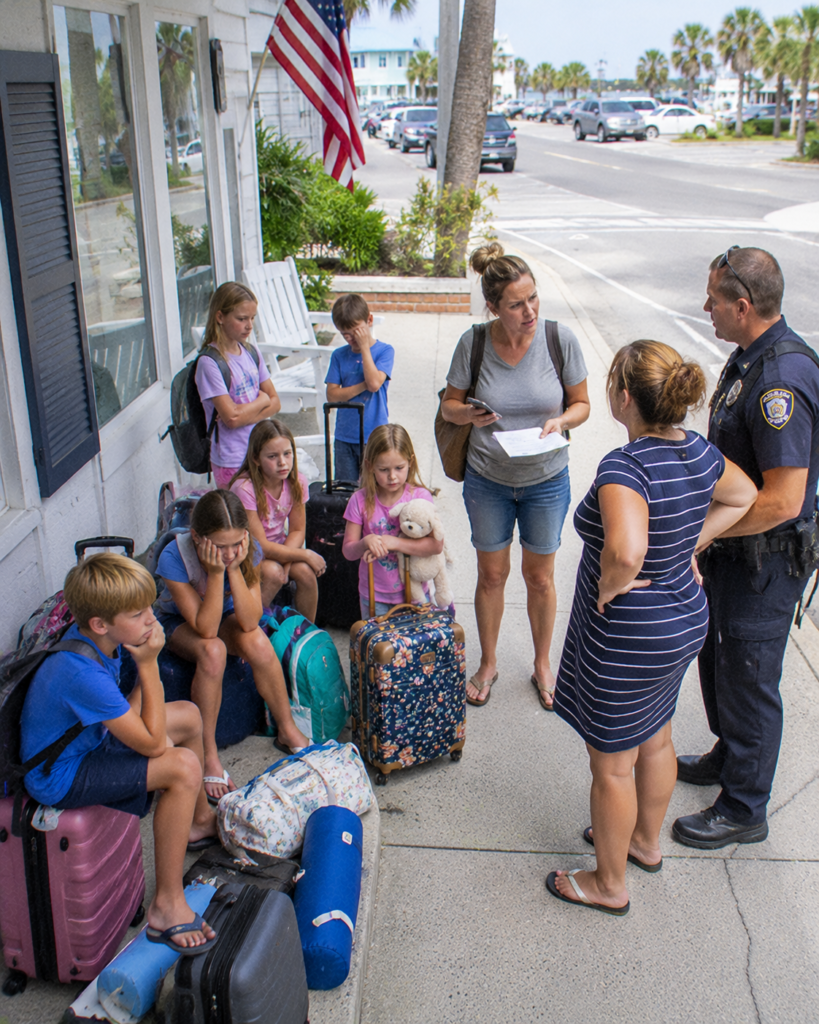
Five small bodies.
Five suitcases.
One blue bag slumped between them.
The rental office sat behind them with its glass door propped open, letting out a cold puff of air every time a guest walked in or out.
The afternoon smelled like hot asphalt, saltwater, sunscreen, and somebody’s French fries from the snack stand across the road.
I remember the sound of a luggage tag scraping against the curb.
I remember thinking Lauren must be inside.
My sister always liked making other people wait.
She liked appearing at the last possible second with sunglasses on her head and a coffee in her hand, acting like everyone else had misunderstood the time.
So for one second, I thought she had gone inside to check in.
Then Maddie saw my car.
She ran to me so fast her little sandals slapped the pavement.
Her face was swollen from crying.
“Aunt Emily,” she gasped. “Mom said you’d be here soon.”
I stepped out of my car and looked past her.
Noah, seven, stood by a hard-shell suitcase with his dinosaur backpack pressed to his chest.
The twins, Ava and Sophie, were sitting on one suitcase together, both red-faced and sticky from heat.
Caleb, who was only three, stood barefoot on the curb, hugging a stuffed rabbit with one ear missing.
The sight of his bare feet did something to me.
Not anger at first.
Worse than anger.
A clear, cold understanding that no normal explanation was coming.
“Where is your mom?” I asked.
Maddie wiped her nose with her sleeve.
“She said she and Uncle Travis had to go to the airport.”
I stared at her.
“What airport?”
Maddie looked confused, like grown-ups were supposed to know these things.
“For Hawaii. She said you promised.”
“Promised what?”
“To take us.”
My phone buzzed in my hand before I could answer.
It was an email from Lauren.
The subject line said Family Trip Update.
That was Lauren all over.
She could drop a bomb and label it like a calendar reminder.
I opened it with Maddie still holding the hem of my shirt.
Emily, don’t be dramatic.
Travis and I desperately need this Hawaii trip.
The kids were too expensive to bring, and you already said you had vacation days.
They have clothes, snacks, and their allergy meds in the blue bag.
We’ll be back in ten days.
Do not call Mom.
Do not make this a scene.
You owe me after everything I’ve done for you.
I read it once.
Then I read it again because some part of me needed the words to rearrange into something less insane.
They did not.
Ten days.
Five children.
No adult.
No shoes on Caleb.
No Lauren.
No Travis.
Just a blue bag of allergy medicine and the expectation that I would swallow the whole thing because that was what I had always done.
Lauren was two years older than me, and our whole childhood had been built around the idea that her emergencies were everyone else’s responsibility.
When she forgot her homework, I shared mine.
When she wrecked Mom’s car at nineteen, I was the one who drove her to work for three weeks.
When she had Maddie, I spent nights on her couch so she could sleep.
She never called it help.
She called it family.
Families like ours teach girls to confuse availability with love.
If you answer every call, they eventually stop asking and start assigning.
I called Lauren.
Straight to voicemail.
I called Travis.
Straight to voicemail.
Then I called our mother.
She answered on the second ring.
“Emily, whatever it is, I’m busy.”
“Did you know Lauren left her five kids outside a rental house and flew to Hawaii?”
There was a silence so sharp I could hear the rental office printer clicking behind me.
Then Mom said, “Don’t overreact.”
I laughed.
It came out broken.
“Mom, Caleb doesn’t even have shoes.”
“She told me you agreed to help.”
“I agreed to meet everyone here for a family beach trip. I did not agree to become emergency childcare while she ran off to Hawaii.”
“Emily,” Mom said, lowering her voice, “calling authorities would destroy your sister.”
I looked at Noah scratching at his arm.
I looked at Ava crying silently.
I looked at Sophie trying to wipe Ava’s face with the bottom of her own shirt.
I looked at Caleb whispering that he was hungry.
“No,” I said. “Lauren did that herself.”
Then I hung up and dialed 911.
The dispatcher asked for the address twice.
My voice was steady because it had to be.
At 2:18 p.m., I reported that five children had been left outside a vacation rental without a parent or guardian.
At 2:21 p.m., I photographed the kids’ suitcases, Caleb’s bare feet, the blue allergy-med bag, and Lauren’s email with the timestamp showing.
At 2:24 p.m., I asked the rental clerk for the office address on a printed receipt.
At 2:27 p.m., I texted Lauren one sentence.
I called the police.
Three dots appeared.
Then disappeared.
Then appeared again.
No reply.
The rental office clerk came outside with a paper coffee cup in her hand.
She looked at the children and went pale.
A family loading beach chairs into a silver SUV slowed down to stare.
Then the father looked away like not seeing it made him less responsible for what was happening.
A small American flag hung beside the rental office door, snapping lightly in the hot wind.
Nobody wanted to be involved.
That is the thing about public cruelty.
People will watch a child cry in broad daylight and still wait for someone else to decide it counts.
The first police cruiser rolled into the lot about twenty minutes later.
Maddie grabbed my sleeve so tightly her nails pinched through my shirt.
“Aunt Emily,” she whispered. “Mom said if we told anyone, you would go to jail.”
I crouched down in front of her.
“You are not in trouble,” I said.
She shook her head.
“She said you would be.”
Before I could ask what else Lauren had said, a black SUV pulled in behind the police car.
The driver’s door opened.
A woman stepped out in a beige blazer.
She had sunglasses in one hand and a folder in the other.
She did not look at Maddie.
She did not look at Caleb’s bare feet.
She looked at me.
That was when I understood my sister had not just abandoned her children.
She had prepared for what would happen when I refused to carry her lie.
The woman introduced herself as Lauren and Travis’s attorney.
She said it loudly enough for the officer to hear.
Then she opened her folder and removed a stack of papers.
“My clients informed me there was a scheduled childcare arrangement,” she said.
The officer’s face did not change much.
But his eyes moved.
From me.
To the children.
To the papers.
And I felt the ground tilt.
The top page was an itinerary.
My name was typed beside approved pickup contact.
The second page was labeled temporary caregiver authorization.
At the bottom, in blue ink, were my initials.
Not my signature.
My initials.
Close enough to suggest permission.
Far enough from real to make me sick.
“That is not mine,” I said.
The attorney did not blink.
“We can let the proper parties review it.”
“You mean the police?” I asked.
Her mouth tightened.
Maddie leaned forward to see the paper.
Then she whispered, “That’s not Aunt Emily’s.”
The attorney’s eyes flashed.
It lasted half a second.
But half a second was enough.
She had not expected one of the children to say anything.
Noah started crying then.
He folded around his dinosaur backpack and kept repeating, “Mom said don’t tell, Mom said don’t tell.”
The officer crouched in front of him.
His voice softened.
“Don’t tell what, buddy?”
Noah shook his head and cried harder.
The attorney tried to speak over him.
I raised my phone.
“Before anyone accepts another piece of paper from her folder,” I said, “you should see what Lauren sent me.”
I opened the email.
I showed the timestamp.
I showed the line about Hawaii.
I showed the line about ten days.
I showed the line that said, Do not call Mom.
The officer stood up slowly.
The attorney’s grip tightened around her folder until the edge bent.
“Ma’am,” the officer said to her, “where exactly did you get those initials?”
For the first time since she stepped out of the SUV, the lawyer had no ready sentence.
The silence spread across the parking lot.
The rental clerk lowered her coffee cup.
One of the guests near the silver SUV whispered, “Oh my God.”
The attorney said, “I received these documents from my clients.”
“When?” the officer asked.
She hesitated.
“This morning.”
“What time?”
Another hesitation.
That was when I knew.
Lauren had not panicked after I called 911.
She had set the trap before she ever left for the airport.
The officer asked me to forward the email to the address on his card.
Then he asked the rental office clerk whether there were cameras facing the curb.
The clerk nodded quickly.
“One above the office door,” she said. “And one facing the lot.”
The lawyer looked at the camera then.
Just once.
Just enough.
I saw it, and so did the officer.
Process has a sound when it starts moving.
A radio crackle.
A notepad flipping open.
A clerk saying she can pull footage.
A child finally breathing because an adult in uniform is asking the right questions.
The officer separated the kids from the lawyer’s side of the conversation.
He asked Maddie simple questions.
Who drove you here?
When did your mom leave?
What did she say?
Maddie answered in pieces.
Lauren had told them it was a surprise vacation.
Then she told them plans changed.
Then she told them Aunt Emily had begged to spend time with them.
Then she told Maddie that if anyone asked questions, she should say Aunt Emily had agreed.
Maddie started shaking halfway through.
I put my arm around her and felt her little body try not to fall apart.
No child should have to decode adult cowardice at nine years old.
No child should be handed a script and told love depends on performing it.
The rental clerk pulled the footage in the office.
We all stood inside while the air conditioner blew cold against my damp shirt.
The screen showed Lauren’s rented van pulling up.
It showed Travis unloading suitcases.
It showed Lauren crouching in front of Maddie and pointing toward the office.
It showed Caleb already barefoot.
It showed Lauren hugging none of them.
Not one.
Then it showed her and Travis getting back into the van and driving away.
The lawyer looked smaller under fluorescent light.
She said, “I was not aware of that sequence of events.”
The officer wrote that down.
Those words mattered.
I was not aware.
Not denial.
Distance.
Self-preservation.
Within an hour, a child welfare worker arrived.
The children were checked for immediate needs.
Caleb got a pair of cheap flip-flops from a beach shop because I refused to let him stand on that pavement another second.
Noah’s arm was washed and examined.
The allergy medication was logged.
The suitcases were counted.
The email was forwarded.
The video was saved.
The printed caregiver authorization went into an evidence envelope because the initials were not mine.
Lauren finally called me at 5:09 p.m.
I let it ring while the officer watched.
Then I answered on speaker.
She did not ask about the kids.
She said, “What did you do?”
That sentence told everyone in the room everything they needed to know.
I said, “I told the truth.”
Lauren started crying, but it was the kind of crying that searched for an audience.
“You have no idea what you’ve done to me,” she said.
The child welfare worker looked at Caleb asleep against my hip.
The officer looked at the phone.
I said, “Lauren, your son was barefoot in a parking lot.”
She snapped, “He takes his shoes off all the time.”
That was the moment Maddie lifted her head.
Her voice was small, but it carried.
“Mom, you told me not to tell about the paper.”
Lauren went silent.
Not confused.
Not shocked.
Caught.
The call ended eight seconds later.
After that, things moved in the slow, heavy way official things move.
Statements.
Reports.
A temporary safety plan.
A relative placement review.
Our mother called me fourteen times and left three voicemails.
The first said I was destroying the family.
The second said Lauren had made a mistake.
The third said I should think about what people would say.
I saved all three.

By 8:40 p.m., the kids were eating chicken fingers and applesauce in a quiet room near the rental office while the child welfare worker made calls.
Caleb fell asleep with his cheek against the one-eared rabbit.
Ava and Sophie curled against each other on two vinyl chairs.
Noah would not let go of his backpack.
Maddie sat beside me and stared at the floor.
“Are you going to jail?” she asked.
“No,” I said.
“Is Mom?”
I did not lie to her.
I said, “I don’t know what happens next. But grown-ups are going to have to answer questions.”
She nodded like that was both terrifying and relieving.
The next morning, Lauren’s Hawaii pictures appeared nowhere.
No smiling airport selfie.
No beach post.
No cocktail with a sunset behind it.
For once in her life, my sister understood that posting the performance could become evidence of the crime.
Travis tried to claim he thought I had agreed.
Then the officer asked why he had blocked my number before boarding.
Lauren tried to claim the authorization had been discussed.
Then the email proved she had told me after the children were already standing outside.
The initials were reviewed.
They were not mine.
The footage showed the drop-off.
The rental clerk gave a statement.
Maddie told the truth.
Noah told enough.
And my mother, when asked whether she had known I agreed to take the children for ten days, finally admitted Lauren had only told her I was helping.
Helping.
That soft little word people use when they know the real one would sound too ugly.
The full case did not end in one dramatic courtroom scene.
Real life rarely gives you the clean satisfaction of a gavel and a gasp.
It ended through reports, interviews, temporary orders, supervised conversations, and a lot of adults being forced to say plain things out loud.
Lauren and Travis did not get to turn abandonment into a misunderstanding.
They did not get to turn forged initials into family confusion.
They did not get to turn five frightened children into luggage someone else was supposed to claim.
For a while, the kids stayed with relatives under a safety plan.
I was part of that plan, but this time the words were written correctly.
My consent was asked for.
My signature was real.
My boundaries were documented.
The first night Maddie stayed with me, she placed the one-eared rabbit on my couch beside Caleb and said, “He gets scared if he wakes up alone.”
I almost cried right there in the hallway.
Instead, I set out water cups, found extra blankets, and made toast because care is sometimes quieter than outrage.
Care is shoes by the door.
Medicine logged on the counter.
A night-light in the bathroom.
A phone left on loud in case somebody wakes up afraid.
Weeks later, Maddie asked me why her mother had said I would go to jail.
I told her some adults say scary things when they want children to stay silent.
She thought about that for a long time.
Then she said, “But I didn’t.”
“No,” I said. “You didn’t.”
She looked down at her hands.
“Was that bad?”
That question hurt more than the email.
More than the lawyer.
More than my mother telling me not to make a scene.
Because an entire afternoon in a parking lot had taught her to wonder if telling the truth was betrayal.
I pulled her close and said, “That was brave.”
And I meant it.
Lauren had wanted five children to stand on a curb and carry her lie.
She wanted me to panic, fold, apologize, and absorb the damage the way I always had.
But she made one mistake.
She underestimated the children.
She underestimated the clerk.
She underestimated timestamps, cameras, emails, and tired women who finally stop confusing silence with love.
Most of all, she underestimated what happens when the person everyone calls dramatic starts documenting instead.
I still think about that small American flag by the rental office door.
I think about it snapping in the wind while five children waited with suitcases at their feet.
It was not a grand symbol that day.
It was just cloth on a pole beside a glass door.
But under it, in the bright heat of that parking lot, the truth became harder to ignore.
Lauren had left them there.
The papers were not mine.
And for the first time in our family, someone else had to carry the weight of what she had done.