The photograph was not of Lucas.
That was the first thing my mind registered, and for one strange second, relief flickered through me.
Then I looked closer.
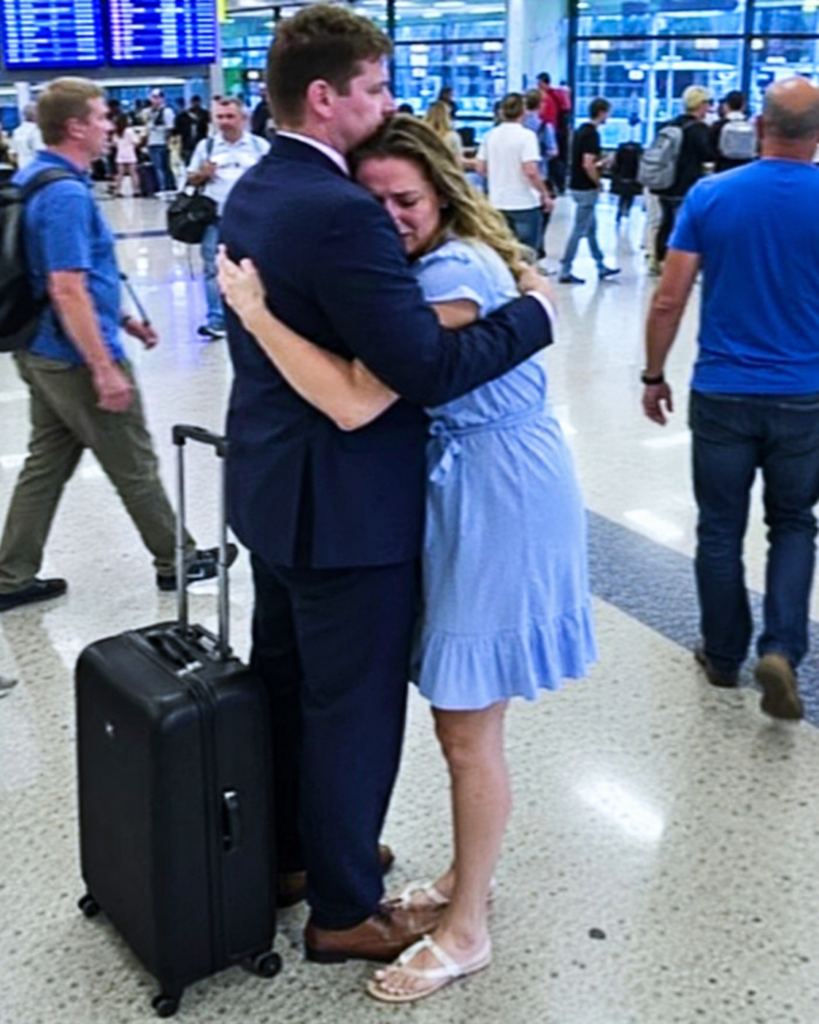
It was a picture of our house.
Our front door.
Our porch.
Taken from across the street, slightly angled, as though whoever had taken it had been sitting in a parked car under the maple tree near Mrs. Bellamy’s mailbox.
My breath caught.
The photo showed me and Lucas leaving the house together that morning, each of us dressed for the airport. Lucas was smiling. I was looking down, pretending to search for something in my purse. It was ordinary enough, almost dull.
Except someone had been watching us.
I enlarged the image with trembling fingers.
In the reflection of the living room window, barely visible behind the porch column, was a figure standing near the side gate.
A woman.
Dark coat. Sunglasses. One hand resting on her rounded stomach.
Melanie Harper.
I stared until my eyes burned.
My phone buzzed again.
Another message.
“Don’t transfer the money yet.”
The room seemed to tilt.
I looked from the phone to my laptop screen, where the confirmation button still waited.
$720,000.00
One click.
One second.
A decision that could change everything.
I wanted to press it. Every instinct in me screamed to protect what was mine before Lucas could touch it. But the message had sliced cleanly through my anger and left uncertainty behind.
Who was this person?
How did they know what I was about to do?
My thumb hovered over the keyboard.
“Who is this?” I typed.
Three dots appeared almost immediately.
Then disappeared.
Then appeared again.
Finally, the reply came.
“Someone who knows Lucas is not the only one lying.”
I sat down slowly.
The house felt different now. Too quiet. Too open. I suddenly noticed every small sound: the refrigerator humming in the kitchen, the faint tick of the wall clock, the distant bark of a dog somewhere down the street.
For three days, I had believed I understood the shape of the betrayal. Lucas had lied. Lucas had planned to leave. Lucas had a pregnant mistress. Lucas wanted our money.
It was ugly, but it was simple.
Now, suddenly, nothing felt simple.
My phone rang.
Unknown number.
I let it ring twice, watching the screen as though it might reveal the caller’s face if I stared hard enough.
On the third ring, I answered.
For a moment, no one spoke.
Then a woman’s voice said, “Anne?”
It was quiet. Careful. Not young, not old. Maybe my age. Maybe a little older.
“Yes,” I said.
“You don’t know me.”
“That’s obvious.”
“I know this is frightening.”
A laugh escaped me, sharp and humorless. “You texted me a photo of my house and told me not to touch my own money. Frightening is one word for it.”
“I’m sorry.”
“Who are you?”
A pause.
“My name is Grace.”
The name meant nothing to me.
“How do you know Lucas?”
“I don’t. Not really.”
“That’s not an answer.”
“No,” she admitted. “It isn’t.”
I stood up again, unable to sit still. My eyes went to the study window. The curtains were open. Anyone outside could see me standing there, phone pressed to my ear, laptop glowing on the desk.
I walked over and pulled the curtains shut.
Grace heard the rings slide across the rod.
“Good,” she said softly.
My skin prickled. “Are you watching me right now?”
“No.”
“Were you watching me this morning?”
“Yes.”
The honesty was so blunt it silenced me.
“Why?”
“Because I needed to make sure Lucas actually left.”
Something cold moved through my chest.
“He left,” I said. “He got on the plane.”
“To San Diego,” she replied.
I closed my eyes.
Not Zurich.
Not even Palm Springs directly.
San Diego.
“He had a connection,” she continued. “A private car booked from there. Palm Springs by evening.”
I tightened my grip on the phone. “How do you know that?”
“Because I’ve been following his arrangements for six weeks.”
The room seemed suddenly smaller.
I looked at the laptop again. The bank screen had dimmed. The confirmation button was still there, waiting like a trap.
“Grace,” I said slowly, “you have about ten seconds to explain why I shouldn’t call the police.”
“You probably should,” she said. “Eventually.”
“Eventually?”
“Not before you look in your safe.”
My eyes shifted toward the hallway.
We had a safe in the back of the coat closet. Fireproof, heavy, bolted into the floor. Lucas kept passports there, insurance documents, property papers, birth certificates. I hadn’t opened it in months.
“What’s in my safe?”
“That depends on what he removed.”
I swallowed.
“Removed?”
“Lucas was at your house yesterday afternoon while you were at the dentist.”
I said nothing.
I had gone to the dentist at two. Lucas had told me he was at the office tying up loose ends before his so-called international transfer.
“He left with a folder,” Grace said. “Blue. Legal size.”
“How do you know?”
“Because I was parked outside.”
The anger returned, but now it had nowhere clean to land.
“You were stalking my husband.”
“I was trying to understand what he was doing.”
“Why?”
“Because my sister is Melanie Harper.”
That name dropped between us like glass breaking.
For a few seconds, I could not speak.
I had imagined Melanie in fragments: the other woman, the smiling coworker in holiday party photos, the person Lucas texted too late at night, the woman who had taken what was mine. I had not imagined her having a sister. A family. Someone worried enough to follow her.
Grace exhaled shakily.
“Anne, I know what you found on his laptop. I know about the condo. I know about the pregnancy. But there are pieces you don’t have.”
My voice came out quieter than I expected.
“Is Melanie with him?”
“No.”
That surprised me.
“She isn’t?”
“She thinks he’s in Zurich.”
I sat back down.
For a while, neither of us spoke.
The clock ticked on the wall.
Outside, a car passed slowly down the street, its engine fading into afternoon silence.
Finally, I said, “You need to start from the beginning.”
Grace gave a small, tired laugh.
“I wish I knew where the beginning was.”
“Try.”
Another pause.
“My sister met Lucas last year at a professional development conference in Boulder. She works in commercial design. He was charming. Funny. Attentive. Exactly the kind of man who makes you feel like the room has narrowed around you.”
I hated how well I understood that.
Lucas had made me feel that way once.
When we first met at a charity auction five years earlier, he had seemed almost impossibly present. He remembered small details. He asked questions and listened to the answers. On our third date, he brought me tea from a shop I’d mentioned only once. When my father died, he became patient and gentle in a way that felt like shelter.
He had built himself carefully.
Or maybe he had built whatever each woman needed.
Grace continued. “Melanie told me he was separated.”
My mouth tightened.
“Of course he did.”
“She didn’t know about you at first.”
“And then?”
“She found out four months ago.”
My heart gave a dull thud.
Four months.
Four months of knowing.
“Did she care?”
Grace did not answer quickly. That, at least, I respected.
“She cried for two days,” she said at last. “Then Lucas told her you knew the marriage was over. That the two of you were quietly dividing things. That he didn’t want to upset you publicly before his work transition.”
I looked around my study, at the framed photograph on the bookshelf from our trip to Santa Fe. Lucas’s arm around my shoulders. My head turned toward him, laughing at something he had said.
Quietly dividing things.
“He told her I was emotionally fragile, didn’t he?”
Grace’s silence was enough.
I smiled without humor.
“He always did like making women feel like someone needed protecting.”
“I’m not defending her,” Grace said. “I’m just telling you what she believed.”
“And now?”
“Now I don’t know what she believes. She won’t speak to me.”
“Why?”
“Because I told her Lucas was lying.”
I closed the laptop without completing the transfer.
The sound seemed louder than it should have been.
Grace noticed.
“You didn’t move the money?”
“No.”
“Good.”
“Don’t mistake that for trust.”
“I don’t.”
I stood and walked toward the hallway.
The coat closet door stuck slightly, as it always did in dry weather. I pulled it open, pushed aside winter jackets, and crouched before the safe.
My fingers moved over the keypad.
My birthday.
Lucas had insisted it was too obvious. I had joked that burglars didn’t know my birthday. He had smiled and said, “I do.”
The safe clicked.
Inside, at first, everything seemed normal.
Passports.
House deed.
Insurance files.
A small velvet box containing my mother’s pearl earrings.
Then I noticed the gap.
The blue legal folder was gone.
I remembered it immediately. My father’s estate documents. Copies of trust paperwork. Records showing the inheritance had been mine before the marriage.
My throat tightened.
“He took the folder,” I said.
Grace inhaled on the other end of the line.
“Then he’s further along than I thought.”
“What does that mean?”
“It means he isn’t only planning to leave you. He may be planning to argue that the money was marital property.”
I sank back on my heels.
“That won’t work,” I said, though I wasn’t sure.
“Maybe not. But it could delay things. Freeze things. Pressure you.”
I thought of Lucas in first class, perhaps sipping wine, perhaps texting me some tender message from thirty thousand feet.
I thought of him taking that folder from the safe with hands that had once held mine in hospital waiting rooms and hotel balconies and quiet kitchens.
A strange grief rose in me then, different from rage.
It was not grief for losing him.
It was grief for realizing I had not known the person who lived beside me.
“Anne?” Grace said.
“I’m here.”
“You need a lawyer before you touch the money.”
I laughed under my breath. “That sounds suspiciously sensible for a stranger who just admitted to watching my house.”
“I know how this sounds.”
“No, I’m not sure you do.”
“I’m trying to help my sister,” she said. “And maybe you, too.”
“Why?”
“Because Lucas told Melanie you were greedy. Cold. Difficult. He said you would destroy him financially just to punish him.”
I closed the safe and leaned against the wall.
“And you believed him?”
“No,” Grace said quietly. “Because that was almost exactly what my ex-husband used to say about me.”
For the first time, her voice cracked.
Not dramatically. Just enough for me to hear a person behind the warning.
“I know the difference between a complicated marriage and a story designed to make one person look unreasonable,” she said. “Lucas’s story was too clean.”
I stayed there on the floor for a long moment, my knees tucked beneath me, the phone warm against my ear.
“What do you want from me?” I asked.
“I want you to meet me.”
“No.”
“Anne—”
“No. You’ve been watching my house, tracking my husband, texting me cryptic warnings. I’m not meeting you anywhere.”
“Fair.”
That took some of the force out of me.
“Fair?”
“Yes. That’s fair.”
I heard papers rustle on her end.
“I’ll email you what I have. Flight details. Lease records. Screenshots. Messages Melanie showed me before she cut me off. Some financial information, though not enough.”
“How did you get my email?”
“Lucas gave it to Melanie.”
I closed my eyes.
Of course he had.
Not because he wanted us to speak. Because he had probably shown Melanie carefully selected messages from me, curated proof of the wife he had invented.
“Send it,” I said.
“And Anne?”
“What?”
“Check your joint account again.”
My eyes opened.
“Why?”
“Because the wire request Lucas scheduled might already be pending.”
I ended the call without saying goodbye and ran back to the study.
The banking site asked me to log in again.
My fingers were less steady now.
Password.
Security code.
Account summary.
For one merciful second, the balance still read $720,000.00.
Then I clicked into activity.
There it was.
Pending transfer: $350,000.00
Scheduled for processing at 5:00 p.m.
Recipient: Desert Horizon Property Holdings.
My ears began to ring.
Not the full amount.
Not yet.
Just enough for a down payment, perhaps. Or furniture. Or a business account. Or whatever story he had told himself made it acceptable.
I looked at the time.
3:42 p.m.
I called the bank.
The hold music felt endless. Cheerful piano notes played while my marriage collapsed in scheduled transactions.
When a representative finally answered, I explained as calmly as I could that I needed to stop a pending transfer from a joint account.
“I can certainly look into that for you,” the woman said in a polished voice. “May I verify your identity?”
I answered questions.
Mother’s maiden name.
Last four digits.
Security phrase.
Then silence while she reviewed the account.
“I do see the scheduled transfer,” she said. “Because this is a joint account, either account holder can initiate transactions. However, since it has not processed, I can place a temporary hold pending fraud review.”
“Do that.”
“I’ll need to ask whether you believe the other account holder is acting fraudulently.”
I looked at the wedding photo on my desk.
Lucas in a navy suit.
Me in ivory lace.
His hand at my waist.
Both of us smiling as though the future were something we had agreed on.
“Yes,” I said. “I do.”
The word felt heavier than expected.
The representative’s tone changed, becoming softer but more formal.
She explained that the account would be restricted. No outgoing transfers without additional verification. She advised me to consult an attorney immediately. She gave me a case number, repeated it twice, and told me I would receive documentation by email.
When the call ended, I remained at the desk, pen still in hand, staring at the case number written across the back of an old grocery receipt.
That was when Lucas texted.
“Boarding went smoothly. I miss you already. Don’t forget to eat something, okay? Love you.”
For a moment, I simply looked at the message.
There were so many things I could have written.
Where are you really?
Who is Melanie?
Why did you take my father’s papers?
Instead, I typed, “I miss you too. Safe flight.”
Then I set the phone face down.
It felt less like deception than self-defense.
Grace’s email arrived twenty minutes later.
The subject line read: Documents.
No greeting.
No explanation.
Just attachments.
I opened them one by one.
Screenshots of messages between Lucas and Melanie.
“My marriage has been over for years.”
“Anne understands but can’t let go.”
“Once Zurich is settled, everything will be easier.”
“I hate leaving you to handle this pregnancy alone.”
“Two years and we’ll be free.”
That line made me pause.
Two years.
I had assumed Lucas used that length of time because it sounded believable for a foreign assignment. Long enough to explain absence. Not forever, not immediately suspicious.
But in his messages to Melanie, two years appeared again and again.
Two years and we’ll be free.
Free from what?
I opened the next attachment.
A lease agreement for the Palm Springs condominium. I had seen it before, but this copy had an additional page.
Occupants: Lucas Everett, Melanie Harper.
Expected move-in date: July 1.
Emergency contact: Grace Harper.
Grace’s name had been crossed out by hand.
Beside it, in Lucas’s handwriting, was another name.
Daniel Voss.
I stared at it.
I did not know the name.
The next attachment was a photo of a business card.
Daniel Voss
Private Wealth Strategy Consultant
Voss Meridian Advisory
Below that was an address in San Diego.
A strange pressure built behind my ribs.
Private wealth strategy consultant.
It sounded respectable enough to be meaningless.
The final attachment was a scanned handwritten note, apparently photographed quickly. The image was slightly blurred, but I could read most of it.
“L—
Do not let A. move funds before conversion. Once asset classification is complete, timeline holds. D.V. says pressure must look voluntary. Zurich story buys time. M. must remain calm. No direct conflict until documents are secured.”
I read it once.
Then again.
A. Anne.
L. Lucas.
M. Melanie.
D.V. Daniel Voss.
The anger I had been holding hardened into something steadier.
Lucas was not improvising.
Someone was advising him.
I called the only person I trusted with legal matters: my father’s old attorney, Miriam Kell.
She was seventy-one, sharp-eyed, and had once told me that most disasters became less frightening when sorted into folders. My father had adored her. As a child, I remembered her visiting our house with thick files under one arm and lemon candies in her purse.
She answered on the fourth ring.
“Anne,” she said warmly. “It’s been a while.”
At the sound of her voice, my composure nearly cracked.
“Miriam, I need help.”
The warmth vanished, replaced by focus.
“Are you safe?”
“Yes.”
“Good. Start there.”
So I did.
Not with every emotion. Not with the humiliation or the airport goodbye or the way Lucas had kissed my forehead while planning to empty our life behind my back.
I gave her facts.
Zurich.
Palm Springs.
Melanie.
Pregnancy.
Joint account.
Missing estate folder.
Pending transfer.
Daniel Voss.
Miriam listened without interrupting except to ask dates, names, amounts.
When I finished, she was silent for several seconds.
Then she said, “Do not move the full balance today.”
“I almost did.”
“I understand why. But moving all of it could create complications, especially if he claims you acted punitively. We are going to be precise.”
“What do I do?”
“First, preserve everything. Screenshots, emails, text messages, bank records. Do not alter or delete. Second, open a new individual account at a different institution if you don’t already have one, but we will decide what to transfer after reviewing the source of funds. Third, I want you to come to my office tomorrow morning.”
“Miriam, the folder from Dad’s estate is gone.”
“I have copies.”
Relief hit so fast I had to grip the desk.
“You do?”
“Of course I do. Your father was a cautious man.”
My eyes filled unexpectedly.
For the first time all day, the tears were not performance.
“I should have called you sooner,” I whispered.
“You are calling now.”
That was Miriam. No wasted comfort. No scolding. Just the next step.
“Anne,” she said, “I need to ask something delicate.”
“All right.”
“Did Lucas ever ask you to sign anything recently? Anything he presented as routine?”
I frowned.
“He asked me to sign updated tax documents last month. I didn’t really read them. He said our accountant needed them.”
“What exactly did you sign?”
“I don’t know.”
“That becomes our first priority.”
After we ended the call, I sat very still.
The house had begun to darken around me. Afternoon slipped toward evening, stretching shadows across the floor. The rooms were neat, familiar, almost serene. There were two coffee mugs in the sink. Lucas’s old running shoes by the mudroom door. A half-read mystery novel on his nightstand.
Marriage was strange that way.
Even when trust died, ordinary things remained.
I went upstairs.
In our bedroom, Lucas had left his side almost bare. Closet half-empty. Dresser drawers pulled clean. The missing spaces looked accusing.
I opened the drawer of his nightstand.
Nothing.
Then the closet shelves.
Nothing but a few shoeboxes and a stack of sweaters he claimed were too bulky to pack.
In the bathroom, his shaving cream remained beside the sink.
I picked it up, then set it back down.
A ridiculous thought crossed my mind: he had left enough behind to make the lie believable. Enough to suggest return. Not enough to inconvenience himself.
I sat on the edge of the bed.
The last time I had been in this room with him, he had held my suitcase while I searched for my earrings. He had watched me in the mirror.
“You okay?” he had asked.
I had nodded.
He had stepped behind me and rested his hands on my shoulders.
“You look pale.”
“I didn’t sleep much.”
“I know this is hard.”
I remembered the concern in his eyes.
I remembered wanting to scream.
Instead, I had said, “It will be harder when you’re gone.”
He had kissed the top of my head.
The tenderness of the gesture had been the cruelest part.
Now, alone in the room, I wondered whether any of it had ever been real.
Not all of it could have been false, could it?
There had been Sunday mornings making pancakes. Snowstorms by the fireplace. The night my father died and Lucas held me while I shook so hard I could barely breathe.
Were those lies too?
Or had he loved me in the only way he knew how—until wanting something else became more important than the promises he made?
My phone rang again.
This time the caller ID showed Lucas.
My stomach tightened.
I let it ring once.
Twice.
Then answered.
“Hi,” I said.
“Hey, sweetheart.”
His voice was smooth, warm, familiar.
I closed my eyes.
“Where are you?”
“Still in transit. Long day.”
Not a lie, technically.
“Are you tired?”
“A little. Mostly missing you.”
I looked at the empty half of the closet.
“Me too.”
There was a pause.
“You sound strange.”
“I’ve been crying.”
That part was true.
“Oh, Anne.” His voice softened. “Please don’t do this to yourself.”
Do this to yourself.
Not grieve.
Not miss me.
Do this to yourself.
The phrasing landed with a small, precise sting.
“I’ll be okay,” I said.
“You sure?”
“Yes.”
“Did you eat?”
“No.”
“You need to. Promise me.”
I nearly laughed.
He was still playing husband. Still placing small tokens of care like coins in a jar.
“I promise.”
“Good. Also, I meant to say, there may be a large transfer coming out of the joint account. It’s related to the Zurich relocation.”
My eyes opened.
“There is?”
“Yeah, some housing and tax setup. It’s complicated, international stuff. I didn’t want to burden you.”
His ease frightened me more than panic would have.
“How large?”
“I’m not sure yet. A few hundred thousand maybe, but it’s temporary. Reimbursable.”
I walked to the window and looked out at the quiet street.
“Lucas, that sounds like something we should discuss.”
“We did discuss it. Remember? The relocation package? The financial restructuring?”
“No,” I said carefully. “I don’t remember discussing several hundred thousand dollars.”
A silence.
It lasted only a second, but I heard the change in him.
“Anne,” he said, patient now, “we talked about this last week.”
“No, we didn’t.”
“Maybe you were overwhelmed.”
There it was.
The shift.
Gentleness becoming correction.
Memory becoming negotiable.
“Maybe,” I said.
“I sent some documents too. You signed them.”
My heart beat once, hard.
“What documents?”
“Just authorizations. Nothing serious. The accountant has copies.”
Miriam’s warning echoed in my mind.
“Can you send them to me?”
A faint laugh. “Right now? I’m traveling.”
“When you can.”
“Of course.”
Another pause.
“Is something wrong?”
I looked at my reflection in the window. Pale face. Dark eyes. A woman learning, in real time, how not to reveal herself.
“No,” I said. “I’m just tired.”
His voice warmed again. “Sleep tonight. We’ll talk tomorrow.”
“Okay.”
“I love you.”
I forced the words out.
“I love you too.”
When the call ended, I did not cry.
Instead, I opened my notes app and wrote down everything he had said.
Then I emailed it to myself.
Then to Miriam.
By seven o’clock, the bank confirmed the pending transfer had been placed under review.
At seven-thirty, Grace texted again.
“Melanie is missing.”
I stood in the kitchen holding a bowl of soup I had microwaved but not eaten.
“What do you mean missing?” I typed.
“She left her apartment this afternoon. Phone off. Car gone. Her neighbor says she had a suitcase.”
My first reaction was not sympathy.
I am not proud of that.
My first reaction was suspicion.
“Maybe she went to meet Lucas,” I wrote.
“No. She left before his plane landed.”
“You don’t know that.”
“She sent me one message at 2:11.”
Grace sent a screenshot.
Melanie: “You were right. I found something. I need to think.”
Grace: “Where are you?”
Melanie: “Don’t call Lucas.”
Grace: “Mel, what did you find?”
Melanie: “Ask Anne about Laurel House.”
I stared at the final words.
Laurel House.
The name meant nothing.
Nothing at all.
And yet something about it stirred uneasily at the edge of memory, like a melody heard through a wall.
I typed, “What is Laurel House?”
Grace replied, “I was hoping you knew.”
I sat at the kitchen table.
The soup cooled in front of me.
I searched my email.
Laurel House.
Nothing.
I searched Lucas’s old messages on my phone.
Nothing.
I searched our shared cloud storage.
For several minutes, only unrelated documents appeared: insurance forms, travel itineraries, home repair receipts.
Then one result surfaced.
An image file.
No title except a date from eight years ago, three years before I met Lucas.
I opened it.
It was a scanned photograph of a building.
A large white house with green shutters and a wraparound porch, set back from a road lined with laurel hedges. The image looked old, slightly faded. On the back, someone had written in blue ink:
Laurel House, May 1998.
I enlarged the photo.
There were four people standing on the porch.
A middle-aged couple I didn’t recognize.
A teenage boy with sandy hair.
And a little girl in a yellow dress.
I leaned closer.
The boy was young, but unmistakable.
Lucas.
My fingers went cold.
Why did we have this photo?
Why had Lucas never mentioned Laurel House?
I sent the image to Grace.
Her response came a minute later.
“Anne, the girl in the yellow dress is Melanie.”
For a moment, the kitchen disappeared.
All sound faded.
I looked at the photograph again.
Lucas, perhaps sixteen or seventeen, stood with his hands in his pockets, shoulders angled away from the others. Melanie, maybe six years old, clutched a stuffed rabbit against her chest.
They had known each other as children.
Lucas had not met Melanie last year at a conference.
He had lied about that too.
Grace called immediately.
I answered, still staring at the photograph.
“Where did you get this?” she demanded.
“Our shared cloud storage.”
“Why would Lucas have this?”
“I don’t know.”
“My parents never told me he knew us.”
“Are those your parents in the photo?”
“No.” Her voice shook. “That’s the problem.”
I waited.
Grace breathed unsteadily.
“The woman is my mother’s sister. My aunt Caroline. The man is her husband, Peter.”
“And Laurel House?”
“It was their home.”
“Was?”
“They sold it after the investigation.”
“What investigation?”
Silence.
Then Grace said, “Anne, my aunt Caroline disappeared in 1998.”
I gripped the edge of the table.
“She disappeared from Laurel House?”
“Yes.”
“And Lucas was there?”
“I don’t know. I was only nine. Melanie was six. Our family didn’t talk about it. We were told Caroline left after a breakdown.”
“And did she?”
Grace’s answer was barely above a whisper.
“No one ever found her.”
The soup on the table had gone completely cold.
I looked at the photograph again.
Lucas’s young face.
Melanie’s small hand clutching the rabbit.
The adults on the porch, frozen in a moment that suddenly felt less like a family picture and more like evidence.
“Why would Melanie tell you to ask me?” I said.
“I don’t know.”
But I heard it in Grace’s voice.
She was afraid she did know.
The doorbell rang.
The sound tore through the house.
I stood so quickly the chair scraped the floor.
“Anne?” Grace said.
“Someone’s here.”
“Don’t open it.”
I walked toward the front hall, phone pressed to my ear.
Through the narrow glass beside the door, I saw a delivery envelope leaning against the mat.
No person.
No truck.
Just the envelope.
My name was written across the front in black marker.
ANNE EVERETT
“Grace,” I whispered, “there’s a package.”
“Leave it.”
But I was already unlocking the door.
The porch was empty. The street quiet. The air smelled faintly of rain and cut grass.
I picked up the envelope and shut the door quickly behind me.
Inside was a single key.
Old brass.
And a folded piece of paper.
The handwriting was unfamiliar.
But the message was clear.
“Your husband did not choose Melanie by accident. Laurel House is where this began. Ask Miriam what your father knew.”
I read it once.
Then again.
My father.
The room swayed.
My father had known about Laurel House?
My father, who had welcomed Lucas into our family.
My father, who had trusted him.
My father, whose estate documents Lucas had stolen.
I turned the paper over.
On the back was an address in Palm Springs.
Not the luxury condominium.
A different address.
And beneath it, one final line:
“Melanie is there, but she is not alone.”
END OF PART 2 – LIKE, SHARE AND COMMENT “THE ENTIRE STORY” IF YOU WANT TO READ THE FULL STORY