The detective did not look away from the screen.
Neither did I.
The garage camera had frozen on a woman standing beside my daughter’s car, one hand holding Rachel’s phone and the other gripping a spare key fob.
Sunlight struck the diamond bracelet beneath her sleeve.
I knew that bracelet.
Everyone in the room knew it.
Tyler’s mother, Evelyn, wore it so often that it had become part of her identity.
She wore it to charity luncheons, Christmas dinners, Lily’s baby shower, and the hospital the night my granddaughter was born.
She liked to tell people it had belonged to Tyler’s grandmother, though Rachel once discovered it had been purchased at an estate auction only six years earlier.
Evelyn never let facts interfere with the image she preferred.
On the recording, she leaned toward the open driver’s door.
Rachel was visible behind the wheel, confused and slow, trying to push Evelyn’s hand away.
Tyler stood several feet back.
Vanessa hovered near his SUV.
Then Evelyn removed Rachel’s phone, took the key fob, and spoke clearly enough for the camera microphone to capture every word.
“Leave the baby inside.
It makes her breakdown look believable.”
Tyler’s face had turned the color of paper.
Vanessa covered her mouth with both hands.
The detective, Mara Chen, pressed play.
Evelyn closed Rachel’s door and activated the car’s double-lock setting with the spare fob.
Rachel pulled weakly at the interior handle.
It did not open.
Tyler stepped forward.
“Mom, that’s enough.”
“Then take your wife home,” Evelyn replied.
“She won’t sign.”
“She will after she understands what happens to unstable mothers.”
Vanessa said something the microphone did not catch.
Evelyn turned sharply toward her.
“You wanted him,” she said.
“Now stop pretending you have a conscience.”
The three of them got into Tyler’s SUV.
They drove away.
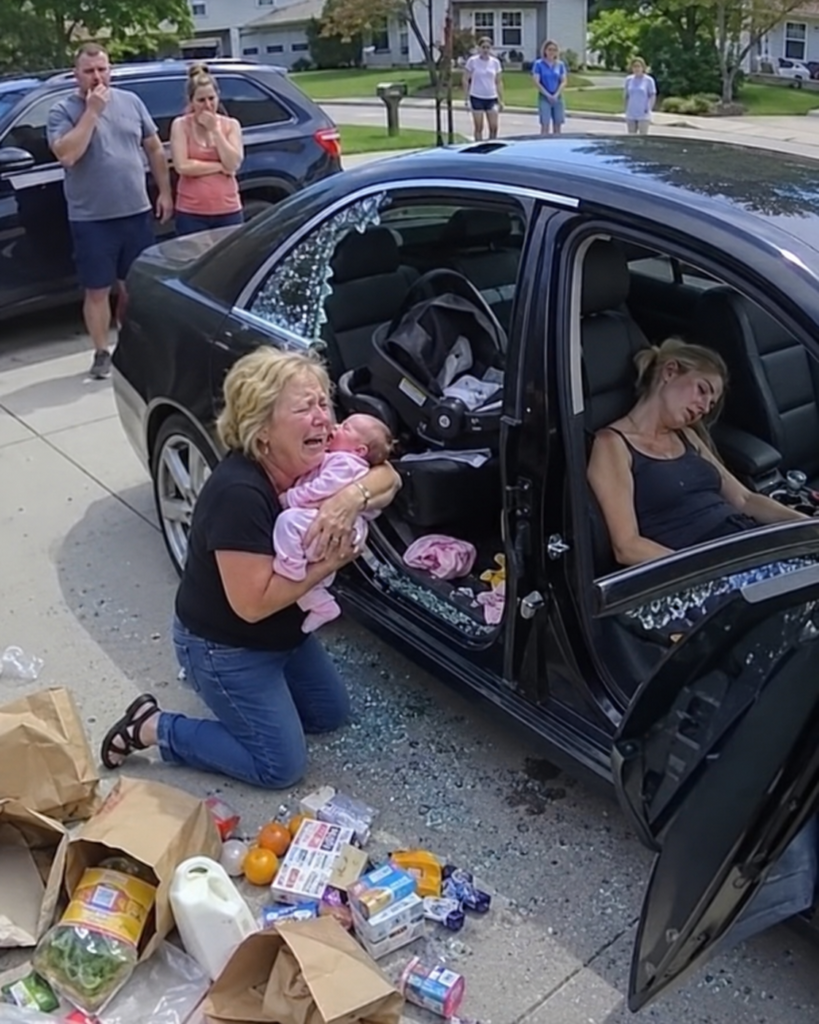
Rachel and Lily remained in the sealed car beneath the sun.
For nearly thirty seconds after the video ended, no one spoke.
Then my front door opened.
Evelyn walked into my house with a lawyer beside her and a leather folder tucked beneath one arm.
She wore cream trousers, low heels, and the composed expression she used whenever she expected a room to rearrange itself around her.
Her gaze moved from Detective Chen to the computer screen.
For one unguarded second, fear crossed her face.
Then she looked at Tyler.
“You were supposed to erase that camera.”
Her lawyer seized her elbow.
“Evelyn, do not say another word.”
But she already had.
Detective Chen stepped between Evelyn and the doorway.
“Mrs.
Langford, please place your purse on the desk and keep your hands where I can see them.”
Evelyn gave a small, incredulous laugh.
“This is absurd.
My daughter-in-law had an episode.
We were trying to protect the baby.”
“By locking both of them inside a vehicle?”
“That is not what happened.”
“We just watched it happen.”
Evelyn’s lawyer straightened.
“A private recording can be manipulated.
Until its authenticity is established, my client will not answer questions.”
Evelyn placed the leather folder on my late husband’s desk as though she were presenting the final word in an argument.
Inside was an emergency custody petition.
It described Rachel as unstable, delusional, careless, and potentially dangerous to her infant.
It claimed Tyler traveled frequently for work and asked the court
to appoint Evelyn as Lily’s temporary guardian.
The petition had been prepared two days earlier.
It had been signed that morning.
Hours before Rachel was found inside the car.
“You planned this,” I said.
Evelyn looked at me with practiced pity.
“I planned to protect my granddaughter from a woman who is clearly overwhelmed.”
My phone rang.
It was the hospital.
The nurse identified herself and asked whether I was somewhere private.
I told her a detective was standing beside me and put the call on speaker.
“Rachel’s toxicology results are back,” she said.
“We detected a prescription sedative in her blood.
The concentration was high enough to impair coordination and judgment, but not high enough to render her immediately unconscious.
Combined with heat exposure, it could have been fatal.”
I looked toward the empty electrolyte bottle visible on the paused recording.
Detective Chen looked at Evelyn.
“Do you have the spare key fob?”
“Of course not.”
“Then you will not object to a search.”
Evelyn’s right hand moved instinctively toward her coat pocket.
That was enough.
Detective Chen instructed her to remain still.
A uniformed officer retrieved the key fob from the pocket, sealed it in an evidence bag, and then found Rachel’s phone inside Evelyn’s purse.
Evelyn stopped smiling.
Her lawyer said she was being detained illegally.
Detective Chen replied, “Your client is on video taking property from an incapacitated woman, locking her and an infant inside a vehicle, and leaving the scene.
We have the victim’s phone in her purse and the vehicle key in her pocket.
She is not leaving.”
Tyler backed toward the wall.
“I didn’t know she put anything in the drink.”
Evelyn turned on him so quickly that even her lawyer flinched.
“Be quiet.”
“You said it would calm Rachel down.”
“Tyler.”
“You said we only needed her confused long enough to sign the papers.”
Detective Chen faced him.
“You should also stop speaking until you have an attorney.”
Tyler stared at the floor.
Vanessa began to cry.
It was not dramatic crying.
There were no sobs or shaking shoulders.
Tears simply rolled down her face as she stood beneath the garage light, looking at the recording of a baby trapped in a car she had walked away from.
“I thought Evelyn was going to bring them inside,” she whispered.
I felt no sympathy for her.
“You watched her lock the doors.”
Vanessa closed her eyes.
“Tyler told me Rachel had taken medication before.
He said she was pretending to be helpless so he wouldn’t leave her.”
“And Lily?” I asked.
“What did you tell yourself about Lily?”
She had no answer.
The police separated all three of them.
Evelyn was taken into custody that night.
Tyler and Vanessa were transported separately for questioning.
The computer, security recorder, electrolyte bottle, custody petition, Rachel’s phone, and both vehicle key fobs were collected as evidence.
I returned to the hospital just before midnight.
Lily was sleeping beneath a lightweight blanket, monitored by a nurse who checked her temperature every few minutes.
The doctors believed she would recover without permanent injury, but they wanted to observe her overnight.
Rachel was awake.
Her voice was weak, and she looked smaller than she had that morning.
When I entered, she reached for my hand.
“Lily?”
“She’s safe.”
Rachel
closed her eyes, and tears slipped into her hair.
I did not tell her to be strong.
I did not tell her everything would be fine.
I had spent too many years as a school administrator watching frightened children forced to comfort adults with optimistic lies.
I simply held her hand and told her what was true.
“You are not alone.”
She remembered more than Tyler expected.
That afternoon, Tyler had told her he wanted to discuss their marriage at my house because it was “neutral ground.” He brought Vanessa with him, claiming honesty required everyone to be present.
Rachel had refused to leave Lily with Evelyn, so she brought the baby along.
Inside Tyler’s SUV, Evelyn handed Rachel an electrolyte drink and said she looked dehydrated.
Rachel took several sips.
Within twenty minutes, she felt dizzy.
When they arrived at my house and discovered I was gone, Evelyn produced the custody petition.
She told Rachel to sign a statement admitting she had experienced dangerous thoughts after giving birth.
In exchange, Evelyn promised the document would remain private and Tyler would continue paying household expenses during the divorce.
Rachel refused.
Tyler told her she had no income, no legal fund, and no proof of his affair that could not be dismissed as stolen private messages.
Vanessa stood beside him and said, “Dragging this out won’t make him love you again.”
Rachel tried to call me.
Evelyn took her phone.
By then, the sedative had begun affecting her balance.
They guided her into her own car, claiming she needed to sit down.
Evelyn placed the baby carrier in the back seat.
Rachel realized something was wrong when Tyler removed the diaper bag and set it on the floor beyond her reach.
“My husband and his mistress,” Rachel whispered to me in the hospital.
“I was trying to say they brought me there.
But Evelyn locked the car.”
She remembered Tyler objecting once.
Not because he feared for Rachel or Lily.
Because he feared what would happen if someone saw them.
Evelyn had assured him that I would not return until evening.
She knew my pharmacy routine.
She knew I usually stopped at the market and then visited my sister on Sundays.
What she did not know was that my sister had canceled lunch because of a migraine.
That small change saved two lives.
Over the next week, the investigation uncovered the rest.
Tyler had been moving money from the marital account for months.
He had charged hotel rooms, jewelry, and a luxury apartment deposit to a business expense card.
When Rachel confronted him about Vanessa, he threatened divorce but discovered that a trust created by his grandfather contained a morality clause affecting control of the family company.
A public adultery scandal could remove Tyler from an executive position and reduce his access to trust distributions.
Evelyn had spent years preparing her son to inherit authority she believed belonged to their family.
Rachel’s refusal to stay silent threatened that plan.
The custody petition served two purposes.
It would discredit Rachel before she could expose Tyler, and it would give Evelyn control over Lily, the only grandchild named as a future beneficiary of another family trust.
The sedative came from an old prescription issued to Evelyn after surgery.
Investigators found matching tablets in
her bathroom and residue in the electrolyte bottle.
Vehicle data confirmed that the doors had been locked with the spare fob at 2:13 p.m.
The car remained sealed until I shattered the window at 2:49.
Phone records revealed a message Evelyn sent Tyler six minutes after leaving my driveway.
“Do not go back.
She needs enough time to be found confused.”
Tyler replied, “What about the baby?”
Evelyn answered, “The baby makes the story credible.”
That message destroyed every claim that the danger had been accidental.
Vanessa eventually agreed to cooperate.
Her cooperation did not make her innocent.
She admitted helping Tyler lure Rachel to my house and lying to police about the timeline.
She also provided messages showing Tyler had described Rachel as “the obstacle” and promised Vanessa they would be publicly together once Evelyn secured control of the custody situation.
Vanessa claimed she believed the plan was only to frighten Rachel into signing documents.
The prosecutor reminded her that she had watched an impaired mother and newborn remain inside a locked car on a hot day.
She pleaded guilty to child endangerment and obstruction in exchange for testimony.
Tyler’s attorneys attempted to portray him as another victim of Evelyn’s control.
The video made that difficult.
So did the text messages, financial transfers, and his immediate effort to stop hospital staff from testing Rachel’s blood.
He had not poured the sedative into the bottle, but he had participated in the setup, abandoned Rachel and Lily, and then tried to conceal the truth.
He was charged with conspiracy, child endangerment, obstruction, and evidence tampering.
Evelyn faced the most serious charges, including attempted murder, aggravated child endangerment, unlawful imprisonment, administering a harmful substance, and tampering with evidence.
At the preliminary hearing, she entered the courtroom in a navy suit and pearls.
She looked composed until the prosecutor played the garage recording.
The room heard Lily’s faint cry through the closed car windows.
Then Evelyn’s voice filled the courtroom.
“Leave the baby inside.
It makes her breakdown look believable.”
Several people in the gallery turned toward her.
For the first time since I had known her, Evelyn could not control what they saw.
Her attorney argued that she had intended to return within minutes.
The prosecutor displayed the pharmacy receipt showing I was expected to be away, the message instructing Tyler not to return, and the custody petition prepared before the incident.
The judge denied bail.
Tyler pleaded guilty before trial.
His agreement required him to testify against his mother, surrender disputed marital assets, and accept a prison sentence.
Evelyn refused every plea offer.
She went to trial eleven months later.
Rachel testified for two days.
Tyler’s defense team had spent months calling her unstable in filings and interviews, but on the witness stand she was precise.
She described the taste of the drink, the weight in her limbs, Vanessa’s silence, Tyler’s refusal to help, and Evelyn’s hand holding the key fob outside the glass.
When the prosecutor asked why she had not unlocked the door herself, Rachel explained that the vehicle had been double-locked and that the sedative made it difficult even to lift her arm.
She remembered trying to stay conscious because Lily’s cries were becoming weaker.
“I thought,” Rachel said, “that if I stopped looking at her, she would
stop breathing.”
No one moved.
Evelyn did not look at her.
The defense suggested Rachel had exaggerated her symptoms because she wanted revenge for Tyler’s affair.
The prosecutor answered with medical records, toxicology results, vehicle data, surveillance footage, and Evelyn’s own text messages.
Mrs.
Alvarez testified that she saw the SUV leave while Rachel’s car remained in the driveway.
The nurse testified that Tyler tried to block the blood test.
Vanessa testified that Evelyn had said a public breakdown would make the custody petition “automatic.”
Then Detective Chen placed the recovered key fob and Rachel’s phone before the jury.
The jury deliberated for less than five hours.
Evelyn was convicted on every major count.
At sentencing, she finally spoke directly to Rachel.
She did not apologize.
She said she had acted to preserve the family and that Rachel had never understood the responsibilities that came with marrying a Langford.
Rachel listened without reacting.
When it was her turn, she stood with one hand resting on the courtroom rail.
“You called it protecting the family,” she said.
“But you were willing to let the youngest member of that family die to protect your name.”
Evelyn’s expression broke.
Only for a second.
But we all saw it.
The judge imposed a lengthy prison sentence.
Tyler received a shorter sentence under his plea agreement.
Vanessa served time in county custody, completed probation, and was ordered to testify in the related civil proceedings.
The family court granted Rachel sole legal and physical custody of Lily.
Tyler’s contact was suspended and could only be reconsidered after his release, psychiatric evaluation, and a separate finding that contact would be safe.
The custody petition Evelyn had prepared became evidence of premeditation instead of proof against Rachel.
The family company removed Tyler from his position.
An independent trustee froze several accounts after the financial transfers were discovered.
Rachel recovered her share of the marital assets and received additional compensation through a civil settlement.
None of that erased what happened.
For months, Rachel could not sit inside a parked car with the windows closed.
The sound of automatic locks made her hands shake.
She checked Lily’s breathing so often at night that she barely slept.
Healing did not arrive as a single triumphant moment.
It came in smaller ones.
The first time Rachel drove alone again.
The first afternoon Lily slept in her car seat without Rachel pulling over to check her temperature.
The day Rachel signed a lease for a bright apartment near my house.
The morning she returned to work part-time and called me from the parking lot, crying because she had made it through the drive.
Lily grew into a lively child with a loud laugh and a habit of grabbing anything that sparkled.
By her first birthday, there was no sign of the terrifying weakness I had heard through the car window.
We celebrated in my backyard.
There were paper flowers, a small cake, and more balloons than any one-year-old needed.
Rachel wore a yellow dress and carried Lily beneath the same garage light that had recorded the truth.
At one point, Rachel stood beside me and watched her daughter chase bubbles across the grass.
“I used to think staying calm meant letting people hurt me,” she said.
“It doesn’t.”
“No.” She looked toward Lily.
“Sometimes staying calm is how you notice where they hid the evidence.”
My late husband’s security camera remained above us, quiet and ordinary.
Tyler had seen a vulnerable woman he could discredit.
Evelyn had seen a mother she could replace.
Vanessa had seen an inconvenience between herself and the life she wanted.
They were all wrong.
Rachel was not powerless.
She was drugged, trapped, humiliated, and nearly killed, but she survived long enough to whisper the first pieces of the truth.
The rest had been waiting inside a locked computer, captured by a camera no one remembered.
That day in the driveway, I shattered a window because I believed I was rescuing my daughter and granddaughter from the heat.
I did not yet understand that I was also breaking open the story their family had planned to tell about Rachel.
They wanted the world to see an unstable mother who endangered her baby.
Instead, the world saw exactly who had locked the doors.