Part 3
For one long second, nobody moved.
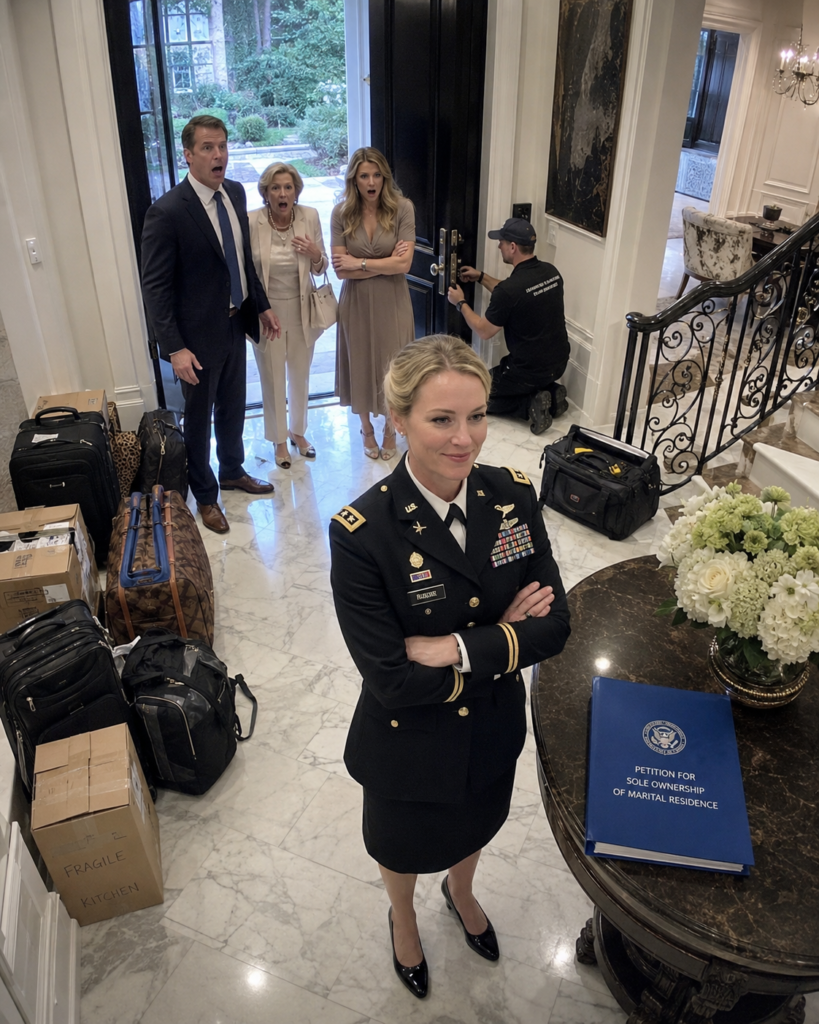
The hallway seemed to narrow around Beulah’s hand. My old military ID rested between her fingers like something ordinary, like a receipt or a hotel key card, not a missing piece of my life I had searched for, reported, and blamed myself for misplacing eight months earlier.
Wesley turned first.
His eyes fell to the card, then lifted to his mother’s face. Whatever fear I had seen in him moments ago changed into something rawer.
“Mom,” he said quietly. “What is that?”
Beulah’s chin rose. The gesture was familiar—practiced, polished, built over years of being believed before anyone asked questions. But this time, it did not fill the hallway. It trembled at the edges.
“It is not what you think,” she said.
Gwen let out a breath that sounded almost like a sob. The folder in her arms was pressed so tightly against her chest that the corners bent.
I kept one hand on the door and one on the chain.
“Where did you get my ID?” I asked.
Beulah looked at me as if I had insulted her by speaking.
“I found it.”
“Where?”
“In Wesley’s things.”
Wesley stepped back as though she had touched him with fire. “No, you didn’t.”
Beulah’s eyes flickered. Briefly. Not much. But enough.
I had seen soldiers lie under pressure. Some did it loudly, hoping volume would cover the gap. Others did it calmly, hoping stillness would look like innocence. Beulah’s lie landed somewhere between the two, dressed in offense but carrying panic underneath.
Gwen shook her head. “Mom, stop.”
“Be quiet,” Beulah snapped.
That was the moment something in Gwen changed.
It was small, but I saw it. Her shoulders dropped. Her grip loosened on the folder. Her eyes, red and frightened, fixed on her mother with a steadiness I had never seen from her before.
“No,” Gwen said. “I won’t.”
The word was not loud. It did not echo. But it did what truth often does when it finally appears—it made the room reorganize itself around it.
Beulah stared at her daughter.
Wesley looked from Gwen to his mother, then back to the ID.
I stepped away from the door just enough to remove the chain, then opened it wider. Not as an invitation. As a decision.
“Come in,” I said. “All of you.”
Wesley’s eyes widened. “Andrea—”
“Only because we are not doing this in front of Mrs. Alvarez’s peephole.”
Gwen entered first, clutching the folder. Wesley followed, careful not to brush against me. Beulah came last, slowly, still holding my ID until I extended my hand.
She hesitated.
I did not move.
Finally, she placed it in my palm.
The plastic was cool and slightly worn. My younger face stared back from it, serious and unsmiling, unaware of how far a small card could travel without me.
I set it on the dining table beside the blue folder and turned to Beulah.
“Start talking.”
She looked toward Wesley, but he did not rescue her.
For the first time in all the years I had known her, Beulah seemed to understand that her son was not standing in front of her. He was standing beside everyone else, waiting.
“I only borrowed it,” she said.
Gwen closed her eyes.
Wesley whispered, “Borrowed?”
Beulah’s composure cracked just enough for embarrassment to seep through. “The bank needed identification documents. Copies. It was paperwork.”
“My paperwork,” I said.
“It was for the family.”
That word, family, had been used against me so many times that I no longer accepted it without inspection. Family could be shelter. It could also be a curtain hung over a broken window.
“For whose family?” I asked.
Beulah’s mouth tightened.
Wesley sank into the chair at the end of the table, the same chair where he had dismissed my promotion as if it were nothing. He rested his elbows on his knees and stared at the floor.
Gwen placed her folder on the table.
“I found more,” she said.
Beulah turned sharply. “You had no right.”
Gwen’s laugh was short and wet. “No right? Mom, you kept documents with Andrea’s name in a storage unit. You used her ID. You let Wesley think he was the one holding everything together while you kept asking for more.”
Wesley looked up. “What does that mean?”
Gwen opened the folder. Inside were receipts, bank notices, printed emails, and a small stack of photographs.
Her fingers shook as she spread them across the table.
“I didn’t understand at first,” she said. “After my divorce, I moved back in with Mom for a while. I thought she was struggling because the business failed. That’s what she told me. But then I started noticing envelopes from banks I didn’t recognize. When I asked, she said Wesley was handling it.”
“I was handling what she told me existed,” Wesley said, his voice rough.
Beulah’s face flushed. “I did what I had to do.”
“With Andrea’s identity?” Gwen asked.
Beulah looked at me then. Really looked at me. There was resentment in her eyes, but beneath it was something older and sadder.
“You don’t know what it is to lose everything,” she said.
The apartment fell quiet.
I thought of desert nights so cold my fingers had gone numb inside gloves. I thought of missed birthdays, empty airport arrivals, friends who came home changed, soldiers who carried grief in silence because the mission always came first. I thought of coming back to a house where my own husband had treated my exhaustion as an inconvenience.
But I did not list any of that. Pain does not become truer because it wins a contest.
“I know what it is to keep going,” I said.
For a moment, Beulah had no answer.
Then Marisol called.
Her name appeared on my phone like a lifeline.
I answered on speaker. “Marisol, you’re on with Wesley, Gwen, and Beulah.”
“Good,” Marisol said, calm as ever. “No one should say anything they are not prepared to have repeated in a legal setting.”
Beulah stiffened.
Wesley looked at the table, then at me. “Andrea, I didn’t forge your signature.”
Marisol’s voice sharpened slightly. “Who did?”
No one spoke.
Gwen pulled one photograph from the stack and slid it toward me.
It showed Beulah standing beside a woman I didn’t recognize in front of a small storefront with paper covering the windows. The sign above the door read BRIDGE & BLOOM—OPENING SOON.
I picked it up.
The woman beside Beulah was younger, maybe in her forties, with auburn hair, a green coat, and a smile too bright for the gray day around her.
“Who is this?” I asked.
Beulah’s face changed.
Not guilt this time.
Fear.
“Where did you get that?” she demanded.
“In the storage unit,” Gwen said.
Beulah reached for the photo, but Wesley caught her wrist—not hard, not violently, just enough to stop her.
“Mom,” he said, and there was heartbreak in his voice. “Who is she?”
Beulah pulled her hand back. Her lips pressed together until they whitened.
Marisol spoke through the phone. “Andrea, describe the photograph.”
I did.
There was typing on Marisol’s end.
Gwen slid over a printed email. “Her name might be Celia.”
The name landed strangely. Not because I knew it, but because Wesley did.
He went still.
I watched his face drain of color in slow degrees.
“Wesley?” I asked.
He stood so abruptly the chair scraped the floor.
“Where did you see that name?”
Gwen pointed to the email. “There. Celia Rowan.”
Wesley snatched up the page and read it. His hand began to tremble.
Beulah whispered, “Don’t.”
But he was already beyond her reach.
The email was brief, sent from an address with the name C. Rowan. The subject line read: FINAL NOTICE BEFORE DISCLOSURE.
Wesley read aloud, his voice barely controlled.
“Beulah, I have waited long enough. You promised this arrangement would not involve Andrea beyond temporary paperwork. You said Wesley understood. If the debt is not settled by the end of the month, I will contact Andrea myself and explain what her name is doing on these documents.”
He stopped.
The air changed again.
I looked at Beulah. “Temporary paperwork?”
Marisol said, “Andrea, send me a photo of that email immediately.”
I did.
Wesley lowered the page slowly. “You told me Celia was gone.”
Beulah shut her eyes.
Gwen looked confused. “Who is Celia?”
Wesley’s voice came out hollow. “Dad’s sister.”
I blinked.
In twelve years of marriage, Wesley had never mentioned an aunt named Celia. I knew of his late father, Thomas, who died before I met the family. I knew Beulah’s version of him: hardworking, quiet, loyal, gone too soon. I had seen one framed photo of him in Wesley’s childhood home, a serious man with gentle eyes.
But an aunt?
“You told me Dad was an only child,” Wesley said.
Beulah opened her eyes, and all the old authority was gone. Without it, she looked tired enough to break.
“Celia was not part of this family.”
“That wasn’t your decision to make,” Wesley said.
“It was after what she did.”
“What did she do?”
Beulah looked away.
Gwen picked up another page. “There are letters.”
“No,” Beulah said.
Gwen hesitated.
I looked at Marisol’s name glowing on the phone screen. The legal part of me knew we were standing in dangerous territory. The human part knew that every lie has roots, and sometimes you have to see the roots before you can stop cutting at leaves.
“Gwen,” I said softly, “read only what concerns the documents.”
She nodded and unfolded a letter.
“Beulah,” Gwen read, “I agreed to invest in Bridge & Bloom because Thomas believed in helping family, and because you promised me Andrea had consented to serve as guarantor only until the first revenue cycle. I have since learned Andrea may not know about any of this. I will not be part of using a soldier’s good name without her knowledge. If you refuse to correct this, I will.”
Gwen’s voice faded.
Wesley sat down again, slower this time.
I watched him absorb it. The anger he had carried into my doorway the night before had been simple compared to this. This was not a fight between husband and wife anymore. This was a house with walls opening, revealing rooms none of us knew existed.
Beulah lowered herself into a chair.
“I was going to fix it,” she said.
That sentence, spoken softly, sounded more dangerous than all her earlier outrage.
“With what money?” Gwen asked.
Beulah flinched. It was the same question Gwen had asked Wesley in the hallway, and now it returned with an answer none of us wanted.
Wesley turned to me. His face was pale. “I believed her.”
I said nothing.
“I knew she needed help. I knew she was using the business account. I knew she wanted paperwork from you, but she told me you had agreed before your deployment. She said you didn’t want to discuss it because you hated financial drama. I should have asked you. I should have asked.”
His voice broke on the second should.
A day earlier, I might have thought tears from him were strategy. Now, sitting at the table with my stolen ID between us, I saw something different. Not innocence. Not absolution. But the collapse of a story he had told himself because it allowed him to avoid harder truths.
“You still moved money,” I said.
“Yes.”
“You still treated me like my work did not matter.”
His eyes filled. “Yes.”
“You still made decisions about my home without me.”
“Yes.”
The room quieted.
There was a strange dignity in the way he stopped defending himself. It did not repair anything, but it changed the temperature of the moment.
Marisol spoke. “Andrea, I recommend ending this conversation and preserving all documents.”
Beulah looked toward the phone. “Am I going to prison?”
No one answered immediately.
That silence seemed to frighten her more than any accusation.
Marisol’s voice remained measured. “That depends on facts, cooperation, restitution, and decisions made by institutions beyond this room. But right now, the best thing anyone can do is stop hiding information.”
Beulah folded her hands in her lap.
For years, those hands had pointed, waved away, rearranged other people’s lives. Now they looked small.
“I was afraid,” she said.
Wesley stared at her. “Of Celia?”
“Of being nothing.” Her voice was almost a whisper. “After your father died, everyone looked at me with pity. Bills came. People stopped calling. Your father had dreams, and I had debts. Celia offered help, but help from her always came with judgment.”
“That doesn’t explain Andrea’s ID,” Gwen said.
“No,” Beulah said. “It doesn’t.”
The admission shocked us into silence.
She turned to me. “You were strong. Organized. Respected. Everything you touched seemed to stand up straighter. Wesley talked about you like you were impossible to impress and impossible to need. I convinced myself your name could carry us for a little while. Just until the business opened. Just until I could prove I wasn’t finished.”
The words were wrong and painful, but for the first time, they sounded true.
I looked at her and felt no triumph. Only a deep exhaustion.
“You did not borrow my strength,” I said. “You stole my trust.”
Beulah’s eyes filled.
Gwen covered her face with both hands, crying openly now. Wesley reached toward her, then stopped, uncertain whether he had the right. After a moment, Gwen took his hand anyway.
That small gesture hurt more than I expected.
Not because I wanted to be part of their family in the old way. Because I had once tried so hard to belong to a family that did not know how to be honest with itself.
Marisol gave instructions. Documents would be scanned. Communication would go through counsel. Beulah would surrender any copies of my identification and paperwork. Gwen agreed to write a statement about what she had found. Wesley agreed to provide account access records.
Agreement did not mean healing.
But it was a door cracked open.
By the time they left, night had settled fully over the city. Beulah paused at the threshold. She looked like she wanted to say something grand enough to repair the room behind her.
Instead, she said, “I am sorry, Andrea.”
The apology arrived late, thin, and trembling.
I accepted it only with a nod.
Wesley lingered after his mother and sister stepped into the hallway.
“I don’t expect forgiveness,” he said.
“Good.”
The corner of his mouth moved sadly. “I deserved that.”
I looked at him, this man I had loved through versions of myself I barely recognized now. He seemed smaller without certainty, but maybe more real.
“What happens next?” he asked.
“Accountability,” I said. “Then whatever life looks like after that.”
“Is there any version where we talk someday? Not about papers. About us.”
I thought of the young man with cheap flowers. I thought of the husband at the dinner table. I thought of the man in front of me now, finally standing inside consequences instead of outside them.
“Someday is not a promise,” I said.
He nodded.
Then he left.
When the door closed, I leaned against it and let myself slide to the floor.
Not dramatically. Not beautifully. Just down, until the wood held my back and the quiet held everything else.
For the first time since the promotion, I cried.
Not for the apartment. Not for the money. Not even for the fraud.
I cried for the woman who had chilled wine and cooked dinner hoping her husband would be proud. I cried because she had deserved tenderness. I cried because she had mistaken endurance for love for too long.
And then, slowly, I stopped.
The next morning, sunlight entered the apartment in clear gold stripes. I opened the windows and let cold air move through the rooms. On the dining table, the promotion certificate caught the light.
I made coffee. I ate toast standing at the counter. I answered Marisol’s emails. I sent scans. I placed my old ID into an evidence envelope.
Then I did something I had postponed for years.
I called my father.
He answered with the cautious warmth of a man who loved me but had learned not to push.
“Andi?”
The childhood nickname nearly undid me.
“Hi, Dad.”
A pause. “Everything all right?”
I looked around the apartment. The quiet. The folders. The empty chair.
“No,” I said. “But I’m getting there.”
He did not ask for the neat version.
“Tell me what you need.”
That was my father. Not dramatic. Not flowery. Steady as a porch light.
“I don’t know yet,” I admitted.
“Then I’ll stay on the phone while you figure out breakfast.”
I laughed through tears. “I already ate.”
“Good. Then I’ll stay on while you drink coffee.”
So he did.
We talked for forty minutes about small things first: his garden, my younger cousin’s new baby, the neighbor’s dog that kept stealing newspapers. Then the larger truths came slowly. I told him about Wesley. About the locks. About the ID.
He was quiet for a long time.
“I wish you’d told me sooner,” he said.
“I didn’t want you to worry.”
“I’m your father. Worrying is not a malfunction.”
That made me smile.
After we hung up, I felt something shift inside me. Support did not erase pain, but it gave pain somewhere to sit.
At work, Colonel Harris called me into her office. She had heard only what I had formally disclosed, but her eyes carried understanding.
“Major Miller,” she said, “leadership is not proven by never falling apart. It is proven by what you build after the ground moves.”
I stood at attention out of habit.
“At ease,” she said, almost smiling.
I relaxed.
“I don’t need details,” she continued. “But I do need you to remember you are not alone in this building.”
“Yes, ma’am.”
“And Miller?”
“Yes, ma’am?”
“Congratulations again. Don’t let anyone turn your achievement into background noise.”
I carried that sentence back to my office like a medal.
Over the next week, the pieces began moving.
Marisol filed the necessary notices. The bank opened an investigation. Beulah surrendered two folders of documents through her attorney. Gwen gave a written statement, then called me one evening from a quiet room and asked if she could say something not for the lawyers.
I almost said no.
Then I remembered her standing in my hallway, choosing truth over fear.
“Yes,” I said.
“I was jealous of you,” she admitted.
I sat by the window, watching rain bead against the glass. “Of me?”
“You had direction. Respect. People listened when you spoke. I thought you looked down on us.”
“I didn’t.”
“I know. I think I needed you to, because then I wouldn’t have to admit I felt lost.”
Her honesty softened something in me.
“Being lost isn’t a character flaw,” I said.
She was quiet for a moment. “I’m trying to believe that.”
“Keep trying.”
It was not friendship. Not yet. But it was the first conversation we had ever had where neither of us performed.
Wesley’s messages became fewer, then changed in tone. He sent bank records. He sent passwords through Marisol. He wrote once, simply: I started counseling today. You don’t have to respond. I just wanted the sentence to exist somewhere true.
I did not answer.
But I did read it twice.
Ten days after the night Beulah appeared with my ID, Marisol called me into her office.
Her building overlooked a busy street lined with winter-bare trees. Inside, everything smelled faintly of paper, coffee, and lemon polish. I sat across from her as she laid out a timeline.
“The fraud issue is larger than we thought,” she said.
My stomach tightened. “How much larger?”
“Your name appears on the credit line. But it also appears on a beneficiary amendment connected to a private family trust.”
I stared at her. “A what?”
“A trust established by Thomas Miller’s parents decades ago. Wesley may not know about it. Beulah may not have had full control over it. Celia Rowan appears to be a co-trustee.”
“Why would my name be anywhere near that?”
“That,” Marisol said, “is the question.”
She turned her laptop toward me.
On the screen was a scanned document dated almost five years earlier. My name appeared in the middle of a paragraph dense with legal language. Not as a borrower. Not as a guarantor.
As a contingent beneficiary.
I leaned closer, not understanding.
“Marisol,” I said slowly, “what am I looking at?”
She folded her hands. “According to this, if certain conditions were met, assets from the Miller family trust could be distributed to support the spouse of Thomas Miller’s direct heir.”
“Wesley’s spouse,” I said.
“You.”
I shook my head. “That makes no sense. Beulah doesn’t even like me.”
“Trusts are not always about who likes whom. Sometimes they’re about old promises.”
She clicked to another page.
There was a letter attached, written in careful cursive. The ink had faded slightly, but the words were readable.
Andrea, if this ever reaches you, it means the family has failed to tell the truth again.
My breath caught.
Marisol watched me carefully. “It’s signed by Celia Rowan.”
The room blurred at the edges.
I read the line again.
The family has failed to tell the truth again.
Again.
“Why would Celia write to me?” I whispered.
Marisol’s expression was gentle but serious.
“Because she may have known something about your marriage, your signature, and the trust long before you did.”
My phone buzzed before I could respond.
A new voicemail.
Unknown number.
I played it on speaker.
An older woman’s voice filled the room—steady, low, and unmistakably alive.
“Major Miller, my name is Celia Rowan. I believe you have found part of the truth, but not the part that matters most. Before you sign anything, before you trust Beulah, Wesley, or even the documents in front of you, you need to know why Thomas Miller put your name in that trust five years before you ever met his son.”
👉 Follow the page and turn on notifications so you won’t miss the next chapter. The story continues in the next post.