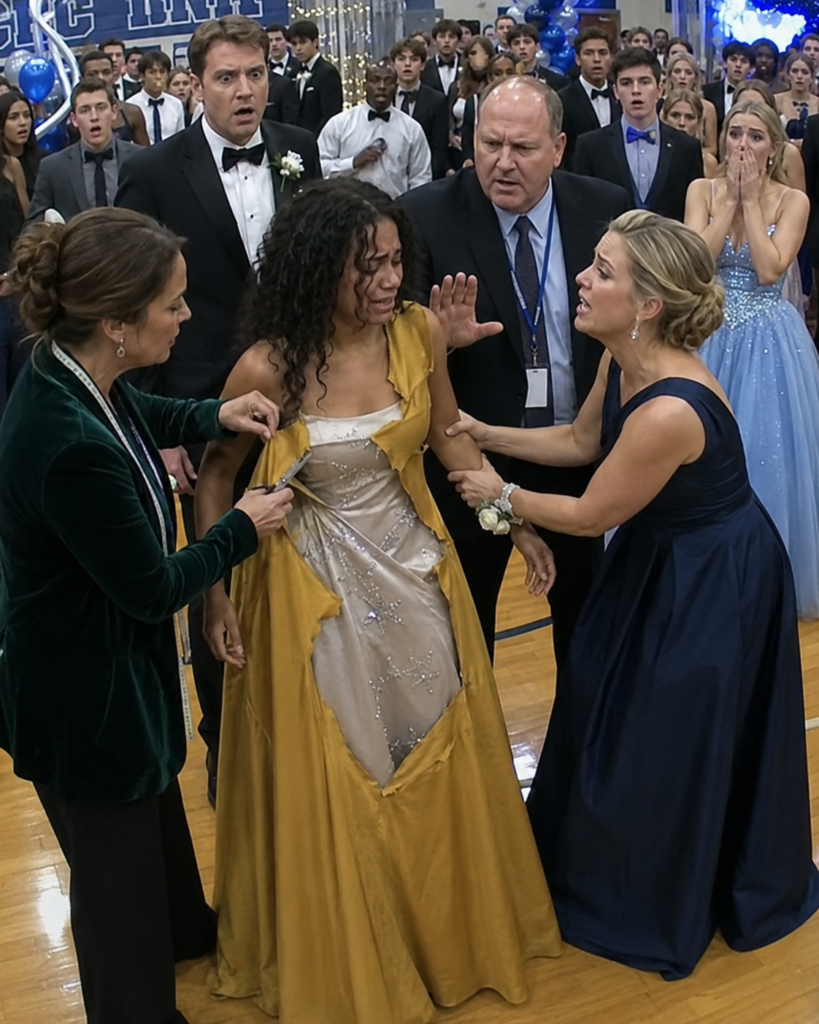
The dress was unfinished and taking up space.
I thought Lily needed something for prom, so I repurposed it.”
“Repurposed it?” Dad repeated.
“The original design was inappropriate.
It was too fitted.
I added fabric to make it suitable.”
Mrs. Alvarez lifted one of the crooked mustard sleeves.
“You stitched this by hand with upholstery thread.
You were not protecting the gown.
You were hiding it.”
A murmur moved through the gym.
Alexis’s eyes darted toward the students holding phones.
She had spent years carefully controlling how people saw her.
She hosted neighborhood dinners, volunteered at school fundraisers, and posted photographs of our supposedly blended family.
Now everyone was watching the mask slip.
“Make them stop recording,” she demanded.
The principal told the students to lower their phones, but the damage had already been done.
More importantly, Dad had heard Brianna’s admission himself.
Mrs. Alvarez reached inside the gown’s padded hem.
Her fingers found something stiff.
She carefully loosened several original silver stitches and pulled out a sealed cream envelope.
My name was written across the front in Mom’s handwriting.
Lily.
Just seeing it made my knees weak.
A small brass key and a business card slipped from behind the envelope and landed on the floor.
Dad picked up the card.
“Dana Bell,” he read.
“Estate attorney.”
The gym doors opened before anyone could say another word.
A woman in a charcoal suit entered carrying a locked leather case.
She was in her sixties, with silver hair and the calm expression of someone who had spent her career walking into rooms where people were already lying.
Mrs. Alvarez exhaled in relief.
The principal had called the number on the card ten minutes earlier.
Dana Bell’s office was only three blocks from the school, and she had still been working when the call came.
Dana stopped when she saw the gown.
“Claire’s dress,” she said softly.
Then she looked at Alexis.
“I wondered who had removed it from the chest.”
Alexis straightened.
“You cannot accuse me of theft because of something a teenager said.”
Dana placed the leather case on a table.
“I don’t need to rely on a teenager.”
She opened the case and removed a thin folder, several photographs, and an inventory signed by Mom before her final hospitalization.
The gown was listed as a specific bequest to me.
The document included photographs of the original design, down to the silver constellations and the message sewn inside the waist.
Dana handed one photograph to Dad.
In it, Mom stood beside the finished gown, thinner than I remembered but smiling.
She had one hand resting on the bodice.
Dad sat down hard in the nearest chair.
“I never saw this,” he said.
“Claire asked me to keep the inventory private until Lily turned eighteen,” Dana explained.
“She was afraid people would treat her belongings as ordinary household property after her death.
She wanted Lily to receive them when she was old enough to protect them.”
I turned eighteen two weeks before prom.
Dana had sent a certified letter to our house requesting a meeting.
I had never received it.
Dad slowly looked at Alexis.
“Did you take that letter?”
“No.”
Dana removed a delivery record from the folder.
Alexis’s signature was printed at the bottom.
She changed her answer.
“I signed for it, but I assumed it was another college advertisement.
I must have thrown it away accidentally.”
“You threw away a certified letter from an attorney?” Dad asked.
Alexis’s composure cracked.
“Why are you interrogating me in front of strangers? I have done everything for this family.
I planned this entire night.
I bought both girls dresses.”
“You bought Brianna a dress,” I said.
“You took mine from Mom’s chest.”
It was the first time I had spoken since the gown opened.
Alexis turned toward me with a warning in her eyes.
“Lily, emotions are high.
You don’t understand how much work I’ve done for you.”
I looked at the mustard fabric lying on the floor.
“You made me wear my mother’s last gift inside out so people would laugh at me.”
No one in the room moved.
For years, Alexis had relied on my silence.
She could make a cruel remark, then call it a joke.
She could give Brianna something expensive and give me the cheapest version, then accuse me of being jealous.
When Dad noticed the tension, she described me as difficult or still grieving.
She had turned my restraint into evidence against me.
That night, it became evidence against her.
Dana handed me the envelope.
The paper trembled between my fingers as I opened it.
Mom’s letter began with the words, “My dearest Lily, if you are reading this, then tonight arrived without me.”
I could not read the rest aloud.
Mrs. Alvarez stood beside me while I read silently.
Mom wrote that she had chosen champagne because it reminded her of sunrise.
The constellations represented the nights we spent on the back porch identifying stars.
She had sewn three silver stitches beneath the left cuff so I would recognize her work, even if someone altered the gown.
The brass key opened a small deposit box at Dana’s office.
Inside were Mom’s original sketches, family jewelry, and the remaining portion of a college fund she had established for me.
The money was not an enormous hidden fortune.
It was enough to cover what my scholarship did not: books, housing, transportation, and the emergencies Mom knew she would not be there to solve.
It was protection, planned carefully by a woman who understood she was running out of time.
Dana’s expression sharpened as she turned another page.
The college account had been inaccessible without my signature, but someone had attempted to request information about it using a copy of my birth certificate.
The request had come from our home address six weeks earlier.
Dad stared at Alexis.
“Tell me that wasn’t you.”
Alexis did not answer.
Brianna began to cry.
“Mom said the money should help both of us,” she whispered.
“She said Lily already had a scholarship.”
Alexis grabbed her daughter’s arm.
“Stop talking.”
The principal intervened again and told her to let go.
Dana closed the folder.
“The request was denied.
However, taking a specifically bequeathed item, intercepting legal correspondence, and attempting to access a protected account are matters that need to be documented.”
Alexis’s anger vanished.
She turned to Dad and reached for his hand.
“Mark, I was trying to help Brianna.
Her university costs more, and Lily was already covered.
We are supposed to be one family.
Claire should not still be controlling everything from the grave.”
Dad stepped away from her.
That sentence ended whatever remained between them.
He looked at the gown Mom had made, at the cheap fabric on the floor, and finally at me.
“I told you to be grateful,” he said.
His voice broke.
I did not rescue him from the truth.
“You did.”
He lowered his head.
For years, I had imagined that one perfect explanation might make him understand.
Standing there, I realized understanding was not enough.
He had watched Alexis diminish me and had repeatedly chosen the explanation that caused him the least inconvenience.
“I kept calling it peace,” he said.
“But it was only peace for me.”
Alexis began begging again.
She asked me to take off the gown before more photographs were taken.
She promised to repair it.
She said the night could still be saved if everyone stopped making accusations.
I looked at Mrs.
Alvarez.
“Can the rest of this fabric come off without damaging Mom’s work?”
“Yes,” she said.
“Claire built this gown to survive almost anything.”
Several theater students brought her sewing kit from backstage.
Behind a folding screen near the drama room, Mrs.
Alvarez removed the mustard sleeves, ribbon, and tulle.
She steamed the champagne silk and repaired the places where Alexis had stitched through the lining.
When I stepped out again, the gym fell silent for a different reason.
The gown was not flashy.
It did not need to be.
The fabric moved softly when I walked, and the silver constellations caught the light one star at a time.
Brianna’s designer dress was still beautiful.
Mine simply meant something no price tag could imitate.
Alexis stood near the exit with her face wet and furious.
Dad told her she and Brianna would not be returning to our house that night.
He arranged for them to stay with Alexis’s sister and asked the principal to have security escort them out.
Brianna paused beside me before leaving.
For one second, I expected another insult.
Instead, she whispered, “I’m sorry.”
It was not enough to erase the years behind us, but it was the first honest thing she had ever said to me.
Alexis did not apologize.
She kept insisting that everyone had misunderstood her intentions until the gym doors closed behind her.
Dad offered to drive me home.
I told him I was staying for the dance.
He nodded and left with Dana to begin documenting what had happened.
The music started again slowly.
My friend Maya took my hand and pulled me toward the dance floor.
At first I could feel people watching, but then someone laughed, another couple began dancing, and the room returned to life.
I did not become prom queen.
No crowd formed to applaud me.
The night did not transform into a perfect movie ending.
It became something better.
It became mine.
I danced in the gown my mother had made.
Each time the silver stars caught the light, I pictured her at the kitchen table, sewing love into a future she knew she would not see.
The weeks after prom were painful and complicated.
Dad filed for divorce after Dana’s records and the household accounts showed that Alexis had taken more than the dress.
She had sold several of Mom’s smaller belongings, intercepted mail, and used money intended for both prom dresses to pay part of Brianna’s designer-gown bill.
The college fund remained untouched.
Dana transferred control to me and helped recover several pieces of jewelry from a resale dealer.
Alexis eventually agreed to repay the missing money rather than fight the evidence in court.
Brianna finished the school year living with her aunt.
She sent me one message before graduation.
She admitted she had known the dress came from the cedar chest, though she claimed she did not know about the letter or college fund.
I believed that part.
I also knew she had laughed anyway.
I told her I accepted her apology but was not ready to forgive her.
For once, I did not soften the truth to make someone else comfortable.
Dad and I began counseling before I left for college.
He apologized more than once, but the apology that mattered most was followed by change.
He stopped asking me to keep the peace.
He listened when the answer hurt.
He accepted that rebuilding trust would take longer than saying he was sorry.
Mrs. Alvarez helped preserve Mom’s gown in an archival box.
Before we packed it away, I asked her to leave one small piece of mustard fabric stitched inside the lining where no one else could see it.
Not because Alexis deserved a place in the dress.
Because I wanted to remember the difference between what something looked like and what it truly was.
For one night, Alexis had tried to make me believe I was the ugly thing in the room.
But beneath every layer she added, my mother’s work remained untouched—waiting for one silver thread to lead me back to it.