The red golf cart was already across my driveway when I came downstairs.
It sat sideways at the apron where my concrete met the street, candy-apple paint glowing in the July sun like Beverly Kowolski had chosen the color specifically so nobody could pretend not to see her.
That was always Beverly’s gift.
Image
She made herself impossible to miss, then acted offended when people noticed the damage she caused.
I stood at the kitchen window with my coffee untouched in my hand.
Across the street, Beverly was not in the cart.
She was three houses down with a clipboard, examining a flower bed as if the future of Magnolia Glenn depended on whether a man named Ed had trimmed his marigolds evenly.
My wife, Diana, came beside me and looked out.
“Again?” she asked.
“Again,” I said.
There was nothing dramatic in my voice that morning.
The drama had been spent over four months, one stolen morning at a time.
Magnolia Glenn looked harmless from the road.
Two hundred forty houses, brick mailboxes, winding streets, tidy lawns, Bradford pear trees that bloomed beautifully for ten days each spring and then punished everybody with slick petals for weeks.
We had moved there for peace.
Diana and I wanted a yard for our boys, Theo and Marcus Jr., and a driveway that belonged to us in the ordinary American way.
You buy a house.
You pull into your garage.
You leave for work when you need to leave.
That was the whole dream.
Beverly turned that dream into a daily negotiation.
She had retired from some insurance office years earlier and poured every remaining ounce of workplace authority into the HOA presidency.
She drove the neighborhood in that red golf cart every weekday morning, visor on, magnetic badge clipped to her shirt, inspecting trash cans, porch paint, mulch depth, and whatever else made her feel necessary.
For a while she was only annoying.
Then she invented traffic calming.
The board had refused to install speed bumps on Glenn Ridge Drive because there was no real speeding problem and no resident had asked for them.
Beverly did not accept refusal well.
She began driving ten miles an hour down the street and forcing everyone behind her to crawl.
Then she discovered my schedule.
I left every weekday at 7:22 a.m.
Not 7:30.
Not whenever I felt like it.
I worked logistics for a distribution company, and my first meeting started at 8:00.
The drive took thirty-one minutes on a normal morning, and seven minutes of buffer was not a luxury.
It was how I kept my day from falling apart before it began.
Beverly saw that, decided my consistency was defiance, and parked her golf cart across my driveway.
The first time, I waited.
I did not honk.
I did not yell.
I called the HOA number, which went to Beverly’s own voicemail, and left a message that the HOA president’s vehicle was blocking my private driveway.
She came back nine minutes later and moved the cart without apology.
I was late to work.
That night I filed a formal complaint.
Beverly answered it herself.
She wrote that temporary positioning of a community vehicle for safety purposes fell within her community services role.
I read that sentence three times.
Then I called my attorney, Carol Stevens.
Carol told me one incident was not enough to justify much beyond documentation.
So I documented.
By the third incident, I had a notebook.
By the tenth, I had a spreadsheet.
By the thirtieth, Diana no longer asked whether Beverly had done it again.
She only asked how long.
The shortest delay was four minutes.
The longest was twenty-two.
Sixty-one times Beverly placed that red cart on my property without permission and forced me to wait inside my own life.
I sent five complaints.
Carol sent a demand letter.
The HOA’s lawyer responded that my work schedule was merely a self-reported preference and that no meaningful hardship had occurred.
That phrase did something to me.
Self-reported preference.
My job.
My paycheck.
My responsibility to my team.
My right to drive away from the house I paid for.
Some people mistake patience for permission.
It is not.
The next morning, Beverly stood by her golf cart while I waited in my car.
She smiled at the windshield.
When I stepped out and told her for the last time to move, she said, “Touch my cart, trash, and I’ll fine you every day until you sell this house.”
There it was.
Not traffic safety.
Not community standards.
Control.
I went inside and called Carol.
I asked a simple question.
If another person’s vehicle is on my private property without permission, may I remove it without damaging it?
Carol was quiet for a second, because lawyers can hear trouble approaching before it knocks.
Then she said I could call police, call a tow company, or remove it by any legal, non-destructive means.
Any legal, non-destructive means.
I am a logistics man.
My work is moving things from where they are to where they need to be.
That sentence lit up a part of my brain Beverly should have left alone.
The golf cart needed to move.
It did not need to move to the curb.
It did not need to move to a tow yard.
It needed to move somewhere Beverly would understand.
Across the street from my house sat Beverly’s attached garage, built from the same plan as mine, with a flat roof section over the front bay.
A flat, open, visible roof.
Large enough for a golf cart.
Strong enough for far more weight than a golf cart.
Petty enough to feel poetic.
I did not trust poetry by itself, so I researched.
I called a structural engineer I knew from warehouse projects and asked about residential flat-roof loads.
I called Carol again and made her walk through the legal exposure until she got tired of my questions.
She would not advise me to do it.
She made that very clear.
But she also told me that if the cart was on my property without authorization, if I could prove the pattern, and if nothing was damaged, Beverly would have a difficult claim.
Then I called a crane company.
Dennis came out two days later for a site assessment.
He was a third-generation crane operator with a face that suggested very little surprised him anymore.
I told him the object, the weight, the lift distance, and the placement surface.
He listened.
Then he said, “Is this legal?”
“My attorney reviewed it,” I said.
He nodded once.
“Then we need a street-use permit.”
That was the part that still makes me smile.
There is a public record in Fulton County showing that a mobile crane was permitted for 18 Glenn Ridge Drive on that Friday morning.
Beverly inspected flower beds, trash cans, and porch flags.
She did not inspect permits.
The night before, I texted her.
I told her she had placed her cart on my private driveway sixty-one times, that complaints and a demand letter had gone unanswered, and that any unauthorized vehicle on my property the next morning would be removed.
She did not reply.
At 7:14 a.m., she parked across my driveway anyway.
At 7:17, Dennis arrived.
A forty-ton crane does not enter a suburban street quietly.
It announces that the small argument is over and physics has been invited.
The diesel rumble rolled through Magnolia Glenn, deep enough to make windows vibrate.
Phil Gaines came out first with folding chairs, because Phil had known enough of the plan to understand that history deserved seating.
His wife brought coffee.
Two neighbors from Magnolia Court appeared.
Then four more.
By 7:22, the time I should have been backing out for work, thirty people were on the sidewalk.
Beverly was still down the street with her clipboard.
She had not turned around.
Dennis lowered the outriggers onto the asphalt.
The metal feet pressed down with slow authority.
He brought out the nylon slings and rigged the cart with the care of a man who knew the difference between spectacle and negligence.
Every strap was checked.
Every angle was measured.
No one spoke.
My boys stood on the porch beside Diana.
I wanted them to see this, not because it was funny, though it was, and not because it was loud, though it was that too.
I wanted them to see that a boundary can be calm and still be absolute.
Dennis signaled from the cab.
The cable tightened.
For two seconds the golf cart remained on the concrete, the slings stretched above it, Beverly’s whole little kingdom balanced between gravity and consequence.
Then the wheels lifted.
The sidewalk went silent.
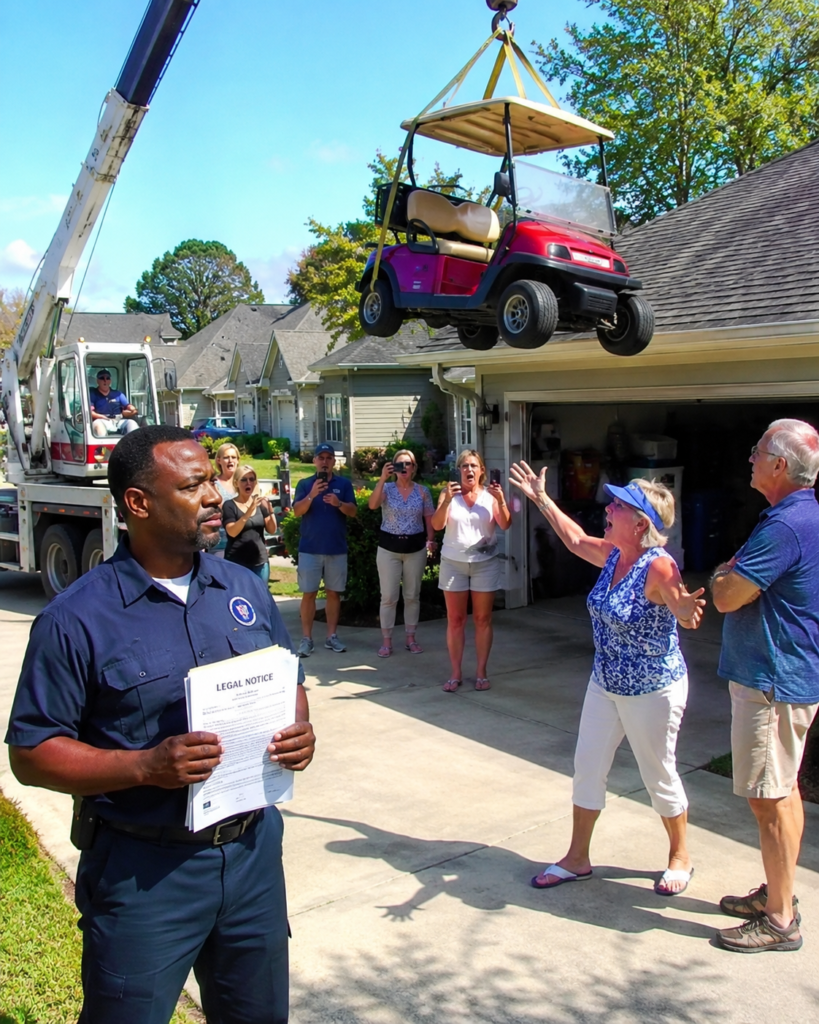
The cart rose over my driveway, red paint shining, front wheels dangling, the empty driver’s seat aimed toward the sky.
Someone whispered, “Oh my God.”
That was when Beverly turned.
Her face changed in pieces.
First confusion.
Then recognition.
Then something beyond anger, because anger requires the world to still make sense.
Her golf cart was forty feet in the air, hanging from a crane boom above the driveway she had treated like public property.
I watched her understand that the morning no longer belonged to her.
Dennis rotated the boom toward her house.
Beverly started running.
The cart crossed the street like the slowest verdict any neighborhood had ever seen.
It passed over the roofline and hovered above the flat section of her garage.
Dennis lowered it inch by inch.
All four wheels touched down at once.
Perfectly level.
Completely intact.
Absolutely visible.
The crowd erupted.
Phil raised both fists from his folding chair.
Beverly reached her front walk and stared up at the red cart sitting on her garage roof.
I crossed to the edge of my driveway, not onto her property, and raised my voice only enough for the phones to catch it.
“Your cart was on my driveway without authorization,” I said. “I have sixty-one documented incidents and five unanswered complaints. Carol Stevens is my attorney of record if you want a permanent resolution.”
Beverly looked at me.
Then she looked at her roof.
Then she went inside and shut the door.
She did not come out for two days.
The cart stayed there through Friday, bright red against the roof like a warning label.
By afternoon, photos were everywhere.
I had not posted them.
I did not need to.
Thirty neighbors with phones had done what four months of board meetings could not do.
They made the truth visible.
By Saturday, cars were slowing on Glenn Ridge Drive to look.
They moved at about ten miles an hour, which felt appropriate.
Carol called that morning and said the HOA attorney had contacted her with a new tone.
Not dismissive.
Not superior.
Very interested in resolution.
I gave her my terms.
Beverly would never place any vehicle on my property again.
The HOA would acknowledge that her traffic calming program had no legal basis.
My five complaints would be marked substantiated in the record.
The cart would come down at Beverly’s expense.
Within two hours, they agreed.
On Monday, another crane company arrived and removed the cart from her garage roof.
The neighborhood watched that too, but it felt less like a spectacle and more like a closing argument.
Six days later, the HOA called an emergency meeting.
For the first time since we had moved to Magnolia Glenn, I received a personal invitation.
The clubhouse was packed.
Every chair was taken.
People stood along the walls.
Theo asked to come, and I let him, because children should learn that power without accountability is not leadership.
Beverly sat at the board table.
She was still composed, still wearing her visor indoors for reasons known only to Beverly, but the shine had gone out of her authority.
The two other board members read a motion into the record.
It acknowledged that the driveway blocking had been unauthorized, that the traffic calming program had not been approved by the full board, and that my complaints were substantiated.
They voted yes.
Beverly paused.
Then she voted yes too.
The motion passed three to zero.
I thought that was the ending.
It was not.
Robert Chen stood up from the third row.
He was a quiet man from Magnolia Court, the kind of neighbor who returned borrowed tools cleaner than when he received them.
He asked whether the board intended to review Beverly’s conduct beyond my driveway.
The room shifted.
Beverly’s eyes narrowed.
Robert did not sit down.
He asked if any other resident had experienced similar blocking, intimidation, or dismissal after complaining.
For one long second, nobody moved.
Then Mrs. Alvarez raised her hand.
Then David Pike raised his.
Then a young mother from Blossom Way raised hers and said Beverly had blocked her driveway during a pediatric appointment and later told her that babies did not create exemptions from community safety.
The final twist was not that Beverly had targeted me.
It was that she had counted on every target believing they were alone.
Once the first hand went up, the room changed.
People began speaking in order, one after another, not shouting, not performing, just putting facts on the table.
Dates.
Photos.
Dismissed emails.
Fines threatened.
Driveways blocked.
The same red cart, the same clipped voice, the same confidence that nobody would make her answer.
Beverly resigned before the end of the month.
The new board removed the traffic calming language from every HOA notice and created a rule that no officer, volunteer, or committee member could obstruct private property access under any circumstances.
My driveway stayed clear.
My boys still talk about the crane sometimes.
They remember the cart in the air, the neighbors on the sidewalk, Phil with his fists raised.
I remember Beverly’s face when she realized control was not the same thing as authority.
Authority serves people.
Control uses them.
And if someone keeps parking their power across your driveway, there comes a morning when patience is not enough.
Sometimes the boundary has to rise high enough for the whole neighborhood to see.