The hospital did not call Emily Carter first.
That was the part she would keep coming back to later, after the police report, after the hospital forms, after the questions that made her mother stop looking her in the eye.
A mother thinks she will know when her child is in danger.
Image
She thinks some invisible thread will snap inside her chest, some ancient warning will drag her out of whatever room she is standing in and point her toward the truth.
But at 11:47 p.m., Emily was in a Denver hotel room with one heel off, a blister burning raw at the back of her foot, and a muted television flashing red across the wall.
The hallway outside smelled like stale coffee and carpet cleaner.
The air-conditioning clicked too loudly every few minutes.
Her navy blazer, the one she had bought on clearance for the promotion review the next morning, was thrown over the back of the desk chair like a costume she no longer had the energy to wear.
She had been rehearsing her presentation for two hours.
Then the television camera panned across yellow police tape.
At first, she did not understand what she was seeing.
There were flashing lights.
There was a backyard fence.
There was a low shed behind a house.
And then the camera caught something small near the edge of the frame, half covered by shadow and police tape.
A blue dinosaur blanket.
Emily knew that blanket the way she knew her own hand.
The worn white corner.
The faded green stegosaurus.
The tiny tear near the seam from the time Noah dragged it through the apartment parking lot after a thunderstorm.
Her heart did not speed up first.
It stopped.
Then it slammed so hard she almost dropped the remote.
She grabbed her phone and called her mother.
Linda answered on the fourth ring, irritated and wide awake.
“Emily? Do you know what time it is?”
“Mom, where is Noah?”
There was not even a pause.
“He’s asleep. He’s perfectly fine.”
Emily sat down on the edge of the bed because her legs had stopped being trustworthy.
“Are you sure?”
“For heaven’s sake, yes. He wore himself out after dinner. Why are you calling like this?”
Emily stared at the television.
The camera had shifted to the front of the property now.
A porch light glowed in the distance.
A neighbor stood behind a cruiser with one hand over her mouth.
“Put him on the phone,” Emily said.
Linda sighed.
It was a small sound, but Emily heard every bit of impatience in it.
“I am not waking him up because you got anxious on a business trip.”
“Mom. Put Noah on the phone.”
“Emily, you always do this. You always imagine the worst. He’s fine.”
That was the second time she said it.
Fine.
Not sleeping soundly.
Not I just checked.
Not let me go see.
Fine.
A lie sounds different when your body already knows the truth.
Emily ended the call with her thumb shaking so hard she missed the button twice.
Noah was supposed to be at Linda’s house in Dallas for three days.
Only three.
Emily had repeated that to herself like a prayer when she dropped him off.
Three days was not abandonment.
Three days was not selfish.
Three days was not enough time for anything terrible to happen.
Her sitter had canceled the morning before her flight.
Her ex-husband was deployed overseas and could not take leave.
Her promotion review was the kind of opportunity that did not come twice for a single mother who had spent years taking meetings on lunch breaks and answering emails after bedtime.
If she got it, she could stop deciding which bill had to wait.
She could stop pretending the electric company reminder was not scaring her.
She could move Noah out of the apartment complex where the upstairs neighbor screamed through the vents and the parking lot lights flickered for days before anyone fixed them.
So she had packed his dinosaur pajamas.
She had packed strawberry yogurt cups.
She had packed the little socks he wore mismatched on purpose.
She had tucked the blue blanket under his arm and told him Grandma’s house would be an adventure.
Noah had looked up at her from the front porch and whispered, “But not the shed, okay?”
Emily had crouched in front of him.
“What do you mean, baby?”
He had glanced past her toward the backyard.
Linda’s shed sat behind the house with a padlock on the door and an old lawn chair leaning against one side.
“It makes bad sounds at night.”
Linda had laughed from the doorway.
“He’s been watching too many monster cartoons. Boys his age are dramatic.”
Emily had wanted to believe that.
She had needed to believe that.
Mothers make bargains with fear when money is tight.
They do not call them bargains.
They call them childcare, work trips, emergency contacts, and doing what has to be done.
At 11:52 p.m., a Dallas number called Emily’s phone.
She answered before the second ring.
“Is this Emily Carter?”
“Yes.”
“This is the hospital intake desk. Your son, Noah Carter, was brought in tonight in critical condition.”
The room tilted.
Emily pressed her hand flat against the hotel desk.
“What hospital? What happened?”
“Ma’am, I need you to come as soon as possible.”
“Who brought him in? My mother?”
A silence opened on the line.
It was not long.
It was long enough.
“He was not brought in by your family.”
Emily’s throat closed.
“My mother just told me he was in bed.”
The woman on the other end softened her voice, and that softness frightened Emily more than panic would have.
“Ma’am, please come right away.”
Emily did not remember packing.
She remembered her purse spilling across the floor.
She remembered lipstick rolling under the bed.
She remembered the hotel clerk’s face changing when Emily asked for the fastest way to the airport.
The clerk handed her a paper coffee cup she never drank.
At 12:32 a.m., Emily booked the only red-eye she could get.
At 12:41 a.m., she was in a rideshare with her suitcase half open on her lap and her phone clutched so tightly her fingers cramped.
She called Linda again.
No answer.
She called Madison.
No answer.
She called Linda again.
This time it rang once and went to voicemail.
Emily stared at the black screen.
Her reflection looked back at her from the glass, pale and stretched thin.
Noah’s photo was still open behind the call screen.
He was grinning with yogurt on his chin, one missing tooth, blue blanket bunched against his shoulder.
Noah was six.
He liked plastic dinosaurs with names longer than his arm.
He asked for thunderstorm cuddles and pretended not to be scared.
He cried when animals got lost in cartoons.
He apologized to doors when he bumped into them.
He still asked Emily to check the closet for monsters, then apologized to the closet when she told him it was empty.
There was no universe where a child like that deserved pain.
On the flight, Emily sat between a sleeping college student and a man in a baseball cap who smelled faintly of aftershave and airport pretzels.
She did not cry.
Crying would have required air.
Instead, she opened the airline Wi-Fi page and refreshed her messages until the little loading circle became something she hated.
At 3:18 a.m., Madison finally texted.
It said only, Mom says don’t panic.
Emily stared at the words until they blurred.
Not Noah is okay.
Not we are at the hospital.
Not I’m sorry.
Mom says don’t panic.
At 6:18 a.m., Emily stood in a hospital corridor in Dallas under white lights that made every face look sick.
The pediatric ICU doors were closed.
A nurse at the station asked for her ID.
Emily’s hands shook so badly the card slipped out twice.
A pediatric surgeon came toward her with the kind of slow, careful walk doctors use when they are carrying news that can break a person.
Beside him stood a detective with a notebook in one hand and a police report folder tucked under his arm.
Emily saw the folder before she heard anything else.
That was when her knees almost gave out.
“Mrs. Carter?” the surgeon asked.
“Ms.,” Emily said automatically.
It was a stupid correction.
It was also the only part of her life she could control in that hallway.
The surgeon nodded.
“Ms. Carter. Noah is alive. He is in critical condition.”
Alive.
Emily grabbed that word and held on to it with everything she had.
Then the rest came.
Fractured wrist.
Bruised ribs.
Internal injuries.
Defensive wounds.
Emily heard herself repeat the last one.
“Defensive?”
The detective’s eyes lowered for half a second.
“Yes, ma’am.”
My six-year-old had fought back.
The words did not fit inside her head.
They were too large and too ugly.
The detective opened his notebook.
“Your mother and sister did not call 911. A neighbor heard screaming and found Noah unconscious near the backyard shed.”
Emily stopped breathing.
The shed.
That locked shed with the rusted padlock.
That place Noah had asked her about on the porch.
That place Linda had dismissed with a laugh.
Emily had trusted her mother with lunch bags, emergency contacts, spare keys, and the soft places in her son’s routine.
Trust is not always stolen in one dramatic moment.
Sometimes you give it away in small practical pieces until someone has enough access to destroy you.
Through the ICU glass, Emily saw Noah.
For a moment, her mind rejected the image.
That could not be her child.
Her child was all motion and questions.
Her child made dinosaur claws with his fingers and roared at grocery carts.
Her child fell asleep with one sock on because two made his feet angry.
This child was still.
Too still.
He lay under white hospital sheets with wires taped to his chest, one hand wrapped in gauze, his face swollen, his body looking impossibly small against the bed.
The monitor beeped steadily.
Emily focused on that sound because it meant he was still here.
Linda and Madison were at the end of the hall.
Linda held tissues in one hand.
Her eyes were dry.
Madison stood beside her in a sweatshirt with the sleeves pulled over her hands, rubbing at one cuff again and again like she could erase something from the fabric.
When Linda saw Emily, she opened her arms.
Emily walked past her.
“Emily,” Linda whispered. “Don’t make a scene.”
Emily stopped.
For one second, the whole hallway went silent in her mind.
Don’t make a scene.
Her son was in the ICU, and her mother was worried about appearances.
Emily turned her head just enough to look at Linda.
“If you lied to me,” she said, “do not speak to me again until the detective tells you to.”
Linda’s face tightened.
Madison looked at the floor.
The nurse checked Emily’s ID bracelet against Noah’s hospital intake form before opening the ICU door.
The form had his name on it.
Noah Carter.
Age six.
Emergency contact: Emily Carter.
Brought in by: neighbor.
Emily stared at that line.
Brought in by neighbor.
Not grandmother.
Not aunt.
Neighbor.
Inside the room, the air smelled like antiseptic, plastic tubing, and something metallic that seemed to live under the cold hospital air.
A nurse adjusted the IV line.
A janitor in faded blue scrubs emptied the biohazard bin in the corner, head down, moving with the careful invisibility of someone used to grief passing inches from his hands.
The detective stayed near the door.
Linda and Madison followed, both performing quiet grief in a way that made Emily’s skin crawl.
Madison sniffed too loudly.
Linda dabbed at dry cheeks.
Emily leaned over the bed.
“Baby,” she whispered. “Mommy’s here.”
Noah’s eyelids trembled.
For one ugly heartbeat, Emily wanted to turn around and put her hands on her mother.
She wanted to shake every lie loose.
She wanted to ask Madison how long a child had to scream before a sister decided he was worth saving.
But Noah’s fingers twitched against the blanket.
So Emily stayed still.
She put one hand near his, not touching the wires, close enough for him to feel her if he could.
“I’m here,” she said again.
His eyes opened a fraction.
They found Emily first.
Then they slid past her shoulder.
The monitor changed.
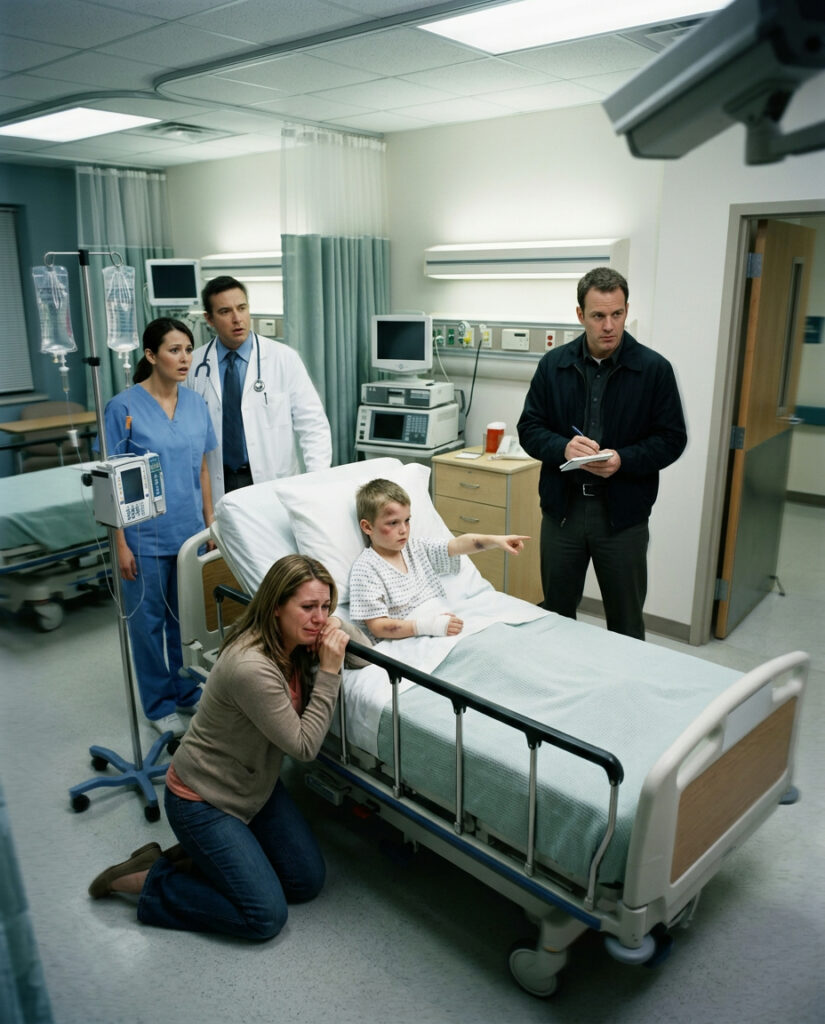
A sharp alarm cut through the room.
The nurse moved quickly toward the screen.
Noah’s bandaged hand lifted from the sheet.
It did not reach for Emily.
It did not reach for Linda.
It did not reach for Madison.
It pointed toward the corner.
Linda gasped so sharply the detective looked up.
Noah’s swollen lips parted.
One broken word came out.
“Monster.”
The janitor stopped moving.
Madison made a sound like she had been hit in the chest.
Linda’s face drained completely white.
Emily looked from Noah’s hand to the corner, then back to her mother’s face.
The detective slowly closed his notebook.
Noah’s hand shook harder.
His lips moved again.
This time the words came out thin and scraped.
“Shed,” he whispered.
The nurse murmured his name, trying to calm him.
Emily bent closer.
“What about the shed, baby?”
Noah’s eyes filled with tears.
“Locked,” he breathed.
Linda took one step backward.
The detective noticed.
He turned toward her.
“Where is the key?”
Linda did not answer.
She stared at Noah like the problem was not what had happened to him, but the fact that he could still speak.
Madison backed into the wall hard enough to rattle a metal supply cart.
A roll of medical tape tipped over and spun once on the tray.
The janitor lowered the red biohazard bag to the floor.
“Sir,” he said.
His voice was rough.
The detective looked at him.
The janitor swallowed.
“I heard something before visiting hours. In the hallway by the service elevator. One of them said nobody would believe a scared kid talking about a monster.”
Madison slid down the wall.
Her sleeve was still twisted in one fist.
“Mom,” she whispered. “Tell them it wasn’t supposed to go that far.”
Emily felt the room tilt again.
Not supposed to go that far.
Those words did not belong in a hospital room with a child on a ventilator.
Those words belonged to plans.
To coverups.
To things adults did and then tried to measure afterward like damage could be negotiated.
The detective opened the police report folder.
He pulled out a printed statement with the neighbor’s identifying details blacked out.
His thumb stopped on one line.
Emily could read only part of it from where she stood.
Child heard screaming near locked shed.
Linda finally looked at Emily.
For the first time in Emily’s life, her mother looked afraid of her.
The detective read quietly, then looked up.
“Ms. Carter,” he said, “I need you to stay with your son. I’m going to ask your mother and sister to step into the hall.”
Linda found her voice then.
“No. I am not being treated like a criminal. This is my grandson.”
Emily turned on her so fast the nurse flinched.
“You told me he was asleep.”
Linda’s mouth hardened.
“You were hysterical.”
“He was in the ICU.”
“I didn’t know how bad it was.”
The detective’s expression did not change.
“Then how did you know to lie?”
That question did what Emily’s anger could not.
It shut Linda up.
Madison began to sob with both hands over her mouth.
Emily did not comfort her.
Some collapses are not remorse.
Some are only fear finding a body to live in.
The detective asked Linda again for the key.
Linda said she did not have it.
The janitor pointed toward Madison’s sweatshirt pocket.
Madison froze.
The room went still around her.
A nurse’s hand paused over the monitor.
The detective extended his palm.
“Madison.”
Madison shook her head.
“I didn’t touch him.”
“The key.”
Her fingers trembled as she pulled a small brass key from the pocket.
It hung from a faded grocery-store rewards tag.
Emily recognized it.
It had been on Linda’s kitchen hook for years.
The shed key.
The detective took it with two gloved fingers.
The moment it left Madison’s hand, Linda said, “You stupid girl.”
Not poor Noah.
Not what have we done.
You stupid girl.
The detective looked at Linda for one long second.
Then he stepped into the hallway and spoke into his phone.
Emily heard only pieces.
Search warrant.
Backyard shed.
Possible evidence.
Child victim.
Noah’s breathing changed.
Emily leaned close again and put her face where he could see it.
“I’m here,” she whispered. “You did so good, baby. You told.”
His fingers curled weakly against the blanket.
The blue dinosaur blanket had been cleaned as much as it could be, but one corner was still darker than the rest.
Emily tucked it near his shoulder.
She hated that blanket for what it had seen.
She loved it because Noah’s fingers still knew how to find it.
Hours passed in pieces.
A social worker came.
Another detective came.
A nurse asked Emily if she had eaten, and Emily said yes even though she had not swallowed anything since the coffee she never drank in Denver.
At 9:06 a.m., the detective returned.
He did not come all the way into the room at first.
He stood near the doorway with his folder held tighter than before.
Emily knew from his face that they had found something.
She kissed Noah’s forehead and stepped into the hall.
Linda and Madison were no longer there.
The chairs where they had been sitting were empty.
On one chair was a balled-up tissue.
On the floor beneath another was a torn corner of Madison’s sleeve thread.
The detective said, “We located items inside the shed. I can’t tell you everything yet.”
Emily nodded because she did not trust her mouth.
“But I can tell you this,” he continued. “Your son was not imagining anything.”
Emily closed her eyes.
A sound came out of her that did not feel human.
The detective waited.
He did not rush her.
When she opened her eyes again, he said, “Your mother and sister are being interviewed separately.”
“Did they hurt him?”
The detective’s jaw tightened.
“We’re still establishing who did what. But someone locked that shed, and someone chose not to call 911.”
That was the sentence that stayed with her.
Someone chose.
Not confusion.
Not panic.
Not a terrible accident nobody understood.
A choice.
Emily went back to Noah’s bedside and sat down.
She took out her phone.
For the first time since the hotel, she opened her messages and scrolled to the thread with Linda.
There were years inside that thread.
Birthday plans.
Grocery reminders.
Pictures of Noah in Halloween costumes.
Linda asking for apartment access when Emily worked late.
Linda reminding Emily she should be grateful she had help.
Emily had been grateful.
That was the cruelest part.
Gratitude can make you hand people keys they never should have touched.
At 11:14 a.m., Emily texted her ex-husband’s military contact line and then called the family liaison number she had been given for emergencies.
Her voice broke twice while she explained.
The woman on the line did not interrupt.
When Emily finished, she said, “We’ll get the message through. Stay by your son.”
So Emily stayed.
Noah woke in fragments that day.
Sometimes he knew her.
Sometimes he cried before he was fully awake.
Once he whispered, “I was quiet.”
Emily bent close.
“You don’t have to be quiet anymore.”
His eyes moved toward the door.
“Grandma mad?”
Emily felt something inside her crack cleanly.
“Grandma does not get to be mad at you.”
“Aunt Madison?”
Emily swallowed.
“She doesn’t either.”
Noah’s fingers tightened weakly around hers.
“The monster said nobody comes.”
Emily looked through the glass at the hospital corridor, at the nurse walking past, at the detective speaking quietly near the station, at the hospital flag decal on the reception desk beyond the doors.
“The monster was wrong,” she said.
By evening, the first formal no-contact order was being discussed.
The social worker used careful language.
Protective arrangements.
Temporary restrictions.
Family safety plan.
Emily signed where she was told to sign.
She wrote her name on medical forms, police contact forms, victim services paperwork, and a release allowing investigators to collect Noah’s clothing as evidence.
Each signature felt like closing one door and bolting another.
Linda called at 7:22 p.m.
Emily watched her mother’s name glow on the screen.
She did not answer.
A voicemail appeared.
She did not play it until the detective was in the room.
Linda’s voice filled the small space.
“Emily, you need to calm down before you ruin this family. Noah is confused. Madison is fragile. You have no idea what you’re doing.”
Emily looked at the detective.
He asked, “Can I save that?”
Emily handed him the phone.
It was the first time in her life she gave someone evidence against her own mother.
It was also the first time she understood that protecting Noah would require grieving people who were still alive.
Over the next days, more pieces surfaced.
The neighbor’s 911 call had come in at 10:58 p.m.
The hospital intake form showed Noah arrived at 11:21 p.m.
The police report documented that Linda told responding officers she had been “inside watching television” and did not know Noah was outside.
Madison’s first statement said she had been asleep.
Her second statement changed that.
Emily did not ask to hear every detail.
Not at first.
She had enough to do with breathing.
Noah needed scans.
Noah needed pain medicine.
Noah needed someone to explain every beep and tube in words a six-year-old could survive.
So Emily became a translator between terror and childhood.
“That machine is counting your brave breaths.”
“That tape is helping your hand rest.”
“That nurse is on Team Noah.”
When Noah cried, Emily held the blanket and let him squeeze the one corner worn almost white.
When he slept, she documented everything she remembered.
The porch conversation.
The phone call with Linda.
The exact words, he’s perfectly fine.
The text from Madison.
Mom says don’t panic.
The detective told her to write it all down while it was fresh.
So she did.
She wrote until her hand cramped.
She wrote until the notebook pages looked like they belonged to another woman, someone colder and more organized than she felt.
But that was what motherhood became in that room.
Not just kissing a forehead.
Not just whispering lullabies.
Receipts.
Timestamps.
Forms.
A spine made out of paper when your body wants to collapse.
Three days after Noah was admitted, Emily’s ex-husband, Daniel, arrived in uniform with his face gray from travel and fear.
Noah was sleeping when Daniel entered.
Daniel stopped at the foot of the bed and put one hand over his mouth.
Emily had not seen him cry since the day he deployed the first time after Noah was born.
He cried then.
Quietly.
Without taking his eyes off his son.
Emily moved aside so he could sit.
Daniel took Noah’s unbandaged hand in both of his.
“Hey, buddy,” he whispered. “Dad’s here.”
Noah stirred.
His eyes opened.
“Did you bring my red dinosaur?”
Daniel broke again.
Then he reached into his bag and pulled out the red plastic dinosaur Noah had left at his apartment months before.
Emily had forgotten it existed.
Noah’s fingers touched it like proof the world still had some good objects in it.
That night, Emily and Daniel sat in the hospital waiting room under a small wall-mounted American flag near the reception desk and talked like people who had once been married and were now united by something more urgent than old wounds.
They agreed on every protective step.
No unsupervised contact.
No family pressure.
No letting Linda rewrite the story as misunderstanding.
Daniel said, “Your mother always talked like guilt was a debt you owed her.”
Emily stared at the vending machine.
“I know.”
“You don’t owe her Noah.”
That sentence landed so hard she could not answer.
The investigation took weeks.
The healing took longer.
Noah left the ICU before he left the hospital.
He moved from tubes to bandages, from alarms to quiet checks, from whispers to small questions.
The first time he laughed, it was because a nurse made his red dinosaur pretend to bite a blood pressure cuff.
Emily had to leave the room afterward because the sound split her open.
Joy can hurt when it arrives too close to horror.
Linda tried to reach Emily through relatives.
She tried shame first.
Then pity.
Then outrage.
She said Emily was destroying the family.
She said Noah was confused.
She said Madison had always been sensitive.
Emily saved every message.
She sent every voicemail to the detective.
She answered none of them.
Madison eventually gave a full statement.
Emily did not learn all of it in one sitting.
She learned enough to know Madison had heard Noah crying.
She learned enough to know Linda had been more concerned about police cars in front of the house than the child near the shed.
She learned enough to understand that the word monster had never been just a child’s imagination.
The legal process moved in slow, grinding steps.
There were interviews.
There were amended reports.
There were court dates where Emily sat with Daniel on one side and a victim advocate on the other, hands folded so tightly her knuckles ached.
Linda looked smaller in court than she had ever looked in Emily’s kitchen.
Madison looked younger.
Neither of those things changed what they had done.
At one hearing, Linda’s attorney used the word misunderstanding.
Emily almost laughed.
The detective looked down at his file.
Daniel’s jaw flexed.
The victim advocate put one steady hand on Emily’s wrist.
When Emily was allowed to speak, she did not give a grand speech.
She did not scream.
She had imagined screaming so many times that silence felt like power.
She looked at the judge and said, “My son was six. He asked me not to leave him near that shed. I trusted the person who told me he was being dramatic. I will never make that mistake again.”
Then she sat down.
Nobody moved for a second.
Later, when Noah was stronger, he started therapy.
He did not talk about the shed at first.
He talked about dinosaurs.
He talked about socks.
He talked about how hospital pudding tasted wrong.
The therapist told Emily not to rush him.
Children tell the truth in pieces because pieces are all their bodies can carry.
So Emily learned to wait.
She learned to make the apartment feel predictable.
Night-light on.
Closet checked.
Door cracked exactly two inches.
Blue blanket washed but never replaced.
Red dinosaur on the pillow.
When storms came, Noah climbed into her bed without asking.
Emily never made him explain.
She just lifted the blanket.
Months later, on a Tuesday evening after school pickup, Noah stood in the kitchen while Emily unpacked grocery bags.
The apartment smelled like laundry soap and tomato soup.
A cartoon murmured in the living room.
Noah held the red dinosaur in one hand and the blue blanket in the other.
“Mommy?”
Emily turned.
“Yeah, baby?”
“If I say monster, you come?”
Emily set down the can in her hand.
She crossed the kitchen, crouched in front of him, and looked him straight in the eyes.
“Every time.”
He studied her face with the seriousness of a child rebuilding the rules of the world.
“Even if Grandma says I’m dramatic?”
Emily’s throat tightened.
“Especially then.”
Noah nodded.
Then he leaned forward and put his forehead against hers.
It was not a full hug.
It was better.
It was trust beginning again in the smallest possible shape.
Emily closed her eyes and held still.
She thought of the hotel room, the muted television, the red banner, the blanket on the screen.
She thought of the hospital intake form and the police report and the detective closing his notebook.
She thought of her mother saying, he’s perfectly fine.
And she thought of the word that had saved her son because he was brave enough to say it when every adult in that room wanted silence.
Monster.
For a long time, Emily believed monsters lived in closets, sheds, and dark corners children were too young to explain.
Now she knew better.
Sometimes monsters answered the phone calmly.
Sometimes they held tissues with dry eyes.
Sometimes they told you not to make a scene.
And sometimes the only way to protect your child is to stop being the daughter who obeys and become the mother who is never quiet again.