The first thing Michael lost was not his freedom.
It was the smile.
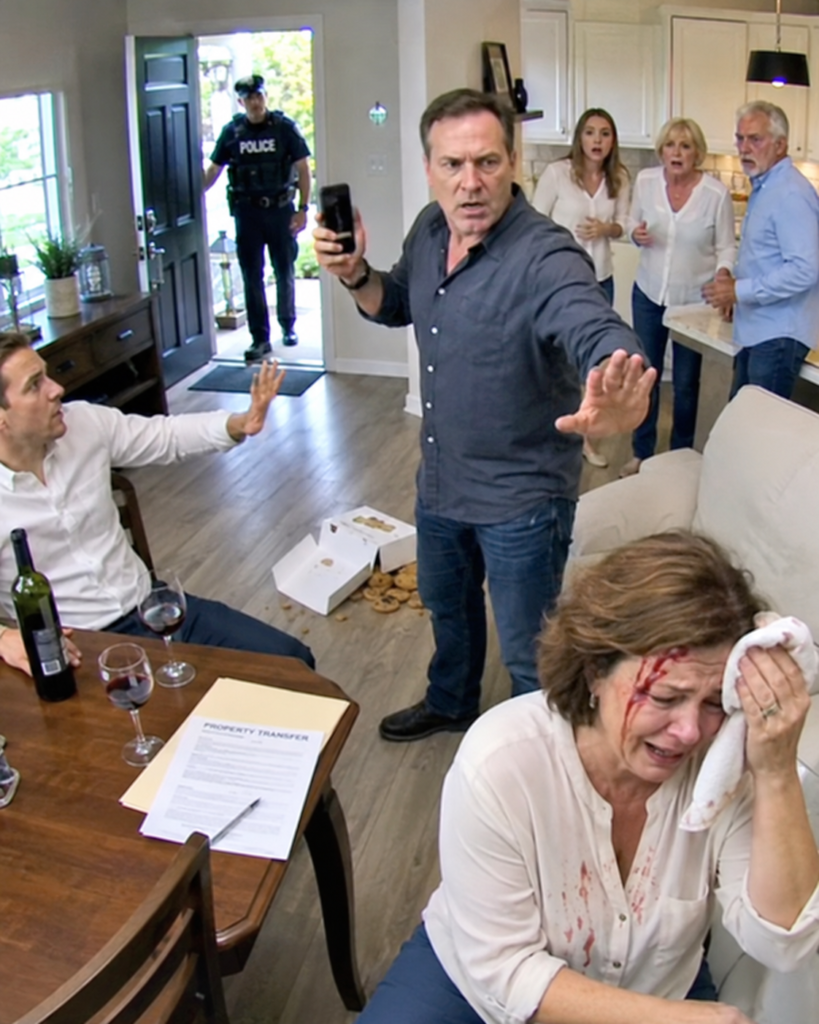
That small, lazy grin he had been wearing when I stepped into the kitchen disappeared so fast I almost missed it.
Image
One moment my son was leaning back in my chair, surrounded by his wife and in-laws, laughing as if my house belonged to him already.
The next, he was staring at the phone in my hand.
The call timer was still running.
The dispatcher was still listening.
Behind me, Sarah sat against the living-room sofa with a towel pressed to her brow, breathing in those short painful pulls that make a room feel smaller.
In front of me, four adults suddenly discovered silence.
David lowered his wineglass until the base touched the table with a soft click.
Jessica’s hand hovered over the folder on the coffee table.
Olivia looked at Michael with a warning in her eyes.
My son stood up too quickly.
“Dad,” he said. “Mom slipped.”
He used the word Mom like a shield.
That hurt more than I expected.
Maybe because I still remembered him at seven years old, running through the sprinkler while Sarah held a beach towel open for him.
Maybe because I remembered the first time he got a fever and Sarah sat awake all night, pressing cool cloths to his neck, whispering that she would trade places with him if she could.
Maybe because the woman bleeding ten steps behind me had given Michael every gentle part of herself, and he had repaid her by leaving her on the floor.
I did not shout.
I did not cross the room.
I kept the phone in my hand and let the dispatcher hear every word.
“Say that again,” I told him.
Michael swallowed.
“She slipped. We were all in here. She got upset.”
David found his voice then.
“This is a misunderstanding,” he said. “Family paperwork gets emotional.”
The phrase family paperwork sat in my kitchen like a dirty dish.
I looked at the open packet.
County recorder forms.
A deed draft.
A notary page.
A blue pen placed neatly beside the signature line.
Sarah’s mother’s beach house was written across the top in a legal description, stripped of every memory Sarah had ever attached to it.
No mention of the porch where her mother had shelled peas in a metal bowl.
No mention of the old guest room where Sarah had slept the summer after her father died.
No mention of the woman who left that house to her only daughter because she wanted Sarah to have one thing no one could take from her.
Greed has a talent for turning a home into paperwork.
I looked back at Michael.
“Your mother said she wouldn’t sign.”
Olivia stepped forward.
“She was confused.”
Sarah made a sound behind me.
It was not loud, but it was enough.
I turned my head slightly, never taking my body out of Michael’s path.
“Sarah,” I said, “did anyone ask you to sign after you had already said no?”
For a second, I thought she might protect him.
That is what mothers do, sometimes even when their children have stopped deserving it.
Her eyes moved to Michael.
His face changed.
Not guilt.
Fear.
“Don’t,” he said.
That one word told the room more than he meant it to.
Sarah closed her eyes.
“Yes,” she whispered.
The dispatcher asked me if the people involved were still present.
I answered clearly.
“Yes. Four adults. One injured woman. Property documents on the table.”
Michael took one step toward the living room.
I stepped with him.
I am not a large man, not the kind who fills doorways for a living, but rage can put steel in an ordinary spine.
“You don’t go near her,” I said.
That was when the sirens turned onto our street.
Olivia’s face drained.
Jessica grabbed David’s sleeve.
David leaned toward the folder, and I saw the calculation happen in his eyes.
He wanted those papers gone.
I moved first.
I picked up the notary packet with my free hand and held it against my chest.
“Do not touch this,” I said.
David straightened, offended now that consequences had entered the room.
“That house could save my restaurant,” he snapped.
Michael flinched at the word my.
It was tiny.
A twitch at the corner of his eye.
But I saw it.
So did Olivia.
The first officer came through the front door before anyone could fix the mistake.
An EMT followed him and went straight to Sarah.
The officer looked at my phone, then at Sarah, then at the four people in the kitchen.
“Who lives here?” he asked.
“My wife and I,” I said.
“Who is injured?”
“My wife. Sarah.”
He nodded toward Michael.
“And you are?”
Michael’s mouth opened, but no sound came out.
“Our son,” Sarah said from the floor.
I heard what it cost her to say it.
The officer separated everyone.
Olivia protested that Sarah was dramatic.
Jessica said older women fall all the time.
David said no one had forced anyone.
Michael kept repeating that his mother had slipped, but he could not explain why a woman who slipped was left alone on the living-room floor while the rest of them stayed in the kitchen with wine.
He could not explain why the papers were open.
He could not explain why Sarah had blood on her collar and fear in her voice.
And he definitely could not explain why the dispatcher had heard him tell her not to talk.
The EMT cleaned the cut above Sarah’s brow and recommended she be checked at the hospital.
When she tried to stand, I saw the bruise already darkening around her upper arm.
Michael saw me see it.
For the first time in his adult life, my son looked smaller than his choices.
The officer photographed the rug.
He photographed the table.
He asked Sarah, gently, if Michael had grabbed her.
Sarah stared at the floor.
I wanted to answer for her.
I wanted to rescue her from the sound of her own truth.
But some truths have to leave the victim’s mouth because that is the first place power returns.
“Yes,” she said.
Michael whispered, “Mom.”
Sarah did not look at him.
That broke him more than anger would have.
The officer opened the packet.
I watched his eyes move over the deed draft, the transfer language, the prepared signature page.
Then his brow tightened.
“Who is Coastal Crest Holdings?” he asked.
The room changed again.
Not loudly.
Worse.
David’s face went hard.
Jessica looked down.
Olivia closed her eyes as if she had been waiting for that name to surface.
Michael turned toward his father-in-law.
“What is that?”
David said nothing.
The officer held the packet where I could see it.
The beach house was not being transferred to Michael.
It was not being sold to pay off the restaurant in any clean way.
The draft deed moved Sarah’s inheritance into a company named Coastal Crest Holdings.
The mailing address belonged to David and Jessica.
Michael’s name appeared nowhere.
Not as owner.
Not as partner.
Not as protected beneficiary.
Nothing.
My son had grabbed his mother hard enough to put her on the floor for a lie he had not even been invited to own.
For a long moment, Michael just stared at the page.
Then he said, “David?”
That one word carried every bargain he had made with himself.
Every dinner where he called his mother selfish.
Every phone call where he told me I was holding him back.
Every time he let Olivia’s parents speak about Sarah’s inheritance as if it were an unclaimed wallet on the sidewalk.
David lifted his chin.
“It was going to be managed properly.”
“By you?” Michael asked.
David did not answer.
Olivia started crying then, but it was the clean kind of crying that asks to be mistaken for innocence.
“We were going to help everyone,” she said.
Sarah laughed once from the living room.
It was a small, broken sound.
Not because anything was funny.
Because sometimes the body reaches for laughter when grief is too sharp to hold.
“Help everyone,” she repeated.
The EMT helped her onto the stretcher, and I walked beside her as far as the front door.
She caught my sleeve.
“The cookies,” she whispered.
I almost broke then.
Not when I saw the blood.
Not when my son lied.
Not when I read the company name.
When my wife, still dazed and hurt, remembered the almond cookies I had bought to make her smile.
I told her they would be waiting when she came home.
Michael stood in the hallway with an officer beside him.
His eyes were wet now.
“Mom,” he said again.
Sarah finally looked at him.
The room seemed to hold its breath.
“You left me on the floor,” she said.
No scream could have done more damage.
Michael covered his mouth.
The officer asked him to turn around.
He did.
I will never forget the sound of the handcuffs closing.
It was not satisfying.
People think justice feels like victory.
Sometimes it feels like standing in the ruins of a house you helped build, realizing one wall was rotten for years and you kept painting it anyway.
At the hospital, Sarah needed stitches.
She also needed quiet.
I sat beside her bed while she slept, my phone buzzing with messages from people who had no right to ask questions yet.
Olivia called fourteen times.
David called once.
Jessica texted that we were destroying the family.
I read that message twice.
Then I blocked her.
Family is not destroyed when abuse is exposed.
It is exposed because someone already destroyed it from the inside.
The next morning, our attorney came to the hospital with copies of the photos and the packet information.
Sarah signed nothing about the house.
She signed only the paperwork needed to keep Michael, Olivia, David, and Jessica away from her while the investigation moved forward.
Her hand shook when she wrote her name.
I held the clipboard steady.
A week later, we learned the full truth.
David’s restaurant was worse than failing.
There were overdue loans, unpaid vendors, and a landlord already preparing legal action.
Coastal Crest Holdings had been created three days before I came home.
Three days.
They had not been asking Sarah for help.
They had been building a net.
Michael had been useful because he was blood.
He could get through the door.
He could make the demand sound like family loyalty.
He could call his mother’s refusal selfish and make her wonder if love required surrender.
That was the part Sarah struggled with most.
Not the cut.
Not the bruise.
The fact that her own child had become the voice other people used to take from her.
One month later, Sarah and I drove to the beach house.
The air smelled like salt and old wood.
She stood on the porch for a long time without speaking.
Then she unlocked the door.
Inside, dust floated in the sunlight.
Her mother’s blue mixing bowl still sat on the top shelf.
Sarah touched it with two fingers and cried without covering her face.
That was when I knew she had started to come back to herself.
Michael wrote letters.
At first, they were apologies shaped like excuses.
David pressured me.
Olivia lied.
I panicked.
I never meant for Mom to get hurt.
Sarah read none of them.
Later, one letter arrived that was different.
It said, I did this. I chose them over you. I left you there. I will spend the rest of my life knowing that.
Sarah folded it and placed it in a drawer.
She did not forgive him that day.
Forgiveness is not a vending machine where the right words buy access back into someone’s life.
It is a door the injured person owns.
Sarah was allowed to keep hers closed.
People asked me if I regretted calling 911 on my son.
They asked it softly, as if fatherhood should have made me hesitate.
I always gave the same answer.
I did not call 911 on my son.
I called 911 for my wife.
There is a difference.
The beach house is still Sarah’s.
The deed packet sits in our attorney’s office now, sealed in a plastic evidence sleeve.
The pen too.
I used to think a pen was harmless until I saw one waiting beside my injured wife like the final step in a theft.
Sometimes the weapon in a family is not the hand that grabs.
Sometimes it is the paper waiting for a signature after fear has done its work.
Sarah keeps the white bakery box from that night folded flat in a drawer at the beach house.
The cookies were stale by the time she came home from the hospital.
She ate one anyway.
She said it tasted terrible.
Then she smiled for the first time since I walked through that door.
Not a big smile.
Not a healed one.
But hers.
And after everything they tried to take, that was enough for me to know we had won the only thing that mattered.
We kept the house.
We kept the truth.
And Sarah kept herself.