By the time the recording began playing through my outdoor speakers, my backyard no longer looked like a wedding.
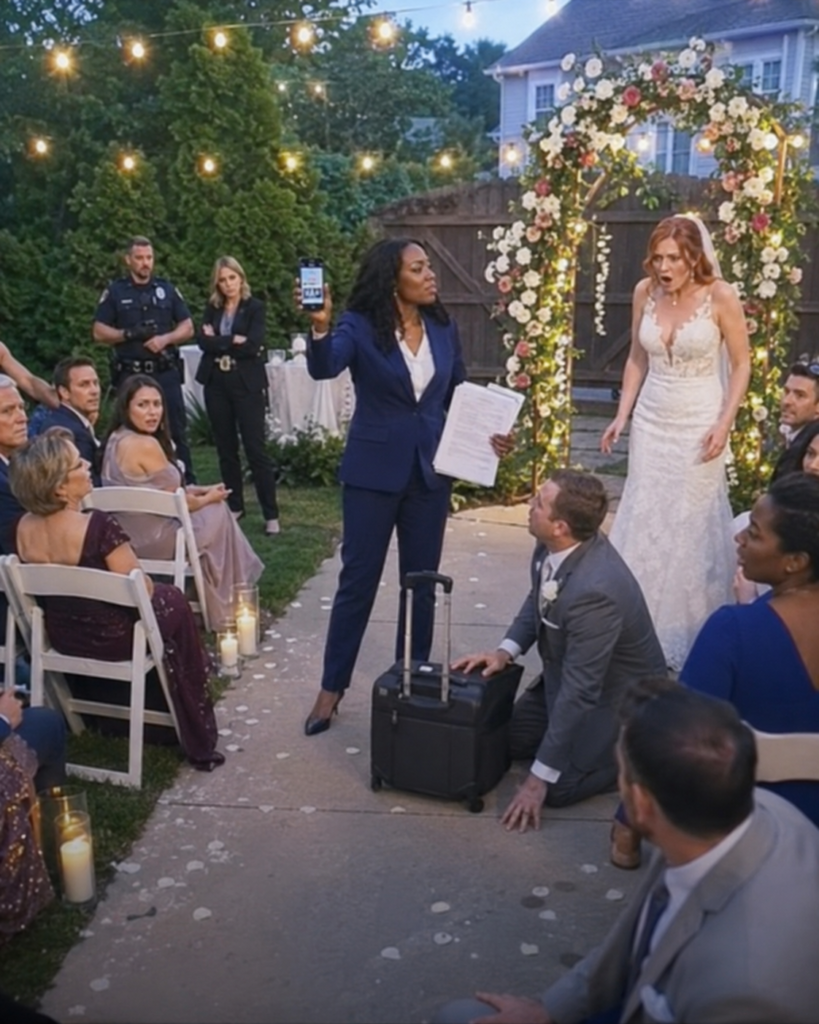
It looked like a room full of people realizing the floor had disappeared.
Ethan’s voice came out first, low and irritated, the way he spoke when he thought only family was listening.
Image
“She’ll sign if she thinks she’s saving the business,” he said on the recording.
My attorney stood beside the signing table with her hands folded, watching his face instead of the speaker.
Ethan stared at the black recorder as if it were alive.
Madison stopped touching the pearls.
Ethan’s mother whispered, “Turn that off.”
Nobody moved to help her.
Eight weeks earlier, Ethan had sat in my kitchen with his father and mother while I was supposedly asleep upstairs with a migraine.
I had not been asleep.
I had been in the guest room with my laptop open, listening to my bank’s fraud department explain why a dormant business account had suddenly received three failed access attempts from a device registered to Ethan’s father’s office.
I remember looking down the hallway and seeing the light under the kitchen door.
I remember hearing my own name spoken like I was a stubborn lock.
“Claire is sentimental,” Ethan’s father had said that night. “Use the grandmother angle.”
I had placed one security call the next morning.
Then I waited.
Waiting is not weakness when you know what you are waiting for.
It is evidence gathering.
Back in the yard, the recording continued.
Ethan’s mother gave a small, ugly laugh through the speakers.
“She has no husband, no children, no real family in that house,” she said. “She’ll cling to Ethan before she clings to paperwork.”
That line hit me harder than seeing Madison in white.
Because Madison had used almost the same words months before while handing me tea on her sofa.
“You and Ethan are basically family already,” she had told me. “Maybe you should stop acting like everything has to be separate.”
At the time, I thought she was comforting me.
Now I understood she had been testing the wall.
The investigator, whose name was Dana Holt, lifted one hand and stopped the recording.
Silence moved across the lawn.
The violinist had lowered her bow.
The caterer stood in my kitchen doorway holding a tray of shrimp she suddenly did not want to carry.
Dana looked at Ethan.
“Mr. Vance, I am going to ask you one time,” she said. “Did you submit the transfer request received by Ms. Harper’s bank this afternoon?”
Ethan opened his mouth.
His father answered first.
“This is a private family matter.”
Dana’s gaze shifted to him.
“Forgery and attempted wire fraud are not private.”
One of the officers stepped closer to the signing table.
Ethan’s mother set her champagne glass down so slowly it clicked against the linen.
Madison began to cry, but quietly, beautifully, like she was auditioning for sympathy.
I had watched her cry better than that when a hostess gave away her favorite table.
“Claire,” she whispered, “I didn’t know it was like this.”
I looked at the pearls on her ears.
“You borrowed my grandmother’s earrings for one night,” I said. “You kept them for six months.”
Her face changed.
There it was.
Not guilt.
Calculation.
She reached up to remove them, but my attorney spoke before I could.
“Leave them where they are.”
Madison froze with one hand near her throat.
My attorney took a printed inventory sheet from her briefcase and handed it to Dana.
The pearls were not the biggest crime in that yard.
They were the smallest proof of the pattern.
Six months of borrowed things.
Six months of missing invoices.
Six months of Ethan asking whether my grandmother had left the house to me outright or through a trust.
Six months of Madison sitting across from me, nodding while I blamed myself for being suspicious.
I used to think betrayal had to arrive shouting.
Sometimes it arrives with soup, tissues, and a friend who tells you not to overreact.
Dana opened the cream folder on the table.
The top page had my name on it.
Claire Elise Harper.
The signature line underneath was blank, because they had planned to put a pen in my hand after the ceremony and tell me I was being dramatic, selfish, unstable, and cruel if I refused.
The page below it was not blank.
It carried a transfer draft that would have moved the house into a limited company controlled by Ethan and his father.
The third page gave Ethan temporary management authority over my consulting contracts during what they called my “emotional recovery period.”
I laughed once.
It came out colder than I meant it to.
Ethan flinched.
“You were going to make me sign away my house at your wedding to my best friend,” I said.
He finally looked at me.
For a second, I saw the man who used to bring me coffee on Sunday mornings.
Then I saw the man who had let his bride wear my grandmother’s pearls.
“I was going to fix it after,” he said.
The sentence was so small that even his mother looked away.
Dana asked him to repeat himself.
He did not.
An officer stepped beside Ethan’s father and asked him to place his phone on the table.
The older man laughed.
It was the laugh of someone who had spent his whole life being obeyed before he finished a sentence.
“You people cannot be serious,” he said.
Dana nodded toward the officer.
“We are.”
That was when Ethan’s father made his first mistake in front of everyone.
He grabbed the property folder.
Not quickly enough to steal it.
Just quickly enough to show every camera on my house that he believed it could hurt him.
The officer caught his wrist and pushed the folder back onto the linen.
No one screamed.
No one needed to.
The sound of his cuff closing was louder than the wedding march had been.
Ethan’s mother started forward.
“Don’t you dare touch my husband.”
Dana turned to her.
“Mrs. Vance, you are going to want to stay where you are.”
“I did nothing.”
The recorder clicked again, and her own voice filled the yard.
“Put the house in Ethan’s reach before Claire finds a spine,” the recording said. “Madison can handle the friendship side.”
Madison made a sound like air leaving a tire.
Every guest turned toward her.
She looked at me then, really looked at me, and I think she understood that there was no speech left that could make her the wounded bride.
Not in my yard.
Not wearing my pearls.
Not beside the folder with my name on it.
The investigator asked Madison whether she had encouraged me to share passwords or account access with Ethan.
Madison said no.
My attorney removed another sheet from her file.
It was a printout of a text Madison had sent Ethan after one of our wine nights.
She still uses the grandmother’s birthday.
Madison covered her mouth.
I remembered that night exactly.
She had asked me silly questions from an online quiz, laughing about how predictable our password habits were.
First pet.
First street.
Favorite family date.
Grandmother’s birthday.
I had answered because she was my best friend and I was tired of feeling like suspicion made me ugly.
That was the part I had to forgive myself for later.
Not trusting Ethan.
Not trusting Madison.
Trusting the version of myself that wanted love to be simple.
The officers separated them before the vows could ever be said.
Ethan sat in one of the gold chairs with his hands cuffed in front of him, veil still hanging over one shoulder where it had slipped from Madison during the commotion.
It looked ridiculous.
It looked perfect.
Madison kept asking whether she needed a lawyer.
Ethan’s mother kept saying the guests were misunderstanding.
Ethan’s father stopped speaking altogether.
The caterer asked my attorney whether she should pack up the food.
My attorney looked at me.
For the first time since I had stepped through the gate, the decision was mine alone.
“Feed the officers first,” I said.
A few people gasped, as if hospitality was the scandal.
I walked to the arch and touched one of the roses.
They were beautiful.
That almost made it worse.
I had chosen them for a dinner where I planned to tell Ethan I wanted us to try counseling before the distance between us became permanent.
He had used them to marry Madison.
So I took one rose from the arch and laid it on the signing table beside the folder.
Then I asked Dana if I could have my earrings back.
Madison shook her head before anyone answered.
“They were a gift,” she said.
I turned to her.
“From whom?”
She looked at Ethan.
Ethan looked at the grass.
That was the second mistake.
Dana asked Madison to remove the pearls and place them in an evidence pouch.
Madison obeyed with trembling fingers.
When the earrings left her ears, she seemed smaller.
Not humbled.
Exposed.
My grandmother had worn those pearls to her courthouse wedding in 1958.
She had cleaned houses for thirty-one years, bought this property when no one in her family believed she could, and left it to me with one sentence in her will: Never sign away the roof that lets you sleep.
Ethan knew that sentence.
Madison knew it too.
That was why they had planned to use grief as the lever.
They thought the house was sentimental enough to manipulate me and valuable enough to steal.
They were right about the value.
Wrong about the woman.
As the officers walked Ethan’s father toward the gate, one of Ethan’s business partners stood up.
“Claire,” he said, “I didn’t know.”
I believed him.
I also remembered every dinner where he had let Ethan interrupt me while I explained the contracts I had negotiated, the clients I had saved, the revenue I had brought in.
Not knowing is sometimes honest.
Not asking is sometimes convenient.
I said nothing.
He sat back down.
Dana collected the folder, the recorder, the printed texts, and the bank alert I had forwarded from the airport.
Then she told me the part I had been waiting to hear.
“Your title is safe,” she said. “Your accounts are locked down. Your business contracts are protected.”
I nodded.
I did not cry until then.
One tear, maybe two.
Not because I had lost Ethan.
Because I had almost lost myself trying to be fair to people who had mistaken kindness for vacancy.
The final twist came twenty minutes later, after the first vehicle pulled away with Ethan’s father inside.
My attorney handed me a second folder.
I recognized the blue tab on it.
It was the trust document I had signed at the airport before I ever came home.
While Ethan and Madison were rehearsing vows in my backyard, my attorney had moved the house into the Harper Family Trust under the protection clause my grandmother had written years earlier.
No boyfriend could touch it.
No forged request could move it.
No temporary husband, future husband, or almost-husband could claim it by charm, pressure, or paperwork.
And because Ethan’s family had tried to transfer it after the trust was recorded, the attempted theft was no longer just ugly.
It was documented.
Timestamped.
Witnessed.
The wedding they built to take my house became the event that protected it.
Madison heard that from the back of the second vehicle.
She looked at me through the half-open door, mascara finally breaking down her perfect face.
“Claire,” she said, “please. We were friends.”
I walked close enough for her to hear me without raising my voice.
“No,” I said. “You were evidence.”
The officer closed the door.
The candles were still burning when the last guest left.
I stood alone in the yard after midnight while the caterers packed what remained of the food into silver trays.
My outdoor speakers were silent.
The rose arch leaned slightly to one side.
My suitcase was still lying where I had dropped it.
I picked it up myself.
Inside the house, my kitchen smelled like garlic, lemon butter, and champagne.
For a moment, I hated that smell.
Then I opened the windows.
I washed my grandmother’s pearls in warm water and laid them on a towel beside the sink.
I took off the dress I had flown home in.
I changed the locks before sunrise.
By Monday, the house did not belong to Ethan.
It did not belong to his father.
It did not belong to the lie Madison wore down my aisle.
It belonged to the woman who came home early, saw the trap, and pressed record before she stepped through the gate.
And every summer after that, when the roses bloomed, I let them.
Not for him.
Not for her.
For my grandmother.
For the roof she told me never to sign away.
For the night I learned that silence can be shock, but it can also be strategy.