The morning Grace handed me that note, the whole house still felt asleep.
It was one of those winter mornings that never fully became day.
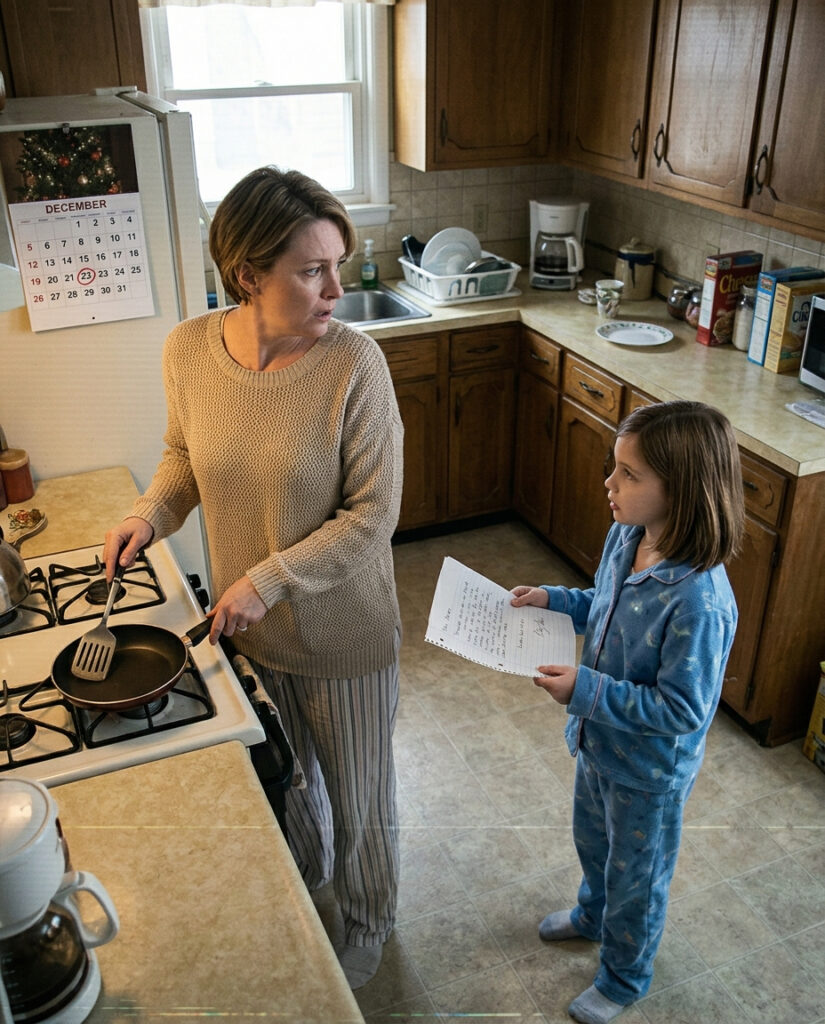
The sky outside the kitchen window was a dull, washed-out gray, and the frost on the glass made everything beyond it look far away. I was standing at the stove in thick socks and an old sweater, turning pancakes that were already too dark because my mind was somewhere else—half on overdue invoices, half on the electricity bill, half on the strange pressure in my chest that had become so normal I barely noticed it anymore.
Then I heard Grace’s feet on the stairs.
Soft. Careful. That pause on the last step that always creaked no matter how gently she tried to take it.
She appeared in the doorway wearing her planet pajamas, hair tangled from sleep, clutching a single folded sheet of white paper in both hands. Not loosely. Carefully. The way a child carries something that feels important but wrong.
Her face made my stomach tighten before I even saw the note. She wasn’t sleepy. She wasn’t cheerful. She had that quiet, searching look children get when they already know something is bad and are trying to figure out whether you know it too.
“Mom,” she said in a small voice. “I found this on the counter.”
I turned the stove off without thinking.
I wiped my hands on a dish towel and took the page from her.
The handwriting hit me before the words did.
My mother’s handwriting. Precise, neat, disciplined loops. The same handwriting that used to appear on lunch notes, school forms, birthday cards, Christmas tags. I had known that script my entire life. Seeing it there on plain printer paper made my throat close.
I read it once.
Jessica,
We’ve decided it’s time for you and Grace to find your own place. Please be moved out by the time we return from Bella’s on the 28th. We’ll discuss everything when we get back.
Mom and Dad.
I read it again because my brain refused to accept the first reading.
Then a third time.
No explanation. No conversation. No warning. Just a deadline, a signature, and the kind of cold finality people use when they don’t want discussion—only compliance.
Behind me, one of the pancakes began to burn.
“Mom?” Grace asked. “What does it mean?”
I realized I had gone completely still.
On the wall beside the refrigerator hung the cheap farm calendar my father got free from the hardware store every year. My eyes went straight to the square with today’s date.
December 22.
My parents had left that morning for my sister Bella’s house three states away. I had watched them pull out of the driveway with wrapped gifts in the trunk and travel mugs in the cup holders, heading off to spend Christmas where they clearly believed they were wanted more.
Back on the 28th.
Six days.
They were giving me six days to move myself and my nine-year-old daughter out during Christmas week.
Six days to find somewhere I could afford.
Six days to pack our lives into boxes and disappear before they got home, as if we were something embarrassing they wanted gone before the neighbors noticed.
I swallowed hard and crouched in front of Grace so I was eye-level with her.
I had learned over the last year that children study your face the way sailors study weather. They know when the storm is real, even when you smile.
“It means,” I said, forcing my voice to stay steady, “Grandma and Grandpa want us to move out before they get back from Aunt Bella’s.”
Her eyes widened instantly.
“Why?”
That was the part I couldn’t answer. Not in a way a nine-year-old could carry.
I could guess. I could feel the answer in a hundred little humiliations I had ignored, in the way my mother’s tone changed whenever Bella called, in the way my father had started referring to the basement apartment as “temporary” even though I was the one quietly keeping half the house running.
But I didn’t know exactly what story they had told themselves to make this feel acceptable.
“I don’t know yet,” I admitted. “But we’re going to figure it out. Okay? We are.”
Grace searched my face for a long second.
“Are we in trouble?” she whispered.
“No,” I said immediately. “No, sweetheart. We are not in trouble.”
“Then why do we have to go?”
My chest tightened so sharply it almost stole my breath.
“Sometimes adults make decisions that only make sense to themselves,” I told her. “And sometimes those decisions are unfair. This might be one of those times.”
She looked down at her pajamas and nodded, but she didn’t look reassured.
Neither did I.
I stood, turned back to the stove, and dropped the ruined pancake into the trash. Burnt batter and cold air filled the kitchen as I cracked the window open. The December wind slipped in immediately, sharp and bitter, and somehow it fit the moment perfectly.
Because this house had once meant safety to me.
I grew up here. I knew every squeaky board, every stubborn cabinet, every draft in every winter window. When my marriage collapsed the year before and Grace and I had nowhere stable to land, my parents told me to come home “for a little while.” They said the basement would give us privacy. They said family helps family. They said I could breathe here.
So I moved in.
I paid what they called a small rent. Then I paid the internet because my father complained about the cost. Then the oil delivery because my mother said things were tight after my father’s retirement. Then groceries, then the water bill, then the property tax installment “just this once,” then the cable package my father insisted he needed for football, then my mother’s pharmacy refill when Bella was supposedly going through a difficult month again.
Somewhere along the way, I stopped being the daughter getting back on her feet and became the quiet financial patch holding their household together.
And now, apparently, I was being removed like a problem.
I spent the rest of that morning moving through the kitchen on automatic. I made new pancakes. Packed Grace’s lunch. Brushed her hair. Signed the form for her school field trip. Smiled when she looked at me. Kissed her forehead at the door. Promised I’d pick her up on time.
The minute the school bus pulled away, I went back inside, sat at the table, laid the note flat in front of me, and finally let myself feel it.
Not just fear.
Not just panic.
Humiliation.
A deep, sick humiliation that made my skin feel hot.
Because they had not even given me the dignity of a conversation.
They had written a note. Left it on the counter. Gone to Bella’s for Christmas.
Like I was a tenant behind on rent.
Like Grace and I were clutter they expected gone before they returned.
I cried for exactly four minutes.
Then I stopped.
Something in me went cold and strangely calm.
I opened my laptop.
First, I checked my savings. Thin. Not enough to magically fix this.
Then I checked rentals. Almost nothing available the week of Christmas.
Then I started making calls.
By noon, an old friend from college—Nina—called me back. She had a furnished in-law suite above her garage. Small, but warm. Month-to-month. Not perfect, but available immediately.
I said yes before she finished the sentence.
Then I started packing.
I packed in silence that first day. Not dramatic silence. Working silence. The kind that settles over someone who has realized there is no point wasting energy on disbelief.
Books. Clothes. Grace’s art supplies. Winter coats. Toothbrushes. Her stuffed fox. My tax folders. The coffee mug with the chipped handle. The framed photo of Grace at age five in rain boots. Every small thing that meant our life was still ours.
The basement slowly stopped looking like a home and started looking like a place we had only borrowed.
That night, after Grace went to bed, I walked upstairs and stood in the dark kitchen.
I looked around at the house I had helped keep afloat.
Then I opened my banking app.
I canceled the automatic transfer for their rent support.
I canceled the utility payments that came from my account.
I canceled the grocery delivery subscription my mother used.
I removed my card from the oil company.
I stopped the cable autopay.
I stopped everything.
Each confirmation email felt like a tiny lock clicking shut.
By December 27, our boxes were loaded. Nina had left a wreath on the door of the little suite and a welcome basket on the counter for Grace with hot chocolate, crayons, and fuzzy socks. I nearly broke down right there from the simple kindness of it.
On the morning of the 28th, I took one final walk through the basement. Empty shelves. Bare walls. Mattress gone. Lamps gone. No sign we had ever lived there except the cleaner smell and a single pale rectangle where Grace’s bookshelf used to stand.
I set my parents’ spare keys on the kitchen counter.
And beside them, I left their note.
No reply. No explanation. No goodbye.
Just the same paper they had used to erase us.
Then I strapped Grace into the car and drove away.
They got home just after dark.
I know because my phone lit up while I was helping Grace hang paper snowflakes in our new tiny kitchen.
Mom calling.
Then Dad.
Then Mom again.
Then both of them, back to back, over and over.
I let it ring until the sixth call.
Then I looked at the screen, took one long breath, and answered…
The next part of what they said to me that night—and what I told them after everything I’d been paying for—still makes my hands shake, so if you want part two, go to the comments because that’s where it all started to come apart…
Part 2 … 👇👇👇
Part 2:
I put the phone on speaker and set it down on Nina’s counter.
My mother was the first voice I heard, sharp and breathless. “Jessica, what is this? Where are your things?”
I leaned against the sink and looked at Grace coloring at the table like she had already decided this new place was safe.
“You asked me to be out by the 28th,” I said. “It’s the 28th.”
My father cut in, furious. “You don’t leave like this without discussing it. The oil company called. The cable is off. Your mother’s pharmacy texted about payment. What exactly did you do?”
That was the moment I understood.
They weren’t shocked that I had gone.
They were shocked that the money had gone with me.
“I stopped paying bills that weren’t mine,” I said.
There was silence for half a second, then my mother’s voice cracked into something uglier. “After everything we’ve done for you?”
I almost laughed.
Everything they’d done for me.
The basement I paid to heat. The groceries I stocked. The taxes I helped cover. The Christmas they left me out of while handing Bella another perfect holiday.
Then my father lowered his voice, the way he always did when he wanted control more than volume.
“You need to come back here tonight,” he said. “We need to talk about what you owe us.”
I looked at the note they had written, now folded in my coat pocket.
And for the first time in my life, I didn’t feel like their daughter.
I felt like the witness to my own eviction.
“No,” I said quietly. “What we need to talk about is what I’ve been covering for the last eleven months… and what Bella still doesn’t know about why you really wanted that basement empty before New Year’s.”