The morning I walked into my husband’s private divorce meeting with our sleeping daughter in my arms, Pierce Tower smelled like lemon cleaner, leather, and the kind of money that never had to explain itself.
The elevator was quiet enough for me to hear Grace breathe.
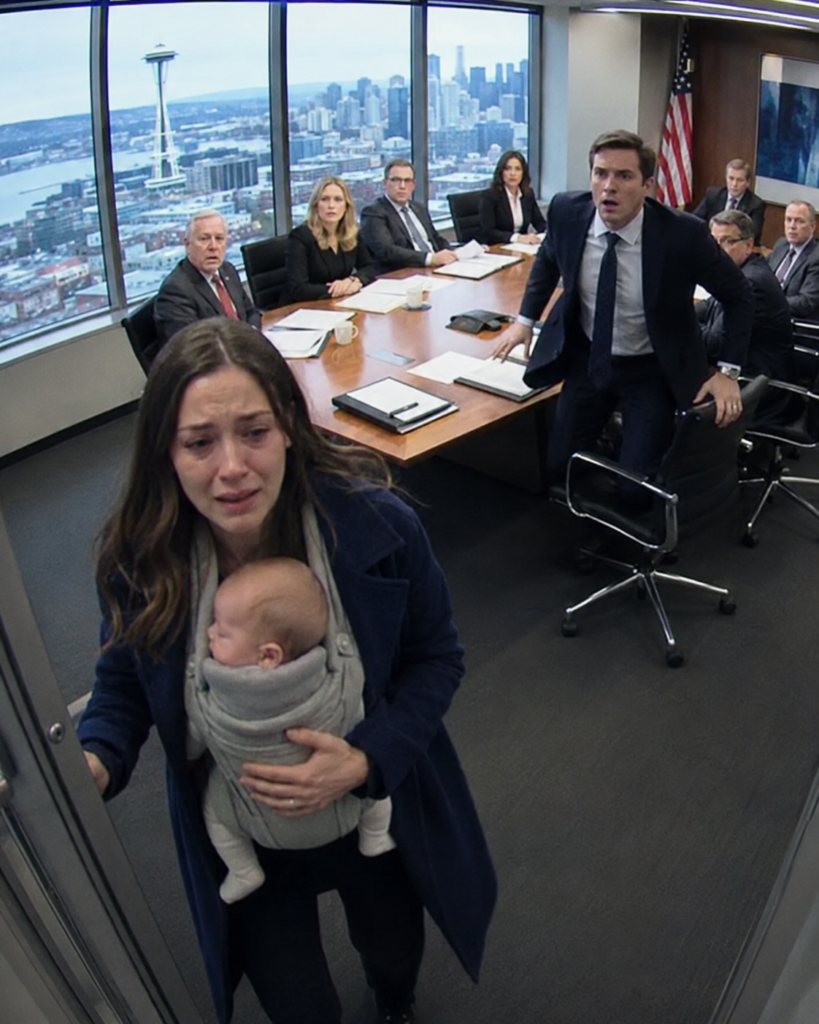
She was tucked against my chest in the baby carrier, one cheek pressed to my blouse, her little hand curled around a loose thread near my collar.
Image
She was four months old.
Four months of doing everything alone.
Four months of hospital intake forms, late-night feedings, and pretending I was not scared every time the mail came.
Her father had never held her.
Her father had never seen her.
Her father, Preston Waverly, was upstairs preparing to end our marriage as cleanly as his attorneys could manage.
I watched the elevator numbers climb.
Twenty-six.
Twenty-seven.
Twenty-eight.
The white glow of the panel made my reflection look washed out.
I was twenty-nine years old, still legally Hannah Waverly, wearing a navy coat with a missing cuff button and a cream blouse that Grace had already wrinkled with her tiny fists.
My hair was pinned back because babies grab anything they can reach.
My shoes were plain.
My hands were steady.
That surprised me most.
For a year, I had imagined this moment in pieces.
Sometimes I pictured myself crying.
Sometimes I pictured myself shouting.
Sometimes, during the loneliest nights after Grace was born, I pictured myself simply walking away and letting Preston believe he had won whatever quiet war he thought marriage had become.
But that morning, with my daughter warm against me, I felt no need to perform pain for men who had already priced it.
Preston believed our marriage would end with a signature.
He believed I would accept the settlement packet, sign the waiver, and disappear from his life as if I had been a long appointment that ran over schedule.
The packet had arrived two days earlier by courier.
The envelope was thick, cream-colored, and so expensive it felt insulting in my hands.
Waverly Dissolution Draft, the cover page read.
Inside were the kinds of phrases that make cruelty sound like accounting.
Separate property.
Final release.
No continuing claims.
The settlement amount was modest by Waverly standards, which meant it was designed to look generous to anyone who did not understand the scale of what Preston had.
There was no mention of Grace.
There was no line for the daughter he did not know existed.
There was only my name, his name, and the expectation that I would be grateful for being dismissed politely.
At 8:42 that morning, the elevator carried me toward the executive floor.
The divorce meeting was set for 9:00.
I had the settlement packet folded in my tote bag.
I had Grace’s birth certificate tucked inside my coat.
I had her hospital bracelet in a small plastic sleeve, because by then I understood something I wished I had learned earlier.
Love without proof can be denied by people who know how to hire lawyers.
Paper, however, has a different kind of voice.
The elevator chimed.
The doors opened.
The executive floor of Pierce Tower looked exactly as it had the last time I visited Preston at work, back when I still believed being patient made me loyal.
Polished wood.
Tall glass walls.
Gray carpet so thick it swallowed footsteps.
Assistants moved behind clean reception desks with paper coffee cups and quiet urgency.
Phones rang softly.
Nobody raised their voice.
Nothing in that place was allowed to look messy.
Not grief.
Not marriage.
Not a woman carrying a baby into a room full of men who thought they had already handled her.
The receptionist looked up.
Her face changed before she caught herself.
“Mrs. Waverly,” she said, standing quickly. “Mr. Waverly is still in a private meeting.”
Her eyes flicked to Grace.
Then away.
A year earlier, I would have apologized.
I would have taken a seat.
I would have smoothed my skirt, folded my hands, and waited until Preston decided whether his wife deserved a few minutes between calls.
That was how our marriage had trained me.
Small waits.
Small silences.
Small humiliations that never looked large enough to name.
Preston had not always been cold.
That was the part people never understand from the outside.
Men like him do not begin by shutting every door.
They begin by opening the right ones.
When we first met, he remembered how I took my coffee.
He sent a car when it rained.
He listened when I talked about my mother’s old recipe box and the tiny apartment I had rented before I met him.
He told me I made him feel normal.
I thought that was love.
Later, I understood it was also convenience.
For three years, I gave Preston the part of his life that did not require strategy.
I learned his moods.
I hosted dinners where his investors praised his discipline while I cleared plates.
I remembered his father’s medication schedule when Preston forgot.
I signed holiday cards, kept track of birthdays, and carried the soft side of a family that valued hard edges.
Then I became inconvenient.
Pregnancy did not make me fragile.
It made me visible.
And Preston had never liked anything he could not control.
When I tried to tell him, he was in London for a financing round.
That was what his assistant said.
When I called again, his phone went to voicemail.
When I sent the first message, he replied twelve hours later with one sentence.
Not now, Hannah.
By the time I realized he had blocked one of my numbers, I was sitting in a clinic waiting room under fluorescent lights, filling out forms with my hand pressed to my stomach.
Emergency contact.
I wrote his name.
Then I crossed it out.
The memory came back as I stood on that executive floor, watching the receptionist decide whether to physically stop me.
She did not.
I kept walking.
At the end of the hall stood Preston’s private conference room.
The double doors were heavy, polished, and fitted with brass handles that had probably been chosen by a designer who charged more per hour than my monthly rent after I left the penthouse.
Behind those doors were the attorneys.
The advisers.
The settlement language.
And Preston.
I paused with my hand on the handle.
Grace stirred in her sleep.
Her mouth moved softly, searching for comfort even while dreaming.
I touched the back of her head.
“We’re going to be okay,” I whispered.
I did not know whether I was promising her or asking her to lend me courage.
Inside the room, a man’s voice was speaking.
Measured.
Expensive.
A chair scraped lightly.
A page turned.
I heard Preston say, “She’ll sign.”
Two words.
That was all.
She’ll sign.
Not Hannah.
Not my wife.
Not the woman who had sat alone through appointments, packed her own bags, and learned to install a car seat by watching a video at 2:00 in the morning.
She.
For one ugly heartbeat, I wanted to kick the doors open so hard they slammed against the walls.
I wanted to put every bill, every unanswered message, every lonely night on that polished table and make him look at all of it.
But Grace was sleeping.
And rage, I had learned, is a luxury when a child is resting against your chest.
So I opened the doors calmly.
Every conversation inside stopped.
The room was larger than I remembered.
Floor-to-ceiling windows looked out over Seattle, pale morning light spreading across the conference table.
A small American flag sat on a side credenza beside a framed photo of Preston shaking hands with someone important.
Legal folders were lined up in front of the attorneys.
A financial adviser had a tablet open.
Preston sat at the far end in a charcoal suit, his posture relaxed, one hand resting near a fountain pen.
He looked annoyed first.
That hurt more than I expected.
Not shocked.
Not sorry.
Annoyed, as though I had interrupted a call.
Then his eyes moved from my face to the baby carrier.
His expression changed so quickly that everyone saw it.
Grace slept through the first crack in her father’s composure.
“Hannah,” Preston said.
My name sounded foreign in his mouth.
One of the attorneys stood halfway, then thought better of it.
The financial adviser looked down at his tablet as if a screen might save him from witnessing a marriage turn human.
At the window stood Preston’s father.
Charles Waverly had always been the only person in that family who frightened me without ever raising his voice.
He was old money without the softness people pretend comes with age.
He remembered names, debts, weaknesses, and promises.
During my first Christmas with the Waverlys, he had handed me a glass of sparkling water before I asked, then later told me Preston needed a wife who understood discretion.
At the time, I thought he was welcoming me.
Now I understood he had been warning me.
Charles turned from the window.
His gaze landed on Grace.
The color drained from his face before Preston even understood what he was seeing.
That was the first moment I knew the room held a secret I had not brought with me.
Preston stood.
His chair scraped back hard.
“Whose baby is that?” he asked.
The attorney nearest me closed his folder.
Nobody told Preston not to ask.
Nobody told him how cruel he sounded.
Nobody in that room had been hired to protect dignity.
I adjusted Grace against my chest and walked to the table.
My shoes made almost no sound on the carpet.
I removed the folded birth certificate from inside my coat.
Then I placed the hospital bracelet beside it.
The bracelet was tiny.
Absurdly tiny.
Grace Waverly.
Date of birth.
Mother’s name.
Father’s name.
Preston stared at the paper without touching it.
For once, he did not have language ready.
I said, “She is your daughter.”
No one moved.
The freeze that followed was not silence exactly.
It was more physical than silence.
A pen hovered over a legal pad.
A tablet screen dimmed and went black.
Someone’s coffee cup trembled slightly against a saucer.
Outside the glass wall, the receptionist stood still with one hand at her mouth.
Nobody moved.
Preston looked from the birth certificate to me.
“That’s not possible.”
It was such an ordinary sentence for such an unforgivable moment.
I almost laughed.
Instead, I reached into my tote bag and pulled out the hospital intake form copy, the appointment record, and the printed messages I had sent before Grace was born.
I had documented everything.
The first call.
The second call.
The message marked delivered.
The one marked read.
The email to his assistant asking him to contact me.
The clinic visit on October 17.
The delivery record at 3:18 a.m.
I had not done it because I was planning revenge.
I had done it because when a powerful man begins erasing you, proof becomes a way to stay alive.
Charles Waverly sat down slowly.
That, more than Preston’s face, made the attorneys nervous.
Preston did not sit.
He looked at his father.
Then back at me.
“Why didn’t you tell me?” he demanded.
The unfairness of it passed through the room like cold air.
Even one of his attorneys looked down.
I opened the folder and slid the printed messages across the table.
“I tried.”
Preston barely glanced at them.
Men who are used to being believed do not examine evidence until the room stops believing them.
Charles reached for the top sheet first.
His hand shook.
That was new.
I had never seen Charles Waverly shake.
He read the first message.
Then the second.
Then he looked at Preston in a way I could not interpret.
Not anger.
Worse than anger.
Recognition.
“Dad,” Preston said quietly.
It was the first time he sounded afraid.
Charles did not answer him.
Instead, he opened the leather folder in front of him.
The folder had been closed when I entered.
I had assumed it held the final settlement papers.
It did not.
Charles removed a sealed envelope.
Cream paper.
Old blue ink.
My name written across the front.
Hannah.
Not Mrs. Waverly.
Not a legal label.
Hannah.
The room shifted around that envelope.
Preston’s face changed again, and this time I understood the difference.
When he saw Grace, he was shocked.
When he saw the envelope, he was scared.
Charles placed it beside the birth certificate.
“Hannah,” he said, and his voice sounded older than it had a minute before. “Before my son says one more word, you need to know why he was told not to look for you.”
Preston snapped, “Dad. Don’t.”
That one word told me everything and nothing.
It told me the silence had not been accidental.
It told me someone had made a choice.
It told me my daughter’s absence from Preston’s life had been arranged long before I walked into that room.
Charles did not look at his son.
He slid the envelope toward me.
Grace woke then.
Not fully.
Just enough to make a small sound against my chest.
It was soft, confused, alive.
Preston flinched as if the sound had touched him.
I picked up the envelope.
My fingers felt clumsy.
The paper was thick, the flap sealed, the ink slightly faded.
Inside was a letter dated five months earlier.
Five months.
Before Grace was born.
Before the settlement packet.
Before Preston’s attorneys decided what my silence was worth.
I unfolded it while everyone watched.
The first line made no sense to me.
The second made my breath catch.
The third made Preston grip the edge of the table.
Charles had known I was pregnant.
More than that, he had known because Preston had received my message after all.
It had not disappeared.
It had not been lost in travel, buried by assistants, or swallowed by business.
Preston had read it.
Charles had seen it.
And then Charles had made a decision that turned my daughter’s first months into a lie.
The letter was not addressed to me.
It was addressed to Preston.
Charles had written it after discovering my message on Preston’s forwarded correspondence, and every line carried the cold structure of a man used to controlling outcomes.
He had warned Preston not to contact me until the pending acquisition closed.
He had written that a pregnancy could complicate the family office review.
He had written that emotional decisions made in a weak moment could cost the company leverage.
Then came the sentence that made the entire room disappear.
Once the dissolution is complete, appropriate arrangements can be made privately.
Appropriate arrangements.
That was what they had called my daughter.
Not a baby.
Not a grandchild.
Not Grace.
A complication to be arranged.
Preston sank back into his chair.
“I didn’t agree to that,” he said.
His voice was small.
Charles turned toward him.
“You didn’t refuse it.”
The words landed harder than shouting.
For the first time since I had known him, Preston looked like a boy sitting in a room built by his father.
But I could not afford to feel sorry for him.
Grace shifted against me again, and that tiny weight reminded me exactly who had paid the price for their cowardice.
I looked at Preston.
“You knew there was a chance.”
He swallowed.
“I thought…”
He stopped.
There was no ending to that sentence that could help him.
The lead attorney stood and said, carefully, “We should pause this meeting.”
“No,” I said.
My voice did not rise.
That made everyone listen.
I placed the letter flat on the table, beside the birth certificate, the bracelet, and the stack of messages.
The whole story was there now.
Not all of it, but enough.
Enough paper to make denial difficult.
Enough dates to make silence look intentional.
Enough proof to turn a divorce meeting into something else.
Charles looked at me.
For the first time, he seemed to understand that I had not come there to beg.
I had come because my daughter deserved to exist in the one room where they had tried hardest to erase her.
“What do you want?” Preston asked.
It was the wrong question.
It was always the wrong question with men like him.
They assume pain arrives with a price tag.
I looked down at Grace.
Her eyes had opened, dark and unfocused, her little mouth working like she was deciding whether to cry.
I touched her cheek.
Then I looked back at Preston.
“I wanted you to know her name before your lawyers removed mine.”
Nobody spoke.
The sentence did what I needed it to do.
It made the room human again.
One attorney looked away.
The financial adviser closed his tablet.
Charles sat with both hands on the table, staring at the letter he had written like it had somehow changed while no one was watching.
Preston took one step toward me.
I took one step back.
It was small, but everyone saw it.
He stopped.
“Hannah,” he said. “Please.”
That word might have meant something once.
Before the missed appointments.
Before the settlement packet.
Before I learned to rock a newborn in the dark while wondering how someone with so much power could make me feel so completely alone.
But by then, please was not a repair.
It was only a sound people make when consequence finally reaches them.
The meeting did pause after that.
Not because Preston ordered it.
Because Charles did.
He told the attorneys to leave the room.
They hesitated, but only for a second.
Power recognizes power, and for all Preston’s wealth, the oldest authority in that room still belonged to his father.
When the door closed behind them, there were four of us left.
Charles.
Preston.
Me.
Grace.
The baby made a soft hungry noise, and I reached into my bag for the small bottle I had packed at dawn.
The ordinary motion broke something in the room.
The billionaire heir, the old patriarch, the divorce strategy, the legal folders, all of it had to wait while a four-month-old baby decided she was hungry.
That was the first honest thing that happened all morning.
Preston watched me feed her.
His eyes filled, but I did not soften.
Tears are not proof of change.
Sometimes they are only shock leaving the body.
Charles spoke first.
“I was wrong.”
I looked at him.
“No,” I said. “You were deliberate.”
The words sat between us.
He accepted them because he had no defense.
Preston pressed both hands against his face.
“I thought I had time.”
I almost asked, time for what?
Time to finish a deal?
Time to decide whether fatherhood fit his schedule?
Time to let his attorneys build a cleaner version of the story?
Instead, I capped the bottle and tucked Grace closer.
“You had a daughter,” I said. “That was the time.”
The divorce did not end that day.
Nothing so complicated ends in one scene, no matter how badly people want a clean ending.
There were new filings.
There were amended disclosures.
There were meetings where Preston’s lawyers became much more careful with their language.
There was a paternity test, not because I doubted anything, but because Preston’s world needed a laboratory report before it could admit what my body had already known.
There were custody discussions.
There were financial corrections.
There was Charles Waverly’s private apology, written this time to me, not around me.
I kept copies of everything.
The revised settlement draft.
The acknowledgment of paternity.
The trust paperwork created for Grace.
The letter Charles wrote admitting that he had advised Preston to delay contact until after the acquisition closed.
Documentation did not heal me.
But it stopped them from pretending the wound was imaginary.
Preston met Grace properly three weeks later in a family counselor’s office, not in a penthouse, not in a boardroom, not anywhere he could hide behind money.
He cried when she grabbed his finger.
I watched him carefully.
I did not punish him by pulling her away.
I did not reward him by pretending the tears were enough.
I simply let the moment be what it was.
A beginning, maybe.
Not a forgiveness.
Those are different things.
People ask whether I stayed married to him.
The answer is no.
Not then.
Not after that room.
Some betrayals do not destroy love all at once.
They destroy the place where love was supposed to live.
Preston became Grace’s father slowly, through scheduled visits, missed chances he had to own, and ordinary tasks that no one applauded.
Diapers.
Pediatric appointments.
A fever at midnight.
A first Christmas morning where he sat on the floor in jeans instead of a suit and let Grace chew on wrapping paper while he looked both terrified and grateful.
Charles never fully recovered the authority he had once carried in my mind.
Maybe that was fair.
He loved Grace, in his way, but he also learned that access is not a right people inherit.
It is earned.
Every visit went through me.
Every promise had to be kept.
Every apology had to survive beyond the moment it was spoken.
As for me, I stopped being the woman who waited outside doors.
That may be the part I remember most.
Not Preston’s face.
Not Charles’s letter.
Not the attorneys frozen over their polished documents.
I remember my hand on that brass handle.
I remember Grace breathing against my chest.
I remember deciding that the blank line where my future was supposed to be did not belong to them.
An entire room had tried to turn my life into a file.
But my daughter was not a clause.
She was not a complication.
She was Grace.
And the morning I carried her into that divorce meeting, the most powerful man in the room lost the one thing his fortune could never buy back.
He lost the right to say he had not known.
And I finally stopped asking to be seen.
I made them look.