The sound of Theodore’s hand against my face did not echo the way I expected it to.
It was not huge or cinematic.
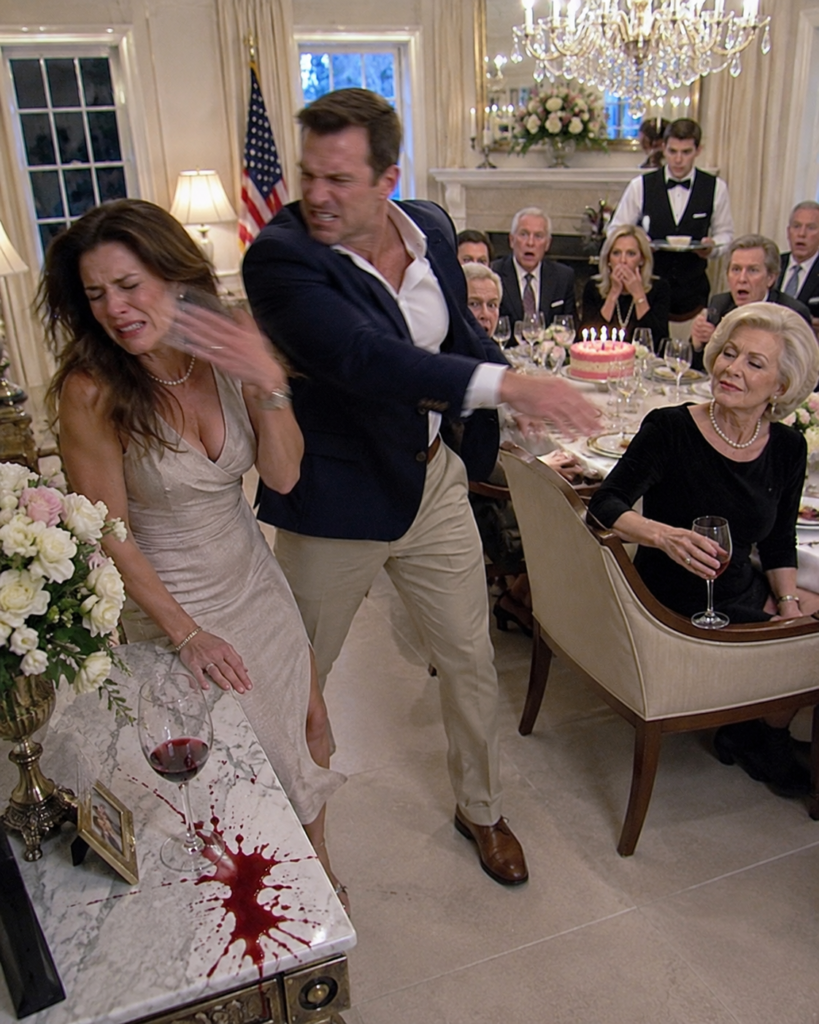
It was sharp, flat, and final.
Image
The kind of sound that makes every person in a room decide who they really are before anyone says a word.
My hip hit the entryway console table, and one of Margaret’s crystal glasses tipped sideways.
For half a second, it rocked on the edge like it was waiting for someone decent to catch it.
No one did.
The glass dropped, shattered across the marble, and red wine spread near my shoe.
The chandelier above us kept glowing.
The birthday candles in the dining room still smelled like vanilla and smoke.
Somewhere near the kitchen, one of the waiters stopped breathing loudly enough that I heard it.
Eighteen relatives stood or sat around Margaret Patterson’s sixty-second birthday lunch, and not one of them stepped toward me.
Not his sister.
Not his uncles.
Not the cousins who had toasted Theodore ten minutes earlier like he was the pillar holding the whole family up.
Margaret smiled.
That was the part I remembered most clearly later.
Not the pain.
Not even the humiliation.
The smile.
“At last,” she said, touching the pearl necklace at her throat. “You finally put things in order, son.”
I had bought that necklace for her the previous Christmas.
Theodore stood in front of me breathing hard, his face red, his hand still half-raised as if the room had not already seen enough.
“Get out of this house today,” he said.
His voice shook with rage, but it was not the voice of a man who had lost control.
It was the voice of a man who believed he had an audience.
The argument had started at lunch, in the same dining room Margaret loved showing off to anyone willing to admire it.
The Willow Creek house was enormous, the kind of place with an elevator, a deep front porch, trimmed hedges, and oak stairs polished so often they reflected the chandelier light.
Outside, a small American flag stood near the mailbox because Margaret liked the house to look respectable from the street.
Inside, she had filled the rooms with flowers, rented extra linens, hired a chef, hired waiters, and brought in a live band that played softly near the garden doors.
Everyone complimented Theodore.
Everyone complimented Margaret.
No one asked who had paid the invoices.
I had.
By then, that was the pattern of my marriage.
I paid quietly.
Theodore received praise loudly.
Margaret acted wounded if anyone disrupted the arrangement.
At the table, she lifted her glass halfway through dessert.
“I want to toast my son,” she said. “Despite marrying a cold woman, he still manages to support this entire family.”
A few people laughed.
Not all of them.
Enough.
Theodore lowered his eyes to his cake.
I looked at him, waiting for one word.
He gave me none.
Then Margaret turned the knife.
She said I did not know how to be a wife.
She said some women are too busy being important to become mothers.
Then she said maybe my empty nursery was punishment.
Eight months earlier, I had lost a baby.
The hospital intake bracelet was still in a small box in my nightstand.
The discharge papers were in a folder I had never been able to throw away.
The date on the top page was February 14.
Theodore had been there when the nurse handed me those papers.
He had watched me sign them with shaking hands.
He had walked me to the parking lot afterward and held me while I cried into his coat.
That memory sat between us at Margaret’s birthday table like another guest.
He still said nothing.
“Do not use the death of my baby to humiliate me again,” I told her.
The room went quiet.
Margaret placed her spoon on her plate.
The click was tiny.
It carried anyway.
“That was my grandchild too,” she said.
“Then you should have respected their memory.”
Margaret pressed one hand against her chest and looked around the table.
“Did you hear how she speaks to me in my own house?”
Theodore pushed his chair back.
For one second, I thought grief had finally reached him.
For one second, I thought he was getting up to stand beside me.
Instead, he walked around the table and slapped me.
The table froze.
Forks hung halfway to mouths.
A cousin’s champagne glass stopped just below her lips.
The centerpiece candles flickered as if they were the only things in the room still brave enough to move.
A spoonful of sauce slipped off a serving spoon and landed on Margaret’s cream table runner.
Everyone stared at me as if silence could pass for manners.
Nobody moved.
My cheek burned.
My mouth tasted like copper.
I touched the side of my face and looked at Theodore.
He looked proud for half a second.
That half second told me more than three years of marriage had.
Violence is not always a loss of control.
Sometimes it is a performance.
Sometimes a man raises his hand because he believes the room has already agreed to excuse it.
“Go upstairs and pack your clothes,” he said. “The jewelry stays here. So does the SUV. So do the credit cards.”
He looked me up and down like I was an employee being fired.
“You are not taking anything I paid for.”
Margaret crossed her arms.
“And hand over the keys,” she said. “This house is Patterson family legacy, not a shelter for ungrateful women.”
I almost laughed.
Not because it was funny.
Because the lie was so large it had become furniture.
Everyone had been walking around it for years.
The Willow Creek house had never been Patterson family legacy.
Six months before I married Theodore, I bought it through a family holding company.
The deed transfer had been signed at 9:18 a.m. on a Tuesday.
My attorney had the county clerk receipt.
My name was not on the front door, but my money was under every brick.
Theodore never asked why the mortgage disappeared.
He never asked how the property taxes got paid early every year.
He never asked why contractors answered my calls faster than his.
And Margaret never asked where her $180,000 monthly support came from.
She believed, because Theodore let her believe, that it came from a trust fund left by his father.
That trust had been empty for years.
I knew because I had seen the statements.
Theodore brought them to me in the second year of our marriage, pale and sweating, saying his mother could not handle the truth.
“She’ll get sick,” he had said. “You don’t know what she’s like when she feels abandoned.”
I believed him then.
Or maybe I wanted to believe there was still kindness behind his fear.
So I covered the driver.
I covered the medications.
I covered the social club dues.
I covered the vacations Margaret called restorative because luxury always sounds better when it is wrapped in medical language.
Then his construction company lost two major contracts.
Payroll was due on a Friday.
Vendors were threatening to stop deliveries.
Theodore came home that night and sat at the kitchen island with his head in his hands.
I did not lecture him.
I did not shame him.
I arranged loans through a company he never bothered to investigate.
I paid salaries.
I paid debts.
I kept his name clean.
He repaid me by letting his mother call me a parasite in rooms I had financed.
That is the thing about being useful to people who do not respect you.
They call your sacrifice support until they want to pretend it never happened.
Then they call you lucky.
At Margaret’s birthday lunch, standing beside broken glass with eighteen people watching, I finally understood the full shape of what I had built.
Not a marriage.
A stage.
And every person in that room had been assigned a role.
Theodore was the provider.
Margaret was the matriarch.
I was the cold wife who should be grateful for the roof over her head.
Except the roof was mine.
My fingers tightened around my purse strap.
For one ugly heartbeat, I wanted to shout every number in their faces.
The house.
The payroll transfers.
The credit cards.
The monthly support.
The vacations.
The medical bills.
The pearls at Margaret’s throat.
I wanted to make the whole room watch her shrink.
I did not.
Rage would have given them a story they knew how to tell.
Competence gave me something better.
Evidence.
I picked up my purse.
Theodore blinked.
That seemed to insult him more than tears would have.
“Is that it?” he asked. “You’re not even going to apologize?”
I stopped near the front door.
The porch light had just turned on outside.
Through the glass, I could see the driveway and the small flag by the mailbox moving softly in the evening air.
I turned back.
“I want to remember your faces,” I said.
Margaret let out a dry laugh.
“What for? To tell your therapist?”
I took out my phone.
First, I photographed the entryway.
The broken glass.
The red wine.
The relatives.
Theodore’s raised hand dropping too late.
Then I tilted the camera just enough to capture the security camera mounted above the staircase.
“No,” I said. “So my lawyer knows where to start.”
For the first time, Theodore’s expression changed.
It was small.
A flicker.
But I saw it.
He raised his hand again, and one of his uncles grabbed his wrist.
“Enough,” the uncle said quietly.
That was the first useful thing anyone in that room had done.
I walked outside without looking back.
The air felt cold against my cheek.
My car service was twelve minutes away.
I stood in the driveway with my purse over my shoulder, my phone in my hand, and the sound of the party still leaking through the closed door.
They did not come after me.
I was glad.
At 6:12 p.m., my phone buzzed.
A bank notification appeared on the screen.
Margaret Patterson had just charged $74,000 at a jewelry store on the supplementary credit card I paid for.
For the first time all afternoon, I smiled.
Not because I was happy.
Because she had just documented motive, access, arrogance, and timing in one clean transaction.
I opened my contacts and tapped my attorney’s name.
She answered on the second ring.
“Emily?”
“Freeze every card tonight,” I said.
She did not ask me to repeat myself.
My attorney, Claire, had been waiting for that sentence longer than I had wanted to admit.
For months, she had told me to separate the accounts.
For months, I had told her Theodore was not cruel, only weak.
There are apologies you make for someone because you love them.
Then there are apologies you make because admitting the truth would force you to act.
“Are you safe?” Claire asked.
“I’m outside the house.”
“Did he touch you?”
I looked at my reflection in the dark window beside the front door.
My cheek was red.
My eyes looked strangely calm.
“Yes,” I said. “In front of everyone.”
Her voice changed.
Not louder.
Colder.
“Good. Then we start with the security footage, the card activity, and the holding company documents.”
My phone buzzed again.
This time it was Margaret.
Leave the black diamond earrings in the upstairs safe.
I know they are in your drawer.
I stared at the message.
The earrings had belonged to my mother.
They were listed in the probate inventory filed after she died.
They had nothing to do with Theodore.
Nothing to do with Margaret.
Nothing to do with the Patterson name.
A second message came in.
And do not embarrass Theodore by pretending this house is yours.
Behind the glass, Theodore looked down at his own phone.
Margaret leaned over his shoulder.
Her smile disappeared slowly, the way light drains out of a room when a door closes.
“Forward those to me,” Claire said.
I did.
Three seconds later, she exhaled once.
“Emily, listen carefully,” she said. “There is something in the purchase file Theodore never saw, and if Margaret opens that safe before I get there, we have a bigger problem.”
“What problem?” I asked.
“The safe is not listed as Patterson property.”
My car pulled into the driveway then, headlights washing over the front steps.
The driver slowed when he saw my face.
I raised one hand to show I was fine, though I was not sure that was true.
Claire kept talking.
“The safe was installed after closing. The invoice was paid by your holding company. If Margaret removes anything from it after being told to leave your property alone, that becomes a very different conversation.”
I looked back through the window.
Margaret was no longer in the foyer.
Theodore was turning toward the staircase.
My stomach went cold.
“She’s going upstairs,” I said.
“Do not go back in alone,” Claire said.
“I’m not.”
I opened the car door and sat down, but I did not tell the driver to leave.
Instead, I opened my banking app.
One by one, I froze the supplementary cards.
Margaret’s card.
Theodore’s emergency card.
The household card.
The driver card.
Each little confirmation screen felt less like revenge and more like breathing.
Then I opened the property file Claire had emailed me months earlier.
I had never needed to use it.
I had been ashamed even to keep it on my phone.
Now I scrolled until I found the deed transfer, the holding company registration, the insurance binder, and the schedule of covered assets.
There it was.
The safe.
The jewelry inventory.
My mother’s earrings.
At 6:19 p.m., Theodore called me.
I let it ring.
At 6:20 p.m., he called again.
I let it ring again.
At 6:21 p.m., he texted.
What did you do?
I looked through the windshield at the house I had bought before he ever promised to love me.
For three years, I had believed silence was protection.
For three years, silence had protected everyone but me.
I typed back one sentence.
Ask your mother what she is holding.
The front door opened.
Margaret stepped onto the porch with a small velvet case in her hand.
Behind her, Theodore looked terrified.
Not angry anymore.
Terrified.
Claire was still on speaker.
“Tell her to put it down,” she said.
I lowered the window.
My voice did not shake.
“Margaret,” I called, “put my mother’s earrings back.”
The relatives crowded behind her in the doorway.
The same people who had watched me get slapped now watched Margaret clutch stolen jewelry on a porch she believed belonged to her.
She lifted her chin.
“These belong to the family,” she said.
“No,” I said. “They belong to my mother’s estate.”
Theodore whispered something to her.
She slapped his hand away.
That almost made me laugh.
Power is strange when it starts changing owners.
People who loved rules when they were winning suddenly call every boundary cruelty.
Claire spoke from the phone in my lap.
“Emily, tell her I am hearing this.”
“My attorney is on the line,” I said.
Margaret’s face tightened.
“You ungrateful little—”
“Careful,” I said.
It was the quietest word I had spoken all day.
It landed harder than shouting.
Theodore came down the steps, palms open.
“Emily, let’s just talk.”
I looked at him.
All I could see was his hand coming toward my face in a room full of witnesses.
“No,” I said. “Now we document.”
Claire had me take three photos.
Margaret holding the velvet case.
The open front door.
The relatives watching.
Then she told me to leave the property and meet her at her office.
I did not cry in the car.
That surprised me.
The driver kept glancing at me in the mirror, then offered a bottle of water without making a speech.
That small kindness almost broke me.
At Claire’s office, the lights were still on.
She met me in the lobby wearing jeans, a blazer, and the face of a woman who had stopped being surprised by men like Theodore a long time ago.
She took one look at my cheek and said, “We start with the police report.”
I nodded.
Then she said, “And the house.”
By 8:03 p.m., the first report was drafted.
By 8:41 p.m., the card freezes were confirmed.
By 9:12 p.m., Claire had sent Theodore notice not to remove, destroy, transfer, or conceal any property connected to the house, the company loans, the safe, or the household accounts.
At 9:18 p.m., exactly twelve hours after the original deed transfer time from years earlier, Theodore called Claire’s office.
She put him on speaker with my permission.
He sounded smaller than I had ever heard him.
“Emily,” he said, “my mother is upset.”
I closed my eyes.
That was what finally broke something clean inside me.
Not the slap.
Not the jewelry.
Not the money.
The fact that even then, his first concern was Margaret’s feelings.
“Your mother is upset,” I repeated.
He took that as an opening.
“She didn’t understand what was happening. You embarrassed her. You know how she gets when she feels attacked.”
Claire looked at me, but she did not interrupt.
I said, “You hit me.”
Silence.
Then Theodore said, “I was angry.”
“You hit me in front of eighteen people.”
“I said I was angry.”
“No,” I said. “You were confident.”
That was when he stopped talking.
Claire slid a document toward me.
It was not a divorce filing yet.
It was simpler than that.
Cleaner.
A property access restriction letter.
A demand for preservation of security footage.
A financial audit notice concerning the Patterson household support transfers.
A request for immediate return of estate jewelry.
I signed each page.
My hand trembled only once.
Claire noticed, but she did not comment.
Some women need comfort first.
That night, I needed a pen.
The next morning, Theodore discovered the truth in pieces.
First, the cards declined.
Margaret tried to order breakfast through her driver account, and the payment failed.
Then her social club called about dues.
Then the pharmacy asked for a new payment method.
Then Theodore’s office manager called him because a vendor had received audit questions about loans tied to his company.
By noon, Claire had received six emails from him, each one less arrogant than the last.
The first accused me of being dramatic.
The second asked for a conversation.
The third said Margaret had a heart condition.
The fourth said we should not involve lawyers.
The fifth asked what exactly I owned.
The sixth had no subject line.
It said only, Please.
I did not answer any of them.
Instead, I met Claire at the house with a locksmith, a property manager, and two witnesses.
Not police drama.
Not shouting.
Just process.
Locks were changed.
Rooms were photographed.
The safe was opened and inventoried.
The velvet case was back inside, but the earrings were not arranged the way my mother had left them.
That detail hurt more than I expected.
Claire saw my face soften and closed the safe herself.
“You can grieve later,” she said gently. “Today we finish the list.”
So we did.
Every room was documented.
Every drawer that mattered was photographed.
Every account was cross-referenced.
The security footage from the staircase camera was preserved.
There was Theodore’s hand.
There was the glass falling.
There was Margaret smiling.
There I was, standing very still in a room that had mistaken my silence for weakness.
When Theodore finally came to Claire’s office two days later, he looked like he had not slept.
Margaret was not with him.
That told me everything.
He sat across from me and stared at the folder on the conference table.
“Emily,” he said, “I made a mistake.”
“A mistake is forgetting an anniversary,” I said. “You hit me because your mother wanted an audience.”
His eyes filled.
Once, that would have pulled me toward him.
I would have remembered the hospital parking lot.
I would have remembered his hands around mine.
I would have remembered every gentle thing and tried to make it outweigh the cruel one.
But an entire room had taught me to stop wondering if I deserved better.
The answer had been on the floor in broken glass.
Claire opened the folder.
She did not raise her voice.
She did not need to.
“The house belongs to Emily’s holding company,” she said. “The household support account belongs to Emily. The supplementary cards belong to Emily. The company loans that kept your business alive trace back to Emily. The jewelry your mother attempted to remove belongs to Emily’s mother’s estate.”
Theodore stared at her as if language had stopped working.
Then he looked at me.
“You should have told me.”
I almost smiled.
“I did tell you,” I said. “For three years, I told you in invoices paid, payroll covered, medication delivered, taxes filed, repairs approved, and silence swallowed. You just liked the lie better.”
He put his face in his hands.
I felt nothing close to victory.
Victory would have meant he never raised his hand.
Victory would have meant our baby’s memory had been safe at that table.
Victory would have meant Margaret’s smile never became the clearest thing I remembered.
What I felt was steadiness.
And after years of shrinking myself to keep a family comfortable, steadiness felt like freedom.
In the weeks that followed, people tried to soften what happened.
They said Margaret was old-fashioned.
They said Theodore had been under pressure.
They said families say things at birthdays.
I kept the photo of the broken glass.
I kept the bank notification.
I kept the messages about the safe.
I kept the security footage.
Not because I wanted to live inside that day forever.
Because some stories only stay honest when you keep the receipts.
The Willow Creek house did not remain a Patterson stage.
The family photos came down first.
Margaret’s flowers went next.
The pearls were returned through attorneys because I refused to meet her in person.
The little American flag by the mailbox stayed.
It had never been the problem.
The problem was the people inside who thought a house became theirs just because they were loud enough in it.
Months later, when I walked through the dining room again, the marble had been cleaned.
The console table had been repaired.
No one would have known a glass had shattered there unless they knew where to look.
I knew.
I stood in that entryway with my hand on the purse strap I had carried out that night and listened to the quiet.
For once, the silence belonged to me.
And it did not feel like fear.
It felt like the moment after a door closes on people who never believed you would be strong enough to lock it.