[The following]
Six months earlier, Cole had brought me a folder while I was helping our mother move. He said Grandpa needed updated emergency contacts and that my signature simply confirmed I could speak to doctors if something happened.
I had signed two pages without reading the entire packet. Shame moved through me before anger did.
I had spent years believing Cole was careless, impulsive, and selfish. I had never considered that he might be methodical.
Grandpa remembered the folder. Cole had told him the same thing, except Grandpa had been asked to sign a page naming Cole as a temporary financial assistant.
Detective Ortiz told us not to assume what the documents were until she saw them, but her tone made the danger clear. If Cole had combined our signatures with stolen identification, he might have created authority neither of us intended to give him.
The officers documented the swelling on my cheek. I gave a formal statement and agreed to let them copy my messages.
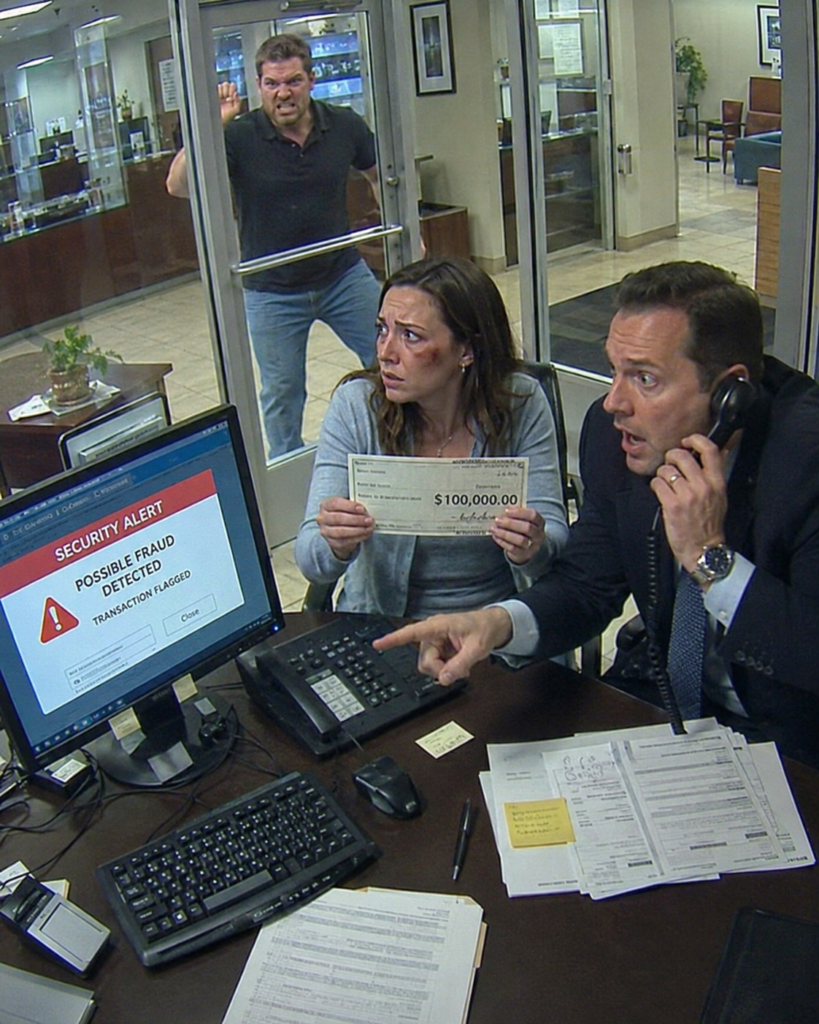
Malcolm froze the fraudulent account before the mobile deposit could clear, and the bank placed an alert on Grandpa’s profile. My real check could not be deposited until the investigation separated it from the duplicate image, but for the first time that day, I did not care about the money.
I cared about how much of our lives Cole had already touched. I stayed that night with my closest friend, Taryn Vale, an attorney who handled business disputes.
She did not pretend to be my criminal lawyer, but she knew enough to help me make a list. Freeze my credit, change every password, replace my driver’s license, pull my credit reports, preserve messages, and stop discussing the case with anyone who might repeat information to Cole.
My mother called seventeen times. When I finally answered, she was crying.
Her name was Denise, and she had spent most of my childhood translating Cole’s behavior into softer words. He had not stolen; he had borrowed.
He had not lied; he had panicked. He had not manipulated me; he had needed his sister.
“Maren, he says you attacked him,” she said. “He says Grandpa gave both of you the money and you tried to take all of it.”
“He slapped me.”
There was a pause.
“He says you pushed him first.”
I stared at Taryn across the kitchen table. She could hear every word through the speaker.
“Did he tell you he opened a bank account in my name?”
“What?”
“Did he tell you he photographed the check before Grandpa gave it to me and tried to deposit it?”
My mother’s breathing changed.
“He said there was a misunderstanding.”
“A misunderstanding does not require my Social Security number.”
She began pleading with me not to make this bigger. That phrase had protected Cole for years.
It had kept his unpaid loans private, his gambling rumors quiet, and his angry outbursts inside the family. I realized then that silence had not prevented damage.
Silence had simply made the damage easier.
“I am not making it bigger,” I said. “I am refusing to make it smaller.”
I ended the call. The next morning, Detective Ortiz asked me to come to Grandpa’s house while officers supervised a search of his office.
Nothing was broken. That was the disturbing part.
Whoever had taken the records knew exactly where to look and had likely been invited in many times. We found three years of bank statements in a locked filing cabinet, but six monthly statements were missing.
Grandpa’s laptop showed repeated logins from an unfamiliar device. His email had a forwarding rule that silently sent messages containing words like bank, transfer, statement, and verification to an address none of us recognized.
Taryn helped us print everything before the rule was disabled. Then Grandpa found a carbon copy from an old checkbook.
It showed monthly payments of $3,850 to a company called Northline Property Consulting. He had never hired that company.
The business registration listed Cole as the organizer. Grandpa sat down hard in his desk chair.
Over the previous eighteen months, Northline had received nearly $70,000 from his account. The transaction notes called the payments maintenance fees for rental properties, but Grandpa had sold his last rental four years earlier.
“I trusted him,” Grandpa said.
His voice held no rage, only humiliation. That was the moment my fear turned into resolve.
Cole had counted on our love becoming embarrassment. He believed Grandpa would rather lose money than admit his own grandson had deceived him.
He believed I would rather surrender the check than expose the fact that I had signed papers without reading them. He believed Mom would smooth everything over before the police could ask difficult questions.
He had studied every weakness in our family and turned each one into a lock. Detective Ortiz asked whether I was willing to make a controlled call.
Cole still believed I had the check. If I let him talk, he might explain what he wanted me to do with it.
I agreed. With the detective recording through approved equipment, I called him from Grandpa’s kitchen.
Cole answered immediately.
“Finally,” he said. “Do you have it?”
“Yes.”
“Then stop being stupid and bring it to me.”
“What did I sign, Cole?”
Silence.
“You signed what you needed to sign.”
“That is not an answer.”
His voice dropped. “You signed documents saying Grandpa authorized us to manage certain funds. If you go to the police, those papers make you part of it.”
My hand tightened around the phone, but Detective Ortiz raised one finger, reminding me to stay calm.
“Part of what?”
“Don’t play innocent. Bring me the original check. Once I have it, I can fix the deposit, close the account, and make the paperwork disappear.”
There it was. Not a full confession, but enough to show knowledge no innocent person should have.
“Why did you use my name?”
“Because yours was clean.”
The words landed colder than the slap. Then he added, “And because nobody ever believes you over me.”
The line went dead. For most of my life, that sentence would have broken me.
Instead, I looked at Grandpa, at the detective, and at the printed records covering the table.
“This time,” I said, “he doesn’t get to decide who believes me.”
The recording gave Detective Ortiz probable cause to expand the investigation, but she warned me that Cole would become more dangerous once he realized the bank had blocked the money. She was right.
By noon, he had sent messages to relatives claiming I had manipulated Grandpa into giving me his savings. By evening, he had posted a vague statement online about elder abuse inside our own family.
He never used my name, but everyone knew who he meant. My phone filled with questions.
An aunt asked whether Grandpa was competent. A cousin told me I should split the gift to keep the peace.
One family friend said that even if Cole had made a mistake, involving police was cruel. Not one of them asked why my face was bruised.
I stopped defending myself one person at a time. Taryn helped me write a single response.
Grandpa was safe, the bank had identified suspected fraud, and the matter was being handled by law enforcement. I would not discuss evidence privately.
Then I turned off notifications. The next discovery came from my credit report.
Three credit cards had been opened in my name over the previous year. The balances totaled $26,000.
The mailing address belonged to a private mailbox Cole rented through Northline Property Consulting. One card had paid for online betting, another for hotel rooms, and the third for a luxury watch he had worn to my birthday.
I remembered complimenting that watch. He had smiled and told me hard work finally paid off.
Grandpa’s forensic accountant uncovered more. The monthly transfers to Northline were only part of the scheme.
Cole had used the false authorization documents to request a line of credit secured against Grandpa’s house. The application had not closed yet, but it was scheduled for final approval the following week.
If the birthday check had cleared into the fake account, Cole planned to use it as proof of liquidity and move the money before the bank completed its review. The total exposure was more than $200,000.
Grandpa listened without interrupting. Then he asked Taryn to arrange a meeting with an estate attorney.
He removed Cole as alternate executor, canceled every authorization carrying Cole’s name, and placed a formal fraud alert on his property title. He also changed the locks.
My mother arrived while the locksmith was working. She stood in the driveway staring at the new deadbolt as if it were a public announcement of our family’s collapse.
“You are locking your own grandson out?” she asked.
Grandpa looked at her for a long time.
“He locked Maren in a room and hit her. He used her identity. He used mine. The question is not why I’m locking him out. The question is why we kept giving him keys.”
Mom flinched. I expected her to argue, but instead she sat on the porch and covered her face.
She admitted Cole had asked her for money repeatedly. She had given him almost $30,000 from a retirement account and had lied to us about why she could not afford repairs on her house.
He told her he owed dangerous people and that refusing him could get the family hurt.
“Did you believe him?” I asked.
“I believed he was scared.”
“That is not the same as believing he was honest.”
She nodded, tears sliding between her fingers. For once, I did not rush to comfort her.
I loved my mother, but I could no longer protect her from the consequences of protecting him. That night, Cole called Grandpa from a new number.
Detective Ortiz had already arranged for future calls to be preserved. Grandpa answered on speaker.
“You changed the locks,” Cole said.
“Yes.”
“You let Maren turn you against me.”
“No,” Grandpa replied. “You did that yourself.”
Cole’s voice sharpened. “She signed the papers, too. If I go down, she goes down.”
I felt the old instinct to explain, to prove, to beg Grandpa not to doubt me, but he never looked away from the phone.
“Then bring copies of every document,” Grandpa said. “Tomorrow, Taryn’s office. We settle everything privately.”
Cole hesitated.
“And the check?”
“Maren will bring it.”
Detective Ortiz had suggested the offer. The original check would remain secured at the bank, but we would place a harmless photocopy inside an envelope.
The meeting room would be monitored with everyone’s consent except Cole’s. It was legally permitted and coordinated by investigators.
The goal was not to provoke him. It was to let him explain the documents he claimed made me responsible.
The next afternoon, Cole entered Taryn’s conference room wearing a suit and the watch purchased with my stolen credit. He smiled when he saw the envelope in front of me.
“There she is,” he said. “The reasonable sister.”
He placed a folder on the table. Inside were copies of documents bearing my signature and Grandpa’s.
At first glance, they looked legitimate, but Taryn immediately noticed that several pages used different fonts, inconsistent margins, and notary seals from a county neither of us had visited. Cole sat across from me and tapped the envelope.
“Give me that, and I’ll destroy these.”
“What happens after you destroy them?” I asked.
“The account gets closed. Grandpa gets his money back eventually. You tell the police you overreacted.”
“And the cards in my name?”
His smile disappeared.
“And Northline?” I asked. “And the loan against Grandpa’s house?”
He looked toward the door.
“You set me up.”
“No,” I said. “I finally read what you put in front of me.”
Cole stood so quickly his chair struck the wall. He grabbed the folder and reached for the envelope, but Grandpa placed one hand over it.
“You stole from me,” Grandpa said.
“I was going to pay it back.”
“With what?”
Cole’s face twisted.
“With the check you should have given me in the first place.”
The room went silent. Then he realized what he had said.
He shoved Grandpa’s hand away, snatched the envelope, and tore it open. When he saw the photocopy, panic replaced rage.
He rushed for the door. Detective Ortiz stepped in from the hall and ordered him to stop.
Cole bolted through the rear exit instead. He left the forged documents behind.
Cole was not arrested at the office. Detective Ortiz had enough to question him, but the investigators wanted the financial records tied directly to him before they moved.
And he had not physically attacked anyone during the meeting. By the time officers reached his apartment, he was gone.
For the next forty-eight hours, he became a shadow around the edges of our lives. He sent my mother voice messages saying I had ruined him.
He emailed Grandpa from an encrypted address and promised to return every dollar if we withdrew our statements. He called relatives and said I had fabricated the fraud because I wanted the entire inheritance.
Each version made him more innocent and me more monstrous. Then someone broke into Grandpa’s house.
The new lock had been forced shortly after midnight. The security camera caught Cole entering through the side door with a hood pulled over his face.
He went directly to the office, opened drawers, removed the laptop, and carried away two document boxes. He knew Grandpa was staying with me, but he did not know Detective Ortiz had asked us to install a second camera inside the office.
That camera recorded his face clearly when his hood slipped. He also did not know the laptop had been replaced with an old device containing no useful files.
At 2:13 a.m., my car alarm went off outside Taryn’s building. We watched from an upstairs window as a dark figure opened the rear door and leaned inside.
Police arrived before we went downstairs, but the person fled through an alley. In the backseat, officers found a canvas bag containing blank checks from Grandpa’s missing checkbook, copies of the forged documents, and one of the credit cards opened in my name.
Cole was trying to build the story he had already told everyone: that I had stolen Grandpa’s financial information and created Northline myself. For a few seconds, I could not speak.
If we had found the bag without cameras, without the bank records, without the controlled call, it might have looked convincing. He had not simply planned to take my money.
He had planned to leave me carrying his crimes. Detective Ortiz showed me the side door footage and asked whether I still recognized the man.
“That is my brother,” I said.
The sentence hurt, but it no longer weakened me. Investigators obtained warrants for Cole’s apartment, storage unit, digital accounts, and Northline records.
They found betting statements, counterfeit notary stamps, copies of my identification, Grandpa’s missing bank statements, and a spreadsheet listing how much he believed each relative could be pressured to contribute. Next to my name, he had written, “Clean credit, guilt responsive, likely to comply if Mom calls.”
I read that line twice. Every birthday call, every request for money, suddenly looked different.
He had reduced my love for him to a vulnerability in a spreadsheet. Mom asked to see the evidence.
Detective Ortiz could not show her everything, but Grandpa shared the spreadsheet page and the transfers from his account. Mom sat at the kitchen table for nearly an hour without speaking.
Then she opened her phone and played the most recent message Cole had sent her.
“Tell Maren to drop it,” his voice said. “If she doesn’t, I’ll make sure the whole family knows she stole from Grandpa. You know people will believe you. Say you saw her taking his checkbook.”
Mom stopped the recording.
“He wants me to lie.”
“He expected you to,” I said.
That distinction finally reached her. Helping Cole had always felt to her like love.
Now he was asking her to become evidence against her own daughter. Our extended family had already planned a Sunday lunch for Grandpa’s birthday week.
Cole knew about it, and Detective Ortiz believed he might appear because he still thought public pressure could force us to back down. She advised us not to create a confrontation, but Grandpa refused to cancel.
“He has used the family as a shield,” he said. “I am done hiding behind the same shield.”
We did not turn the lunch into a performance. There was no projector, no dramatic stack of evidence, no speech rehearsed for applause.
Grandpa simply stood before everyone arrived and told them the truth in plain language. The bank had identified a fraudulent deposit.
Accounts had been opened in my name. Money had been diverted from his.
Law enforcement was investigating. He asked relatives not to contact Cole or repeat details that could interfere.
Half the room looked ashamed. The cousin who had told me to split the check avoided my eyes.
My aunt quietly apologized. Then the front door opened.
Cole walked in wearing yesterday’s clothes. His face was unshaven, and the expensive watch was gone.
He looked around the room, saw the expressions, and immediately understood that Grandpa had spoken first.
“So, this is the trial?” he said.
“No,” Grandpa replied. “That comes later.”
Cole pointed at me.
“She planned all of this. She hated that you trusted me. She has been waiting for a chance to cut me out.”
Mom stood between us. I had never seen her do that before.
“Did you ask me to lie about Maren stealing the checkbook?” she asked.
Cole’s expression changed.
“Mom, you don’t understand.”
“Answer me.”
“I was trying to protect us.”
“Did you use her identity?”
He looked at the relatives watching him and chose the mistake he always made. He performed instead of telling the truth.
“Maren gave me permission,” he said. “She knew about the account.”
I took out my phone, opened the recording Detective Ortiz had authorized us to preserve, and played his voice from the controlled call.
“Because yours was clean.”
Nobody moved. Then came the line he had trusted most.
“Nobody ever believes you over me.”
Cole lunged for my phone. Grandpa tried to block him, and Cole shoved him sideways into a chair.
Two officers waiting in an adjacent room entered immediately. Cole fought when they took his arms, shouting that the evidence was fake and that I had stolen his future.
As they led him toward the door, he twisted around and stared at me.
“You think you won?” he shouted. “You destroyed this family.”
I looked at my mother supporting Grandpa, at the relatives who could no longer pretend, and at the bruise on my cheek that had begun turning yellow.
“No,” I said. “I stopped you from destroying what was left.”
The door closed behind him. For the first time in years, nobody ran after Cole.
Cole’s arrest did not produce the instant relief I expected. It produced paperwork, interviews, hearings, and a silence in the family that felt unfamiliar.
For weeks, every unknown number made my stomach tighten. His attorney argued that the financial transfers were family loans and that I had knowingly allowed him to use my information.
The forged documents, however, created a problem his explanations could not solve. The bank’s device records placed the fraudulent deposit on Cole’s prepaid phone.
The account application contained a selfie in which he had covered most of his face with a cap and mask, but investigators matched the room behind him to photographs from his apartment. His storage unit held Grandpa’s statements and copies of my identification.
The security footage showed him entering Grandpa’s office and later approaching my car. The recorded calls showed that he knew the fake account existed and wanted the original check destroyed.
The forensic audit ultimately traced $214,600 in stolen funds, fraudulent credit, and attempted borrowing. Not every dollar had been successfully taken, but the plan was larger than any of us had imagined.
Cole called Mom from jail and asked her to post bail. She listened for less than a minute.
“I love you,” she said, “but I will not rescue you from this.”
Then she ended the call. That choice cost her.
She cried afterward, questioned herself, and nearly called back, but she did not. Grandpa refused to pay for Cole’s defense, removed him from the will, and formally dissolved every business connection between them.
Cole’s employer fired him after learning he had used company equipment to create some of the forged records. His fiancée returned the ring and moved out.
The relatives who once defended him stopped repeating his accusations when investigators began asking who had received them. Months later, Cole accepted a plea agreement covering bank fraud, identity theft, elder financial exploitation, document forgery, burglary, and assault-related conduct.
The judge ordered restitution, several years in state custody, and supervised release afterward. He was also prohibited from contacting me or Grandpa except through attorneys.
At sentencing, Cole turned toward me and said he was sorry. Then he added that none of this would have happened if Grandpa had divided the money fairly.
That sentence told me his apology was still in negotiation. When I addressed the court, I did not ask for cruelty.
I asked for accountability. I explained that the deepest harm was not the lost money or damaged credit.
It was learning that my brother had mapped our compassion and used it as a financial strategy. I spent years saving him from consequences.
“I believed that was love,” I said. “It was not. It was permission.”
The judge approved the agreement. Outside the courthouse, Mom asked whether I felt satisfied.
I thought about the slap, the fake account, the bag planted in my car, and the way Cole had shouted that I destroyed the family.
“No,” I said. “I feel finished.”
That was better than revenge as I had once imagined it. I did not have to ruin Cole.
I only had to stop standing between him and the results of his own choices. The bank eventually cleared the original gift and reissued it as a cashier’s check.
Grandpa offered to increase the amount because of what I had endured, but I refused. $100,000 was already more than enough, and I did not want Cole’s crimes to turn Grandpa’s generosity into compensation for pain.
I used part of the money as a down payment on a small brick building where I opened a restoration studio. I had dreamed about the business for years, but kept postponing it because Cole always had a newer emergency.
Another portion went into savings, and some paid for therapy, legal expenses, and the work required to repair my credit. The first thing I framed for the studio was not the check.
It was a photograph of Grandpa standing beside me on opening day, holding a level while I tried to hang the sign straight. Mom took the picture.
Our relationship did not heal in one conversation. She attended counseling, learned to recognize financial and emotional manipulation, and apologized without asking me to forgive her immediately.
Sometimes she still began sentences with, “But he is your brother.” Then she stopped herself and tried again.
Grandpa recovered a portion of the stolen money through seized accounts and restitution. What mattered more to him was rebuilding his sense of judgment.
Fraud had made him doubt his intelligence, but shame belonged to the person who deceived him, not to the person who trusted family. A year after sentencing, Cole sent a letter through his attorney.
He wrote that prison had changed him, that he understood why I testified, and that he hoped we could become siblings again someday. Near the end, he asked whether I could speak to Grandpa about restoring a small part of his inheritance.
I folded the letter and placed it in a drawer. Maybe Cole would truly change.
Maybe he would learn to apologize without attaching a request. But his rehabilitation was no longer my assignment.
Forgiveness, if it came, would not mean access. Love, if it remained, would not mean surrender.
On my thirty-first birthday, Grandpa handed me a plain envelope. My body tensed before I could stop it.
He noticed and smiled sadly.
“It is only a card,” he said.
Inside, he had written one sentence.
“The best thing you built this year was a life nobody else controls.”
I kept that card. Looking back, the $100,000 did change my life, but not because it bought a building.
It exposed the price I had been paying to keep peace with someone committed to chaos. The day my brother slapped me, he believed fear would make me obedient.
Instead, it finally made the truth impossible to ignore. Families do not survive because one person absorbs every injury.
They survive when love includes honesty, boundaries, and consequences. Sometimes protecting a family means refusing to protect the person harming it.
THE END