It was back up it alone.
Every guest turned as I passed.
Some looked shocked.
Some embarrassed.
Some curious in the way people become when someone else’s private pain interrupts a beautiful event.
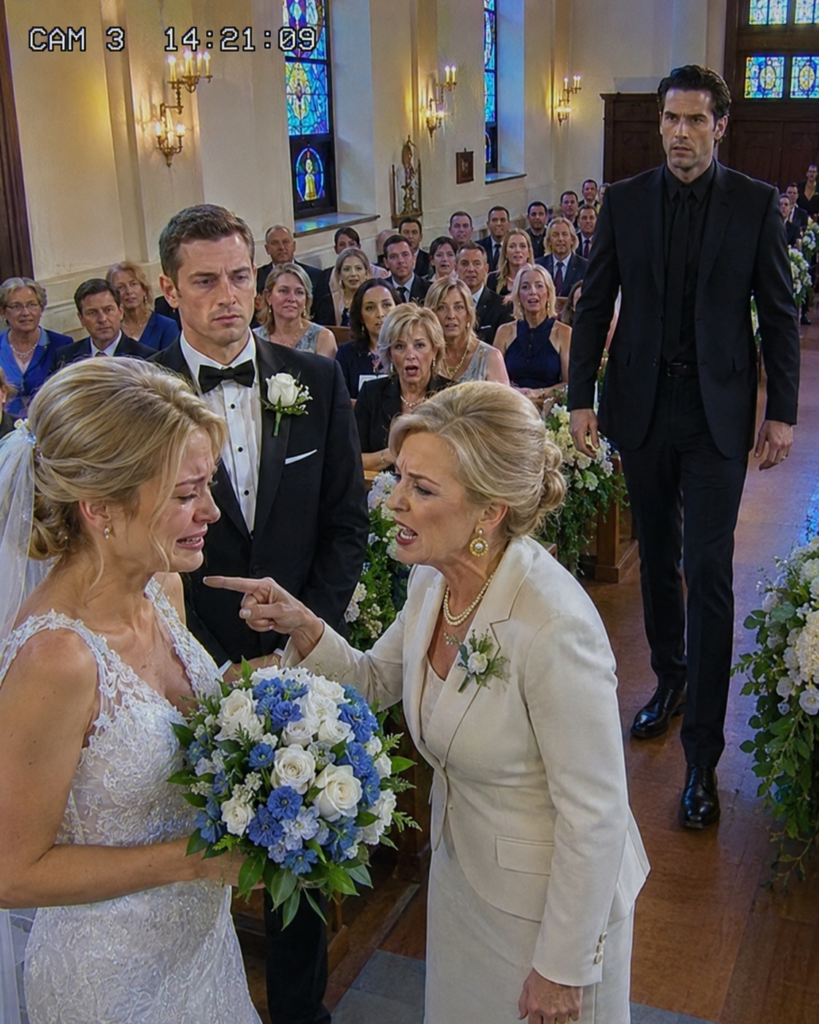
The pearls lay inside my bouquet beside my mother’s locket, cool and heavy against the stems.
My wedding dress whispered over the chapel floor.
Behind me, Ethan said my name.
“Clara.”
I stopped.
Not because I owed him.
Because I needed to know whether the man at the altar was finally ready to speak without hiding behind discomfort.
I turned.
He stood beneath the flowers, face pale, hands empty.
Margaret was beside him, rigid with fury disguised as elegance.
The pastor looked like he wanted to be anywhere else.
Ethan took one step toward me.
“I didn’t know about the pearls.”
I believed that.
But belief did not soften enough.
“No,” I said. “You didn’t.”
His eyes filled with desperate relief.
Then I continued.
“But you knew about the laughter.”
The relief vanished.
The chapel went silent again.
Ethan’s mouth opened.
Closed.
I looked at him, really looked.
The man I had loved.
The man who brought coffee to the library.
The man who once wrote notes in the margins of books he gave me.
The man who kissed my forehead when I worried about fitting into his world.
The same man who had stood beside me while his vows turned my life into a charming rescue story.
The same man who whispered, just let her, when his mother tried to decorate me with family superiority.
“You knew I was uncomfortable,” I said. “You knew your mother corrected me. You knew your relatives treated my father like an afterthought. You knew your vows made people laugh at me, not with us.”
His face crumpled.
“I thought they were being harmless.”
A sad laugh rose in my throat.
“Harmless to whom?”
He flinched.
Good.
Some questions should land.
My father came to stand beside me then.
Slowly, because of his leg.
Proudly, because he had always known how to stand when it mattered.
He looked at Ethan, not with anger, but with something heavier.
Disappointment.
“I raised Clara to believe love should never require her to apologize for where she came from.”
Ethan lowered his eyes.
Arthur Bell remained near the back row, silent.
He did not take over the moment.
That mattered.
He had stood up, revealed the truth, then stepped aside so I could choose.
Margaret did not understand that kind of power.
She only understood control.
She stepped forward.
“Clara, emotions are high. This can be discussed privately after the ceremony.”
There it was.
Privately.
The favorite room of people who harm publicly.
I turned to her.
“You placed that necklace on me in front of everyone.”
“It was meant as an honor.”
“No,” I said. “It was meant as a reminder that I should be grateful to wear what you thought was yours.”
Her face tightened.
“You have no idea what this family has carried.”
Arthur’s voice cut through the chapel.
“She has every right to know what her mother carried.”
Margaret turned sharply.
“Arthur, enough.”
He smiled faintly.
“You said that to Eleanor too.”
The name changed the air.
My mother’s name.
Spoken in a room where she should have been remembered with tenderness, not erased beneath pearls and polite insults.
I looked at Arthur.
“What happened between them?”
He did not answer immediately.
Instead, he looked at my father.
My father nodded once.
That startled me.
“How much do you know?” I asked him.
My father’s hand tightened around his cane.
“Enough to regret keeping quiet too long.”
The sentence hurt.
Not because I blamed him.
Because secrets, even loving ones, still leave children standing in rooms without maps.
Margaret said, “This is absurd. Eleanor chose her life.”
Arthur turned to her.
“Yes. She chose love. And your family punished her by calling it a fall.”
My father’s eyes closed briefly.
I understood then.
Not all of it.
Enough.
My mother had been connected to the Whitmores long before I was born.
Not as staff.
Not as charity.
Not as some small-town woman lucky to be near their legacy.
She had been part of their world.
Maybe more deeply than they wanted to admit.
Arthur continued.
“Eleanor Bell and Margaret Whitmore were raised almost like sisters. The Bell and Whitmore families created a private art and heirloom trust together generations ago. Eleanor was trained in restoration. She knew every painting, every archive, every jewel, every record.”
He looked at the pearls in my bouquet.
“Including those.”
Margaret looked toward the guests, clearly aware that donors, business partners, and family friends were hearing too much.
Arthur did not care.
“When Eleanor married Thomas Hayes, your family decided she had chosen beneath her station. But the trust documents did not disappear because your pride was offended.”
My father spoke then, voice low.
“Eleanor never cared about station.”
Arthur smiled softly.
“No. She cared about truth.”
I stared at my father.
“Why didn’t you tell me?”
His face folded with pain.
“Your mother wanted you to grow up free from their world.”
“Free?” I looked around the chapel. “Dad, I almost married into it without knowing I was already tied to it.”
He flinched.
“I know.”
That was all he said.
No defense.
No excuse.
Just I know.
And because he had never once tried to make me doubt my own pain, I could accept his regret as love, even if it came late.
Ethan stepped forward again.
“Clara, we can pause. We can talk. We don’t have to end everything here.”
End everything.
How strange.
I had thought the ceremony would begin my life with him.
Now he was asking me not to end something that had apparently been built on gaps, silence, and a family history I had never been allowed to know.
I looked at him.
“Why did you write those vows?”
His face reddened.
“I meant them kindly.”
“A project, Ethan?”
He swallowed.
“My cousin used that phrase as a joke during the rehearsal dinner. I thought if I repeated it lightly, it would show I didn’t care what they thought.”
I stared at him.
“You used their insult in your vows to prove you were above it?”
He looked ashamed.
When he did not answer, I nodded.
“That is the problem. You wanted credit for loving me without correcting the people who made loving me sound generous.”
The words moved through the room.
Not loud.
Clear.
My cousin Maya stood from my side.
“She’s right.”
Several people turned.
Maya, who had been biting her tongue for months, looked ready to bite through steel.
“She is right,” she repeated. “At the engagement party, your aunt asked Clara whether she was nervous about learning formal table settings. At the shower, your sister joked that our side looked like a book club that wandered into a gala. And at the rehearsal, your uncle called her father ‘salt of the earth’ like it was a compliment and a boundary.”
My father looked down.
My chest tightened.
I had noticed all of it.
But hearing someone else name it made the room feel less lonely.
Maya continued.
“You all knew. You just thought she’d be polite enough to let it pass.”
Arthur looked at Maya with approval.
Margaret’s face turned colder.
“This is becoming very uncivil.”
My father looked at her.
“No. It is becoming honest.”
The pastor cleared his throat.
“I think perhaps the ceremony should pause.”
A few guests murmured.
Pause.
What a small word for a room breaking open.
I looked at Ethan.
“I need to read what Arthur brought.”
“Now?” Margaret snapped.
I looked at her.
“Yes. Now.”
Arthur handed the folded document to me.
It was not a legal file.
Not exactly.
It was a letter.
My name was written across the front in my mother’s handwriting.
Clara.
My hands trembled.
The chapel blurred around the edges.
My mother had written my name.
Not to the Whitmores.
Not to Arthur.
To me.
I wanted to run somewhere private.
I wanted to read it alone with my father.
I wanted to press it to my chest and pretend the room was not watching.
But then I remembered Margaret fastening pearls around my neck like ownership.
I remembered Ethan’s vows.
I remembered every polite laugh.
No.
They had made my dignity public.
My mother’s truth could be public too.
I opened the letter.
My eyes filled before I read the first line.
My Clara,
If Arthur is giving you this on your wedding day, it means the Whitmores have forgotten themselves badly enough to forget me too.
A sound moved through the guests.
My mother’s voice seemed to fill the chapel.
Not literally.
But I could hear her.
Dry humor.
Gentle strength.
The way she used to fold laundry while telling stories that always had lessons hidden inside.
I continued reading aloud.
I hope they have welcomed you kindly. I hope I am wrong to prepare this. But if they have made you feel small, then I want you to know this before you make any promise: you come from love, work, dignity, and a history they do not own.
My voice shook.
My father wiped his eyes.
Arthur looked down.
Margaret stood rigid.
The Bell-Whitmore Collection was never meant to be a trophy for one family. It was built by two families and preserved by many hands. I restored it because beauty deserves care, not because wealth deserves decoration. When I married your father, some people believed I had stepped away from power. They were wrong. I stepped toward peace.
I paused.
Stepped toward peace.
That sounded like her.
I chose not to raise you inside their arguments. Perhaps that was brave. Perhaps it was foolish. Parents rarely know which until later. But I did not leave you with nothing. Arthur holds the documents. Your father knows the heart of the story. And the pearls, if they ever appear on your wedding day, should be worn only if you choose them. Never as proof that you are worthy. You were worthy before anyone opened a box.
The letter blurred completely.
I lowered it for a moment.
My father came closer, but did not take it from me.
He simply stood beside me.
I breathed.
Then I read the final lines.
If love asks you to become smaller, pause. If family offers acceptance like charity, pause. If someone places history on your shoulders without truth, pause. You do not have to reject love to reject humiliation. You do not have to accept disrespect to keep peace. Choose the place where your whole self can breathe.
I love you beyond every room,
Mom
The chapel was silent.
Not stunned silent.
Reverent silent.
The kind of silence people give when something true has arrived and no one quite knows how to stand near it.
I folded the letter carefully.
Then I placed it inside my bouquet beside the pearls and the locket.
Margaret’s eyes were wet, but I did not know if they came from regret or exposure.
Maybe both.
Ethan looked shattered.
For the first time, not because the wedding was falling apart.
Because he finally understood the person he had helped make small was never small at all.
He stepped toward me.
“Clara, I am sorry.”
Those words might have saved me weeks ago.
Months ago.
At the engagement party.
At the shower.
At the rehearsal dinner.
Before the vows.
Before the pearls.
Now they arrived late, but not meaningless.
I nodded.
“I believe you.”
His face lifted.
“But I cannot marry you today.”
The chapel exhaled.
Ethan closed his eyes.
Margaret made a small sound.
My father stood taller beside me.
I continued.
“Not because of Arthur. Not because of the trust. Not because of the pearls. Because today showed me that you loved me, but you did not protect me from becoming a story your family told about their own generosity.”
Ethan’s face crumpled.
I said it gently.
That mattered to me.
I was not trying to destroy him.
I was trying to stop disappearing.
“I don’t know what happens next,” I said. “But I know it cannot begin with vows spoken in a room where I just had to prove my worth.”
He nodded slowly.
Tears slid down his face.
“I understand.”
And perhaps, for the first time, he did.
Margaret stepped forward.
“Clara, please. Think about the guests. The families.”
I looked at her.
“I am.”
Then I turned to the pastor.
“I’m sorry.”
He looked at me with kind eyes.
“My dear, do not apologize for telling the truth before a vow.”
That nearly undid me.
Maya started crying.
My aunt Ruth blew her nose loudly.
Arthur smiled faintly.
I removed the engagement ring from my finger.
Not dramatically.
Not with anger.
With sadness.
Because I had loved Ethan.
Because part of me still did.
Because walking away from a wedding does not mean you stop caring about the person waiting at the altar.
It means you finally care about yourself too.
I placed the ring in Ethan’s hand.
“This belongs to the promise we need to understand before we make it.”
He closed his fingers around it.
Then stepped aside.
He gave me the aisle.
That was the first truly protective thing he did all day.
I took my father’s arm.
Arthur walked a few steps behind us.
Maya gathered the train of my dress without being asked.
Together, we left the chapel.
Outside, the sun was bright.
Too bright.
The estate lawn had been prepared for photographs.
White chairs.
A champagne table.
A floral arch.
A string quartet waiting awkwardly under a tent.
Everything beautiful.
Everything suddenly irrelevant.
I stood on the stone steps and breathed.
For the first time that day, the air felt like mine.
My father squeezed my arm.
“Your mother would be proud.”
I looked at him.
“Would she be angry you didn’t tell me?”
He winced.
“Yes.”
That answer made me laugh through tears.
“Good.”
“She was usually right when angry.”
“I know.”
Arthur approached slowly.
“Clara, I owe you more explanation than a chapel allowed.”
“Yes,” I said.
“You’ll have it.”
“Did you love my mother?”
The question surprised both my father and Arthur.
Arthur looked at my father.
My father sighed.
“She knows how to ask directly. That’s Eleanor.”
Arthur smiled sadly.
“Yes,” he said. “I loved her. Not the way your father did. Not in the life-building way. But enough to keep my promise.”
My father nodded.
There was no jealousy in his face.
Only old understanding.
That comforted me strangely.
My mother had been loved widely.
Not owned.
Loved.
We did not go to the reception.
Instead, my father, Maya, Aunt Ruth, Arthur, and I went to a small diner fifteen minutes away because Aunt Ruth declared, “Nobody makes life decisions on an empty stomach.”
I sat in my wedding dress in a red vinyl booth eating pancakes at two in the afternoon while strangers pretended not to stare.
It was absurd.
It was perfect.
Arthur placed a folder on the table after the plates were cleared.
“This contains the trust documents. Do not sign anything today. Do not agree to anything today. Read. Ask questions. Choose counsel who is not connected to me or the Whitmores.”
I looked at him.
“You don’t want me to just trust you?”
“No,” he said. “Your mother would haunt me.”
My father smiled.
“She would.”
That was when I began to trust Arthur.
Not because he had stood up in the chapel.
Because he told me not to hand him my decisions.
The weeks that followed were difficult.
Not dramatic every day.
Mostly paperwork, questions, awkward calls, and learning how much of my mother’s life had been hidden behind her gentle smile.
The Bell-Whitmore Collection was real.
So was the trust.
The pearls were only one piece.
There were paintings, letters, antique furniture, rare books, and historic objects connected to two families and several community institutions.
The Whitmores had managed them for years.
Not always badly.
That was important.
This was not a simple story of villains locking treasure in a room.
The collection had been preserved.
Displayed.
Used for fundraising.
But the truth of its ownership and my mother’s role had been softened, blurred, and eventually removed from public memory.
My mother had restored the pieces.
The Whitmores had taken the applause.
That sounded familiar.
Ethan called three days after the wedding.
I almost did not answer.
Then I did.
“Clara,” he said.
“Ethan.”
His voice was rough.
“I’m not calling to ask you to change your mind.”
“Okay.”
“I’m calling because I read my family’s archive notes.”
My breath caught.
“And?”
“You were right.”
Two words.
Simple.
Late.
Necessary.
He continued.
“Your mother’s name is everywhere in the early records. Restoration reports. Acquisition notes. Correspondence. My family kept referencing her as consultant, then later as external support, then eventually not at all.”
I closed my eyes.
“What does Margaret say?”
A silence.
Then, “She says history is complicated.”
I laughed softly.
“Of course.”
“I told her complicated is not the same as erased.”
That sentence landed gently.
Not as repair.
As a sign.
“You said that?”
“Yes.”
“Good.”
He inhaled.
“I should have said things like that before.”
“Yes.”
“I’m sorry.”
“I know.”
“I’m going to cooperate with Arthur and your attorney.”
“Thank you.”
“And Clara?”
“Yes?”
“I rewrote the vows.”
My throat tightened.
“Ethan—”
“I know. Not for a ceremony. Not to change your mind. I just needed to write the truth after using the wrong words.”
I did not ask to hear them.
Not then.
But I did not hang up either.
Months passed.
The canceled wedding became local gossip for a while.
Society pages called it “an unexpected postponement.”
Online whispers filled in details incorrectly.
Some said I had staged the whole thing to claim money.
Some said Arthur was my real father.
He was not.
Some said Ethan left me at the altar.
He did not.
People love making a woman’s choice into something done to her.
I released one statement through my attorney.
The ceremony did not proceed because important family and legal truths came to light. I ask for privacy as I learn more about my mother’s legacy and make decisions with care.
That was all.
Margaret hated the phrase “my mother’s legacy.”
Good.
The trust review led to public corrections.
Museum records were updated.
My mother’s restoration work was credited.
The collection was placed under joint independent oversight.
And eventually, a small exhibition was announced:
Eleanor Bell Hayes: The Hands That Preserved the Room
The first time I saw my mother’s name on the museum wall, I cried so hard Maya had to guide me to a bench.
A photograph of her stood at the entrance.
She was younger than I remembered her, wearing a white blouse, hair pinned back, one hand resting on a damaged frame.
She looked focused.
Alive.
Brilliant.
My father stood beside me and whispered, “There she is.”
Arthur stood behind us, silent.
Ethan came to the exhibition opening.
Alone.
No Margaret.
No Whitmore entourage.
He approached me carefully.
“You look beautiful,” he said.
I almost smiled.
“Risky opening.”
He looked embarrassed.
“I mean… you look like yourself.”
That was better.
“Thank you.”
We walked through the exhibition together.
He stopped before one of my mother’s restoration notes and read it fully.
Not skimming.
Reading.
At the end, he said, “She was extraordinary.”
“Yes.”
“I wish I had known.”
“So do I.”
He looked at me.
“I mean before I hurt you.”
“I know.”
There was no easy way through that moment.
We stood inside it.
That was new for us.
No smoothing.
No pretty exit.
Just truth.
Over time, Ethan and I began meeting for coffee.
Not secretly.
Not romantically at first.
Carefully.
He had moved out of Whitmore House.
He had begun working with the museum board to correct records.
He had publicly credited my mother in a donor speech, which caused Margaret to leave the room.
When he told me that, I laughed.
Then cried.
Progress is confusing.
One afternoon, he handed me an envelope.
“My rewritten vows,” he said. “You don’t have to read them.”
I took them.
Not because I was ready.
Because I was curious about who he was becoming.
I read them later at home.
Clara,
I once thought loving you meant bringing you into my world and hoping you would see the good in it. I understand now that love should have made me question the parts of my world that asked you to shrink. I called you simple because I did not understand that your clarity was strength. I called my family harmless because their harm never landed on me. I am sorry. If I ever stand beside you again, it will not be as the man who offers you a place. It will be as the man who knows you already had one.
I read that paragraph four times.
Then I put it away.
Not because it fixed everything.
Because it deserved time.
A year after the wedding-that-wasn’t, the museum hosted a community day in my mother’s honor.
Not a gala.
Not a private donor event.
A real community day.
Free entry.
Children’s restoration workshops.
Library partnerships.
A lecture about women’s hidden labor in art preservation.
My father gave a short speech.
Arthur told a story about my mother arguing with a wealthy collector over whether beauty mattered if nobody learned from it.
Maya cried.
Aunt Ruth heckled gently from the second row, “Tell them about the pancakes!”
Everyone laughed.
Margaret attended.
Yes.
She arrived near the back, wearing gray, looking less armored than usual.
I saw her standing before my mother’s photograph.
For a long time, she did not move.
I approached.
“Margaret.”
She did not turn immediately.
Then she said, “She would have hated all this attention.”
I smiled despite myself.
“Yes.”
“She preferred the work.”
“Yes.”
Margaret swallowed.
“I envied her.”
That surprised me.
I stayed silent.
“She left,” Margaret said. “She chose love, a smaller life, freedom from all of this. I told myself she had fallen because it was easier than admitting she had escaped something I was still trapped inside.”
The honesty was unexpected.
Not enough to erase anything.
But real.
“She never saw my life as small,” I said.
Margaret nodded.
“I know that now.”
She turned to me.
“I am sorry for what I did at the wedding.”
I waited.
She continued.
“I wanted to make you feel fortunate. I wanted everyone to see that I had the power to accept you. It was ugly.”
“Yes,” I said.
Her mouth tightened, but she nodded.
“It was.”
I appreciated that she did not ask for forgiveness.
Maybe she knew better.
Maybe she was learning.
Ethan appeared across the room but did not interrupt.
He saw us, then stayed where he was.
That mattered too.
Later, Margaret donated funds to the museum’s restoration education program anonymously.
I knew because Arthur told me, and Arthur knew everything.
“She asked me not to tell you,” he said.
“Then why are you telling me?”
“Because I am old and poorly behaved.”
I laughed.
But I did not contact her.
Some apologies are best observed from a distance before being trusted up close.
Two years after the canceled wedding, Ethan asked me to dinner.
Not at an expensive restaurant.
At the diner where I had eaten pancakes in my wedding dress.
That was either brave or foolish.
Possibly both.
I went.
He was already there, sitting in the same booth, wearing a navy sweater instead of a suit.
“I thought this place deserved a better memory,” he said.
“It already had one.”
He smiled.
“Fair.”
We ordered pancakes for dinner.
Aunt Ruth would have approved.
For a while, we talked about ordinary things.
My work at the library.
His museum projects.
My father’s new obsession with bird feeders.
Arthur’s habit of sending me newspaper clippings with handwritten notes like “relevant” or “nonsense.”
Then Ethan grew quiet.
“I still love you,” he said.
I looked down at my coffee.
“I know.”
“I’m not asking for what I lost that day.”
“What are you asking for?”
“A chance to know you without trying to fit you into my family’s story.”
The answer was good.
Dangerously good.
I looked at him.
“And what if knowing me means never marrying me?”
His face flickered with pain.
“Then I would still rather know you honestly than have almost married you wrongly.”
That sentence did something in me.
Not a dramatic door opening.
More like a window unlatching.
“I don’t know,” I said.
“I know.”
“I still love you too.”
His eyes filled.
I held up a hand.
“That is not a promise.”
“I understand.”
“Love was never the only issue.”
“I know.”
We left dinner without grand decisions.
That became our second beginning.
Slow.
Unphotographed.
No family involvement.
Coffee.
Museum walks.
Conversations that did not avoid hard rooms.
He came to my father’s house for dinner only after asking if my father was comfortable.
My father said, “Comfortable? No. Willing? Yes.”
Ethan brought pie.
Aunt Ruth interrogated him for forty-five minutes.
Maya graded his answers later and gave him a B-plus.
“He lost points for saying ‘complex’ too much,” she said.
“Fair,” Ethan replied.
That made us laugh.
Margaret remained mostly outside our relationship.
By my choice.
Ethan respected that.
When she asked about me, he told her, “If Clara wants you to know, she will tell you.”
That sentence may have been one of the most romantic things he ever did.
Not because it sounded romantic.
Because it protected my boundary without making me enforce it myself.
Three years after the wedding, Ethan proposed again.
Not with the old ring.
Not in a chapel.
Not in public.
In the museum restoration room where my mother’s tools were displayed behind glass.
He did not get down on one knee at first.
He asked, “May I ask you something important?”
I laughed.
“That is a very careful opening.”
“I have learned caution.”
“Good.”
Then he knelt.
He held out a ring with no family stones.
No borrowed legacy.
A simple gold band with a tiny blue enamel flower inside, inspired by the flowers from my first bouquet.
My mother’s locket had held blue too.
My eyes filled.
He said, “Clara, I do not want to bring you into my family as proof of anything. I want to build a life beside you where your mother’s name, your father’s dignity, your work, your humor, your anger, your joy, and your whole history are welcome. Will you marry me when and how you choose?”
When and how you choose.
Those words mattered more than the ring.
I said yes.
But we waited another year.
Because this time, no one rushed.
The wedding was small.
Very small.
A garden behind the public library.
Forty guests.
Blue flowers.
My father walking me down the aisle.
Maya holding the bouquet.
Arthur sitting in the second row beside Aunt Ruth, because the back row no longer suited him.
Margaret was invited only after a long conversation.
She came.
She sat quietly.
She did not wear pearls.
When it came time for vows, Ethan looked at me and said, “I once failed you in front of a room. Today, I choose you in front of one, not to repair the past with performance, but to honor the truth that taught me how to love better.”
I cried.
Then I said, “I once walked away from an altar because my whole self could not breathe there. Today, I walk toward you because there is room.”
No pearl necklace.
No family speech.
No one telling me I was being welcomed through a door.
The doors were open.
All of them.
At the reception, my father gave a speech.
It was short.
“My wife Eleanor once told me that love is not proven by how high a person lifts you in public, but by whether they let you stand fully on your own ground. Clara stands on her own ground. Ethan, stand beside her well.”
Ethan nodded.
“I will.”
Arthur raised his glass.
“To Eleanor.”
Everyone lifted theirs.
Even Margaret.
Especially Margaret.
Years later, people still ask me about the stranger in the back row.
Arthur hates being called that now.
“I was invited by a woman with excellent judgment,” he says.
He became family in the strange way some people do when truth ties them to you more strongly than blood.
The Bell-Whitmore Collection became a public trust.
The pearls were displayed once, briefly, with the full story.
Then I had them returned to storage.
Not because I hated them.
Because I no longer needed them to mean anything about my worth.
Sometimes I visit them.
They rest in a velvet case under soft light.
Beautiful.
Heavy.
Silent at last.
Beside them is my mother’s note:
Never as proof that you are worthy.
People stand there and read it.
Some wipe their eyes.
Some take photos.
Some simply nod.
I always hope the sentence follows them home.
Because maybe they need it in a different room.
A family dinner.
A workplace.
A relationship.
A wedding.
A place where someone is offering acceptance like charity.
I was humiliated at my own wedding.
That is true.
But it is not the whole truth.
I was also witnessed.
By Arthur.
By my father.
By Maya.
By my mother’s words.
And finally, by myself.
The stranger in the back row stood up, yes.
But the real turning point came when I chose to walk away from an altar that could not hold my dignity.
That walk saved me.
Not from love.
From a smaller version of it.
So if you ever find yourself standing in a beautiful room, being made to feel grateful for disrespect, pause.
If someone laughs and calls it harmless, pause.
If someone offers you a place only after reminding you how generous they are, pause.
And if a truth stands up in the back row of your life, listen.
It may not make the moment easier.
But it may make the rest of your life honest.
Have you ever been made to feel small in a room where you should have felt loved? What would you have done if you were Clara?