My Family Toasted My Disinheritance at Thanksgiving, Until Dad Accidentally Named Me as the $68 Million Buyer
Thanksgiving at my parents’ house in Naperville always looked warmer than it felt.
The windows fogged with oven heat. Copper pans hung over the kitchen island. My mother’s candles made the dining room smell like clove and orange peel. From the outside, it was the kind of Illinois family home people drove past and called blessed.
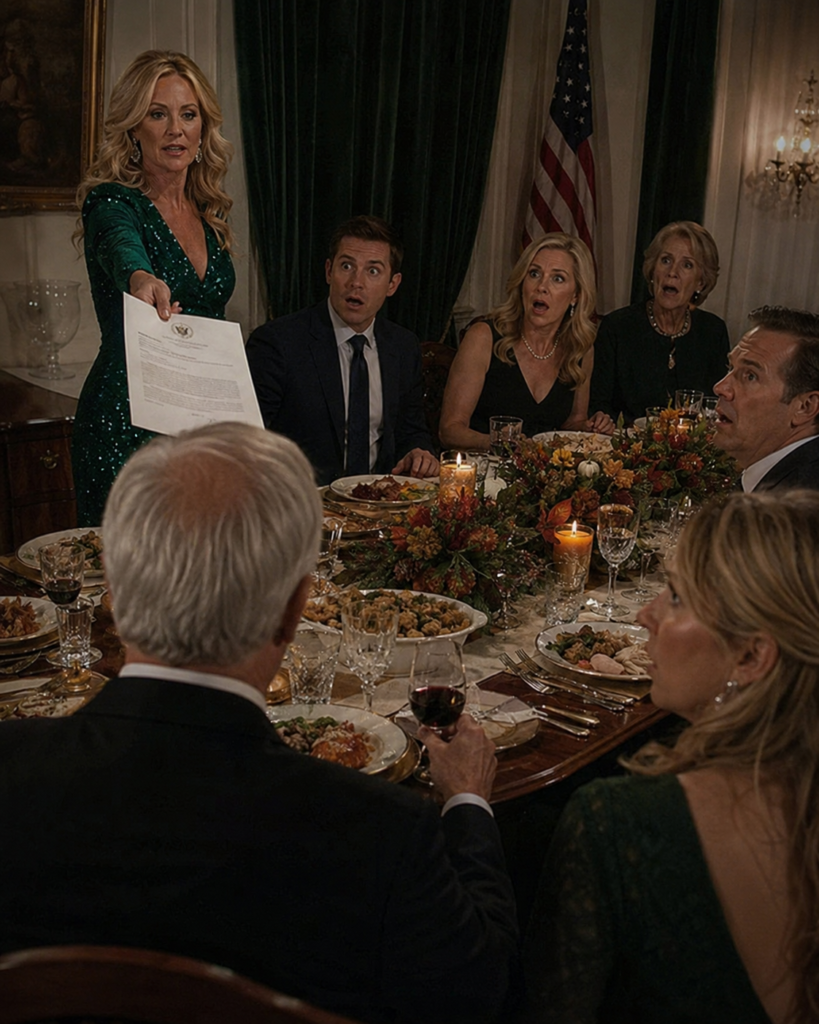
Inside, it was a stage.
My mother, Vivian Whitaker, had built her entire adult life around presentation. The garland on the stair rail had to dip exactly the same distance between every spindle. The turkey had to be photographed before carving. The cranberry sauce, even if nobody ate it, had to sit in a crystal bowl passed down from some aunt whose name no one remembered.
And my father, Grant Whitaker, always waited until everyone had a full glass before he decided who needed to be reminded of their place.
That year, I was twenty-nine, sitting at the far end of the table between my Aunt Carol, who smelled faintly of peppermint schnapps, and my youngest cousin, who kept scrolling through football highlights under his napkin.
I had not been home for Thanksgiving in three years.
There was a reason for that.
My brother Preston sat to my father’s right, wearing a navy sweater and the smug expression of a man who had failed upward so many times he considered gravity a personal insult. My sister Meredith sat beside him, dripping gold bracelets and laughing too loudly at every sentence Dad finished.
They had both arrived late.
I had arrived at nine that morning, because my mother had texted me three days earlier.
Can you come early? I’m overwhelmed.
So I had peeled potatoes, trimmed green beans, lifted the turkey, fixed the garbage disposal, reset the Wi-Fi, found the extra folding chairs, driven to Jewel-Osco for butter, and cleaned wine off the cream rug after Preston’s wife spilled a glass and pretended not to notice.
By four o’clock, my siblings were being praised for showing up with store-bought pies.
“Preston brought bourbon pecan,” Mom announced, as if he had personally harvested the pecans in a field of moral redemption.
“Meredith found the cutest bakery in Hinsdale,” Dad said.
I looked at the mashed potatoes I had made from scratch and said nothing.
That was the family system. Preston performed charm. Meredith performed importance. I performed usefulness.
And useful people were not thanked.
They were assigned more work.
By the time we sat down, the dining room glowed. My mother dimmed the chandelier. The Bears game murmured from the family room. My father stood at the head of the table with his wineglass in one hand and that polished, dangerous smile on his face.
I knew that smile.
It had appeared when I was sixteen and he announced to the family that my “little bookkeeping mistake” had cost him a client, when the mistake had actually been Preston forgetting to send an invoice.
It had appeared when I was twenty-two and he told a room of employees that I had “a lot to learn about loyalty,” after I questioned why Meredith had put a personal trip to Scottsdale on the company card.
It had appeared when I was twenty-seven and he fired me from Whitaker Logistics in front of the executive team, claiming I had become “emotionally unstable,” because I had discovered he was hiding vendor debt before a bank review.
That smile was never casual.
It meant a knife was already in his hand.
“Before we eat dessert,” Dad said, tapping his glass with a knife, “I want to make an announcement.”
Preston grinned like he already knew.
Meredith covered her mouth, badly pretending surprise.
My stomach tightened.
My father looked around the table, letting silence gather. He loved silence when he controlled it.
“As many of you know,” he began, “Whitaker Logistics has been in this family for forty-three years.”
Everyone nodded.
The company had started with my grandfather and two delivery trucks in Aurora. By the time I was in college, it had become a regional warehousing and freight coordination business serving manufacturers across Illinois, Wisconsin, Indiana, and Iowa.
By the time I was twenty-six, I knew every route, every vendor contract, every warehouse lease, every broken forklift, every seasonal cash crunch, and every client who paid late but was worth keeping.
Preston knew the golf memberships.
Meredith knew the company Instagram password.
Dad lifted his chin. “I have carried that business through recessions, fuel spikes, labor shortages, and plenty of family disappointments.”
His eyes moved to me.
There it was.
The room shifted. Not visibly. Not enough for outsiders to notice. But I felt everyone lean inward.
My family loved a public correction as long as it was not aimed at them.
“I’ve made a decision,” Dad continued. “After months of negotiation, I am selling Whitaker Logistics.”
Aunt Carol gasped.
My mother pressed a hand to her pearls.
Preston’s smile got wider.
Meredith’s eyes shone like someone had opened a vault.
Dad paused for maximum effect.
“For sixty-eight million dollars.”
The room erupted.
“Oh my God!”
“Grant!”
“Dad, that’s incredible!”
“Sixty-eight?”
“Are you serious?”
Preston stood up and hugged him. Meredith started crying, though I noticed no tears made it past her lower lashes.
My mother looked like she had just been crowned queen of a small but tasteful country.
I sat still.
Sixty-eight million dollars.
That number was familiar.
Too familiar.
Dad raised both hands. “Now, now. We’ll talk details later. But I want to make something clear tonight, in front of everyone.”
The air changed again.
My father turned toward me.
“Mara,” he said.
I looked at him.
My name sounded wrong in his mouth. Like he was using it as evidence.
“You have spent the last few years creating distance from this family,” he said. “You left the company. You refused to respect my leadership. You questioned decisions you didn’t understand.”
I felt my hands go cold.
Across the table, Preston leaned back, delighted.
Meredith gave me a pitying look so rehearsed it could have had stage directions.
Dad continued. “Your brother and sister stayed loyal.”
That almost made me laugh.
Preston had nearly lost our biggest account because he forgot to renew a shipping insurance rider. Meredith had once approved an ad campaign featuring a stock photo of forklifts from Germany and a slogan with the word “freight” spelled wrong.
But loyalty, in my father’s language, meant agreement.
Not competence.
Not honesty.
Agreement.
“So,” Dad said, “I want there to be no confusion later. Preston and Meredith will be taken care of from the sale proceeds.”
My mother stared down at her plate.
She knew.
Of course she knew.
Dad looked right at me.
“You will receive nothing.”
The table went quiet.
Even the football game in the other room seemed to lower itself.
Aunt Carol stopped chewing.
My cousin finally looked up from his phone.
I felt every eye land on me, waiting for the show. Waiting for me to cry, shout, plead, accuse, leave.
That was what my father wanted.
He had dragged me back into the house I had outgrown to make me small in front of everyone who had ever watched him do it.
Preston lifted his glass.
“To loyalty,” he said.
Meredith joined him.
“To family,” she added.
Several relatives, confused and uncomfortable but too cowardly to resist a toast, lifted their glasses too.
My father watched me over the rim of his wineglass.
I looked down at my plate.
Turkey. Gravy. Green beans. A roll I hadn’t touched.
Then I looked back up and asked one question.
“Who’s the buyer?”
Dad blinked.
It was a small blink. Barely there.
But I saw it.
“The buyer?” he repeated.
“Yes,” I said. “Who bought Whitaker Logistics?”
His smile returned, broader this time. He mistook my question for panic. He thought I was asking because I wanted to know which stranger would own the company my grandfather built.
He thought he still had the last card.
“A private acquisition group,” he said proudly. “Northline Harbor Capital.”
My fork slipped from my fingers and hit the plate with a soft silver ring.
I tried not to laugh.
I failed.
It came out quietly at first, just one breath. Then another.
Preston’s grin faded. “What’s funny?”
Meredith narrowed her eyes. “Mara, seriously?”
Dad’s face hardened. “Do you have something to say?”
I wiped the corner of my mouth with my napkin.
“Yes,” I said. “I was just wondering how long you were going to brag before realizing you sold the company to me.”
The silence that followed was the cleanest sound I had ever heard.
Dad stared at me.
Mom’s hand froze against her pearls.
Preston laughed once, sharply. “That’s not funny.”
“No,” I said. “It’s not.”
Meredith shook her head. “You’re lying.”
I reached into my handbag, took out my phone, opened the secure deal folder, and turned the screen toward my father.
He did not move at first.
Then he leaned forward.
His eyes landed on the closing notice.
Northline Harbor Capital, LLC.
Managing Member: Mara Whitaker.
Final acquisition price: $68,000,000.
Scheduled transfer: December 2.
His face changed.
Not all at once.
First confusion.
Then calculation.
Then recognition.
Then something I had never seen on my father before.
Fear.
I placed the phone facedown beside my plate.
“Happy Thanksgiving,” I said.
No one spoke.
For once, not even my father.
And that was how the warmest-looking house in Naperville finally began to burn.
Three years earlier, I had left Whitaker Logistics with a cardboard box and a security guard walking six feet behind me.
Dad had not called it firing.
He had called it “protecting the company from emotional volatility.”
The truth was less poetic.
I had discovered that Preston had been hiding delayed vendor payments by moving invoices into inactive project folders. He had done it to keep his quarterly bonus intact. Meredith knew, because she had approved marketing expenditures that should have been frozen. Dad knew too, at least by the end, but admitting that would mean admitting the golden children had been using the company like a family ATM.
So he did what he always did.
He blamed the person who found the mess.
Me.
“You are making accusations that could destroy this family,” he told me in his office.
His office had a wall of framed newspaper clippings about the company, most of them featuring him shaking hands with someone in a suit. Behind his desk was a photograph of my grandfather, Samuel Whitaker, standing beside the company’s first truck in 1981.
Grandpa Sam had loved that photo.
Dad loved what it made people think about him.
“I’m not making accusations,” I said. “I’m showing you invoices.”
He glanced at the folder in front of him but did not open it. “Preston made a timing judgment.”
“He hid $1.4 million in unpaid vendor balances.”
Dad’s jaw tightened. “Lower your voice.”
“There are mechanics refusing service until we pay them. Fuel suppliers are threatening COD status. You’re about to walk into a bank review with false liquidity numbers.”
“Mara.”
“If the bank finds out before we disclose it, we’ll be in default.”
He stood. “Enough.”
I remember the exact shade of his tie that day. Deep red with tiny navy dots. I remember the hum of the HVAC. I remember looking past his shoulder at Grandpa Sam’s picture and thinking, He would have opened the folder.
“You’ve always had this problem,” Dad said.
“What problem?”
“You think being competent gives you the right to be disrespectful.”
I almost smiled because it was such a perfect summary of our family.
Competence was useful when it protected them.
Dangerous when it exposed them.
“I think the company matters more than Preston’s ego,” I said.
Wrong sentence.
My father’s face went still.
By noon, my building badge stopped working.
By one, HR had a severance packet ready.
By two, the security guard was walking behind me through the operations floor while employees pretended not to stare.
I didn’t cry until I reached my car.
Not because I was fired.
Because as I sat in the parking lot with that cardboard box on the passenger seat, I realized no one was coming after me.
Not my father.
Not my mother.
Not Preston, whose mess I had covered more times than I could count.
Not Meredith, who once called me at midnight from a hotel bathroom in Nashville because she had lost her company credit card and needed me to calm Dad down.
None of them.
My phone did buzz once.
It was a text from my mother.
Please don’t make this harder than it has to be.
That was the day something inside me stopped asking to be loved correctly by people who benefited from loving me wrong.
I drove to my apartment in Chicago, carried the box upstairs, and placed it on the kitchen table.
Inside were the remains of ten years of loyalty.
A framed photo of me and Grandpa Sam beside Truck 12.
A dented travel mug.
Three notebooks filled with route optimization plans my father had dismissed because Preston didn’t understand them.
A small brass key Grandpa had given me when I graduated college.
“That’s for the old records room,” he told me. “Your dad doesn’t care about paperwork unless a banker asks for it. But history matters, kiddo. Numbers tell stories people try to bury.”
At the bottom of the box was a folded letter I had forgotten existed.
Grandpa wrote it to me six months before he died.
Mara,
Your father likes applause. You like answers. Applause fades. Answers compound.
If the company ever stops feeling like a place where truth matters, don’t waste your whole life begging liars to respect math.
Build something cleaner.
Love,
Grandpa Sam
I read that letter four times.
Then I opened my laptop.
By midnight, I had registered Harborline Advisory LLC.
It was supposed to be a consulting firm.
Just me, my laptop, and a reputation Dad thought he had destroyed.
But Dad had underestimated two things.
First, people in logistics talk.
Second, I had been the one actually solving their problems.
Within three weeks, a former client called.
Then another.
Then a warehouse manager from Joliet asked if I could review their freight contracts.
Then a food distributor in Rockford hired me to redesign their inventory flow.
I worked from my kitchen table for six months. I lived on coffee, spreadsheets, and rage so quiet it felt like discipline.
I did not trash my father.
I did not beg former employees for loyalty.
I did not post dramatic updates online.
I just answered calls.
And when people asked what had happened at Whitaker Logistics, I said, “I’m no longer with the company, but I wish them well.”
That sentence made me more money than revenge ever could have.
Because in business, restraint is a flare gun.
People notice.
A year after I left, Harborline Advisory became Harborline Operations Group.
By then, I had three employees, a rented office near Fulton Market, and clients in four states.
One of those clients was Daniel Ross, a private equity partner who looked like he had been born wearing quarter-zips.
Daniel was not charming. He was better than charming.
He was precise.
He hired me to evaluate a struggling freight brokerage in Indiana. I found the problem in nine days: not labor, not demand, not software, but a bad incentive structure that rewarded dispatchers for volume instead of margin. Daniel’s team had spent four months missing it.
After the presentation, he sat across from me in a glass conference room and said, “You don’t talk like a consultant.”
“Is that a complaint?”
“No. Consultants tell me what sounds expensive. You tell me what’s true.”
“Truth is usually expensive after people ignore it.”
He smiled. “Have you ever considered acquisitions?”
“No.”
“You should.”
“I don’t have acquisition money.”
“You have acquisition judgment. Money is easier to find.”
I laughed because I thought he was being polite.
He wasn’t.
Over the next year, Daniel introduced me to lenders, operators, family office investors, and two retired executives who had spent their careers buying ugly companies with beautiful bones.
That phrase stayed with me.
Ugly companies with beautiful bones.
It sounded like half the families I knew.
I learned how deals were structured. How seller financing worked. How earnouts hid fear. How debt could be a tool or a noose. How founders lied to themselves about value. How children ruined companies they inherited but never understood.
I learned quietly.
Carefully.
Obsessively.
And all the while, Whitaker Logistics was bleeding.
Not publicly.
Not at first.
Dad still gave interviews to local business journals. Preston still posted photos from client golf outings. Meredith launched a rebrand with a blue-and-silver logo that looked like a regional airline from 2004.
But vendors called me.
Former employees called me.
Clients called me.
I learned that Dad had replaced the warehouse management system with a cheaper platform Preston’s friend sold him.
It crashed during peak season.
I learned Meredith had signed a five-year marketing contract with a firm that specialized in lifestyle brands, not logistics.
I learned the bank had tightened covenants.
I learned Dad was taking meetings with buyers.
And then, one rainy Tuesday in March, Daniel called me.
“I have something interesting,” he said.
“I’m listening.”
“Regional logistics company. Family-owned. Illinois-based. Revenue’s declining, but assets are strong. Seller thinks it’s worth eighty million.”
My hand stopped above my keyboard.
“What’s the name?”
Daniel paused.
“Whitaker Logistics.”
I did not speak.
“Mara?”
“I’m here.”
“I didn’t know if you’d want to be involved.”
I looked out the window at the rain sliding down the glass.
For years, I thought revenge would feel hot.
It didn’t.
It felt cold.
Clean.
Like opening a door in winter.
“Send me the book,” I said.
The book was worse than I expected.
Whitaker Logistics still had valuable contracts, owned two warehouses outright, held long-term leases on three more, and had a fleet that was older but serviceable. The bones were there.
But the management layer was rotten.
Margins had shrunk. Customer churn had increased. Vendor terms had worsened. Fuel hedging was sloppy. Insurance premiums had jumped after claims Preston had failed to escalate properly.
Dad wanted eighty million.
No serious buyer would pay that.
Unless the buyer knew exactly what the business could become after removing the people damaging it.
For two months, I studied the company like a surgeon reviewing scans of a body she used to live in.
Then I created Northline Harbor Capital.
I did not use my name anywhere Dad would see.
Daniel’s group helped structure financing. A family office out of St. Louis took a minority stake. A lender from Cincinnati backed the senior debt. I rolled in equity from Harborline, nearly every dollar I had made and saved.
Was it risky?
Yes.
Was it personal?
Also yes.
But it was not reckless.
That mattered.
I was not buying my father’s company to burn it down.
I was buying my grandfather’s company to save it from the people who thought inheritance was management.
The first offer went in at fifty-two million.
Dad rejected it with theatrical outrage.
The second offer went in at fifty-eight.
He rejected that too.
The third offer was sixty-four with contingencies.
He stalled.
Then came the bank pressure.
Then a major client threatened not to renew.
Then a vendor filed a lien notice.
By October, Dad came back.
He wanted seventy-two.
We offered sixty-eight.
Final.
No retrade unless diligence uncovered fraud.
He accepted.
Through all of it, he never knew it was me.
That was not an accident.
The deal team used intermediaries. Communications went through counsel. Northline’s ownership structure was legal, clean, and private. Dad saw what he wanted to see: outside money, polished buyers, a chance to exit before the damage became obvious.
He did not ask enough questions.
That had always been his weakness.
He confused confidence with control.
The Thanksgiving invitation arrived two weeks before closing.
Mom called, not texted.
That alone made me suspicious.
“Mara, sweetheart,” she said, using the voice she reserved for church friends and emotional manipulation. “We’d love to have you home this year.”
“Why?”
A pause.
“Because it’s Thanksgiving.”
“That hasn’t mattered for three years.”
She sighed. “Don’t be difficult.”
“I’m not being difficult. I’m being accurate.”
Another pause. In the background, I could hear cabinets closing.
“Your father has news,” she said.
There it was.
“What kind of news?”
“He should tell you himself.”
“Then he can call me.”
“Mara.”
“Mom.”
Her voice softened. “Please. I want one nice holiday.”
That sentence did what she intended.
It hooked the old part of me.
The daughter who had once believed if she helped enough, performed enough, swallowed enough, eventually someone would look up and say, You must be tired.
So I went.
But I did not go as the daughter begging for a seat.
I went as the buyer.
After I told them, the dining room stayed silent long enough for the candles to start feeling loud.
My father’s mouth opened, then closed.
Preston reached for my phone.
I moved it before he touched it.
“Don’t,” I said.
His face flushed. “What the hell is this?”
“A closing notice.”
“You expect us to believe you have sixty-eight million dollars?”
“No,” I said. “I expect you to understand that acquisition financing exists.”
Meredith laughed, brittle and high. “This is insane. Dad, tell her.”
Dad said nothing.
That was when everyone else understood.
Aunt Carol slowly set down her wineglass.
My cousin whispered, “Holy crap,” and got elbowed by his mother.
Mom stared at Dad. “Grant?”
He remained standing at the head of the table, but something had gone out of his posture.
“How?” he asked.
Not loudly.
That almost made it worse.
I folded my napkin and placed it beside my plate.
“The same way anyone buys a company. Due diligence, financing, legal review, purchase agreement.”
“You hid behind Northline Harbor.”
“I used a lawful acquisition entity.”
“You deceived me.”
I looked around the table.
That was rich.
“No, Dad,” I said. “Your advisors disclosed the buyer structure. Your attorney had access to the documents. You chose not to care who controlled the buyer because you were too busy celebrating the price.”
Preston shoved back his chair. “This is fraud.”
Daniel had warned me someone would say that.
I was ready.
“It’s not,” I said. “But you’re welcome to call your lawyer and ask him why he let you sign.”
Meredith pointed a trembling finger at me. “You did this to humiliate us.”
I looked at her.
Meredith, who had once told a vendor I was “basically office support” while I was negotiating a six-figure rate correction.
Meredith, who had called me dramatic after Dad fired me.
Meredith, who was already spending money from a sale that had not closed.
“No,” I said. “Dad did the humiliating. I asked one question.”
Dad’s eyes sharpened. “You think this makes you powerful?”
“No,” I said. “Owning the company makes me responsible. You should try understanding the difference.”
Preston barked a laugh. “You can’t run Whitaker Logistics.”
I turned to him. “I already did.”
His face twisted.
I continued, calm now, because calm was the one thing they had never known how to fight.
“I ran vendor negotiations while you were golfing with clients who didn’t like you. I rebuilt the routing model you called unnecessary. I caught the billing errors you blamed on software. I managed warehouse staffing because you couldn’t remember which supervisors reported to you.”
He stood taller. “You’re rewriting history.”
“No. I’m finally not letting you edit it.”
Mom whispered, “Please don’t do this at the table.”
I looked at her.
For most of my life, Mom’s role had been soft enforcement. Dad made the wound. Mom asked me not to bleed on the carpet.
“At the table is where Dad chose to do it,” I said.
Her eyes filled. Real tears this time. Maybe for me. Maybe for herself. Maybe for the fact that the script had slipped from everyone’s hands.
Dad placed both palms flat on the table.
“The deal hasn’t closed.”
“No,” I said. “It hasn’t.”
“Then I can terminate.”
I nodded. “You can try.”
Something flickered in his eyes.
He knew.
The agreement had penalties. The bank knew. Vendors knew a sale was pending. Key clients had consented based on continuity assurances. Walking away now would not return him to power. It would drag him into exposure.
“You think you’ve trapped me,” he said.
“No. I think you trapped yourself and blamed me for noticing.”
Preston turned to Dad. “Can she cut us out?”
That was the first honest thing he had said all night.
Dad did not answer.
So I did.
“The sale proceeds go to the current ownership as defined before closing. That’s Dad’s side. What he does with his money is his business.”
Meredith relaxed slightly.
I looked at her.
“But nobody at this table should assume employment after closing.”
Her mouth fell open.
Preston went still.
Dad’s voice dropped. “You wouldn’t.”
“I would.”
“You’d fire your own brother and sister?”
“I’d evaluate them like any other executives.”
Preston scoffed. “I’m Chief Client Officer.”
“You lost clients.”
“I maintained relationships.”
“You expensed relationships.”
Meredith glared. “I’m VP of Brand Strategy.”
“The company ships industrial parts and refrigerated goods through the Midwest. It does not need a brand strategy that includes influencer partnerships.”
Aunt Carol made a strangled sound into her napkin.
Meredith looked ready to throw her wine.
Dad’s anger returned because fear embarrassed him.
“You ungrateful little—”
“Careful,” I said.
The word landed harder than I expected.
Maybe because I had never said it to him before.
Not like that.
Not as a warning.
Dad stared at me.
I stood.
The chair legs scraped softly against the floor.
“I didn’t come here to fight,” I said. “I came because Mom asked me to. Then you announced in front of this family that you planned to punish me financially for refusing to protect lies. So let’s finish the honesty portion of the evening.”
I reached into my handbag again and removed a folded sheet of paper.
Not deal documents.
Not legal threats.
A note.
Old. Creased. Yellowing slightly at the edges.
Dad recognized it before anyone else did.
His eyes changed.
I unfolded it.
“Grandpa Sam wrote this to me before he died,” I said.
Mom closed her eyes.
I read only one line.
“If the company ever stops feeling like a place where truth matters, don’t waste your whole life begging liars to respect math.”
The room was motionless.
I folded the letter again.
“Closing is scheduled for December 2. After that, Whitaker Logistics becomes Northline Harbor Logistics. We’ll keep the warehouse staff. We’ll keep dispatch. We’ll keep drivers who want to stay. We’ll honor client commitments. We’ll pay vendors on time. We’ll fix the systems. And for the first time in years, decisions will be made by people who understand the work.”
Preston’s voice was low. “You think employees will follow you?”
I looked at him.
“They already called me.”
That landed.
Hard.
Because deep down, he knew it was true.
Dad’s hand curled into a fist against the tablecloth.
“You won’t get away with this,” he said.
I almost felt sorry for him then.
Almost.
Because he still thought this was theft.
He could not understand that the company had been available to anyone with money.
I was simply the first person who wanted it for more than extraction.
“I’m not getting away with anything,” I said. “I’m coming back.”
Then I picked up my coat from the back of the chair.
Mom stood quickly. “Mara, don’t leave.”
I looked at the candles, the turkey, the untouched pies, the perfect napkins folded like little fans beside plates full of resentment.
“I already did,” I said.
And this time, when I walked out of my parents’ house, no security guard followed me.
The calls started before I reached I-88.
First Meredith.
Then Preston.
Then Mom.
Then Dad.
Then Preston again.
I let all of them ring.
By the time I got back to my apartment in Chicago, I had eighteen missed calls and nine text messages.
Preston: You better answer.
Meredith: This is disgusting even for you.
Mom: Please call me. Your father is very upset.
Dad: We need to discuss this privately.
Dad again: Do not do anything rash.
That one made me laugh.
I made tea, changed into sweatpants, and sat on my couch watching snow threaten the city from a low iron sky.
At 10:43 p.m., Daniel called.
“Happy Thanksgiving,” he said.
“You heard?”
“I received a message from seller’s counsel asking for an emergency call tomorrow morning.”
“Of course you did.”
“How bad?”
“Dad announced the sale at dinner and said I’d get nothing. Preston toasted loyalty. I asked who the buyer was.”
Daniel was quiet for two seconds.
Then he laughed so hard he coughed.
“I’m sorry,” he said. “That is objectively terrible and also magnificent.”
“I thought you didn’t do emotional commentary.”
“I make exceptions for Shakespearean logistics acquisitions.”
I leaned back against the couch. “Can he kill the deal?”
“He can make noise. But based on the agreement, not cleanly. We’ll talk to counsel in the morning. Do not engage directly tonight.”
“I wasn’t planning to.”
“Good. Also, Mara?”
“Yeah?”
“Be careful. People who feel publicly cornered often stop acting rationally.”
I looked at my dark phone screen.
“I know.”
And I did.
Because my father’s favorite weapon had always been control.
If he could not control the deal, he would try to control the story.
By morning, the story had already begun.
At 7:12 a.m., a former Whitaker Logistics employee sent me a screenshot.
Preston had posted on LinkedIn.
Big changes ahead for Whitaker Logistics. Sad to see how greed and betrayal can infect even family legacy, but grateful for loyal people who built this company the right way. More soon.
He had added a photo of himself standing in front of a warehouse he had never once entered without complaining about the smell of diesel.
By eight, Meredith had posted on Instagram Stories.
Some people confuse revenge with success. Protect your peace.
Behind the text was a selfie of her in sunglasses, sitting in her Mercedes.
By nine, Dad had called a “family business meeting” at his house without inviting me.
By ten, my attorney, Rebecca Singh, called.
Rebecca had the kind of voice that made bad ideas reconsider themselves.
“Seller’s counsel is claiming failure to disclose beneficial ownership.”
“Do they have grounds?”
“No. Their own side waived further disclosure after entity verification. We provided everything required under the agreement. They may argue emotional distress, which is not a purchase agreement term.”
“What does that mean practically?”
“It means your father is angry.”
“Known issue.”
“Do not contact him directly. Do not respond to social media. Do not discuss employment decisions yet. And Mara?”
“Yes?”
“Did you knowingly conceal your identity for the purpose of inducing a lower price?”
“No. The offer was based on financials. We would have paid the same regardless of whether he knew.”
“Good. Keep saying that because it’s true.”
After the call, I opened the diligence folder and reviewed every document again.
The numbers were solid.
The financing was committed.
The legal structure was clean.
Still, Daniel’s warning sat in my chest.
People who feel publicly cornered often stop acting rationally.
By Monday, my father proved him right.
He went to the office.
Not unusual.
Then he called an all-hands meeting.
Very unusual.
I know because three people texted me before he finished speaking.
One was Elena Ruiz, the warehouse operations director in Aurora.
Elena had worked at Whitaker Logistics for eighteen years. She started as a temp, became a shift lead, then warehouse manager, then director. She knew more about the company’s physical operations than anyone alive.
Dad had denied her a promotion twice because, according to him, she “lacked executive polish.”
That meant she did not flatter him.
Her text was short.
He’s telling everyone the buyer plans layoffs and asset stripping. Is that true?
I called her immediately.
“No,” I said when she answered.
She exhaled. “I didn’t think so.”
“What exactly did he say?”
“That an outside group is taking over. That management fought for employees but couldn’t stop the buyer. That everyone should prepare.”
My hand tightened around the phone.
“That’s a lie.”
“I know. But people are scared.”
“I’m coming in after closing. I’ll meet with everyone directly.”
“That may be too late.”
I stood from my desk.
Elena lowered her voice. “Mara, he’s cleaning out files.”
The room seemed to tilt slightly.
“What files?”
“I don’t know. Preston and two guys from IT are in the records room. Boxes are being moved.”
Grandpa Sam’s brass key flashed in my memory.
The old records room.
Numbers tell stories people try to bury.
“Elena,” I said carefully, “do not interfere. Do not confront anyone. But write down what you see. Dates, times, names.”
“Already am.”
“Thank you.”
I hung up and called Rebecca.
By noon, she had sent a litigation hold notice to seller’s counsel demanding preservation of all company records pending closing.
By two, Dad called me directly.
I answered because Rebecca was conferenced in silently.
“Have you lost your mind?” he snapped.
“Hello, Dad.”
“You sent a legal threat to my company?”
“The company you agreed to sell.”
“You don’t own it yet.”
“And you’re obligated to preserve its records.”
“I’m not being lectured by my daughter about obligations.”
Rebecca muted herself and whispered, “Let him talk.”
So I did.
Dad continued. “You think because you played some cute little shell game, you’re ready to sit in my chair?”
“No.”
That stopped him.
I continued. “I don’t want your chair. I’m replacing it.”
His breathing changed.
“You arrogant—”
“Did you remove files from the records room?”
Silence.
There it was.
“Who told you that?” he asked.
“Did you?”
“You have spies now?”
“Employees who care about the company. Did you remove files?”
“You’re not entitled to every scrap of paper in that building.”
“Under the purchase agreement, Northline is entitled to company records.”
“I built that company.”
“Grandpa built that company. You inherited it.”
The line went so quiet I could hear faint office noise behind him.
“Be very careful,” he said.
“I am.”
“No, Mara. You’re not. You’re poking around in things you don’t understand.”
I looked at Rebecca’s muted square on my laptop. Her expression sharpened.
“What things?”
Dad caught himself.
“Nothing,” he said.
But it was too late.
Nothing always means a door.
And I had just heard it unlock.
The week between Thanksgiving and closing became a war fought through lawyers, rumors, and old paper.
Dad tried to delay.
He claimed distress.
Then incomplete disclosure.
Then buyer misconduct.
Then “family coercion,” which made Rebecca laugh without smiling.
None of it worked.
The bank wanted the deal closed.
Vendors wanted payment.
Clients wanted stability.
Dad had spent months telling everyone the sale would solve everything. Now he could not easily explain why he wanted to stop it just because the buyer turned out to be the daughter he had publicly underestimated.
But the records room bothered me.
It bothered Daniel too.
“Could be tax issues,” he said.
“Could be old lawsuits.”
“Could be personal.”
“With my father, those categories overlap.”
The purchase agreement had indemnities. If Dad had hidden liabilities, we had recourse. But legal recourse after closing was not the same as knowing what bomb you were standing on.
I thought about Grandpa Sam’s letter.
The brass key.
The old records room.
I had not used that key in years.
I still had it.
On Wednesday night, Elena called.
“He’s gone,” she said.
“Who?”
“Your father. Preston too. They left around six. Security’s on the south entrance. North side camera’s still down from the storm.”
“Elena.”
“I’m not telling you to come. I’m telling you if someone with a lawful pre-closing inspection right happened to arrive with counsel authorization, the night supervisor wouldn’t stop them.”
I closed my eyes.
“Elena, did Rebecca put you up to this?”
“No. I’m tired of watching men in fleece vests destroy what women keep running.”
That was the most Elena sentence I had ever heard.
“I can’t break into a company I don’t own yet.”
“You still have your old access card?”
“It was deactivated.”
“What about the key your grandfather gave you?”
I opened my eyes.
“How do you know about that?”
“Sam gave me one too.”
For a moment, I couldn’t speak.
Elena’s voice softened. “He trusted people who respected the work.”
An hour later, I stood outside the old Aurora warehouse under a sky the color of wet steel.
Rebecca was with me.
So was a third-party records auditor named Miles, who looked approximately twelve but carried evidence bags with the seriousness of a federal agent.
We entered through the north administrative door using Elena’s key, not mine. That mattered, Rebecca said. Elena had current authority. We were there under written inspection rights. Everything was documented.
The warehouse smelled exactly as I remembered.
Dust. Shrink wrap. Coffee. Diesel. Cardboard.
It hit me so hard I had to stop walking.
This building had been my childhood in strange pieces. Summer afternoons doing homework in the dispatch office. Grandpa teaching me to read inventory codes. Dad yelling into phones. Drivers bringing me gas station candy because I remembered their kids’ names.
I had loved this place before I knew loving a business could hurt.
The old records room was behind the former dispatch bullpen, down a short hall under flickering fluorescent lights.
Elena met us there.
She held a clipboard and a ring of keys.
“They moved twelve boxes,” she said. “Maybe more. But they missed the back cabinets.”
Rebecca nodded. “We document what remains. We do not remove originals unless allowed. We scan where necessary.”
Elena unlocked the door.
The records room was colder than the hall. Metal shelves lined three walls. Banker boxes sat in uneven stacks. Filing cabinets with peeling labels ran along the back.
The place looked forgotten.
But not abandoned.
Someone had been there recently.
Dust disturbed. Box outlines on shelves. A dolly mark on the floor.
Miles began photographing.
Rebecca dictated notes.
I stood in the doorway, pulse slow and heavy.
“What are we looking for?” Elena asked.
“I don’t know,” I said.
That was not entirely true.
I was looking for the thing my father feared more than losing money.
I was looking for the story.
We found it in the bottom drawer of a gray filing cabinet labeled S.W. PERSONAL / 1998-2006.
S.W.
Samuel Whitaker.
Grandpa.
The drawer stuck. Elena had to pull hard enough that the cabinet screeched.
Inside were hanging folders.
Insurance.
Property.
Estate.
Aged correspondence.
And one red folder with no label.
The same kind of red folder Grandpa used for urgent documents.
My throat tightened.
Rebecca looked at me. “Do you want me to open it?”
I shook my head.
I put on gloves.
Then I opened the folder.
Inside was a copy of an agreement dated March 14, 2006.
I recognized Grandpa’s signature immediately.
I recognized Dad’s too.
The document was a shareholder transfer and restriction agreement.
At first, the language blurred. Legal clauses. Ownership units. Voting rights.
Then one paragraph snapped into focus.
Upon the death or incapacity of Grant Whitaker, or upon any voluntary sale of a controlling interest in Whitaker Logistics, Inc., Samuel Whitaker’s reserved Class B legacy shares shall convert into a ten percent non-voting economic interest to be held in trust for Mara Evelyn Whitaker, provided she has reached the age of twenty-five.
I read it again.
Then again.
My breath disappeared.
“Elena,” I whispered.
She stepped closer. “What is it?”
I handed it to Rebecca.
Her eyes moved across the page.
Then she became very still.
“Mara,” she said carefully, “were you aware of this?”
“No.”
“Did your father ever disclose this?”
“No.”
“Did estate counsel?”
“No.”
Rebecca turned the page.
There were attachments.
Trust documents.
Letters.
A memorandum from Grandpa to an attorney.
Mara has the head for the company. Grant will resist this. He believes Preston should inherit control, though Preston lacks discipline. I do not wish to create family war while living, but I want Mara protected from being erased.
The room blurred.
I sat down on a metal stool because my knees had stopped feeling reliable.
Grandpa had known.
Not everything, maybe.
But enough.
He had seen the shape of my life before I had language for it.
He had tried to leave me a rope.
And Dad had buried it.
Rebecca’s voice was calm, but her eyes were bright with controlled fury.
“This changes things.”
“How much?”
“A lot.”
The Class B shares were non-voting, but economic. Ten percent of sale proceeds, if enforceable, meant $6.8 million should have been allocated to me from Dad’s sale.
But more importantly, the document suggested my father had represented full ownership for a sale while failing to disclose a legacy interest.
That was not just family ugliness.
That was deal ugliness.
And deal ugliness had consequences.
Miles scanned everything.
Rebecca documented chain of custody.
Elena stood beside the door like a guard.
Before we left, I looked once more at Grandpa’s memorandum.
I want Mara protected from being erased.
For years, I thought I had survived my family by becoming hard.
But sitting in that cold records room, holding proof that someone had seen me clearly, I realized I had not become hard.
I had become precise.
There was a difference.
Hard breaks.
Precise cuts.
Closing day arrived with freezing rain.
Chicago wore December badly that morning. The sky pressed low. Cars hissed along wet streets. Everyone in the conference room had damp coats and careful faces.
Dad attended from his attorney’s office in Oak Brook.
I attended from Rebecca’s office downtown with Daniel, two lenders, a tax attorney, and a closing specialist named Janine who spoke only in wire confirmations.
Preston and Meredith were not part of the closing.
That did not stop them from texting me.
Preston: You’re destroying Dad.
Meredith: I hope the money keeps you warm when you’re alone.
I did not respond.
At 9:15 a.m., Rebecca disclosed the red folder documents to seller’s counsel.
At 9:17, seller’s counsel requested a private call.
At 9:19, Dad called me himself.
Rebecca shook her head.
I declined.
At 9:26, seller’s counsel returned to the main call sounding like a man who had just discovered the floor was not where he left it.
“We need to discuss a potential escrow adjustment,” he said.
Rebecca replied, “We need to discuss seller’s failure to disclose an existing economic interest.”
Daniel leaned back slightly, expression unreadable.
My father’s voice cut through the speaker.
“That document is old.”
Rebecca didn’t blink. “It is executed.”
“It was never implemented.”
“It contains signatures, trust language, and transfer triggers.”
“My father was confused near the end.”
The sentence hit me like a slap.
Grandpa had been sharper at eighty-two than Dad was at fifty.
Rebecca’s voice cooled. “Mr. Whitaker, I would strongly advise against making unsupported claims regarding the capacity of the individual whose signed agreement you appear to have concealed.”
Silence.
Then Dad said, “Mara, this is between us.”
I finally leaned toward the microphone.
“No,” I said. “That’s what you always say when paperwork proves you lied.”
No one spoke.
The closing specialist stared at her laptop with the intense focus of a woman determined not to be emotionally present.
Seller’s counsel cleared his throat. “Perhaps we can resolve this without delaying the transaction.”
That meant they knew delay would be worse for them.
Rebecca proposed an escrow: $8 million held back pending resolution of the legacy share claim and any related indemnity issues.
Dad exploded.
“No.”
His attorney muted him.
Then unmuted.
“We can agree to $4 million,” counsel said.
Rebecca looked at me.
I shook my head.
“Eight,” I said.
Seller’s counsel sighed. “Six point eight.”
The exact amount.
Grandpa’s ten percent.
I looked out the window at the rain sliding down the glass.
For a moment, I saw myself at sixteen, sitting at Dad’s dining room table while he told relatives my math award was “nice, but Mara needs to learn people skills.”
At twenty-two, staying late to fix payroll while Preston celebrated a promotion he hadn’t earned.
At twenty-seven, carrying a cardboard box past employees who wanted to help but needed their jobs.
At twenty-nine, sitting at Thanksgiving while my father announced I would get nothing.
Nothing.
That word had been his gift.
Now I returned it.
“Seven point five,” I said.
Rebecca’s mouth almost twitched.
Dad shouted something muffled in the background.
Seller’s counsel said, “We need five minutes.”
They took twelve.
When they came back, they agreed.
At 11:48 a.m., wires initiated.
At 12:03 p.m., Janine confirmed receipt.
At 12:11 p.m., signatures completed.
At 12:16 p.m., Whitaker Logistics was no longer my father’s company.
It was mine.
No champagne popped.
No one cheered.
Daniel shook my hand.
Rebecca hugged me, quickly and professionally, as if affection also needed proper documentation.
Then she handed me a folder.
“What’s this?”
“Your first board consent.”
I opened it.
Appointment of Chief Executive Officer: Mara Evelyn Whitaker.
I stared at it.
Daniel said, “Ugly company. Beautiful bones.”
I smiled.
“Let’s get to work.”
I walked into the Aurora warehouse at 2:30 p.m.
Not alone.
Daniel came with me. So did Elena, Rebecca, a transition HR consultant, and a systems lead from Harborline.
The employees had been told there would be an all-hands meeting after closing. Dad had not been invited.
Neither had Preston.
Neither had Meredith.
By the time I stepped onto the warehouse floor, nearly two hundred people had gathered between the loading bays and the old dispatch boards.
Drivers in hoodies and work jackets.
Warehouse staff in safety vests.
Dispatchers holding coffee cups.
Office employees whispering in clusters.
Some looked relieved.
Some looked scared.
Some looked angry.
I didn’t blame them.
For weeks, they had been fed rumors that I was coming to slash jobs and sell assets. Some probably believed I had betrayed my family. Some probably believed Dad. Some didn’t know what to believe.
I climbed onto the low platform near Bay 4, where supervisors usually gave safety briefings.
Elena stood below, arms crossed.
I looked out at the faces.
I recognized so many.
Mike Donnelly from fleet maintenance, who once patched a truck during a snowstorm with parts he swore came from “a miracle and a junk drawer.”
Tasha Bell from dispatch, who could calm furious clients faster than anyone I’d ever heard.
Raj Patel from inventory systems, who had been ignored by Preston so consistently that he stopped sending suggestions.
And dozens of newer employees who knew me only as a rumor.
I took the microphone.
“Good afternoon,” I said. “I’m Mara Whitaker. As of today, Northline Harbor Logistics owns this company.”
A low murmur moved through the crowd.
“I know many of you have heard things about what happens next. So I want to say this clearly. We are not here to strip the company. We are not shutting down Aurora. We are not canceling benefits. We are not laying off warehouse staff, drivers, dispatchers, mechanics, or customer service teams as part of this transition.”
The room shifted.
People looked at each other.
I continued. “We are reviewing executive and senior management roles. That review will be based on performance, operational need, and conduct. Not last names.”
Someone near the back muttered, “About time.”
A few people laughed.
I let it pass.
“I worked here for ten years,” I said. “Some of you know that. Some of you know how I left. I’m not going to relitigate family history on a warehouse floor.”
Elena raised one eyebrow, as if impressed by my restraint.
“But I will tell you what I believe,” I said. “This company was built by people who showed up before sunrise, answered calls during storms, fixed mistakes they didn’t make, and kept promises that salespeople made too easily. That is the company worth saving.”
The room grew quiet.
“My grandfather used to say trucks don’t move because someone gives a speech. They move because someone checked the fuel, loaded the pallet right, planned the route, answered the phone, and told the truth when something went wrong.”
Mike Donnelly nodded.
“So here’s what changes immediately. Vendor payment review starts today. Safety and maintenance backlog review starts tomorrow. Dispatch escalation gets rebuilt this week. We’re freezing nonessential executive spending. No more vanity marketing contracts. No more client entertainment without margin review. No more hiding bad news until it becomes expensive.”
Tasha Bell actually clapped once before catching herself.
Then others joined.
Not thunderous.
Not theatrical.
Real.
Short.
Tired.
Hopeful.
I raised a hand.
“I’m not asking you to trust me because of my name. In fact, given recent history, I’d understand if my name made that harder.”
More laughter, stronger this time.
“I’m asking you to judge me by what happens next.”
After the meeting, employees lined up with questions.
Real questions.
Will routes change?
What about overtime?
Are we keeping Blue River Foods?
Can we fix the handheld scanners?
Is it true Preston approved that terrible software?
I answered what I could.
When I couldn’t, I said, “I don’t know yet.”
It felt strange how powerful those words were.
I don’t know yet.
In my father’s company, uncertainty had been treated as weakness, so people lied.
In mine, uncertainty would be a starting point.
Around five, Elena found me in the old dispatch office.
“You did good,” she said.
Coming from Elena, that was a parade.
“Thank you.”
“People are still nervous.”
“They should be. Change is nerve-racking.”
“But they’re less scared.”
“That’s something.”
She leaned against the desk. “Your father called me.”
I looked up.
“When?”
“Twenty minutes ago.”
“What did he say?”
“That I owed him loyalty.”
I almost smiled. “What did you say?”
“That loyalty to a man and loyalty to a company are not the same thing.”
I sat back.
“Elena, I’m going to offer you COO.”
Her face changed.
For once, Elena Ruiz had no immediate answer.
“You don’t have to respond now,” I said.
“Yes, I do.”
I waited.
She crossed her arms. “Do I get actual authority or just a title that makes your transition look good?”
I grinned.
“Actual authority.”
“Budget?”
“Yes.”
“Hiring control?”
“Within plan.”
“Can I fire people who make work harder just because they wear expensive shoes?”
“Case by case.”
She considered.
“Then yes.”
I stood and held out my hand.
She looked at it, then hugged me instead.
It lasted one second.
Maybe two.
Then she stepped back. “Don’t make it weird.”
“I wouldn’t dream of it.”
For the first time that day, I laughed without bitterness.
Then my phone buzzed.
Mom.
I almost ignored it.
But something in me was tired of letting other people decide which conversations I was strong enough to have.
I answered.
“Hi, Mom.”
She was crying.
Not the controlled dining-room kind.
The messy kind.
“Mara,” she said, “your father left.”
I froze.
“What do you mean, left?”
“He packed a bag. He said he couldn’t stay in a house where everyone had betrayed him.”
Everyone.
That was new.
“Where did he go?”
“I don’t know.”
“Is he safe?”
“I think so. He took the Lexus.”
I rubbed my forehead.
Mom sobbed softly. “Preston is furious. Meredith says you planned this to destroy the family. Your father won’t answer me. I don’t know what to do.”
For twenty-nine years, that sentence would have activated me like a fire alarm.
I don’t know what to do.
I would have driven over. Made calls. Managed emotions. Absorbed blame. Translated cruelty into logistics.
But standing in the dispatch office of the company I had just bought, with employees waiting for decisions that actually belonged to me, I felt the old reflex rise.
Then pass.
“I’m sorry you’re upset,” I said.
“Mara, please.”
“I can’t fix Dad’s reaction for you.”
“He’s your father.”
“Yes.”
“And I’m your mother.”
“Yes.”
“Does that mean nothing?”
There it was.
The old trap.
If you will not rescue us, you do not love us.
I looked through the office window at the warehouse floor, where Elena was already talking to supervisors.
“It means something,” I said. “It does not mean everything.”
Mom cried harder.
I softened my voice, but not my boundary.
“If you think Dad might hurt himself or someone else, call 911. If you need a friend, call Aunt Carol. If you want to talk to a lawyer or financial advisor, do that. But I am not leaving the company on closing day to manage the consequences of Dad’s choices.”
Silence.
Then she whispered, “You sound so cold.”
“No,” I said. “I sound separate.”
I ended the call gently.
Then I stood there for a long time, holding the phone.
It hurt.
Of course it hurt.
Freedom did not mean numbness.
It meant the pain no longer got to drive.
Dad reappeared two days later at the Union League Club in Chicago, where he gave a lunch speech to a group of business acquaintances about “the erosion of family enterprise in modern America.”
Someone sent me a recording.
I did not watch it.
Preston watched it six times and then sent me a paragraph accusing me of elder abuse, financial manipulation, and “weaponized feminism,” which Meredith probably helped him phrase.
Meredith started calling vendors, implying the transition was unstable.
That, I did address.
Through counsel.
Firmly.
By the second week of December, both Preston and Meredith received formal notices that their executive roles were terminated effective immediately, with severance contingent on non-disparagement and cooperation.
Preston came to the Aurora office anyway.
Security called me before letting him past reception.
“Send him to the conference room,” I said.
Elena frowned. “You sure?”
“No. But do it.”
Preston entered like he still owned the air.
He wore a camel coat and fury.
I sat at the far end of the conference table with Rebecca on speakerphone, muted but listening.
Preston glanced around. “You redecorated fast.”
“We removed the whiskey cart.”
“Dad liked offering clients a drink.”
“Dad liked offering himself one at eleven in the morning.”
His jaw flexed.
He sat without being invited.
“You think you won,” he said.
“I think we’re busy. What do you need?”
He laughed, but there was panic underneath. I could see it now. Maybe it had always been there.
“I need you to stop pretending you can erase me.”
“I terminated your role. That’s not erasure. It’s employment action.”
“I brought in millions in business.”
“You inherited accounts that predated your involvement.”
“Clients loved me.”
“Three requested new points of contact in the last eighteen months.”
His face reddened.
I slid a folder across the table.
He didn’t open it.
“What’s that?”
“Performance review documentation. Client churn, expense issues, missed renewals, internal complaints.”
“You built a file on me?”
“You built the file. We printed it.”
He looked away.
For a moment, he seemed younger.
Not innocent. Never that.
But smaller.
“When we were kids,” he said, “you always had to be better than me.”
That surprised me.
“Preston.”
“No, seriously. Grades, numbers, Grandpa’s attention. You couldn’t just let me have anything.”
I stared at him.
The conference room hummed quietly.
“You were given everything,” I said.
He scoffed.
“You got Dad’s approval even when you failed. You got promotions when you weren’t qualified. You got mistakes covered, debts excused, chances repeated. I got responsibility.”
“You got to be the smart one.”
The sentence hung between us.
There it was.
The rotten little seed.
I had spent my life envying his ease.
He had spent his envying my competence.
What a stupid tragedy.
“Preston,” I said quietly, “being trusted to clean up messes is not the same as being loved.”
His face changed.
For one second, the room lost its armor.
Then he put it back on.
“You sound like a therapist.”
“You should try one.”
He stood abruptly. “Dad’s going to fight this.”
“Dad signed the deal.”
“He’ll fight you.”
“I know.”
“You’re going to end up alone.”
I looked at him.
“No,” I said. “I was alone at that table. This is different.”
He had no answer.
After he left, Rebecca unmuted.
“That was both sad and legally useful.”
I almost laughed. “You recorded?”
“As agreed.”
“Good.”
I looked at the empty chair where my brother had been.
For the first time, I did not feel the familiar urge to translate his cruelty into injury.
Maybe Preston was wounded.
Maybe he was spoiled.
Maybe both.
But explanation was not absolution.
And I was done paying emotional invoices I never approved.
Meredith was more strategic.
She did not storm the office.
She called Mom.
Then Aunt Carol.
Then cousins.
Then vendors.
Then, finally, a lifestyle journalist she knew from a charity gala.
Three days before Christmas, a glossy online magazine published a piece titled:
When Daughters Take Over: The Family Feud Behind a Midwest Logistics Empire
It included a dramatic photo of Meredith in a cream turtleneck looking out a window.
It described me as “estranged,” “ambitious,” and “secretive.”
It described Dad as “a heartbroken founder.”
Founder.
That word alone nearly made me respond.
Grandpa was the founder.
Dad was the heir.
But the piece did something more dangerous.
It suggested I had used “insider knowledge” from my time at the company to acquire Whitaker Logistics below market value.
Daniel called immediately.
“We need a response.”
Rebecca agreed.
I didn’t.
“At least a statement,” Daniel said.
“No.”
“Mara, reputationally—”
“Who reads that magazine?”
“People Meredith wants to impress.”
“Do our clients?”
“Probably not.”
“Do our lenders?”
“They know better.”
“Do employees?”
“Maybe.”
That mattered.
So I wrote an internal note.
Not defensive.
Not dramatic.
Just clear.
Team,
You may see public commentary about the acquisition and our family history. Northline Harbor Logistics will not conduct company business through gossip outlets.
Here is what matters:
Payroll is secure.
Benefits continue.
Vendor stabilization is underway.
Client service improvements are in progress.
Operational decisions will be made based on facts, not family narratives.
Thank you for staying focused during transition.
Mara
Elena read it and said, “Needs one more line.”
“What line?”
She took my laptop and typed:
The work is the work.
I smiled.
“Perfect.”
The note went out at 4:00 p.m.
By 4:07, Mike from maintenance replied-all by accident.
Hell yes.
By 4:09, thirty-six people had liked it in the company system.
By 4:30, someone printed it and taped it in the driver break room.
The work is the work became a joke, then a phrase, then something close to a promise.
Meredith’s article faded in two days.
But Dad did not.
On Christmas Eve, he came to my apartment.
The doorman called up.
“There’s a Grant Whitaker here to see you.”
I looked at the snow falling beyond my window.
“Send him up.”
I don’t know why I said it.
Maybe because it was Christmas Eve.
Maybe because I wanted to see whether the man who had filled rooms my whole life looked smaller outside them.
He did.
When I opened the door, Dad stood in the hallway wearing a dark wool coat, no scarf, his hair damp with snow.
He looked older than he had on Thanksgiving.
Not frail.
Just reduced.
“Can I come in?” he asked.
I stepped aside.
He entered my apartment and looked around like he expected evidence of betrayal on the walls.
My place was not large. Two bedrooms, west-facing windows, bookshelves, a kitchen island where I had built the first version of Harborline. No marble. No grand staircase. No copper pans displayed like trophies.
“Nice,” he said, as if approving it cost him money.
“Tea?”
“No.”
I made some anyway.
He stood by the window.
For a while, neither of us spoke.
Finally, he said, “Your mother is devastated.”
“I’m sure.”
“That’s all you have to say?”
“What would you like me to say?”
“That you care.”
“I do care. I’m not taking responsibility for it.”
He turned. “You always talk like everything is a contract.”
“No. I talk like someone who learned words without boundaries become traps.”
He stared at me.
I placed a mug on the island.
He did not touch it.
“I came to ask you to drop the escrow claim,” he said.
There it was.
Not apology.
Not curiosity.
Not grief.
A request.
I almost laughed, but I was too tired.
“Why would I do that?”
“Because it will tear this family apart.”
“No. Concealing Grandpa’s documents did that.”
His face darkened. “You don’t understand what my father was like.”
“I understood him pretty well.”
“You knew the grandfather version. The patient old man who taught you inventory codes and gave you candy from his desk. You didn’t know the father who criticized every decision I made.”
That stopped me.
Dad looked out the window again.
“He never thought I was enough,” he said.
The apartment was very quiet.
For once, my father’s voice did not sound performed.
It sounded worn.
“He gave me the company,” Dad continued. “Then spent the rest of his life making sure everyone knew he could have done it better.”
I thought of Grandpa.
Warm hands. Sharp eyes. The smell of tobacco even after he quit smoking. His steady voice telling me numbers tell stories.
Had he been hard on Dad?
Probably.
Had Dad been carrying old wounds like weapons?
Definitely.
But again, explanation was not absolution.
“So you erased me?” I asked.
Dad’s mouth tightened.
“He put those shares in place because he didn’t trust me.”
“He put them in place because he saw me.”
Dad flinched.
I had not expected that.
He looked down at the untouched tea.
“You were always his favorite.”
I stepped back as if the sentence had physical force.
“Do you know what my life would have been like if that were true in any way that mattered?”
He said nothing.
“Grandpa loved me. Yes. But he died when I was twenty-three. You stayed. You were the parent. You had every chance to love me without competing with a dead man.”
His face changed again.
Anger wanted in.
Shame held the door.
“You embarrassed me,” he said.
“At Thanksgiving?”
“At my own table.”
“You humiliated me first.”
“I was trying to teach you consequences.”
I stared at him.
“Dad, I was twenty-nine. You announced to a room full of relatives that I deserved nothing because I stopped letting you use me.”
“You betrayed the family.”
“I bought a company you chose to sell.”
“I didn’t know it was you!”
“Would you have treated the deal differently if you had?”
“Of course!”
“Then you weren’t evaluating the best buyer. You were evaluating your ego.”
He looked away.
The snow thickened outside.
For the first time in my life, my father had come to my home and could not dominate it.
The realization seemed to unsettle both of us.
He finally picked up the mug, then set it down again without drinking.
“What do you want from me?” he asked.
It was such a strange question.
For years, I had a thousand answers.
An apology.
Respect.
Protection.
Pride.
A birthday call without a favor attached.
A father who corrected Preston when he lied.
A mother who didn’t ask me to make cruelty convenient.
A family that loved me when I was not useful.
But standing there, I understood something that felt both merciful and devastating.
I no longer wanted anything from him that he could not freely give.
“Honesty,” I said.
He gave a short, humorless laugh. “About what?”
“The red folder. Did you know?”
His face closed.
There was my answer.
Still, I waited.
He rubbed a hand over his jaw.
“Yes.”
The word was quiet.
I gripped the edge of the counter.
“How long?”
“After your grandfather died.”
“You found it?”
“His attorney sent documents. I put them away.”
“You mean you hid them.”
“I was trying to preserve the company.”
“From me?”
“From division.”
I nodded slowly.
Division.
Another family word that meant my exclusion.
“Did Mom know?”
He did not answer quickly enough.
My chest tightened.
“Did Mom know?”
“She knew there were documents.”
“That’s not what I asked.”
His eyes met mine.
“Yes.”
The room went silent.
That one hurt differently.
Dad’s betrayal was architecture. I had lived inside it so long I knew every hallway.
Mom’s betrayal had always been wallpaper. Softer. Easier to pretend wasn’t structural.
I turned away.
“Mara—”
“You should leave.”
“We’re not done.”
“Yes,” I said. “We are.”
He looked suddenly alarmed. “About the escrow—”
“I’m not dropping it.”
“Mara.”
“I’m not dropping it.”
“She’ll lose the house.”
I turned back.
That was the first time he sounded truly desperate.
“What?”
“Your mother. If the escrow expands, taxes, debt, the settlement, Preston’s loan—”
“Preston’s loan?”
Dad closed his eyes.
And there it was.
Another door.
“What loan?” I asked.
He looked like a man who had walked himself to the edge of a cliff while insisting the road was flat.
“Preston borrowed against expected proceeds.”
I stared.
“Before closing?”
Dad said nothing.
“How much?”
“Mara.”
“How much?”
“Three point two.”
I laughed once. Not because it was funny. Because my body needed somewhere to put the shock.
“Against money he didn’t have yet?”
“It was short-term.”
“For what?”
“Investments.”
“What investments?”
No answer.
I knew then.
“Gambling?” I asked.
Dad’s silence confirmed it.
I walked to the window.
The city below blurred behind snow.
All those years, they had called me difficult for identifying risk.
And the golden son had borrowed millions against imaginary liquidity to cover gambling losses.
“Does Meredith know?”
“No.”
“Does Mom?”
“Yes.”
Of course.
Everyone knew everything except the person expected to fix it.
I turned around.
“You came here because you need the escrow money to clean up Preston’s mess.”
Dad’s shoulders sagged.
“He could be in real trouble.”
“He is in real trouble.”
“He’s your brother.”
“He is a thirty-two-year-old man.”
“He made mistakes.”
“He committed financial stupidity at a minimum.”
Dad’s eyes flashed. “Don’t talk about him like that.”
“Why not? You talked about me like that for years and I was telling the truth.”
He had no answer.
I walked to the door and opened it.
“Mara, please,” he said.
That word from him should have felt satisfying.
It didn’t.
It felt late.
“You need a lawyer,” I said.
“I need my daughter.”
I looked at him.
“No,” I said. “You need the daughter you trained to save everyone from consequences. She doesn’t work here anymore.”
He left without another word.
I closed the door.
Then I sat on the floor of my entryway and cried so hard the tea went cold.
January was brutal.
Not emotionally.
Operationally.
The company was worse than diligence had shown in some areas and better in others.
The Aurora warehouse was salvageable. Joliet needed capital investment. The Rockford cross-dock was underused. The Milwaukee lease was overpriced but strategically useful. The software transition was a disaster wrapped in a vendor contract that had Meredith’s fingerprints all over it.
Elena worked like a storm.
Within three weeks, she had reorganized warehouse reporting, identified $420,000 in unnecessary recurring expenses, and convinced two supervisors not to quit.
Raj Patel became Director of Systems after presenting a recovery plan so good Daniel asked if we had been hiding him for strategic reasons.
Tasha Bell took over client escalation and saved Blue River Foods by telling them the truth, which shocked them so much they renewed for two years.
The work was exhausting.
It was also clean.
Problems did not vanish, but they stopped wearing perfume.
Then came the lawsuit.
Dad filed first.
Of course he did.
The complaint alleged fraud, concealment, emotional manipulation, breach of fiduciary duty, and tortious interference with family expectations, which Rebecca described as “legally decorative.”
We countersued.
Failure to disclose the legacy interest.
Breach of reps and warranties.
Document concealment.
Defamation concerns.
Indemnity claims.
The filings became public enough that local business reporters noticed.
This time, we responded.
Carefully.
Northline Harbor Logistics completed its acquisition of Whitaker Logistics in December. We are focused on stabilizing operations, supporting employees, and serving customers. Legal disputes related to pre-closing ownership disclosures will be addressed through the appropriate process.
No family drama.
No emotional adjectives.
No Meredith window photo.
Then Preston got arrested.
Not dramatically.
Not in a nightclub or airport or casino.
In a bank lobby in Oak Brook.
The charge was not directly gambling. It was wire fraud related to falsified collateral statements for the short-term loan Dad had mentioned. Preston had apparently represented expected sale distributions as guaranteed personal assets and included altered documentation.
The lender reported it.
Dad tried to intervene.
It did not help.
When the news reached me, I was in a budget meeting.
Elena saw my face and ended the meeting without asking.
“Go,” she said.
“I don’t know where.”
“Then sit somewhere that is not this glass conference room.”
I went to Grandpa’s old office.
Not Dad’s office.
We had cleared Dad’s office and turned it into a shared executive meeting room. His giant desk was gone. So were the newspaper clippings.
Grandpa’s old office had been used for storage. I kept it mostly unchanged while deciding what to do with it.
There was still a faded mark on the wall where his photo had hung.
I sat on the floor because there was no chair.
Preston had committed his own acts.
Dad had enabled him.
Mom had hidden it.
Meredith would spin it.
None of that made me happy.
I thought revenge would have a clean ending.
The bad people exposed.
The good person vindicated.
A final scene with sharp dialogue and dramatic exits.
But real consequences were messier.
They splashed.
They stained people who deserved it and people who didn’t.
They made children of adults and adults of children.
My phone rang.
Mom.
I answered.
She sounded hollow.
“Preston was arrested.”
“I heard.”
“Can you help him?”
The question landed like a stone dropped into an old well.
I closed my eyes.
“With what?”
“Lawyers. Bail. Something.”
“Mom.”
“He’s scared.”
“I’m sure he is.”
“He asked for you.”
That broke something small in me.
Not enough to change my answer.
But enough to hurt.
“Why?”
Mom cried quietly. “Because you always know what to do.”
I looked at the blank wall.
There it was.
The family prayer.
Mara will know what to do.
Mara will fix it.
Mara will make the frightening thing smaller.
Mara will pay, plan, absorb, forgive.
I breathed in.
Then out.
“I can give you names of criminal defense attorneys,” I said. “Good ones. That’s all.”
“Mara, he needs more than names.”
“He needs legal counsel and accountability.”
“He’s your brother.”
“And I am the person he publicly accused of fraud while he was committing it.”
Mom made a wounded sound.
I hated that sound.
I hated that some part of me still wanted to comfort it.
But I did not.
“I’ll text you three names,” I said.
“You have become so hard.”
“No,” I said again. “Precise.”
I sent the names.
Then I turned off my phone for one hour.
It was the most peaceful hour of January.
The lawsuit dragged.
Preston’s criminal case moved separately.
Meredith vanished from social media for three weeks, then returned with posts about “healing through betrayal.”
Dad aged visibly.
Mom sold jewelry.
The Naperville house went on the market in March.
Aunt Carol called me after seeing the listing.
“I’m not asking you to fix anything,” she said immediately.
“That’s refreshing.”
She sighed. “I’m asking if you’re okay.”
I didn’t answer right away.
Was I okay?
The company was stabilizing. Employees were staying. Clients were renewing. The lawsuit was strong. Grandpa’s legacy interest looked enforceable enough that settlement pressure was increasing.
I slept five hours a night.
I ate too many protein bars.
I sometimes woke up furious from dreams where I was back at Thanksgiving and couldn’t speak.
“I’m getting there,” I said.
Aunt Carol was quiet.
Then she said, “Your grandfather would be proud.”
I looked toward my office window. Outside, trucks moved through the yard under a pale morning sky.
“Would he?”
“Oh, honey. He used to tell me you were the only one who listened to the business instead of the applause.”
My throat tightened.
“Dad says Grandpa was hard on him.”
“He was.”
I waited.
“Sam expected too much from Grant sometimes,” Aunt Carol said. “That’s true. But Grant turned being wounded into a management style. That’s on him.”
It was the fairest thing anyone in my family had ever said.
“Thank you,” I whispered.
“For what?”
“For telling the whole truth.”
She laughed softly. “At my age, half-truths are too much work.”
By April, settlement talks became serious.
Dad’s legal team wanted confidentiality.
Rebecca pushed for acknowledgment of the legacy interest, escrow release to me, dismissal of Dad’s claims, and non-disparagement.
Dad resisted the acknowledgment.
Of course he did.
Money mattered.
But the sentence mattered more.
Grant Whitaker acknowledges the validity of the Class B legacy economic interest created by Samuel Whitaker for the benefit of Mara Evelyn Whitaker.
He hated that sentence.
I knew because he fought it for eleven days.
On the twelfth, he signed.
The settlement did not make headlines.
Preston’s case did.
He pled guilty to a reduced charge in exchange for restitution cooperation. No prison initially, but probation, monitoring, mandatory treatment for gambling addiction, and a financial restitution plan that would follow him for years.
Meredith moved to Scottsdale and rebranded herself as a “family resilience consultant.”
Nobody in Illinois knew what that meant.
Mom moved into a condo near downtown Naperville.
Dad rented a townhouse in Wheaton.
The big house sold to a cardiologist and his wife, who probably thought the dining room had great natural light.
They were right.
It did.
One year after the acquisition, we held the annual company meeting in the Aurora warehouse.
Not at a hotel.
Not at a country club.
Warehouse floor.
Folding chairs.
Coffee in paper cups.
A banner Raj designed after too much debate:
NORTHLINE HARBOR LOGISTICS
THE WORK IS THE WORK
Elena hated the banner.
Secretly, she loved it.
We had not fixed everything.
No honest operator ever says that.
But the company was profitable again.
Vendor terms were restored.
Safety incidents were down.
Client retention was up.
The Joliet upgrades were underway.
The terrible software contract had been renegotiated into something less terrible, which in logistics counted as a spiritual victory.
We had launched a tuition support program for warehouse employees moving into operations roles.
Mike Donnelly got his maintenance budget.
Tasha Bell got promoted.
Raj got a systems team and, after much pressure, a chair that did not squeak.
At the end of the meeting, Elena surprised me.
I hate surprises.
She knew that.
Which is why she enjoyed it.
She walked onto the platform holding something wrapped in brown paper.
“Before Mara ends this with a very practical closing statement,” she said, “we have something.”
I whispered, “Elena.”
She ignored me.
“Some of us knew Sam Whitaker,” she said. “Some didn’t. But this place still has his fingerprints all over it. We found this in storage.”
She handed me the package.
The room watched.
I unwrapped it.
Inside was the framed photograph of Grandpa Sam beside the first truck in 1981.
Not the copy from Dad’s office.
An original print.
On the back, in Grandpa’s handwriting, were the words:
For the one who remembers that a company is people moving promises.
I couldn’t speak.
Elena pretended not to notice.
“Anyway,” she said gruffly, “we thought it should go somewhere better than a storage closet.”
The room applauded.
This time, I let myself feel it.
Not as hunger.
Not as proof I was worthy.
Just warmth.
Afterward, when most people had left, I carried the photo to the renovated front office.
We had created a wall there.
Company history.
Not vanity history.
Real history.
The first truck.
Old route maps.
Photos of warehouse crews.
Dispatch boards.
A list of employees who had been with the company more than fifteen years.
I hung Grandpa’s photo in the center.
Elena stood beside me.
“Looks right,” she said.
“It does.”
“You ever miss them?”
I knew who she meant.
My family.
I considered lying.
Then didn’t.
“Sometimes I miss who I needed them to be.”
Elena nodded.
“That’s different.”
“Yeah.”
My phone buzzed.
A text from Mom.
Happy Thanksgiving, Mara. I know it’s complicated. I hope you’re well.
Thanksgiving again.
A full year later.
I stared at the message.
No demand.
No guilt.
No request.
Just a sentence.
Maybe therapy was working.
Maybe loneliness was.
Maybe both.
I typed back:
Happy Thanksgiving, Mom. I hope you’re well too.
I did not add more.
It was enough.
That evening, I did not go to Naperville.
I hosted Thanksgiving in my apartment.
Not a performance.
A dinner.
Elena came and complained about my knives.
Daniel brought wine and a spreadsheet joke no one appreciated.
Rebecca brought pie from a bakery she claimed was legally superior.
Tasha came with her husband and twins.
Raj brought samosas because, as he said, “Turkey needs help.”
Aunt Carol arrived with peppermint schnapps and gossip.
We ate too much.
We laughed loudly.
No one made a speech designed to wound.
At one point, I stood in the kitchen, watching people pass plates around my table, and felt something unfamiliar settle in my chest.
Not victory.
Not revenge.
Peace, maybe.
Or the beginning of it.
Aunt Carol came to stand beside me.
“You okay?”
I looked at the crowded table.
Daniel arguing with Raj about whether cranberry sauce counted as a condiment.
Elena telling Tasha’s twins not to run near the oven while secretly giving them extra rolls.
Rebecca slicing pie with courtroom precision.
Warm windows.
Orange peel.
Clove.
A home that looked warm because it was.
“I am,” I said.
And I meant it.
Later, after everyone left, I found one note on the kitchen island.
Elena’s handwriting.
The work is still the work. But you did good.
I taped it inside the cabinet where I kept my coffee mugs.
Not because I needed praise to survive anymore.
Because true things deserved to be kept.
Before bed, I opened the old folder where I stored Grandpa’s letter.
I read the line again.
Build something cleaner.
For years, I thought he meant a company.
Now I understood.
He meant a life.
So I did.
THE END