The probate lawyer closed the file, looked up from the last page, and said, “That is the entire estate.”
That was the moment my mother smiled.
It was small enough that no one else in the room would have called it cruel.
It was controlled, polished, almost elegant.
But I had known my mother my whole life, and I knew that smile meant something had happened exactly the way she wanted.
My father sat beside her with his hands folded on the table, calm as a man waiting for his lunch order.
He did not look surprised.
He did not look relieved.
He looked finished.
Across from them, I sat alone with my grandfather’s old canvas bag at my feet.
The bag was faded green, frayed along the seams, and repaired in three places with thread that did not match.
Grandpa had carried it everywhere.
When I was in college, he would show up with it over one shoulder, stuffed with things he thought I needed: spare batteries, screwdrivers, books with cracked spines, once even a cast iron skillet wrapped in newspaper.
Now it held the last things of his that had not become legal property.
The probate room smelled like toner, old coffee, and institutional carpet.
It was the kind of room built to make emotion feel inappropriate.
The walls were beige.
The table was laminate.
The fluorescent lights hummed overhead like they were bored by grief.
Two years had led to that table.
Two years of hospital visits, insurance forms, medication schedules, and late-night conversations with Grandpa when his voice was so thin I had to lean close to hear him.
Two years of my parents saying all the right things in front of nurses and all the wrong things in the hallway.
“We need to think practically,” my mother would say.
“He’s not using the land anymore,” my father would add.
Grandpa would pretend not to hear.
But I saw his eyes sometimes.
Sharp.
Tired.
Watching.
The lawyer began reading the estate distribution in a smooth, careful voice.
“The primary residence located at Willow Creek Road…”
My grandfather’s house.
The white farmhouse with the sagging porch and blue kitchen cabinets.
The place where I had spent summers cracking beans into enamel bowls and listening to Grandpa whistle while he fixed whatever had broken that week.
“…to Daniel and Margaret Mercer.”
My parents.
My mother’s smile did not move, but her shoulders settled.
My father gave a slow nod, as if approving the wording.
The lawyer continued.
The truck went to them.
The tractor went to them.
The equipment shed went to them.
The savings, the timber rights, the south field, the lower pasture, the gun cabinet, even the small account Grandpa used to keep aside for property taxes.
All of it.
Them.
Always them.
Each item was read, assigned, and swallowed by the room.
Nobody gasped.
Nobody challenged anything.
My parents’ attorney turned pages in his neat black binder, where every tab and note had clearly been prepared long before that morning.
He never looked at me.
I understood why.
To them, I was not a party.
I was a possible inconvenience.
I could feel my mother watching me from the corner of her eye.
Waiting for the crack.
Waiting for my face to twist, my voice
to rise, my hands to shake.
She had always been best when she had someone else’s emotion to use as evidence.
So I did not give her any.
I sat still.
Then the lawyer turned one more page.
His voice slowed by the smallest fraction.
“A detached recreational structure on non-income acreage, known informally as the west cabin, is conveyed separately to granddaughter Eliza Mercer.”
My mother let out a soft laugh.
It was barely a sound.
Almost a breath.
But it landed.
The west cabin.
That was what Grandpa had left me.
I knew the place.
Everyone in the family knew it.
Twelve minutes off the highway, down a dirt road that washed out every spring.
Past a crooked cattle gate and into a stand of cedar trees so thick the air always felt darker there.
One room.
No plumbing.
No insulation worth mentioning.
Warped windows, rusted hinges, a stove that smoked if you did not talk to it gently.
Grandpa used it for hunting when he was younger.
After Grandma died, he used it when he wanted to be alone.
In our family, alone meant safe from people asking for things.
My father called the cabin useless.
My mother called it sentimental in the same tone she used for junk.
Their lawyer had described it as “of little market consequence.”
And now it was mine.
When the reading ended, the room changed.
Papers were stacked.
Chairs scraped.
My parents’ attorney clicked his pen shut as if a performance had ended.
My mother stood first.
“Well,” she said, smoothing her sleeve, “I hope now you can finally move on.”
Move on.
As if I had been dragging grief around for attention.
As if I had not spent two years bathing Grandpa’s hands when they shook too hard, organizing his appointments, sleeping in hospital chairs, and listening to him apologize for needing help.
My father picked up Grandpa’s truck keys from the table and slipped them into his pocket.
I stared at the movement.
The key ring had a worn leather fob Grandpa made himself.
I had seen it hanging from his belt since I was a child.
“It’s all legal, Eliza,” my father said.
“Don’t start inventing conspiracies because you’re disappointed.”
Disappointed.
The word was so carefully chosen it almost impressed me.
He needed this to be about greed.
He needed me to sound like someone angry she had not gotten a bigger prize.
That way, no one had to talk about who showed up and who only circled once there was something to collect.
Their lawyer slid an envelope across the table.
Inside were the cabin deed, a county parcel map, and a small key ring with a rusted brass tag.
No letter.
No explanation.
My mother glanced at the keys and smiled again.
“He always knew you liked old things.”
For a second, I wanted to say everything.
I wanted to say that Grandpa cried once in the hospital because my father would not stop asking about the land survey.
I wanted to say my mother had taken his checkbook “for safekeeping” and never gave it back.
I wanted to ask why they had visited more often after the doctor said he had less than a year.
But I saw the room waiting.
I saw the trap.
They were prepared for my anger.
They were prepared for tears.
They were prepared for accusations they could dismiss later as instability.
They were not prepared for silence.
So I stood, picked up Grandpa’s bag, took the envelope, and walked out.
I had inherited the thing they believed was worthless.
The drive to the cabin felt longer than it was.
The highway gave way to county road, then gravel, then dirt.
By the time I reached the gate, my phone had no signal.
The sky was low and gray.
The cedars leaned over the road like they were trying to keep secrets.
The first key stuck twice in the padlock before it turned.
The chain dropped into my hand with a rusty scrape.
The cabin door groaned when I pushed it open.
The smell hit me first: cedar dust, old smoke, cold stone, damp fabric.
It was not good.
But it was honest.
Inside, everything was where memory had left it.
The iron stove sat in the corner.
A narrow bed frame leaned against the wall.
A cracked enamel sink stood dry beneath a shelf.
Grandpa’s workbench was under the window, crowded with jars of screws, pencils sharpened with a knife, a folding ruler, and three tins of nails.
On the back wall hung a faded landscape painting of a river valley.
It was crooked.
I noticed it immediately, then looked away because I could not bear to care about anything so small.
That first night, I slept in my coat under two army blankets and woke up before dawn with my teeth aching from cold.
On the second day, I swept out mouse droppings and found Grandpa’s coffee mugs wrapped in newspaper.
On the third, I went into town for supplies: lamp oil, batteries, canned soup, bottled water, a broom, a cheap skillet, and a pack of work gloves.
On the fourth, I found his old thermos under the bed and had to sit down on the floor.
It still smelled faintly of black coffee.
On the fifth day, I heard the wall.
It was not dramatic.
No knocking.
No movie-style hollow echo.
Just a different sound when the wind came hard from the west.
One section answered with a dull, empty thud instead of the heavy creak of old boards.
I ignored it at first.
I was tired of discovering things.
But on the sixth night, rain came down so hard the roof seemed to tremble.
The cabin felt smaller with every hour.
I could not sleep, so I lit the lantern and began fixing what I could: tightening the latch, clearing the stove pipe, sorting nails by size because Grandpa had always hated mixed nails.
That was when my eyes went back to the painting.
The crooked one.
It was not hanging naturally.
The wire had been looped around the hook twice, awkwardly, like someone had removed it and put it back in a hurry.
My skin prickled.
I crossed the room and lifted the frame.
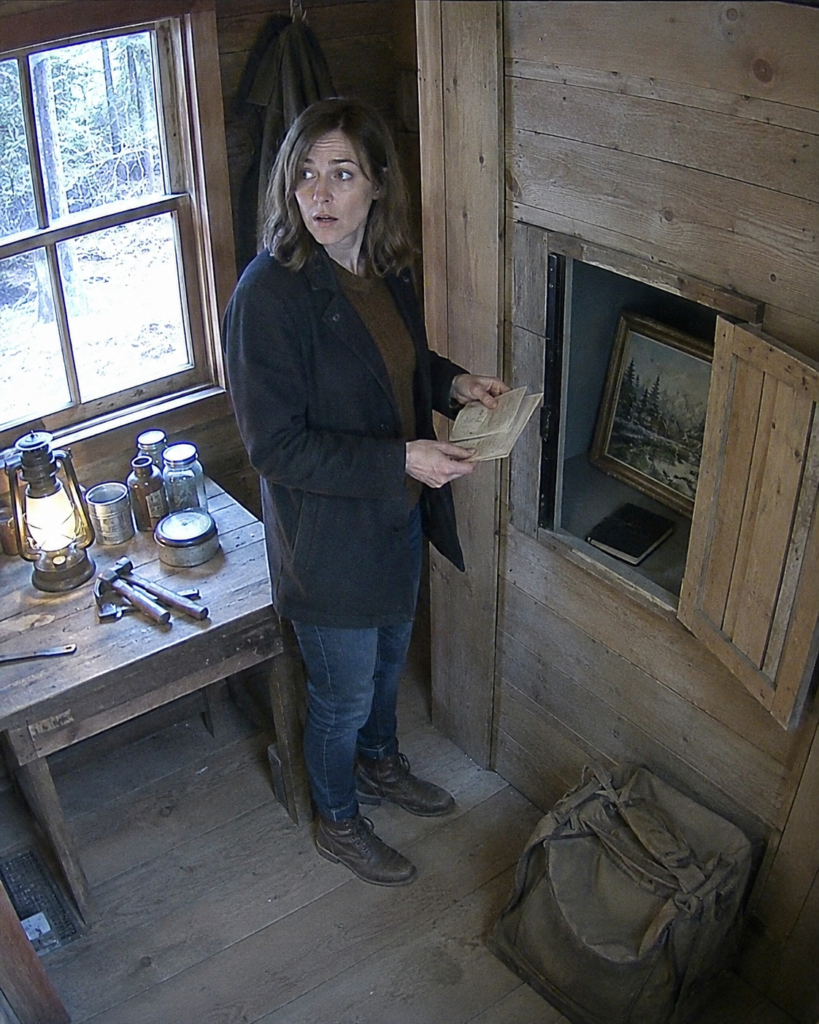
Behind it was a rectangular recess cut neatly into the wall.
Inside was a thick cream-colored envelope.
My name was written across it in Grandpa’s slanted handwriting.
Eliza.
Beneath it were six words.
Open this after they think they’ve won.
My knees almost gave out.
I sat on the edge of
the bed with the envelope in my lap while rain hammered the roof.
For several minutes, I could not break the seal.
I just stared at his handwriting and felt the room tilt around me.
Then I opened it.
Inside was a letter, a smaller key, and a folded sheet of paper with a bank letterhead.
The letter began, My brave girl.
I had to stop there.
Grandpa had called me that when I was little, usually after I had done something I did not feel brave about at all.
Getting stitches.
Speaking at Grandma’s funeral.
Leaving home for college while my mother cried in a way that made me feel guilty instead of loved.
I read on.
My brave girl, if you are reading this, then Daniel and Margaret took exactly what I expected them to take.
Do not be angry at yourself for being shocked.
Good people are often the last to believe what selfish people have been showing them for years.
My hand covered my mouth.
The letter was three pages long.
He wrote that he knew my parents had been pressuring him.
He knew about the documents they brought him when he was on pain medication.
He knew my father had tried to convince him to sign a transfer of the land before the doctors could “make things complicated.”
He also knew I would fight them if he left everything openly to me.
And he knew I would lose more than money trying.
So he let them believe what they needed to believe.
The house, the truck, the equipment, and the accounts they could find were allowed to pass through the will.
He called them bait.
The word made me put the letter down.
Bait.
Grandpa had never been a dramatic man.
He hated exaggeration.
If he used that word, he meant it.
The folded bank paper explained the key.
It belonged to a safe deposit box in a regional bank two towns over.
The box had been opened in my name five years earlier.
Grandpa had paid the fees in advance for ten years.
Access would require the key, my identification, and a sealed authorization document already on file.
At the bottom of the letter, Grandpa had written one final instruction.
Do not tell your parents anything until you have seen what is in the box.
I did not sleep that night.
At sunrise, the rain slowed to a mist.
I drove into town with the envelope tucked inside my coat, one hand resting over it the entire way like someone might reach through the window and steal it.
The bank sat on the corner of Main and Hawthorne, a brick building with brass handles and a flag snapping in the wet morning wind.
The woman behind the desk smiled until I showed her the key.
Then her expression changed.
“Your name?” she asked.
“Eliza Mercer.”
She typed something into her computer.
Her eyes flicked to my face, then back to the screen.
“One moment, please.”
She disappeared into an office and returned with an older man in a charcoal suit.
He introduced himself as Mr.
Albright, the branch manager.
“Miss Mercer,” he said gently, “we’ve been expecting you.”
My throat tightened.
He led me to a private room with a narrow table and a
door that locked from the inside.
A few minutes later, he returned carrying a long metal box.
“We will give you privacy,” he said.
“Press the button by the door when you’re finished.”
The box was heavier than I expected.
Inside were documents, photographs, a flash drive, and another handwritten letter.
The first document was not about money.
It was a sworn statement.
Grandpa had signed it eighteen months before his death in front of a notary and two witnesses.
In it, he stated that he had reason to believe my parents were attempting to manipulate, pressure, and financially exploit him during his illness.
He listed dates.
Conversations.
Amounts withdrawn.
Checks he had not written.
The next folder contained copies of bank records with highlighted withdrawals made after my mother took over “helping” with his finances.
Then came photos of documents my father had tried to get him to sign.
Then audio transcripts.
My hands went cold.
Grandpa had recorded conversations.
One transcript showed my father telling him, “Eliza doesn’t understand land.
She’ll waste it.”
Another showed my mother saying, “If you leave anything substantial to her, Daniel will contest it.
You know what that will do to this family.”
Grandpa’s reply was printed below.
“What family are you talking about, Margaret? The one that visits, or the one that waits?”
I cried then.
Not loudly.
Not the way my mother would have expected.
Just a silent breaking open in a locked bank room under fluorescent lights, with Grandpa’s careful evidence spread across a table.
At the bottom of the box was the second letter.
It told me about the cabin.
The west cabin was not worthless.
The surrounding acreage, the part my parents had dismissed as non-income land, sat on an old access corridor that a renewable energy company had been trying to acquire for years.
Grandpa had refused their offers while he was alive because he did not trust my parents to leave me any part of it.
After Grandma died, he quietly separated the cabin parcel from the rest of the farm.
Then he negotiated a private easement agreement that would only activate after his death and only if the cabin parcel passed to me.
The first payment alone was more than the farmhouse, truck, and equipment combined.
I stared at the page until the words blurred.
The safe deposit box also contained the executed agreement, contact information for the company’s attorney, and proof that the payments had already begun accumulating in an escrow account I could claim.
Grandpa had not left me the broken cabin.
He had left me the only piece my parents had been too arrogant to value.
But he had also left me a choice.
The evidence against my parents was enough to open an investigation into elder financial abuse.
The attorney named in the letter, a woman named Rebecca Sloane, had been instructed to represent me if I chose to challenge any part of the estate or pursue recovery of the missing funds.
Grandpa’s final paragraph was the hardest to read.
I cannot tell you what justice should cost you, Eliza.
I spent too long letting your father mistake silence for permission.
Do what lets you live cleanly.
But never let them convince you that walking away and being robbed are the
same thing.
For two days, I told no one.
I stayed at the cabin, reading everything again and again.
I walked the perimeter of the land with the parcel map in my hand.
I stood under dripping cedars and tried to reconcile the man who had taught me to bait a hook with the man who had quietly built a legal trap around his own son.
Then my father called.
I almost did not answer.
When I did, he did not say hello.
“What exactly are you doing at that cabin?” he demanded.
My body went still.
“Cleaning it,” I said.
“Don’t get attached,” he snapped.
“I talked to a guy who says that parcel may create access issues for the west side.
We need you to sign a simple transfer so we can consolidate the property.”
There it was.
The first crack in their confidence.
My mother came on the line next, her voice softer and much more dangerous.
“Eliza, sweetheart, this is not the time to be stubborn.
That cabin is a burden.
Your father and I are willing to take it off your hands.”
I looked at Grandpa’s letter on the table.
“How generous,” I said.
Silence.
Then my mother said, “Don’t be sarcastic.
It makes you sound bitter.”
For the first time in weeks, I smiled.
“No,” I said.
“I’m not signing anything.”
My father cursed in the background.
My mother lowered her voice.
“You have no idea what you’re interfering with.”
“Yes,” I said quietly.
“I think I do.”
I hung up.
The next morning, I called Rebecca Sloane.
She knew my name immediately.
“Your grandfather hoped you wouldn’t need me,” she said.
“But he made sure I’d be ready.”
Within a week, my parents received formal notice that I was represented by counsel.
Within two weeks, the renewable energy company confirmed the easement agreement and released the first escrow payment.
Within a month, Rebecca filed a petition asking the court to review suspicious financial activity during Grandpa’s illness.
My parents did not smile in the second hearing.
My mother wore black and looked at me as though I had personally invented betrayal.
My father’s jaw was clenched so tightly a vein pulsed near his temple.
Their lawyer was different this time.
So was mine.
Rebecca Sloane sat beside me with one slim folder, no theatrics, no wasted words.
When the judge asked what prompted the petition, she stood and submitted Grandpa’s sworn statement, bank records, and transcripts.
My mother’s face changed when she saw the papers.
Not sadness.
Recognition.
She knew exactly what they were.
My father leaned toward his attorney and whispered harshly, “He couldn’t have.”
But he had.
Grandpa had heard everything.
Kept everything.
Documented everything.
And then he had waited until they were comfortable enough to show the court who they really were.
The farmhouse and equipment were not immediately taken from my parents.
Legal matters do not explode the way people imagine.
They grind.
They expose.
They force people to answer questions under oath that they once thought would die with the person they harmed.
But the missing money was traced.
The unauthorized checks were challenged.
The pressure campaign became part of the record.
And the cabin parcel remained mine.
My parents tried once more to speak to me outside
the courthouse.
My mother reached for my arm, but I stepped back before her fingers touched my sleeve.
“Eliza,” she said, and her voice broke in exactly the place that used to work on me, “we are still your family.”
I looked at my father.
He would not meet my eyes.
“No,” I said.
“Grandpa was my family.
You were just waiting in line.”
My mother flinched as if I had slapped her.
Maybe that was cruel.
Maybe it was the first honest thing I had ever said to her.
The settlement came months later.
My parents had to repay a significant portion of the money taken from Grandpa’s accounts.
They kept the house, but not cleanly.
Not triumphantly.
The record of what they had done followed the judgment, and in a small county, records have a way of becoming reputation.
As for the cabin, I fixed the roof first.
Then the windows.
Then the stove.
The energy company built its access road farther down the ridge, exactly where Grandpa had negotiated it, leaving the cabin untouched.
The payments gave me the freedom to restore the place without selling it, without begging anyone, without turning his last gift into quick cash.
One afternoon, almost a year after the probate hearing, I rehung the landscape painting on the back wall.
Straight this time.
Behind it, the recess was empty except for Grandpa’s first envelope.
I left it there, not hidden anymore, but protected.
Sometimes I still hear my mother’s laugh in that probate room.
Sometimes I still see my father sliding Grandpa’s truck keys into his pocket like love could be collected by whoever grabbed fastest.
But then I remember the sentence written in Grandpa’s hand.
Open this after they think they’ve won.
He had known them.
He had known me.
And in the end, the thing they mocked as worthless became the only inheritance that told the truth.
What stayed with me was not just that my parents tried to take everything.
It was that Grandpa gave them enough rope to reveal themselves, then left me to decide whether mercy meant silence or whether silence was how people like them kept winning.