The morning Karen Doyle tried to steal my truck, I was holding a coffee mug, wearing one boot, and thinking about nothing more dramatic than whether the lake wind would ruin my Saturday.
My name is Nathan Hail. I am thirty-nine, a former search-and-rescue mechanic turned marina contractor, and my wife, Mara, has always preferred quiet mornings. We lived on Willowmere Lane, a narrow street that curved along Lake Briar outside Raleigh, North Carolina, where every house had a view of the water, a dock, or at least a neighbor who acted like owning mulch gave them constitutional authority. It was supposed to be peaceful there. That was why we bought the place after years of renting apartments near military bases and airports. I wanted a garage, a workbench, a porch, and one old rescue truck I could restore without anyone asking what it did for property values.
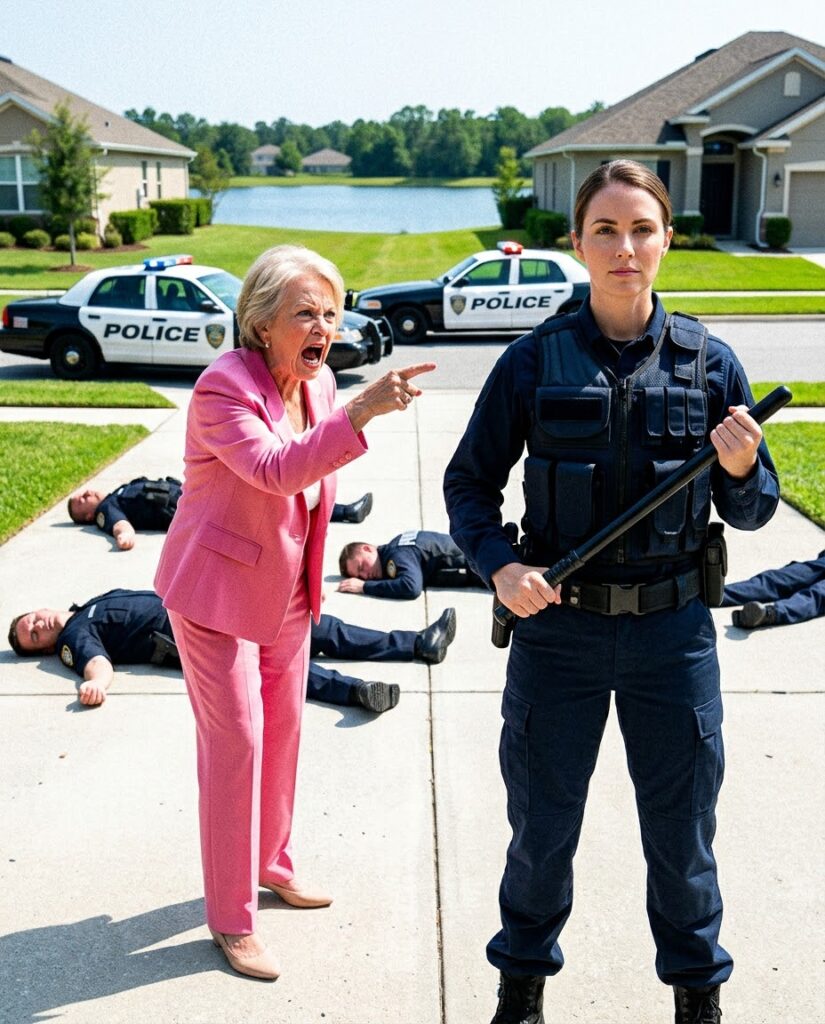
Mara wanted windows facing the lake and a room where no one called her at three in the morning.
She got the windows. The calls still came.
Most people on our street knew almost nothing about my wife. They knew she jogged early, wore plain jeans, kept her hair in a low ponytail, and never raised her voice. They knew she was polite at mailbox gatherings but never stayed long. They knew she traveled sometimes for government trainings, though no one knew which government or what kind of training. That was how Mara liked it. She had spent eight years instructing federal response teams, then moved into a quieter field operations role that was quiet only by her definition. In her world, quiet meant no headlines.
In our neighborhood, however, quiet was interpreted as weakness by one person in particular.
Karen Doyle lived four houses down in a white brick colonial with blue shutters, a fountain shaped like a heron, and a front porch lined with signs about kindness she ignored with athletic dedication. She was fifty-two, divorced, expensively blonde, and convinced that every cul-de-sac needed a queen. She called herself the president of the Willowmere Homeowners Association even though, as anyone with internet access could confirm, the association had dissolved five years earlier when the county rezoned our lake road. The old HOA bank account had been closed. The bylaws were void. Enforcement authority returned to the county.
Karen did not accept this.
She printed newsletters. She delivered violation notices. She measured grass height with a ruler. She told a retired widower his birdbath encouraged unsanctioned wildlife. She fined a young couple for hanging a Pride flag, then backed down when Mara asked her, very gently, which statute she thought she was enforcing. Karen hated Mara after that, but she hated my truck more.
The truck was a matte black Ford rescue pickup, heavy, dented, and ugly in the honest way useful machines are ugly. It had reinforced bumpers, a winch, auxiliary lights, radios, and county emergency plates because I used it for flood response contracts. The department that issued those plates also had a federal mutual-aid arrangement, which meant the truck appeared in systems Karen could not understand and should never have touched.
To her, it was an eyesore.
For months she left notes under my wiper. Commercial vehicle prohibited. Unapproved emergency equipment. Visual disturbance. Unauthorized driveway storage. Each notice arrived on fake HOA letterhead with a logo that looked as if it had been designed by a committee of angry clip art. I ignored them until she taped one to our door with red block letters that said FINAL WARNING BEFORE SEIZURE.
Mara read it while standing barefoot in the foyer. She smiled once, which in our marriage usually meant someone had just made a terrible mistake.
“Does she know there is no HOA?” I asked.
“She knows,” Mara said. “She does not care.”
“Should we do something?”
“We will if she escalates.”
I should have asked what Mara considered escalation.
Saturday came bright and cool, the kind of early spring morning when the lake shivered under silver light. I opened the front door at 8:06 with my coffee in one hand and my left boot unlaced. Three men in cheap black uniforms were already circling my truck.
At first, my brain tried to make them into tow operators. Then I saw the plastic badges, the crooked patches, the empty radios clipped to their shoulders, and the way one man’s vest hung two sizes too large while another’s looked as if it had been borrowed from a child. The tallest slapped a yellow notice on my windshield. The smallest filmed me with his phone. The third stood by the tailgate with one hand near a holster that seemed suspiciously flat.
“HOA orders,” the tall one barked. “This vehicle is being seized.”
I set my mug on the porch rail. “No, it is not.”
Karen appeared from behind them like a stage manager entering her own play. She wore shiny black heels, white slacks, and a coral blazer too bright for the hour. A clipboard was tucked under her arm. Her smile was triumphant.
“You are done here, Nathan,” she snapped. “This truck violates code. These officers will remove it now.”
I looked at the men. “Those are not officers.”
Karen laughed sharply. “Oh, please. They are armed, aren’t they? Step aside before things get messy.”
The smallest man tried to deepen his voice. “Sir, back off. We do not want trouble.”
His hand shook. That was the detail I remember most. Not Karen’s voice, not the fake badge, not the tow notice. His hand shook like a kid about to lie to a teacher.
“Show me your badges,” I said.
The three men glanced at one another. Panic flashed across their faces so quickly Karen tried to cover it with volume.
“They do not need to show you anything,” she said. “I run this neighborhood.”
“No,” I said. “You run a newsletter.”
Her face tightened. “Touch that truck,” she ordered the men.
The tall one reached for my driver’s door. I took one step down from the porch, and the man with the empty-looking holster moved toward me. He wanted me intimidated. He wanted the old theater to work. A uniform. A weapon. A confident woman yelling authority from behind a clipboard. Maybe it had worked on other neighbors.
It did not work on me.
But I also knew enough not to lunge at scared men pretending to be armed.
Then I heard the front door open behind me.
Mara stepped onto the porch in jeans, a gray T-shirt, and bare feet. Her hair was damp from the shower, pulled back without ceremony. She did not ask what was happening. She looked at Karen, the fake officers, the truck, the notice, the holsters, and me. Her expression changed by a millimeter. To anyone else, she looked calm.
To me, she looked dangerous.
Karen rolled her eyes. “Great. Another one. Stay out of this, honey. The HOA is handling a violation.”
Mara did not look at her. She looked at the three men. “Step away from my husband and drop the weapons.”
The street went still.
The tall man swallowed. “Ma’am, do not interfere. This is official HOA business.”
Mara tilted her head. “Official?”
“Yes.”
“Then you will not mind explaining why your radios do not have batteries.”
All three men stiffened. Karen blinked. “What does that matter?”
Mara walked down one porch step slowly. “Your holster is empty. His badge number has seven digits in the wrong format. That vest was manufactured as a paintball accessory. Who hired you?”
The smallest lowered his phone. The man by the tailgate whispered something I could not catch.
Karen jabbed her clipboard toward Mara. “They work for me.”
Mara finally looked at her. “You hired armed imposters to intimidate a homeowner.”
“They are enforcement officers.”
“There is no enforcement authority.”
“This is my neighborhood.”
“No,” Mara said. “It is a county road with lake access.”
Karen’s mouth twisted. “Who do you think you are?”
Mara reached into her back pocket and removed a small worn leather case. She flipped it open.
The change was immediate. The tall man stepped backward. The smallest said, “Oh, hell.” The third lifted both hands without being asked. Karen leaned forward, squinting at the badge inside, and all the color drained from her face.
Mara’s voice stayed quiet. “I am Agent Mara Hail, Federal Response Training Division. You are standing on county property, attempting to seize a vehicle registered under a federal mutual-aid field operations program.”
Karen shook her head. “No. That truck is illegal.”
“No,” Mara said. “What you are doing is illegal.”
The tall man’s face went pale. “We did not know. She said she had authority.”
Karen spun on him. “Do not blame me. I paid you to enforce rules.”
Mara looked back at the tall man. “Evan Mercer.”
His knees seemed to loosen. “How do you know my name?”
“Because I trained the team that arrested you during a contractor fraud sweep last year. You failed the background screen, disappeared before follow-up, and apparently upgraded to driveway theater.”
The other two froze completely.
Evan’s hands went up higher. “We were not going to hurt anybody.”
“You brought fake weapons to an intimidation job.”
“They are airsoft.”
“That does not improve your situation.”
Karen’s voice cracked. “Wait. You know them?”
Mara turned. “Better than you did.”
Karen tried to recover. She lifted her chin, but the old authority would not settle on her face. “I was protecting property values.”
“You invented an association, printed false notices, hired criminals, and attempted to seize government-linked property.”
“I did not know it was government-linked.”
“You did not care what it was.”
Neighbors had begun opening doors. Mr. Alvarez from across the street stepped onto his porch in a robe. The young couple Karen had bullied over the Pride flag came out together, phones in hand. Mrs. Whitcomb, eighty-three and ruthless with binoculars, pulled a lawn chair to her walkway as if court had convened.
Karen saw them watching and changed tactics. “Everyone, please go back inside. This is an official HOA matter.”
Mara said, “There is no HOA.”
The sentence landed harder than I expected because it was said in public, with witnesses, by someone Karen could not dismiss.
Karen laughed once, too loudly. “Of course there is. I have been president for two years.”
“You have been pretending for two years.”
I pulled out my phone, opened the county registry page I had bookmarked months earlier, and turned it toward her. Dissolved. County-administered. No active homeowner association. No private enforcement authority.
Karen stared at the screen. Her lips moved around the words. “That is outdated.”
“It was updated last month,” I said.
“I do not care what the county says,” she shouted. “This street needs standards.”
From the end of the block came the low growl of an engine. A black SUV turned onto Willowmere Lane and moved toward us too slowly, the way official vehicles do when everyone watching knows they were invited by technology, not by people. Evan whispered, “No. Not them.”
Karen heard him. “Who is that?”
Mara’s badge had sent a distress ping when opened under duress. I knew that because once, during a thunderstorm, she had explained her equipment to me while changing batteries at the kitchen table. Karen did not know that. She watched the SUV stop at our driveway with the expression of a woman realizing her imaginary kingdom had borders.
Two agents stepped out. The first was a broad man in a black suit with silver hair and the expression of someone who disliked surprises. The second was younger, wearing a windbreaker with federal lettering on the chest.
“Agent Hail,” the older man said. “We received your badge ping. Status?”
“Three armed imposters hired by a civilian,” Mara replied. “Attempted intimidation and seizure of field operations vehicle. No shots fired. No injuries.”
Karen flinched at the word agent. “This is ridiculous. I am the HOA president.”
The older agent looked at her. “Ma’am, there is no HOA here.”
“Why does everyone keep saying that?”
“Because it is true.”
The windbreaker agent moved toward Evan and the other two. “Hands where I can see them.”
The men obeyed. Their performance collapsed entirely now. Without Karen’s shouting behind them, they looked like what they were: cheap men in cheaper costumes who had expected easy money and found federal attention.
Karen pointed at them wildly. “They said they were enforcement officers.”
Evan snapped, “You paid us fifty dollars each and gave us plastic badges.”
The neighbors murmured.
Karen’s face folded, then hardened again. “I wanted order. This neighborhood used to have standards.”
Mara stepped closer. “Standards are not threats.”
“You think you are special because you have a badge?”
“No,” Mara said. “I know I am accountable because I have one. That is the difference.”
The older agent’s radio crackled. “We located the fourth suspect. Detained inside the Doyle residence.”
The fourth suspect.
Every head turned toward Karen. For one naked second, she looked not angry but terrified. She clutched her clipboard to her chest and glanced toward her house.
Mara saw it. “Who is in your house?”
“No one.”
The radio crackled again. “Male, early twenties, attempting to destroy documents. ID pending.”
Karen whispered, “No.”
“Who is he?” the older agent asked.
Karen backed into our fence. “He was helping me.”
“Name.”
“My nephew. Ryan.”
The windbreaker agent nodded to the radio. “Bring him out.”
A minute later, two county deputies who had apparently arrived from the side road escorted a skinny young man in a hoodie around the corner. His wrists were cuffed. His face was blotchy. He looked barely twenty.
Karen made a wounded sound. “Ryan.”
He would not look at her. “I told you this was a bad idea, Aunt Karen.”
“You told me you could make it official.”
“I said I could make it look official. That is not the same thing.”
Mrs. Whitcomb from across the street said loudly, “I knew those violation letters looked stupid.”
No one laughed, but the line cut through the tension.
Ryan’s shoulders slumped. “She wanted notices. Badges. Forms. She wanted people to think she could fine them.”
Mara asked, “Did you print seizure notices?”
Ryan nodded.
“How many?”
“Hundreds.”
A murmur rolled across the street.
Karen began crying then, sudden and messy. “I just wanted people to listen. Everyone ignores me. The county ignores me. My ex-husband took the boat and everyone laughed. Then the HOA dissolved and this neighborhood started looking like nobody cared. I cared.”
Mr. Alvarez said from his porch, “You fined me for tomato cages.”
Karen turned on him. “They were visible from the road.”
Mara raised one hand, and somehow everyone quieted.
The older agent stepped beside her. “We can transport all of them now.”
Karen looked at Mara with desperate hope. “Please. You have power. Use it to help me. I did not hurt anybody.”
Mara’s face did not soften. “You could have gotten people killed.”
“They were fake guns.”
“The people responding would not have known that.”
Karen looked at the men. Evan stared at the pavement.
Mara crouched slightly so she was level with Karen, who had sunk onto the curb. “You are not leaving with them yet.”
Everyone went still.
Karen lifted her head. Hope crept into her face. “You are helping me?”
“No,” Mara said. “You are leaving with me after you tell the truth.”
“What?”
Mara pointed toward my truck. “Dash camera. Audio and video. It has been recording since they touched the handle. Neighbors are watching. You created fear on this street using fake authority. Before the legal process begins, you are going to undo the lie publicly.”
Karen shook her head. “I want a lawyer.”
“You will get one. This is voluntary. But if you want anyone here to believe you understand what you did, start with the truth.”
The older agent looked at Mara, then at the neighbors, then nodded once. “Your call.”
I knew what Mara was doing. Arrest would handle the law. It would not handle the neighborhood. Karen had spent two years making people doubt their own rights, hiding behind fake letterhead and invented rules. If she left without speaking, fear would linger in mailboxes and whispered conversations. Mara wanted the spell broken in daylight.
Karen stood on shaking legs. Her coral blazer looked ridiculous now, as if borrowed from the woman she had pretended to be.
I opened the dash camera feed on my phone and set it to record a separate clip. Mrs. Whitcomb lifted her own phone. The young couple did too. Nobody cheered. Nobody taunted. For once, Willowmere Lane was completely quiet.
Karen looked down at her clipboard. Then she let it fall onto the grass.
“My name is Karen Doyle,” she began. Her voice cracked. She swallowed. “There is no Willowmere HOA. It was dissolved before I started sending notices. I knew that. I told people there were rules because I wanted control. I made fake violation letters. I had my nephew print forms and badges. I paid men to scare Nathan Hail into giving up his truck.”
She covered her mouth, then forced her hand down.
“I lied to my neighbors. I threatened people with fines that did not exist. I used the idea of property values because I was angry that nobody listened to me anymore. I am sorry.”
Mr. Alvarez crossed his arms. The young couple held hands. Mrs. Whitcomb lowered her phone and wiped her eyes, which surprised me more than anything else that morning.
Mara stood beside Karen but not close enough to comfort her. “Tell them what happens next.”
Karen took a shaky breath. “I am going with the agents. I will cooperate. Any notice I sent is void. No one owes me money. No one has to follow rules I made up.”

For the first time since we moved to Willowmere Lane, Karen sounded like a person instead of a position.
Mara nodded to the older agent. “Now.”
Karen did not fight when they guided her toward the SUV. Ryan was placed in the second vehicle. Evan and the other two were loaded separately, their fake uniforms stripped of meaning under the bright morning sun.
As the vehicles pulled away, the neighborhood remained outside. No one knew what to do with freedom when it arrived without a meeting agenda.
Mr. Alvarez finally walked over to my driveway. “Nathan,” he said, looking at the truck. “For the record, I always liked it.”
“You called it aggressive last month.”
“I meant that as admiration.”
The young couple laughed. The sound spread. Not cruel laughter, not triumph, just relief escaping through people who had been holding their breath for too long.
Mara walked back to me and brushed dust from my shirt where the wind had thrown grit from the driveway.
“You okay?” she asked.
“I had one boot on when three fake cops tried to steal my truck. No, but getting there.”
She looked down at my feet and almost smiled. “Next time, lace both before confronting criminals.”
“Next time someone tries to steal my truck, I am sending you first.”
“I was in the shower.”
“You came out fast.”
“Badge ping would have brought the team either way.”
“That is not as comforting as you think.”
She finally smiled fully, small and private. “I know.”
The county response after that was swift and embarrassingly thorough for Karen. Deputies collected boxes of fake notices from her house. They found spreadsheets tracking imaginary violations and payments some frightened residents had actually made. They found a binder labeled Enforcement Strategy, which included photographs of my truck, the Pride flag, Mr. Alvarez’s tomato cages, and Mrs. Whitcomb’s unauthorized flamingo decorations.
The county prosecutor charged Karen with fraud, extortion-related offenses, impersonation facilitation, and conspiracy connected to the fake enforcement team. Ryan faced forgery and obstruction charges, though his cooperation helped him. Evan and his friends discovered that fake badges become very real problems when used near federal property.
The federal side stayed quieter. Mara wrote reports, gave statements, and disappeared twice for meetings she described only as tedious. The truck remained in my driveway, untouched except for a new dash camera system Mara installed with the intensity of a woman who considered wiring a love language.
Willowmere Lane changed slowly. At first people seemed embarrassed. Neighbors admitted they had paid Karen small fines because arguing felt exhausting. A widower confessed he had removed his late wife’s rose trellis after Karen threatened legal action. The young couple said they had considered moving. Mrs. Whitcomb revealed she had a drawer full of violation notices and had been saving them because, in her words, “Someday that woman was going to trip on her own broom.”
Mara suggested a county information meeting. Not an HOA meeting, she said carefully, because that phrase made people twitch. A county representative came to the community dock with folding chairs and explained actual rules: noise ordinances, setbacks, lake access, emergency lanes, vehicle restrictions, and complaint procedures. It took ninety minutes. Nobody was fined. Nobody measured grass.
At the end, Mr. Alvarez raised his hand and asked whether tomato cages were legal.
The county representative blinked. “Yes.”
Mrs. Whitcomb asked about flamingos.
“Also yes.”
Someone asked about my truck.
The representative checked his notes. “Registered and permitted.”
Everyone turned toward Karen’s empty house. The silence said enough.
Karen did not return for three months. When she did, it was under pretrial conditions, thinner, quieter, and without the coral blazer. She stopped at our driveway one evening while Mara and I were sanding a porch railing. I felt my body tense before she spoke.
“I am not supposed to contact witnesses about the case,” Karen said quickly. “I am not here to argue.”
Mara set down the sandpaper. “Then why are you here?”
Karen looked at the truck, then at the street. “I sold the house.”
I said nothing.
“I wanted to tell you I am sorry without cameras.” Her voice shook, but not theatrically. “The apology on the street was true, but I was scared then. I am scared now too, but differently. I thought control would make people respect me. It made them afraid. That is not the same thing.”
Mara studied her for a long moment. “No, it is not.”
“I am taking a plea,” Karen said. “Restitution. Probation likely. Community service. Ryan’s lawyer says he may avoid jail because he cooperated.”
“Good,” Mara said. “He is young enough to become something else.”
Karen nodded. “I hope I am too.”
No one rescued her from the silence after that. She had to stand in it. Finally I said, “Why the truck?”
She laughed once, sad and small. “Because it was big and black and impossible to ignore. I wanted this street to look the way I imagined it before my life fell apart. Your truck reminded me I could not control even a driveway.”
I looked at the vehicle, then at her. “It is a rescue truck.”
“I know that now.”
Mara picked up the sandpaper again. “Good luck, Karen.”
Karen seemed to understand that was all she would receive. She walked away slowly, not defeated exactly, but reduced to human size.
A moving truck came the next week. Nobody watched from lawn chairs. That felt like mercy.
Months later, Willowmere Lane held its first real neighborhood gathering at the dock. Not a board meeting. Not a standards committee. Just folding tables, paper plates, grilled burgers, and children dropping watermelon into the grass. Mr. Alvarez brought tomatoes from his legally visible cages. Mrs. Whitcomb brought cookies shaped like flamingos. The young couple hung their Pride flag from their stroller canopy because they had adopted a baby girl, and nobody said a word except to ask her name.
Mara sat beside me on a bench facing the lake. She wore jeans, a soft blue shirt, and the relaxed expression she only wore when no one needed her to be dangerous. The truck was parked up the hill, catching sunset on its windshield.
“You know,” I said, “when we moved here, I thought quiet meant nothing happened.”
Mara leaned her shoulder against mine. “Quiet means you can hear trouble early.”
“That sounds like something from a training manual.”
“It should be.”
I looked down the street where Karen’s house now belonged to a retired nurse and her husband, who had already planted chaotic flowers along the walkway. No one had measured them.
“Do you miss the old version?” Mara asked.
“Of the neighborhood?”
“Of thinking people like Karen were just annoying.”
I thought about the fake uniforms, the empty holster, the way fear had entered the driveway wearing plastic authority. “No. Annoying can become dangerous when nobody says no.”
Mara nodded. “That is why we say no early.”
The sun dropped behind the lake, turning the water copper. Children shouted near the dock. Someone played old Motown from a speaker. Mr. Alvarez argued cheerfully with the county representative about fishing permits. Mrs. Whitcomb chased a napkin with more determination than grace.
For the first time, Willowmere Lane felt like a neighborhood instead of an audience waiting for Karen’s next accusation.
I never removed the old fake seizure notice from my garage wall. I framed it in a cheap black frame and hung it above my workbench, next to my socket set and flood response maps. People think I keep it there as a joke. Partly, I do. But mostly it reminds me that power can be faked for a long time if good people keep treating it as easier to ignore than challenge.
Mara calls it my shrine to bad paperwork.
Maybe it is.
The plea hearing happened in July, on a wet morning that smelled like asphalt and summer rain. Mara and I attended because the prosecutor said victims had the right to speak, though neither of us wanted a performance. Karen stood in a navy dress with no jewelry, her hands folded as if she had finally learned that stillness was not the same as dignity. She admitted to the fake association, the false notices, and the intimidation scheme. She did not blame stress, divorce, property values, or the county. She simply said, “I made people afraid because I thought fear was respect.” That was the only sentence of hers I believed completely.
The judge ordered restitution to every neighbor who had paid her invented fines, probation, community service, and a written apology mailed to every house on Willowmere Lane. Ryan received deferred judgment after agreeing to testify, perform community service, and attend a document fraud program that sounded boring enough to be effective. Evan and the others took separate deals, each barred from security work and required to surrender every fake badge and replica weapon they owned. The law did not make anyone whole, but it placed the mess where it belonged: on the people who made it.
A month later, envelopes arrived in every mailbox. Karen’s apology was typed, signed by hand, and awkward in a way that felt more honest than polished remorse. She listed the things she had done without dressing them up. She wrote that people had the right to their homes without fear of fake authority. She wrote that she had confused control with care and shame with leadership. Mrs. Whitcomb read hers aloud on the dock, adding commentary after every paragraph until Mr. Alvarez begged her to spare us the legal analysis. Even then, nobody threw the letters away immediately. We all needed to see the confession in our own hands.
The strangest repair was ordinary kindness returning. People asked before trimming shared hedges. They borrowed ladders. They stopped whispering when county envelopes arrived. The young couple painted their nursery yellow. Mr. Alvarez expanded his tomatoes. Mrs. Whitcomb added two more flamingos out of spite, then claimed they were emotional support birds. I worked on the truck with the garage open, and instead of complaints, neighbors came by with questions about flood season, winches, batteries, and how to prepare if the lake rose again. The thing Karen tried to remove became the thing people trusted when storms came.
That was when Willowmere finally began to feel like home again for everyone.
On the anniversary of the morning it happened, I opened the front door with coffee in hand, both boots laced, and found nothing in the driveway except my truck, a few fallen leaves, and lake light stretched across the hood. No fake officers. No clipboard. No invented kingdom. Just quiet.
Mara came up behind me and slid one arm around my waist.
“Everything okay?” she asked.
I looked at the street, at the legal tomato cages, the flamingos, the flowers, the flag, the houses no longer holding their breath.
“Yeah,” I said. “For once, it actually is.”
She kissed my shoulder and went inside to make breakfast. I stayed there a moment longer, watching the lake wind move through the trees, thinking about how quickly ordinary mornings can reveal extraordinary truths. Karen had believed authority was something you could print, purchase, and perform. Evan had believed fear was a shortcut to money. Ryan had believed fake documents were harmless if nobody checked. I had believed ignoring nonsense made it powerless.
Mara had known better.
Authority is not a badge in a leather case, though hers had helped. It is not a clipboard, a uniform, a title, or a rule printed on letterhead. Real authority is responsibility. It is restraint when you could humiliate someone worse. It is consequences applied without cruelty. It is knowing when the law must handle a person and when a truth must be spoken out loud so a whole street can finally breathe.
That morning, Karen came for my truck and found my wife.
By sunset, the fake kingdom was gone.
THE END