By the time I locked Sullivan’s Diner that Tuesday night, there was blood on the floor, rain hammering the alley door, and a stranger on the ground with two silent babies strapped to his chest.
That is the part people would call impossible if I didn’t still wake up some nights smelling bleach, gunpowder, and burnt coffee.
But impossible things happen all the time in South Boston. They just usually happen to other people.
At two in the morning, Sullivan’s looked the way it always looked after a long shift—grease shining under yellow light, pie case half-empty, stools crooked, and the old neon sign in the front window buzzing like it had one bad minute left in it. I was twenty-four, three years behind on the nursing degree I had abandoned when my mother got sick, and eighty-four thousand dollars in debt because cancer in America doesn’t just kill you. It invoices the people who loved you after it’s done.
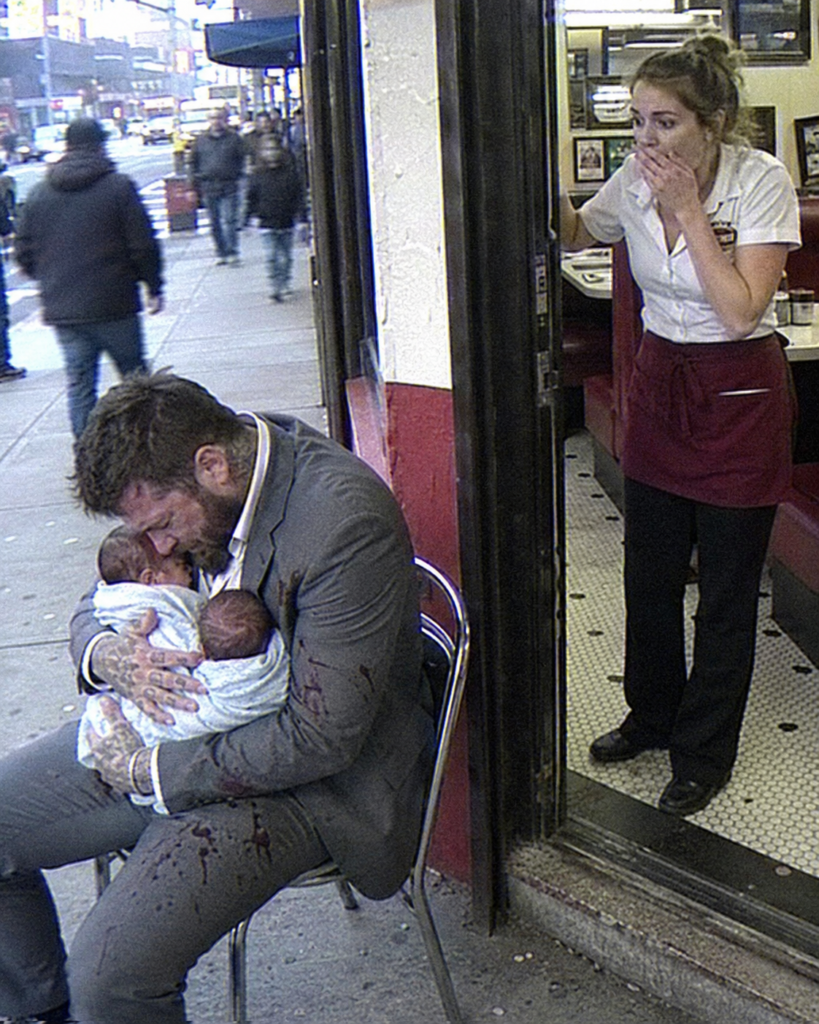
Part 2: “Leo and Stella.”
“I’m Ella.”
A beat passed.
“Jack,” he said.
It was a lie, or at least not the whole truth. I knew that before he finished saying it.
“Well, Jack, you can’t stay here. My morning cook gets in at five.”
He looked up, eyes sharp again despite the blood loss. “Where do you live?”
“Upstairs.” The answer slipped out before I could stop it.
He reached into the bag and pulled out two bundles of cash thick enough to change my life on the spot. He set them on the flour sack between us.
“I need forty-eight hours,” he said. “Locked door. No doctors. No police. You do that, there’s more.”
I stared at the money.
It was enough to wipe out my mother’s debt. Enough to finish school. Enough to leave the diner forever.
Then I looked at Stella, asleep against my chest with a milk-drunk sigh, and I understood the truth underneath the cash. Taking it meant stepping across a line I would never find again.
But leaving him here meant the men outside would come back and find three bodies by sunrise.
“Forty-eight hours,” I said.
Getting him upstairs was hell.
The rain had turned the metal fire escape slick as soap. Jack could barely stay conscious. By the time
I got him through my apartment door, he was leaning so heavily against me I thought both of us might go backward off the landing.
I laid old towels and a plastic shower curtain over my bed and helped him down. He passed out almost immediately.
The twins were easier. Babies don’t care whether your life is imploding as long as you’re warm and your bottle is ready. I made them a nest in a laundry basket with blankets and sat in my armchair until dawn, watching them sleep.
They looked absurdly peaceful.
In the gray morning light, it was possible to pretend none of it was real.
Then a floorboard creaked in the bedroom.
I turned and saw Jack sitting bolt upright on my bed, gun in hand, aimed directly at my chest.
I froze.
His eyes were wild for half a second—pure survival, no recognition. Then he took in the floral curtains, the tiny room, me in my diner sweatshirt, and lowered the weapon.
“The kids,” he said.
“In the living room.”
He scrubbed a hand over his face. “Sorry.”
“Don’t apologize with a gun in your hand.”
A surprising sound escaped him then. Not laughter, exactly. Something rougher. More broken.
I brought him water and ibuprofen, which he swallowed dry before taking the glass. He scanned my windows, my locks, the blind spots in the room, every habit of a man who expected death to come through doors.
“Who did this?” I asked.
Part 3: Blood and Bacon Grease
“Family,” he said.
The word didn’t carry any warmth. It dropped from his lips like a heavy, dead thing, pooling in the quiet of my bedroom.
Jack’s icy blue eyes stayed locked on mine, testing me to see if I would flinch. I didn’t. When you’ve watched cancer eat the person you love most, you learn early on that the worst monsters in the world usually share your last name, your DNA, or your roof.
“My brother,” Jack continued, his voice a low, mechanical rasp. “Or rather, the men who decided my brother was no longer fit to lead. They paid him a visit at dinner last night.” He looked toward the living room, where the rhythmic breathing of the twins was the only sound breaking the silence. “Leo and Stella are the only ones who made it out to dessert.”
A cold spike of adrenaline nailed my feet to the floor. “You’re their uncle.”
“I am the only thing keeping them from being loose ends,” he corrected, his jaw tightening as a wave of pain washed over him. His grip on the gun hadn’t loosened, but the barrel was now pointed safely at the floorboards. “If the men who did this find out I survived, they won’t stop. If they find out the kids survived, they’ll burn this whole block down just to make sure there’s no heir left to claim what they took.”
“What did they take?” I asked, though my gut was already twisting with the answer.
Jack finally lowered the gun, resting it on his blood-stained thigh. “Boston.”
I stopped breathing for a second. My mind flashed to the stacks of hundred-dollar bills, the military-grade hardware, the way he had taken a bullet and barely made a sound. I remembered the name floating around the diner for the last few years, whispered over burnt coffee by off-duty cops and nervous dock workers. The phantom who had consolidated the Southie and North End syndicates without starting a war. The man they called the Architect.
“You’re Declan,” I breathed. “Declan Callahan.”
He didn’t blink. “I told you my name is Jack. For your sake, you need to believe that. You didn’t pull Declan Callahan out of an alley. You pulled a stray dog out of the rain. If anyone asks, you haven’t seen a thing. Not a sound. Not a shadow.”
Downstairs, the heavy metal groan of the diner’s front security gate echoed through the floorboards. Five a.m. Mateo, my morning cook, had arrived.
“I have to go down,” I said, glancing at the digital clock on my nightstand. The red numbers glared like a warning. “Mateo will come looking for me if the coffee machines aren’t turned on by five-fifteen.”
Jack shifted, wincing as the movement pulled at his bandaged ribs. He reached out and grabbed my wrist. His skin was burning up. The fever was starting. “Listen to me, Ella. They will come looking. They’ll retrace my steps. They’ll check the alley.”
“I mopped the blood. The rain washed away the rest.”
“They don’t need blood to be suspicious,” he said, his grip tightening. “They just need you to look nervous. You are a tired waitress working double shifts to pay off debt. You are bored. You are oblivious. Do you understand?”
“Bored. Oblivious. Got it.” I gently pulled my wrist from his grasp. “There’s baby formula mixed in the fridge. I’ll come up during my fifteen-minute break. Don’t bleed on my mattress, Jack.”
He gave a sharp, breathless exhale that might have been a laugh in another life. “No promises.”
Stepping out of my apartment and walking down the back stairwell felt like descending onto a different planet.
I threw on a clean apron, tied my hair into a messy bun, and walked into the kitchen just as Mateo was firing up the flat top grill. The smell of raw bacon and heating steel hit me, violently normal compared to the copper and bleach upstairs.
“Morning, El,” Mateo grunted, tossing a brick of hash browns onto the grill. “You look like hell.”
“Didn’t sleep,” I lied smoothly, grabbing a stack of ceramic mugs. “Studying for my boards.”
“You’re gonna kill yourself working like this, kid.”
If only you knew, I thought.
The morning rush hit at six-thirty like a tidal wave. Construction workers, tired nurses off the night shift, and the usual neighborhood retirees flooded the booths. I poured coffee until my wrist ached, balanced plates of eggs and sausage, and smiled at jokes I barely heard. Every time the bell above the door chimed, my heart hammered against my ribs. Every heavy footstep on the linoleum made me think of the men in the SUV.
By eight-thirty, the crowd began to thin. I was wiping down the counter, letting the repetitive motion ground me, when the bell chimed again.
I looked up, and the rag in my hand stopped moving.
Two men walked in. They didn’t belong in Southie, and they certainly didn’t belong in Sullivan’s. They wore tailored wool coats that didn’t have a speck of lint on them. The older one had silver hair and the cold, flat eyes of a shark. The younger one was built like a freight train, his hands buried deep in his coat pockets.
They didn’t look at the menu board. They looked at the exits, the blind spots, and then, finally, at me.
“Two coffees,” the silver-haired man said, sliding into a booth near the back window. The window that overlooked the alley. “Black.”
“Coming right up,” I said. My voice was steady, but my fingers trembled as I grabbed two mugs. You are bored. You are oblivious.
I walked over, set the mugs down, and pulled my order pad out. “Can I get you guys anything to eat? The cherry pie is fresh.”
“Just the coffee,” the older man said. He offered a smile that didn’t reach his eyes. “Long night. You work the night shift here, sweetheart?”
“I closed up last night, yeah. Opened this morning, too. Joys of student loans.” I let out a tired, exaggerated sigh, leaning my weight on one hip. “What brings you guys to this side of town?”
The younger man ignored my question. He was staring out the window, looking at the dumpsters. “Must be quiet around here after midnight. Hear anything unusual last night? Say, around two a.m.?”
My blood ran to ice.
Play it perfectly, Ella.
“Unusual?” I frowned, pretending to think. “Like what? A mugging? We get junkies tipping over the grease traps sometimes, but honestly, with the rain last night, I couldn’t hear myself think. Why? Are you guys cops? Because if this is about the graffiti on the back door again, I already filed a report—”
“We aren’t cops,” the older man interrupted smoothly. He reached into his coat and pulled out a photograph, sliding it across the Formica table. “We’re looking for a friend. He might have been in the area. Had a bit of a… disagreement with some people. We just want to make sure he gets home safe.”
I looked at the photo.
It was Jack. Or Declan. He looked sharper in the picture, dressed in a tuxedo, his eyes holding that same terrifying, calculated stillness.
I stared at it for a beat too long, making sure to furrow my brows in mild confusion. “Handsome,” I said casually, sliding the picture back. “But no. Never seen him. If a guy in a suit like that came into Sullivan’s, he’d stick out like a sore thumb.”
The older man studied my face. He was looking for the micro-expressions—a twitch of the eye, a change in breathing, the sudden swallow of a dry throat. Thanks to my mother’s illness, I had spent three years lying to her every day, telling her we could afford her treatments, telling her she was going to be fine. I knew how to bury terror.
“Well,” the man said, standing up and tossing a crisp hundred-dollar bill onto the table. “If your memory jogs, call the number on the back of the photo. Keep the change for your student loans.”
“Thanks,” I said, offering a bored, weary smile. “Have a good one.”
I watched them walk out. I watched them cross the street, get into a black SUV, and idle there for three agonizing minutes before finally pulling away into the Boston traffic.
I grabbed the hundred-dollar bill, crumpled it into my apron, and ran for the kitchen.
“Mateo, cover the front! I need a bathroom break!” I yelled, already sprinting for the back stairs.
I took the stairs two at a time, fumbling with my keys before throwing the apartment door open.
“They were here,” I said, locking the deadbolt behind me. “Jack, they came into the—”
I stopped.
The apartment was terrifyingly quiet. The laundry basket in the living room was empty.
“Jack?!” Panic seized my throat.
“In here,” a rough voice called from the bathroom.
I ran down the short hall. Jack was sitting on the edge of my clawfoot tub, his skin an unnatural, ashen gray. He had moved the twins into the dry bathtub, lining it with blankets to create a makeshift, bulletproof crib. He held his gun in one hand, but his arm was shaking violently. Sweat poured down his face, matting his black hair.
The bandages around his ribs were soaked through. Fresh blood was seeping into his trousers. He had torn his stitches trying to move the babies.
“I heard the floorboards downstairs,” he gasped, his chest heaving. “Heard you talking. Knew… knew they were close.”
“You tore the packing,” I said, rushing forward and dropping to my knees beside him. I grabbed a fresh towel from the rack and pressed it hard against his side. He let out a low, guttural hiss, his head falling back against the tiled wall.
“Did they… buy it?” he asked, fighting to keep his eyes open.
“For now. But they’re circling. They asked about two a.m. They know you’re in a three-block radius.” I looked at his wound. The edges were angry and red. The heat radiating from his skin was alarming. “Jack, you have a fever. The bullet might have dragged fabric or debris into the wound. You have an infection starting, and you’re losing too much blood.”
“Forty-eight hours,” he muttered, his eyes rolling back slightly. “Just need… forty-eight.”
“You don’t have forty-eight hours!” I yelled, the panic finally breaking through my carefully constructed walls. “You don’t even have twelve! If I don’t get you IV antibiotics and fresh blood by tonight, you are going to die in my bathroom, and I am going to be left explaining to the Irish Mob why I have their rival’s infant niece and nephew in my bathtub!”
At the sound of my raised voice, Stella let out a sharp, startling cry. Leo immediately joined in, their tiny voices echoing off the porcelain tiles.
The sound seemed to jolt Jack back to reality. His eyes snapped open, the haze of fever briefly clearing, replaced by that terrifying, lethal clarity I had seen in the alley.
He looked at the crying babies, then looked down at me, his bloody hand covering mine where I was pressing the towel against his side.
“My bag,” he rasped, his voice suddenly hard as iron. “Front pocket. There’s a burner phone.”
“Who am I calling?” I asked, my hands shaking as I held the pressure.
“A man named Elias. Tell him the Architect needs an extraction. Tonight.” He leaned in closer, his icy blue eyes boring into my soul, burning with a feverish intensity. “And Ella?”
“What?” I whispered.
“Pack a bag. You’ve seen their faces. You lied to Silas’s face downstairs. If I leave you here, you’re dead by tomorrow morning.”
I stared at him, the reality of my choice finally crashing down on me. I had thought I was saving a life. Instead, I had tied my own to a sinking ship of blood, bullets, and Boston’s darkest secrets.
“Hurry,” Jack whispered, his eyes sliding shut as his head rolled to the side. “Before the sun goes down.”