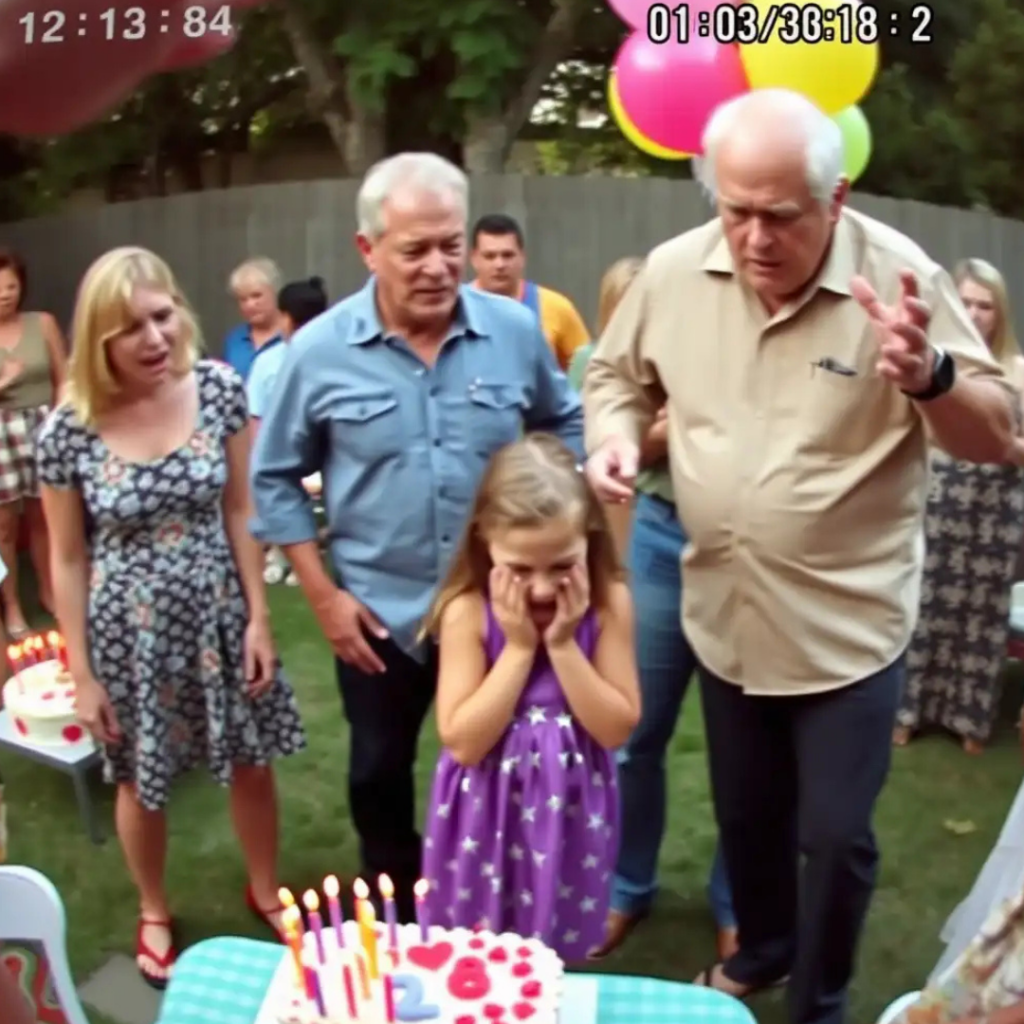
My daughter did not blow out her candles. She stood behind the birthday cake with her hands at her sides, staring straight at my father like she had finally run out of hope. The backyard was full of people—neighbors, cousins, parents, my brother Jason and his wife, my best friend Claire, my husband Daniel. Pink streamers fluttered over the patio. Music played from the speakers. The cake was perfect, crowned with eight candles Lily had picked herself. Everything looked warm and normal. Nothing was.
A week earlier, Lily came home from school with a card for my father. She covered it in silver stars and wrote, “Please come this time, Grandpa.” The phrase this time hit me harder than I admitted. Last year he skipped her party with an excuse. Two years before that, he came late, stayed ten minutes, and spent those ten minutes talking to Jason’s son. Still, I called him again. I always called him again. I always gave him one more chance.
Daniel watched me pace around the kitchen with my phone pressed to my ear. When I hung up, he did not ask what my father had said. He already knew the tone, the hesitation, the lazy promise. “He’s choosing this, Emily,” Daniel told me. “He’s not confused. He’s not awkward. He’s choosing who gets his love.” I defended my father with the same tired excuses my mother used when she was alive. Daniel only looked at me with patience that made the truth harder to avoid.
When my father arrived at the party, he brought nothing. No gift, no card, not even the effort to pretend he was happy to be there. He walked through the side gate like a man showing up for jury duty. But the second Jason greeted him, his whole face changed. He smiled. He laughed. He opened his arms for Jason’s children, Ben and Sophie, and pulled them close like they were the center of his world. He kissed Sophie’s forehead. He ruffled Ben’s hair. He asked about soccer and school with a warmth so natural it made my stomach turn.
Lily saw everything.
She had been running toward him with the glitter card in her hand. I watched her slow down when she realized he had already dropped to one knee for Sophie. I watched the hope drain out of her face. She stopped a few feet away, lowered the card to her side, and turned back toward the bounce house alone. Daniel touched my arm and said nothing. He did not need to.
For the next hour, my father ignored my daughter completely. He laughed with Jason, praised Ben for catching a football, told Sophie she was the smartest girl in the family, and never once looked at Lily on her birthday. By the time we brought out the cake, I felt sick. Daniel leaned close in the kitchen and whispered, “Watch her face. Not his. Hers.”
So I did.
Everyone sang. Lily smiled for one fragile moment. Then the song ended, and she looked past the candles, past the frosting, past me, and locked eyes with my father by the fence. In a voice so clear it silenced the yard, my eight-year-old daughter made her wish.
“I wish you’d stop pretending I don’t belong.”
The silence after Lily spoke felt heavier than shouting.
Nobody moved. The candles burned lower while everyone stood frozen around my daughter’s pain. My father slowly turned away from Jason and faced the cake table. He still held a plastic cup, and I noticed absurd details—the crack near the rim, the line of lemonade on his fingers, the familiar smell of Old Spice. My body remembered him even while my heart wanted to run.
Daniel set the cake down and moved behind Lily, both hands resting on her shoulders. He was not pulling her back. He was letting her know she was not standing there alone.
My father walked closer, each step deliberate. When he stopped in front of her, he tilted his head and spoke in the coldest voice I had ever heard from him.
“What did you just say to me?”
Lily’s chin trembled, but she did not look away. “I said I wish you’d stop pretending I don’t belong.”
A murmur rolled through the yard. Claire gasped beside me. Jason took a step forward and then stopped, as if he still believed this could be patched over.
My father looked at Lily, then at me. His eyes were not shocked. They were irritated.
“This is what happens when you raise a child without manners,” he said. “She thinks she can speak to adults any way she wants.”
For one second, the old version of me tried to surface—the woman who apologized first and swallowed humiliation to keep peace alive. Then Lily turned and looked at me.
Are you going to let him do this to me too?
I stepped forward before fear could drag me back. “She is eight,” I said. “And she is saying out loud what every adult here can already see.”
My father gave a short, ugly laugh. Jason whispered, “Dad, stop,” but he ignored him. He shifted his attention fully to me, and something inside his face changed. It was not anger. It was relief, like a man finally done pretending.
“You want honesty, Emily?” he asked.
I should have stayed silent. Instead, I nodded.
He pointed at Lily first.
“She is not my blood.”
Then he pointed at me.
“And neither are you.”
The world went soundless.
My knees nearly gave out. Claire caught my arm before I fell. Daniel lifted Lily into his arms so fast it looked instinctive. She buried her face against his neck and clung to him without making a sound.
Jason stared at our father in disbelief. “What the hell are you saying?”
But my father was already stepping back, adjusting his collar, his expression turning blank again now that the damage was done. Around us, the party broke apart. Parents hurried toward the gate with their children. Megan pulled Ben and Sophie behind her as if cruelty could spread through the air like smoke.
I could not breathe. I could only stare at the man who had spent my entire life teaching me I was somehow less—and had now finally handed me the reason like a knife.
Jason tried again. “Dad, you need to explain this.”
My father picked up his cup. “There is nothing to explain.”
Then he turned and walked out of my backyard.
He did not look at me. He did not look at Lily. He did not look at the ruined cake or the silver card lying in the grass. He just left, boots steady on the driveway, like he had finished a chore.
Jason hesitated at the gate, shame written all over him, but Megan tugged his sleeve. He followed them out without another word.
When the yard finally emptied, I sat in the chair my father had been using and stared at the half-melted candles. Daniel carried Lily inside. Claire shut off the music.
Two hours later, after Lily fell asleep in Daniel’s arms, I drove to my father’s house. He was waiting on the porch with a glass of whiskey.
I stopped at the bottom of the steps and forced the words out.
“What did you mean,” I asked, “when you said I wasn’t your blood?”
My father did not invite me to sit down.
He took a sip of whiskey and said it flatly. My mother and he had not been able to have a second child. She found me through a private adoption when I was three months old. He agreed because she wanted me. He never left. He simply kept a promise to my mother and spent the next three decades treating me like a guest he had been forced to tolerate.
That was his confession. No apology. No shame.
I asked him if my mother had loved me.
He looked at me then and said, “She did.”
My whole childhood rearranged itself in seconds. The birthdays he forgot. The school plays he skipped. The way Jason’s victories were celebrated while mine were barely acknowledged. The way my mother used to sit on my bed and whisper that some men did not know how to show love. She had not been protecting me from confusion. She had been protecting a secret.
I asked him if he had ever loved me at all.
He did not answer.
That silence was answer enough.
I drove home shaking. When I walked through the front door, Daniel was waiting in the living room. I fell into him before I said a word. I told him everything in broken pieces—the adoption, my mother’s lie, my father’s indifference, the ugly logic behind every wound I had ever tried to explain away. Daniel held me until the words ran out.
The next morning, Lily came downstairs with swollen eyes and climbed into my lap. She twisted a thread on my sleeve before she spoke.
“Mom,” she whispered, “am I not family?”
That question hurt worse than anything my father had said.
I held her face in both hands and told her the truth as carefully as I could. I told her my father had something damaged inside him, and damaged people often pass pain around like it belongs to everyone else. I told her family was not decided by blood, but by who stayed, who protected, who loved without keeping score. I told her she belonged to me, to Daniel, to our home, and nothing a cruel man said could take that away.
She cried then, and so did I.
That afternoon, I blocked my father’s number. I texted Jason once. I told him what our father had admitted and that I needed distance. He did not reply for days. When he finally called, his voice sounded wrecked. He swore he had never known about the adoption. He apologized for leaving the party and for enjoying a version of our father I had never been given. I believed he meant it, but trust did not return overnight. We started again slowly, with careful phone calls and honesty that felt awkward but clean.
Lily began seeing a therapist. At first she barely spoke. Then, little by little, she came back to herself. She laughed easier. She stopped asking whether Grandpa was mad at her. One evening she brought home a painting: three figures in front of a blue house. A woman, a man, and a little girl in a purple dress holding both their hands. She tapped the paper and said, “This is my real family.”
I hung it on the refrigerator and stood there looking at it far longer than I needed to.
My father sent cards after that. Always Hallmark. Always a twenty-dollar bill inside. Never a signature. I threw every one away unopened. Some people called that harsh. Maybe it was. But I had spent too many years confusing access with love. I was done handing my child to a man who treated affection like inheritance law.
I found my adoption records later. They are still in a folder in my nightstand. I have not opened them yet. I will, one day. Not because I need proof that I belong somewhere, but because I no longer fear the truth.
I walked away from the father who never claimed me. I kept the daughter who always will.
Would you forgive him, or walk away forever? Share below—your answer could help someone choose dignity, healing, and courage today.