Margaret Hayes had spent thirty-seven years learning how not to flinch.
Not when her husband left her with a mortgage, a six-year-old boy, and two maxed-out credit cards. Not when she worked double shifts at a pharmacy in Wilmington, North Carolina, then came home to help her son, Ethan, with homework at a kitchen table that wobbled on one short leg. Not when she sold her wedding ring to cover his first semester books at Chapel Hill after his scholarship fell short.
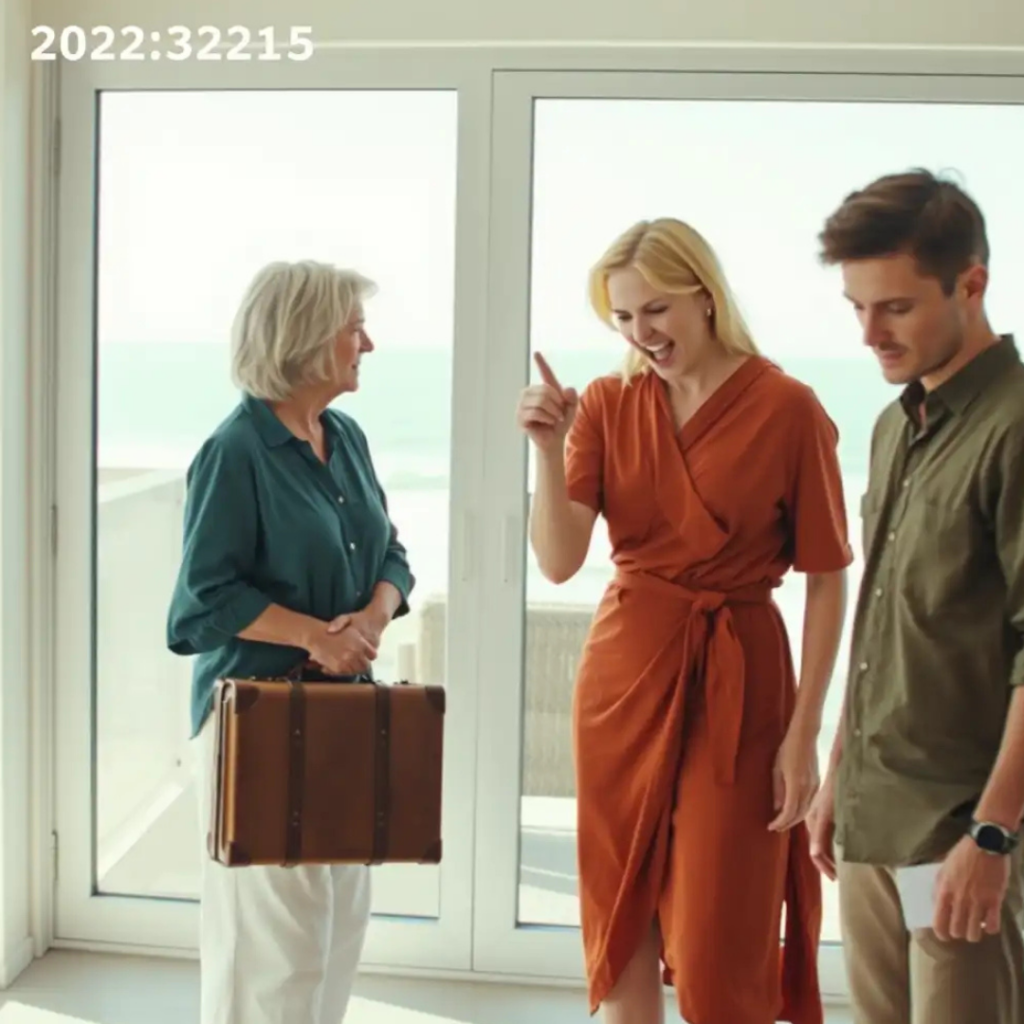
So when she unlocked the door to her beach house in Emerald Isle that July afternoon and heard her daughter-in-law’s voice slice through the hallway like a knife, Margaret did not flinch then, either.
“Why did that old parasite show up here?” Vanessa Caldwell barked from the living room. “We have no room for you!”
Margaret stopped in the entryway, one hand still wrapped around the handle of her small rolling suitcase. She could smell sunscreen, grilled shrimp, and the expensive citrus candle Vanessa always brought wherever she stayed, as though she needed every place to smell like a showroom. Through the archway, Margaret saw Ethan standing by the window in a faded polo shirt, shoulders tense, eyes fixed somewhere over his mother’s left shoulder. Silent. Motionless.
Vanessa stood barefoot on the hardwood floor in white linen shorts and a cream blouse, a woman who had perfected the art of looking polished even while insulting someone in their own home.
Margaret gave a small smile. Calm. Soft. “It’s okay, dear.”
Vanessa blinked, as if robbed of the fight she’d been preparing for.
Margaret set down her bag. “I should have called earlier. Traffic was worse than I expected.”
Vanessa crossed her arms. “This is supposed to be a private family holiday.”
Margaret looked at her son. “I see.”
Ethan swallowed but said nothing.
That hurt more than the insult.
This wasn’t just any beach house. Margaret had bought it twelve years earlier after a brutal decade of saving, sacrificing, and taking on extra work. A modest gray cedar place three blocks from the ocean, with a wraparound porch and blue shutters she painted herself one spring with a brush that kept shedding bristles into the wet paint. It was the first thing she had ever owned outright. The first place that was hers and no one else’s.
And yet Ethan and Vanessa had begun talking about it for two years as if it were already part of their portfolio.
“You should think about putting it in Ethan’s name,” Vanessa had once said over Christmas dinner, smiling over her wineglass. “For tax planning.”
Margaret had smiled back then too. She had not forgotten.
Now she glanced around the room. Their luggage was piled by the stairs. Designer tote bags lined the console table. Children’s toys—belonging to Vanessa’s sister’s kids, Margaret guessed—were scattered across her rug. On the kitchen counter sat grocery receipts, open champagne, and an envelope from a property law office in Raleigh, half tucked beneath a beach hat.
Something cold and sharp settled into place inside her.
She walked to the counter, lifted the envelope, and saw Ethan’s name handwritten beside Vanessa’s.
“Interesting,” she said lightly.
Vanessa stepped forward. “That’s private.”
Margaret met her eyes for the first time. “In my house?”
Ethan finally spoke, too quickly. “Mom, it’s not what you think.”
Margaret turned toward him, still holding the envelope. “Then tell me what I should think.”
Neither of them answered.
And in that silence, Margaret understood exactly what she needed to do next.
Margaret did not open the envelope right away.
She placed it back on the counter with deliberate care, as though the paper might explode if mishandled, then took off her sunhat and set her purse beside it. Vanessa watched her with narrowed eyes. Ethan looked as though he wanted to disappear into the hardwood floor.
“Since I’m apparently intruding,” Margaret said evenly, “I’ll make this simple. I’m tired from the drive, and I’m not interested in shouting in my own kitchen. Ethan, come with me to the porch.”
Vanessa let out a short, humorless laugh. “Anything you have to say to him, you can say in front of me.”
Margaret turned. “No. I can’t.”
The firmness in her voice did what years of politeness never had. Vanessa actually stepped back.
Outside, the evening light fell gold across the porch rails. The ocean wind carried salt and the distant cries of children still playing on the shoreline. Margaret sat in the wicker chair near the fern basket and waited until Ethan took the chair across from her. He looked older than forty-one in that moment. Older, weaker, and somehow younger too—like the boy who used to hide bad report cards in his backpack and hope the problem would vanish if he stayed quiet long enough.
“Talk,” she said.
He rubbed a hand over his face. “Mom, it got complicated.”
“Complicated is when a roof leaks during a storm. This feels more intentional.”
He stared at the floorboards. “Vanessa and I have been looking at options.”
“For what?”
He hesitated. “For the future.”
Margaret almost smiled at that. Such a slippery, bloodless phrase. “Whose future?”
He looked up. “All of ours.”
There it was—the lie, soft as velvet.
She folded her hands in her lap. “Did you speak to a lawyer about transferring this house?”
“Not transferring exactly.”
“Then exactly what?”
He exhaled sharply. “We wanted to set up a trust. To protect the property. To keep it in the family.”
Margaret’s voice stayed calm. “By putting it under your control while I’m still alive.”
His silence answered for him.
“And you planned this without discussing it with me?”
“We were going to discuss it.”
“With paperwork already drafted?”
“Mom—”
“No.” Her voice cut across his. “You don’t get to call me dramatic. Not today.”
He flinched. Good. Let him.
Margaret stood and walked to the porch rail, looking out at the neighboring houses glowing in the dusk. “Do you know how many nights I stayed awake wondering whether you’d notice if I skipped dinner so you could have enough? Do you know how many times I told creditors to give me one more month because your tuition was due? That house is not an asset I forgot to distribute. It is my life, Ethan.”
“I know that.”
“No,” she said quietly. “You know the story. That’s different.”
He came to stand behind her. “Vanessa thinks ahead. She worries. About security.”
Margaret turned slowly. “Vanessa worries about ownership.”
“That’s unfair.”
“Is it?” She held his gaze. “Did she call me a parasite because she was worried?”
He said nothing.
Margaret nodded once. “I thought so.”
Inside, through the screen door, she could see Vanessa pacing in the kitchen, phone in hand, agitated and restless. Margaret had noticed the signs for months. The comments disguised as concern. The pressure to “simplify estate planning.” The casual assumption that retirement meant surrender. But today had stripped the varnish off all of it.
She went back inside.
Vanessa looked up immediately. “So? Are we done with the private conference?”
Margaret ignored the mockery. She opened the envelope and skimmed the first page. Draft transfer structures. Beneficiary recommendations. Language establishing management authority in the event of “age-related incapacity,” with suggested physician certification thresholds.
Margaret read three lines twice.
Then she laughed.
It was not a pleasant laugh. It was low and incredulous, the sound of a woman hearing exactly how little she had been respected.
Vanessa stiffened. “What is funny?”
Margaret held up the paper. “You had a lawyer prepare a framework to remove control of my property if I’m deemed mentally declining?”
“It’s standard planning.”
“It’s predatory planning.”
Vanessa’s chin lifted. “Someone has to be practical. You live alone. You’re getting older. If something happens, Ethan shouldn’t be trapped in probate hell because you were too sentimental to organize your affairs.”
Margaret stepped closer. “You insult me in my house, try to corner my son into swallowing your greed, and then call me sentimental?”
Vanessa opened her mouth, but Margaret kept going.
“Here’s what’s going to happen. You and Ethan will pack every single bag tonight. You will leave before breakfast.”
Vanessa stared. “Excuse me?”
“You heard me.”
Ethan moved forward. “Mom, please don’t do this.”
Margaret turned on him with a sharpness he had not seen since he was sixteen and came home drunk in a borrowed car. “Do not ask me for peace when you brought deception into my home.”
Vanessa scoffed. “You can’t just throw us out.”
Margaret’s expression hardened. “I can. Because my name is the only one on the deed.”
The room went still.
Vanessa’s color changed. “What do you mean?”
Margaret looked at her, and now there was no softness left at all. “I mean the beach house, the Wilmington townhouse, and the small commercial building on Front Street are all titled solely to Margaret Elaine Hayes.”
Ethan’s face drained. “Commercial building?”
“Yes.” Her voice was cool. “The one that pays me rental income every month. The one I bought eight years ago after selling stock I never mentioned because no one asked me about my life unless they wanted something from it.”
Vanessa blinked rapidly. “You never said—”
“You never cared,” Margaret said. “That is not the same thing.”
Then she pulled her phone from her purse, scrolled to a contact, and pressed call.
“Hello, Daniel? It’s Margaret. I need to move tomorrow’s meeting to tonight. Yes, tonight. I’m ready to update my estate documents.”
She let the words hang in the room like a verdict.
“And Daniel?” she added, eyes still on her son and daughter-in-law. “I’m making some major changes.”
Daniel Mercer arrived at eight-fifteen with a leather briefcase, rimless glasses, and the weary patience of a man who had spent twenty years watching families become dangerous whenever inheritance entered the room.
Margaret had known him since he was a junior associate doing closings for a local real estate firm. Back then, he had been earnest and slightly awkward. Now he was composed, silver at the temples, and impossible to rattle.
Vanessa hated him on sight.
They sat around the dining table beneath the brass light fixture Margaret had installed herself. Ethan looked sick. Vanessa looked furious. Margaret looked like a woman who had finally stopped negotiating with people who mistook her kindness for weakness.
Daniel opened a folder. “Margaret briefed me on the essentials. Before we begin, I want to be clear: this meeting concerns her property and her directives. No one else here has decision-making authority.”
Vanessa leaned back in her chair. “This is absurd. We’re family.”
Daniel gave her a professional smile so thin it was almost invisible. “Family disputes are the reason my profession exists.”
Margaret nearly smiled.
Daniel reviewed the holdings one by one: the beach house, paid off; the townhouse in Wilmington, also paid off; the commercial property with three long-term tenants; investment accounts; a conservative but healthy retirement portfolio; life insurance; a savings reserve larger than Ethan had ever imagined. Margaret had never been flashy, never careless, and never eager to discuss money. She had let people underestimate her because sometimes that was more revealing than confrontation.
Tonight, the truth landed heavily.
Ethan whispered, “Mom… all this time?”
“All this time,” she said.
Vanessa recovered first. “Well, then this is even more reason to structure everything properly. Ethan should help manage it. It’s obvious.”
Margaret turned to Daniel. “Read the revised beneficiaries.”
Daniel nodded. “Per Margaret’s instructions, the beach house will be sold upon her death, with proceeds placed into a housing and education fund for single mothers in Carteret County. The commercial building will transfer to a charitable trust providing emergency grants to women over fifty reentering the workforce. Personal savings and investment accounts will be divided between several named beneficiaries, including two longtime friends, one former coworker, and a scholarship endowment at the community college.”
Vanessa’s mouth fell open. “Excuse me?”
Daniel continued, unbothered. “Ethan Hayes will receive one dollar.”
The silence that followed was almost majestic.
Ethan stared at his mother. “One dollar?”
“Yes,” Margaret said. “So no one can argue I forgot you.”
His face crumpled, not with rage at first, but shock. Real shock. As if, deep down, he had still believed there was no line he could cross that would make consequences permanent.
“Mom, that’s insane.”
“No,” she said softly. “It’s deliberate.”
Vanessa slammed her hand on the table. “This is emotional blackmail.”
Margaret’s gaze shifted to her. “No. What you tried was coercion. This is boundaries with paperwork.”
Daniel cleared his throat lightly and slid another document forward. “There is also a no-contest clause attached to the portions of the estate subject to challenge.”
Vanessa looked from the papers to Ethan. “Say something.”
He did. But not to his mother.
“Stop,” he muttered.
“What?”
“I said stop.” He stood abruptly, chair scraping the floor. He looked at Vanessa with an expression Margaret had not seen on his face in years: anger unfiltered by cowardice. “You pushed this. Again and again. Every holiday, every visit, every call about ‘planning’ and ‘efficiency’ and ‘what makes sense.’ You kept saying my mother was vulnerable, outdated, impractical. She was never any of those things. I was just too weak to shut you down.”
Vanessa stared at him as if he had changed languages.
Margaret watched in silence.
Ethan turned toward his mother, eyes wet. “But I still let it happen. I stood there today while she called you a parasite. I did that. So I deserve this.”
Margaret believed him. That was the worst part.
Vanessa rose from her chair. “You pathetic coward. After everything I’ve done for you—”
“For me?” Ethan barked a humorless laugh. “You mean for access. For image. For property.”
Vanessa grabbed her handbag. “Fine. Stay with your sainted mother and her legal pet. See where that gets you.”
She strode toward the door, but Margaret spoke before Vanessa could leave.
“One more thing.”
Vanessa paused without turning.
Margaret’s voice was steady and clear. “You are never welcome in any property I own again. If you set foot on one without permission, I will call the police.”
Vanessa looked over her shoulder, eyes blazing. “You’ll die alone.”
Margaret held her gaze. “No. I’ll live selectively.”
Vanessa left, the front door slamming so hard the hallway mirror trembled.
For a long moment, no one moved.
Then Ethan sank back into his chair, both hands covering his face. “I’m sorry.”
Margaret studied him. The apology was real. So was the damage. Some wounds closed. Others changed shape and stayed.
“I know,” she said.
He looked up. “Can anything be fixed?”
She did not answer immediately.
Outside, the tide was coming in. She could hear it from the porch, steady and indifferent, washing the shore whether people deserved grace or not.
“At this point,” Margaret said, “that depends on what you do when there is nothing left for you to gain.”
Daniel quietly gathered the signed papers. The lamp cast a warm circle over the table, over signatures drying in dark ink, over a woman who had been dismissed as old, soft, and manageable—until the exact moment she decided not to be.
Margaret stood and walked to the front window. Beyond the dunes, the Atlantic rolled beneath the moonlight, vast and unsentimental. For the first time in years, her house felt like hers again.
Not because she had defended the money.
Because she had defended the life behind it.
And that, she thought, was worth far more than anything she would ever leave behind.