The Breath of Secrets
The gates of Lowell Ridge did not swing open; they groaned, a heavy, metallic sound that felt less like an invitation and more like a warning. To the socialites of Westchester, the Lowell mansion was a monument to billionaire Zachary Lowell’s architectural genius. To me, Brianna Flores, it was a paycheck that kept my brother’s tuition paid and the debt collectors from pounding on our door in the Bronx.
I had been the head of the household for four months, and in that time, I had learned the true language of the mansion: silence. It wasn’t the peaceful silence of a library; it was a heavy, suffocating weight that seemed to press the very oxygen out of your lungs.
The East Wing Ghost
Zachary Lowell was a man of cold precision, a titan of industry who built smart cities and green empires. Yet, he was powerless against the shadow haunting the East Wing. His eight-year-old son, Oliver, was dying.
The staff spoke in hushed tones of rare genetic anomalies and untreatable respiratory failure. But every morning at 6:10 AM, as I passed his silk-lined door, I heard it. It wasn’t a child’s cough. It was a deep, wet, rattling sound—the sound of a body fighting an invisible intruder.
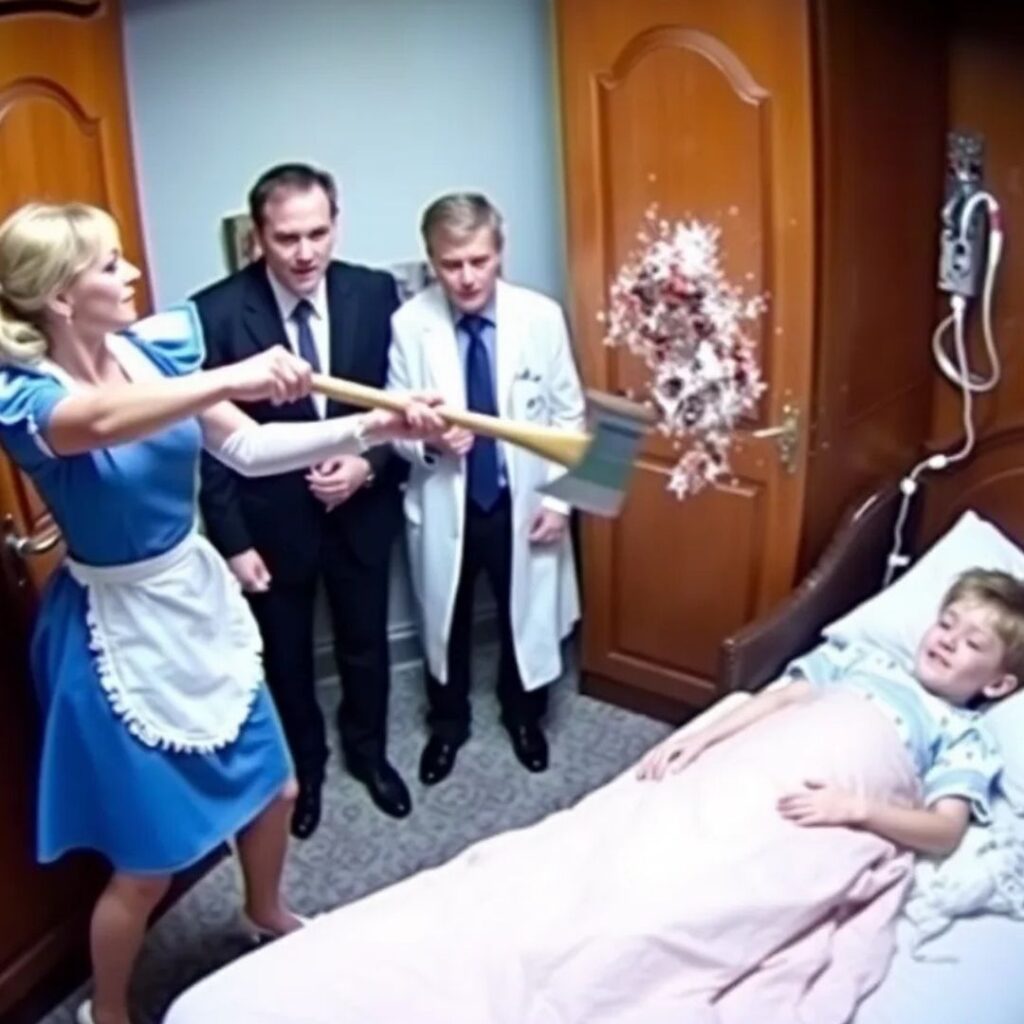
One morning, the heavy door was left ajar. I stepped in, intending only to leave the fresh linens. The room was a masterpiece of luxury: velvet curtains, soundproofed walls, and a state-of-the-art climate control system. In the center of a massive bed lay Oliver—small, skin the color of parchment, tethered to a high-end oxygen concentrator.
Zachary sat by the bed, his head in his hands, the image of a defeated king. As I stood there, I noticed it—a scent. It was sweet, cloying, and metallic. It was a smell I knew from the cracked walls of the tenements I grew up in.

The Black Truth
That afternoon, while the private medical team whisked Oliver away for another round of futile tests, I returned to the room. My gut twisted. I walked to the far wall, where the air conditioning vent hummed silently behind a beautiful silk tapestry.
I pushed the fabric aside. The plaster felt soft. Spongy.
I dug my fingers into a seam and pulled. The silk tore with a shriek, revealing the nightmare beneath. The wall was a pulsating map of toxic black mold. It had thrived in the darkness, fed by a hidden leak in the “smart” cooling system Zachary himself had designed. The very technology meant to protect the boy was circulating poison into his lungs with every mechanical breath.
“What are you doing?”
Zachary’s voice cracked like a whip behind me. I turned, my hands stained black with fungal rot.
“Look at this, Mr. Lowell,” I said, my voice trembling but firm. “You’ve spent millions looking for a ghost in his blood, but the killer is in your walls.”
The Fall of the Empire
The next forty-eight hours were a whirlwind of drama. Zachary didn’t call his board; he called an independent environmental task force I recommended. When the lead specialist stepped out of Oliver’s room, his face was grim.
“It’s Stachybotrys chartarum,” he whispered. “At levels I’ve never seen in a residential property. Prolonged exposure causes exactly the respiratory collapse your son is experiencing. If he’d stayed in that room another month, he would have been gone.”
The board of Lowell Industries went into damage control. They arrived in black sedans, offering me “hush money”—a sum that would have retired me for life—in exchange for a non-disclosure agreement. They feared the scandal: the world’s leading green-energy billionaire had nearly killed his own son with a faulty, mold-infested HVAC system.
Zachary stood in the grand foyer, looking at the men in suits, then at me, and finally at the empty East Wing.
“Get out,” he told the board. “Every one of you. My son almost died because I chose to trust a blueprinted perfection over the reality of a cough.”
A New Foundation
The mansion was gutted. The silk was burned. The soundproof walls were torn down to let the sunlight in.
Oliver’s recovery was nothing short of miraculous. Without the constant intake of toxins, his body began to heal. Within six months, the oxygen tanks were gone. For the first time, the East Wing echoed not with coughing, but with the sound of an eight-year-old laughing as he chased his dog through the garden.
Zachary changed, too. He liquidated his stake in the tech companies that prioritized “form over function.” Instead, he used his wealth to establish the Flores Foundation for Indoor Safety, and he put me in charge of the inspection division.
One evening, we stood on the terrace, watching Oliver run. The boy looked back and waved, his cheeks flushed with healthy color.
“I built systems to change the world,” Zachary said quietly, looking at his son. “But I almost lost the only world that mattered because I ignored what was hiding behind the walls.”
Sometimes, a miracle isn’t a medical breakthrough. Sometimes, it’s just a maid with dirty hands who refused to stop looking.
Because we finally let the house breathe, a boy lived. And because the truth came out, we all learned to breathe a little easier.
The transition from the velvet curtains of Lowell Ridge to the cold steel and glass of Lowell Plaza was seamless, but for me, the stakes had never been higher. Zachary had appointed me the Director of Environmental Integrity, a title that sounded fancy but essentially meant I was the woman who looked for the rot that everyone else pretended wasn’t there.
While Oliver thrived in the clean air of our new home, the corporate side of Zachary’s empire was facing a different kind of crisis.
The Sick Building Syndrome
Lowell Plaza was a seventy-story marvel in the heart of Manhattan—the “Greenest Skyscraper in the World.” It featured vertical gardens, recycled water systems, and a self-contained ecosystem. But for months, the “Lowell Plaza Fatigue” had become a whisper in the halls of the city’s hospitals.
Staff were complaining of chronic migraines, fainting spells, and a metallic taste in their mouths. Zachary’s board dismissed it as “urban stress” or “post-pandemic anxiety.”
“Brianna, I need you to go in,” Zachary told me one night, his eyes weary. “The board is blocking my internal audits. They say I’m being paranoid because of what happened to Oliver. They think I’ve lost my edge.”
“I don’t need an edge to find a leak, Zachary,” I replied. “I just need a flashlight.”
The Ghost in the Glass
I entered the building at midnight, dressed as a regular night-shift cleaner. I knew the rhythm of the staff; they worked fast, they didn’t look up, and they ignored the vents.
I started on the 42nd floor—the executive suite. It was pristine. But as I moved toward the central atrium, where the “Vertical Forest” lived, I felt a familiar heaviness in my chest. It wasn’t the air; it was the smell. It wasn’t the sweet mold of the mansion. This was sharp, chemical, and strangely reminiscent of ozone.
I climbed the maintenance ladder into the irrigation housing for the vertical gardens. On the blueprints, this system was supposed to use filtered rainwater.
But as I opened the main cistern, I didn’t see water. I saw a viscous, shimmering grey sludge.
My portable sensor didn’t just beep; it screamed. High concentrations of Cadmium and Arsenic. —
The Betrayal of the Board
I wasn’t alone in the dark for long.
The lights in the mechanical room hummed to life. Standing at the door was Marcus Vane, the COO and Zachary’s right-hand man for a decade. Beside him were two security guards.
“You should have stayed in Westchester, Brianna,” Vane said, his voice as cold as the steel around us. “This building is a billion-dollar asset. We can’t have a ‘maid’ with a sensor ruining our ESG rating.”
“This isn’t about ratings, Marcus,” I said, stepping back toward the cistern. “You’re recycling industrial runoff from the neighboring construction site to save on water costs. You’re misting heavy metals directly into the air filters of five thousand employees.”
“It’s called ‘innovation’,” Vane sneered. “The filtration system was supposed to handle it. It failed. Fixing it would cost sixty million and stop the stock from hitting a record high.”
“People are dying,” I shouted.
“People are replaceable,” Vane replied. “Data is not.”
He nodded to the guards. But before they could move, the building’s intercom system crackled.
The Recording
“I agree, Marcus. Data is not replaceable.”
It was Zachary’s voice. It wasn’t coming from the room; it was coming from the sensor in my hand.
I hadn’t just been measuring air quality; I had been live-streaming the audio and data directly to Zachary and the Federal Environmental Protection Agency.
“Zachary?” Vane stammered, looking at the ceiling.
“I built this empire on the idea that we could do better,” Zachary’s voice boomed through the mechanical room, vibrating with a rage I had only seen once before—the day I tore the silk in Oliver’s room. “You didn’t just poison my employees; you used my name to hide it. Security, escort Mr. Vane to the lobby. The EPA is waiting.”
The Purge
The scandal was the largest in the history of New York real estate. Lowell Plaza was evacuated and stripped down to its skeleton. Marcus Vane and three board members faced criminal indictments for reckless endangerment and environmental fraud.
Zachary sat in my office a month later. He had lost billions. His stock was in the basement. But for the first time, he looked like he could breathe.
“They want to tear the building down,” Zachary said.
“Don’t,” I told him. “Fix it. Use the money you would have spent on lawyers to build a filtration system that actually works. Turn the ‘Sick Building’ into the first truly transparent one. Sensors on every floor, public data, no more silk panels.”
He looked at me and smiled. “You’re not just a maid, Brianna. And you’re not just a director. You’re the conscience of this company.”
The View from the 70th Floor
A year later, Lowell Plaza reopened. I stood at the top, looking out over the city. The air coming out of the vents was sweet—not the sweetness of decay, but the crisp, sharp scent of rain after a storm.
Oliver was there too, helping his father cut the ribbon. He didn’t have a cough. He didn’t have an oxygen tank. He just had a big, bright smile.
As I watched them, I realized that the rot is always there—in the walls, in the boardrooms, in the hearts of men who think they are untouchable. But as long as there are people willing to look behind the silk, the light always finds a way in.
We didn’t just save a building. We saved a legacy.